

A plumbing service agreement program changes that equation. Instead of waiting for the phone to ring, you build a recurring customer base that generates revenue before a wrench is ever picked up. This guide covers exactly how to build one — from defining scope and pricing correctly, to structuring the legal framework and protecting your margins as enrollment grows.
TL;DR
- Service agreements convert unpredictable call volume into forecastable recurring revenue
- Program success requires four foundations: defined scope, technician buy-in, sound pricing, and a legally reviewed contract
- Price from marginal cost during slow periods — not competitor rates or guesswork
- Growing enrollment means growing financial exposure — a reinsurance-backed structure prevents that from becoming a liability
- Track two numbers most closely: enrollment rate and renewal rate. A renewal rate below 70% signals a structural problem.
Why Plumbing Contractors Should Offer Service Agreements
The business case is straightforward: agreements generate cash before work begins, fill slow-season schedules with planned visits, and reduce dependence on emergency call volume that's nearly impossible to staff for predictably.
The revenue upside goes further than the base fee. According to contractor benchmarks from Level, service agreement customers generate 2–4x more repair revenue than non-agreement customers, with a median gross margin of 37.9% on agreements themselves. That multiplier comes from a simple habit change: agreement customers call you first, trust you more, and don't shop around when something breaks.
Referrals follow the same pattern. A homeowner with a named plumber, a membership card, and a scheduled annual visit is far more likely to recommend that contractor than someone who found a number on Google during a pipe emergency.
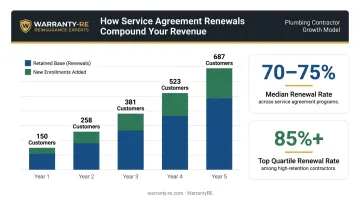
The retention numbers reinforce it. Level reports median renewal rates of 70–75%, with top-performing contractors reaching 85%+. The result:
- Each renewal adds to a base you already earned — you're not rebuilding from scratch every season
- High-renewal programs compound over time, growing revenue without proportionally growing marketing spend
- Retained customers generate repair work, referrals, and upsell opportunities throughout the relationship
What You Need Before Launching Your Program
Launching without the right foundations causes most program failures. Price it wrong upfront and you lock in bad margins at scale. Skip the legal review and you may be selling unregistered service contracts in a regulated state.
Team Readiness
Your plumbers are the sales force for this program — whether you call it that or not. Before launch, every technician needs to:
- Understand exactly what the agreement covers and excludes
- Believe the agreement genuinely benefits customers
- Know how to present it during an active service call without it feeling like a pitch
No marketing budget compensates for a technician who shrugs when a customer asks about the membership. Internal alignment comes first.
Legal and Compliance Baseline
Several states regulate service contracts as insurance products. Three states with specific statutes worth knowing before you launch:
- Texas — Occupations Code Chapter 1304, registration required through TDLR
- New York — Insurance Law Article 79, registration with the Department of Financial Services
- New Hampshire — RSA 415-C, provider registration and financial backing requirements
Have a local attorney review your contract before you sell a single agreement. This is the most avoidable and consequential setup step most contractors skip.
Financial Structure Decision
Before the first agreement is sold, decide how you'll back the financial risk:
- Self-funded reserves — simplest to start, highest exposure at scale
- Third-party warranty provider — risk transfers to the provider, but so does the underwriting profit
- Contractor-owned reinsurance structure — captures underwriting profits, backed by A-rated insurers
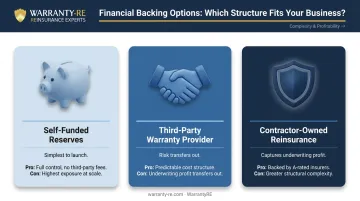
This decision shapes your pricing and your long-term profitability. Locking in the wrong structure at launch typically means renegotiating contracts, repricing agreements, and absorbing margin losses while the program is already running.
How to Create a Plumbing Service Agreement Program Step by Step
Step 1: Define the Scope of Services
A clear scope sets customer expectations, protects you from unlimited liability, and gives technicians a repeatable checklist. A standard plumbing service agreement should include:
- Water heater flush and inspection
- System pressure testing
- Toilet and faucet checks
- Drain flow inspection
- Shut-off valve testing
- Visual inspection for leaks and corrosion
Explicit exclusions matter as much as inclusions. Define what the base agreement does not cover:
- Broken component repair or equipment replacement
- Emergency calls outside the scheduled maintenance visit
- Issues caused by code violations or customer negligence
- Pre-existing conditions identified at first inspection
These exclusions aren't just legal protection — they're how you maintain margin as enrollment grows.
Step 2: Get Your Plumbers to Build and Own the Agreement
Bring your plumbers together and have them define what actually prevents problems. Then assign a dollar value to each included task using this formula:
Task Value = Repair cost if undetected × Annual probability of that failure
A water heater flush that prevents a $1,200 sediment-related failure with a 15% annual probability is worth $180 in perceived value. When plumbers run this math for every task themselves, two things happen: they see the agreement is genuinely a good deal for customers, and they present it that way.
A technician who believes in the program closes enrollments. One who doesn't will undermine it regardless of how good your marketing is.
Step 3: Create the Contract and Legal Framework
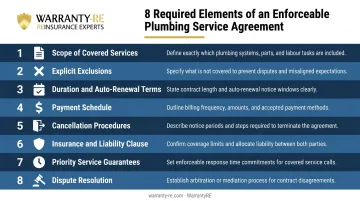
Every enforceable plumbing service agreement contract must include:
- Scope of covered services — specific tasks listed, not vague language
- Explicit exclusions — what is not covered under any circumstances
- Duration and auto-renewal terms — when it starts, when it renews, how notice works
- Payment schedule and accepted methods — annual, monthly, and which options are available
- Cancellation and termination procedures — for both parties, with notice requirements
- Insurance and liability clause — limits contractor liability for consequential damages
- Priority service guarantees — specific response time commitments, not general promises
- Dispute resolution process — arbitration or mediation preference
Have a local attorney review the final contract for state compliance before launch. An unenforceable agreement is worse than no agreement — it creates false expectations and potential regulatory penalties.
Once the legal framework is solid, you can build the commercial structure around it — starting with how you package and price the tiers.
Step 4: Design Your Tiered Package Structure
Two to three tiers give customers a choice and make it easier for plumbers to match plans to different household types. A typical structure:
| Tier | Inclusions | Price Range |
|---|---|---|
| Basic | Annual inspection, written report | Based on your cost model |
| Standard | Annual visit + priority scheduling + trip fee waiver | Based on your cost model |
| Premium | Semi-annual visits + same-day emergency response + repair discount | Based on your cost model |
Critical: Each tier must be independently profitable when you account for loaded labor time, truck and fuel cost, materials, and average discount usage. Do not price tiers based on what competitors charge — base every number on your actual cost structure. Step 5 covers the cost modeling process in detail.
How to Price and Financially Back Your Service Agreements
The Marginal Cost Pricing Method
The agreement price should cover the incremental cost of delivering services during slow periods, not your fully-loaded overhead rate. The relevant costs are:
- Loaded labor time (wage + burden) for the scheduled visit
- Truck and fuel cost for that route
- Materials consumed during the visit
- Technician spiff (PM Magazine cites $10–$20 per agreement sold as a common incentive)
Pricing at marginal cost keeps margins healthy even at an attractive customer price point, because slow-period delivery costs are lower than peak-season rates.
The Value Rate vs. Standard Rate Model
The agreement price becomes your value rate — what members pay. Non-members pay your standard rate. The formula:
Standard Rate = Value Rate ÷ (1 − Discount %)
Using PM Magazine's commonly cited 15–20% member discount as a reference: if your value rate is $250/hour, your standard rate is approximately $300–$313/hour. Framing membership as a reward rather than a discount is a stronger presentation: members aren't getting a price cut, they're accessing a preferred rate.
Calculating Perceived Customer Value
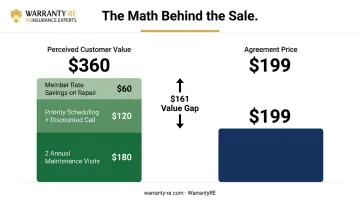
Add up the task values your plumbers calculated in Step 2, then factor in the discount on an average repair ticket. A simple example:
- 2 annual maintenance visits: $180 value
- Priority scheduling + discounted service call: $120 value
- Member rate savings on typical repair: $60 value
- Total perceived value: ~$360
- Agreement price: $199
That gap is the core of the sales conversation: "The annual fee is $199. The value you're getting is $360." When the math is visible, the sale is easier.
Once you know your value gap, the next question is whether your program can sustain it at scale.
Backing the Financial Risk at Scale
Level's benchmarks show that many shops underprice agreements or misreport margins, and the problem compounds as the book grows. A large enrollment with prices locked from year one, rising labor costs, and no adjustment mechanism creates compounding margin erosion.
The structural solution is a contractor-owned reinsurance model. Rather than relying on a third-party warranty provider that keeps the underwriting profit, plumbing contractors can establish an administrator obligor reinsurance company — a structure WarrantyRE has set up for contractors since 1994.
Here's how it works in practice:
- A warranty fee is built into every job's pricing
- That fee flows into a reinsurance account that is legally owned by the contractor
- When claims occur (a fitting failure, a callback on a water heater installation) the claim is paid from that account
- Unused reserves remain the contractor's — not the warranty provider's
The structure is backed by A-rated insurers, meaning if the contractor's reinsurance company cannot cover all claims, the underlying carrier maintains financial responsibility. Unused reserves can be invested through a Trust Company, initially in conservative government bonds, with more flexibility as the account builds above 125% of unearned premiums.
At scale, that reserve account stops being a liability buffer and starts generating a measurable return — one that grows with every agreement you sell.
How to Sell and Grow Your Enrollment
The Right Moment to Present
The best time to present a service agreement is during an active service call — after diagnosing the problem, before presenting the repair quote. The customer is already engaged, already has a problem in front of them, and the value of ongoing maintenance is immediately tangible.
Use a three-column invoice that shows:
| Service | Member Price (Value Rate) | Standard Price | Your Savings |
|---|---|---|---|
| Today's repair | $X | $Y | $Z |
| Annual membership | $A | — | — |
When customers can see the savings side by side, the decision makes itself.
Collateral Your Plumbers Need
- Customer-facing brochure explaining benefits in plain language
- Three-column invoice (built into your dispatch software or printed)
- Maintenance checklist with clearly marked checkboxes
- Membership card delivered after enrollment
The card matters more than it sounds. It makes the membership tangible and reinforces the customer's identity as a member rather than a one-time caller.
Once your plumbers are presenting consistently, tracking a few key numbers tells you whether the program is actually growing — and where to tighten it up.
Four KPIs to Monitor
| Metric | What It Measures | Benchmark |
|---|---|---|
| Enrollment rate | % of eligible customers who sign up when presented | High-performing contractors reach 30–40% |
| Renewal rate | % who renew after year one | Median 70–75%; top quartile 85%+ |
| Revenue per agreement | Base fee + downstream repair revenue | Track against 2–4x repair revenue multiplier |
| Claim cost per customer | Actual delivery cost as % of revenue collected | Should stay well below gross margin target of 37.9%+ |
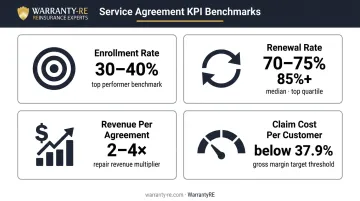
A renewal rate below 70% is a signal to investigate before scaling. The cause is almost always one of three things:
- The agreement isn't delivering perceived value to customers
- Follow-up at renewal is passive or nonexistent
- A price increase at renewal wasn't communicated or handled well
Common Mistakes to Avoid
Get legal review before you sell. Selling an unregistered service contract in Texas, New York, or New Hampshire can result in regulatory penalties and void agreements — and it's entirely preventable.
Involve your technicians in scope design. Agreements built without plumber input create skepticism in the field, and half-hearted presentations produce single-digit enrollment rates no matter how much you spend on marketing.
Price from your own costs, not a competitor's website. What looks profitable at 50 enrollments generates losses at 500. Build the price from your actual marginal cost per visit.
Build in a renewal adjustment mechanism. Locking customers into a fixed price with no adjustment provision creates compounding margin erosion as labor costs climb — include language allowing reasonable annual adjustments at renewal.
Frequently Asked Questions
What kind of plumbing issues are covered by a service agreement?
Service agreements typically cover preventive maintenance tasks — water heater flushes, pressure testing, fixture inspections, drain checks, and shut-off valve testing. They do not cover repair or replacement work, which distinguishes them from home warranties or homeowner's insurance that may respond to sudden system failures.
How do you write up a plumbing service contract?
A plumbing service contract must include the scope of covered services, explicit exclusions, payment terms, duration and renewal/termination conditions, priority service guarantees, and a liability clause. State-level service contract laws may require additional disclosures or language. Have an attorney review the document before you launch.
How much should a plumbing service agreement cost?
Price it from the marginal cost of delivery: loaded labor, materials, truck cost, and technician spiff for the scheduled visit. Avoid publishing a flat price range without running your own cost model first — the right number depends on your market, your visit scope, and your target gross margin.
Are plumbing service agreements worth it for contractors?
Yes, when priced correctly and backed with the right financial structure. Done well, they create predictable recurring revenue and reduce slow-season scheduling gaps. Priced without a solid cost model, they can become financial liabilities as volume grows.
Do I need state approval to sell a plumbing service agreement program?
Several states regulate service contracts as insurance products and require registration and financial backing before contractors can legally sell them. Texas, New York, and New Hampshire are notable examples. Verify your state's requirements before advertising or selling any agreement.
What is the difference between a plumbing service agreement and a home warranty?
A plumbing service agreement is a direct contract between the homeowner and your company covering defined preventive maintenance services. A home warranty is a separate product sold by a third-party company covering repair or replacement of systems and appliances. With service agreements, you collect recurring fees and keep the margin. With home warranty work, you typically receive a flat dispatch fee while the warranty company captures the profit.