

The gap between understanding and results comes down to avoidable mistakes: single-tier pricing that forces yes-or-no decisions, technicians who aren't trained to sell, renewal systems that don't exist, and underwriting profits quietly leaving the business every month.
This article covers five concrete steps to increase service agreement revenue, what you need in place before scaling, the KPIs that separate growing programs from stagnant ones, and the one profit leak most contractors never address.
TL;DR
- Service agreements generate predictable recurring revenue when built on tiered pricing, field-level selling, and profitable rates.
- Training gaps, single-tier programs, and no renewal system are what stall most contractor agreement programs — not lack of demand.
- Five steps drive results: tiered agreements, team selling at every touchpoint, profitable pricing, a renewal engine, and owning your underwriting profit.
- Contractors who control their reinsurance structure keep the profit most third-party providers quietly pocket.
- Attach rate, renewal rate, and revenue per agreement are the three metrics that separate growing programs from stalled ones.
How to Increase Service Agreement Revenue in 5 Steps
Step 1: Design a Tiered Agreement Program
A single-tier service agreement creates a binary decision: buy it or don't. That structure leaves money on the table at both ends : the price-sensitive customer who'd take a basic plan walks away, and the high-value customer who'd pay for premium coverage never gets the option.
A three-tier structure (Basic, Standard, Premium) solves this by giving customers a value comparison instead of a yes-or-no choice. Harvard Business Review's research on good-better-best pricing confirms this approach serves both price-sensitive and higher-willingness-to-pay customers simultaneously without cannibalizing either segment.
What meaningful tier differentiation looks like:
- Basic — Annual maintenance visit, standard scheduling, parts discount
- Standard — Two maintenance visits per year, priority scheduling, parts and labor discounts
- Premium — Two visits, emergency service availability, priority response guarantee, full parts and labor coverage up to defined limits
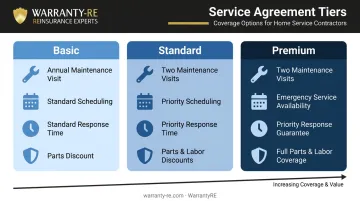
The value gap between tiers has to be tangible, not cosmetic. If Standard and Premium feel nearly identical to a customer, no one upgrades. Response time guarantees, PM visit frequency, and coverage scope are the levers that justify price differences and drive tier mix toward higher-revenue options.
Step 2: Train Your Team to Sell at Every Service Touchpoint
The highest-converting moment to present a service agreement is immediately after completing a repair or install : the customer just experienced what equipment failure costs them firsthand. Calling from the office a week later is not the same conversation.
HVACR Business benchmarks put the minimum conversion target at 25% of service calls converting to agreements, with precision tune-up specialists hitting 70%+. Those numbers require a defined field-sales process, not a casual suggestion at the end of a call.
A simple technician framework that works:
- Show the math by comparing what the customer just paid for the repair against what they would have paid as an agreement holder (typically a discount on service plus the PM visit value).
- Make a direct offer using a specific tier recommendation based on equipment age and condition. Skip "have you heard about our maintenance plan?"
- Remove friction with tablet sign-up or a single-page leave-behind. The fewer steps between interest and commitment, the better.
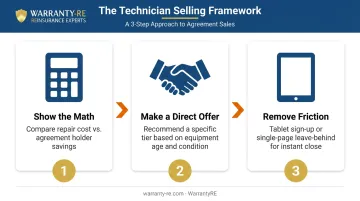
Management visibility matters here. If you can't see which technicians are presenting agreements and which aren't, you can't coach the gaps. Track agreement offer rate by technician — it's the leading indicator of everything downstream.
Step 3: Price Agreements for Profitability, Not Just Affordability
The most common pricing mistake: setting agreement rates based on what sounds appealing rather than what the program actually costs to deliver. The result is an agreement program that grows in volume while eroding margins the whole way up.
Proper pricing accounts for:
- Equipment type and age (older equipment claims more frequently)
- Coverage scope : labor only vs. parts and labor changes the risk profile significantly
- PM visit frequency and response time commitments
- Overhead allocation and target profit margin
FieldEdge's 2024 data puts typical residential HVAC maintenance plans at $175–$300 annually, with comprehensive coverage reaching $600. Commercial systems run $500–$2,000 per unit. These are ranges, not targets : your pricing should be built from your actual costs, not industry averages.
Harvard Business Review's foundational pricing research found that a 1% price improvement drives an 11.1% increase in operating profit, assuming volume holds constant. For contractors running thin margins on agreements, even modest pricing corrections add up fast.
Monthly vs. annual billing: Monthly payment options reduce the sign-up barrier considerably. A $240/year plan presented as $20/month converts at a meaningfully higher rate growing base.
The math is straightforward: 80%+ renewal is the industry benchmark, per HVACR Business. One contractor example from ACHR News had 1,600 active agreements at an 83% annual renewal rate : that's a sustainable, scalable business asset, not just a line item.
Retention also beats acquisition on economics. Acquiring a new HVAC customer runs $200–$300 and requires winning a cold relationship. Retaining an existing agreement customer costs a fraction of that.
A practical renewal system has four components:
- Automated outreach starting 90 days before expiration, not 30 days when the decision feels rushed.
- Post-visit service summary: a written record of what the customer received under the agreement. Customers who can see documented value renew at higher rates and this is the step most contractors skip.
- Equipment aging flags to proactively identify customers whose equipment is approaching end-of-life, pairing the renewal with an upgrade conversation.
- Tier upgrade offer at renewal : customers who've been on Basic for two years are good candidates for Standard. Frame it around what they've experienced.
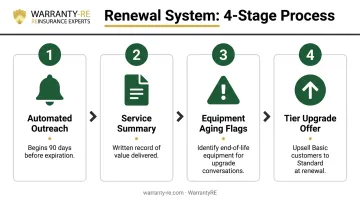
Without a system driving renewal, agreements quietly expire. The customer moves on, and your acquisition cost starts over from zero.
Step 5: Own the Economics — Stop Giving Away Underwriting Profits
Here's a profit leak most contractors never see clearly: you design the agreement, sell it to your customer, deliver the service, and absorb the claims risk. The third-party warranty provider collects the premium, handles none of the customer acquisition, and keeps the underwriting profit (the difference between premiums collected and claims paid).
If third-party providers weren't making money on those agreements, they wouldn't be in business. That margin is real, it's significant, and it's coming from your customers.
A contractor-owned reinsurance structure changes this entirely. Rather than routing premiums to a third party, the contractor establishes their own administrator-obligor reinsurance company. Warranty fees flow into that entity. Claims are paid from reserves. What isn't used in claims , the underwriting profit, stays with the contractor.
Beyond underwriting profit, the structure generates:
- Investment income on held reserves (funds are placed in a trust account and invested in conservative government bonds)
- Tax planning advantages : under IRS Code 831(b), property and casualty insurance companies writing less than $2.9M in annual net premiums may elect to be taxed only on investment income
- Control over the claims experience : the contractor adjudicates their own customers' claims, not a third party's
WarrantyRE has been helping HVAC, plumbing, electrical, and roofing contractors establish and manage their own reinsurance companies since 1994. The full-service administration model handles company setup, claims adjudication, legal filings, tax returns, compliance, and performance reporting so contractors don't take on administrative complexity alongside it. The reinsurance structure is backed by A-rated insurers, limiting the contractor's downside exposure while keeping the upside.
One common misconception worth addressing: you don't need to be a high-volume operation to make this work. The program is designed to be accessible across contractor sizes.
What You Need Before Growing Your Service Agreement Revenue
Before scaling an agreement program, the operational foundation has to support it. Without the basics in place, growth creates chaos rather than revenue.
Minimum requirements:
- A defined customer base with contact records and equipment history
- A CRM or scheduling system capable of tracking agreement status, renewal dates, and service history
- Consistent monthly service call volume to build an agreement base (HVACR Business benchmarks suggest targeting 1,200 residential agreements per $1M in residential retail revenue as a scale reference)
Equipment, Legal, and Compliance Readiness
Service agreement contracts need to be structured correctly for your state. The distinction between a maintenance agreement (scheduled visits only, not regulated as insurance) and a service contract (covers repair or replacement after failure) matters legally. The language in your agreement determines which category applies and what disclosures are required.
At low volume, gaps in this area are manageable. At scale, they create real liability exposure. Contractors who work within a reinsurance structure — like the program WarrantyRE administers — get compliance built in, with contracts reviewed against state-specific requirements from the start.
Team and Process Readiness
Before launching a tiered program push:
- Technicians need scripted language and role-play practice — not a handout they read once
- The sign-up process should be frictionless (tablet, app, or clean paper form)
- Management needs visibility into offer rates by technician
When these pieces are in place before launch, offer rates stay consistent across the team and the program builds momentum from day one instead of stalling out in the field.
Key Factors That Affect Service Agreement Revenue
Two contractors with identical pricing can generate very different agreement revenue — because outcomes depend on variables most contractors never explicitly track.
| KPI | What It Measures | Benchmark |
|---|---|---|
| Attach Rate | % of eligible service calls that result in a new agreement | 25% minimum; 35–40%+ for high performers |
| Annual Renewal Rate | % of agreements that renew each year | 80% minimum |
| Tier Mix | Distribution of customers across Basic, Standard, Premium | Goal: Premium as the most common tier |
| Revenue Per Agreement | Average annual value across the active agreement base | Varies by tier structure and coverage scope |
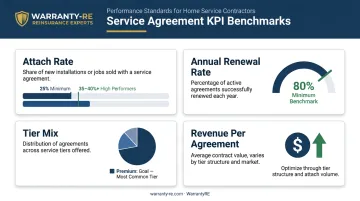
Attach rate drives new agreement volume more than any other factor. Below 20%, there's almost always a training or process gap — technicians aren't presenting consistently, or the offer is too complicated to close in the field.
Renewal rate determines whether the program actually grows. A 10-point difference — 70% versus 80% — compounds significantly over three to five years. At 80%+, the program builds on itself. At 70%, it treads water even with strong new sales.
Most contractors underestimate the revenue impact of tier mix. A program where Basic is the default will generate far less than one where Premium leads — even with the same number of agreements sold. Which tier customers land on depends almost entirely on how technicians present the options and whether they're recommending based on the customer's actual situation.
Common Mistakes Contractors Make Growing Service Agreement Revenue
Most service agreement programs stall because of avoidable structural mistakes — not market conditions. Here are four patterns that consistently limit growth:
- A single-tier offering forces a binary buy-or-don't decision, losing the budget customer who'd take a Basic plan and the high-value customer willing to pay for Premium.
- Positioning agreements as an optional upsell instead of a standard workflow step ties results to individual technician motivation — which makes performance inconsistent across the board.
- Underpricing without modeling actual costs produces volume but erodes margins. Pricing based on guesswork or a competitor's rate ignores your actual labor, parts, overhead, and claims exposure.
- Tracking agreements inside overall revenue numbers instead of separately means you can't pinpoint where the program leaks. If attach rate and renewal rate aren't on your dashboard, you're managing by feel.
Frequently Asked Questions
How do you increase service revenue?
Sell more agreements at every service touchpoint, price them to cover actual costs, train technicians to present them consistently, and build a renewal system that keeps customers. The most overlooked step: retaining the underwriting profit through a contractor-owned reinsurance structure instead of sending it to a third party.
Is a 5% increase in revenue good?
A 5% increase is meaningful, but contractors building an agreement program from a low base should target 10–20% monthly recurring revenue growth in the first year. The more useful metrics are attach rate and renewal rate — top-line revenue percentage doesn't tell you whether the program's fundamentals are healthy.
What should be included in a home service agreement to maximize renewals?
Renewals hinge on three things: tangible coverage (PM visits on schedule, priority response, documented parts or labor), visible service history the customer can reference, and proactive communication throughout the agreement period. Customers who can point to what they received renew at significantly higher rates than those who can't.
How many service agreements does a contractor need to generate meaningful recurring revenue?
Even modest programs generate real money at scale. HVACR Business benchmarks roughly 1,200 residential agreements per $1M in residential retail revenue. At $250/year, 200 active agreements produces $50,000 in annual recurring revenue — a base that compounds as new agreements are added and existing ones renew.
What is the difference between a service agreement and a third-party warranty?
A service agreement is contractor-controlled and built around scheduled maintenance visits and priority access. A third-party warranty is an insurance-like product administered by an outside company that retains the underwriting profit. Contractor-owned reinsurance programs — like those WarrantyRE structures — allow contractors to operate their own warranty entity and keep those profits.
How does owning a reinsurance company increase service agreement profitability?
When a contractor owns their reinsurance company, premiums flow into their own entity instead of a third party. Underwriting profit, investment income on held reserves, and tax planning benefits all stay with the contractor. Under IRS Code 831(b), qualifying reinsurance companies may be taxed only on investment income — a significant advantage for contractors facing large annual tax bills.