Here's the mindset gap most contractors face: labor warranties are seen as a customer promise, not a financial product. That promise becomes an unfunded liability sitting on your books with no financial cushion to draw from when things go wrong.
This article will show you how to reframe labor warranties from a cost obligation into a structured revenue stream—through smarter pricing, tiered packaging, and understanding where the real money in warranties actually goes. The contractors who make this shift aren't just protecting their margins; they're building profit centers.
TLDR
- Labor warranties become a profit center when priced to cover risk — not given away as a sales tactic
- When claims don't happen, third-party warranty providers pocket the underwriting profits; contractors can recapture those margins instead
- Tiered warranty options (1-year, 3-year, 5-year) increase average ticket size and close rates
- A contractor-owned warranty reserve converts every install into a source of ongoing revenue
Why Plumbing Labor Warranties Quietly Cost You Money
The Hidden Cost of the Freebie Problem
When you bundle a labor warranty into the job price without separate accounting, you absorb every callback as a pure cost. According to contractor-reported data, callback rates typically fall between 1-2% of completed jobs. Anything above 3% is considered a red flag that suppresses margins through rework costs.
The costs compound quickly even at low callback rates. Each callback carries a fully loaded cost:
- Break-even labor rate of $75-$85 per hour (before profit)
- Average overhead per visit of $250-$300 (truck, dispatch, insurance allocation)
- Opportunity cost of pulling plumbers off billable work
The Math of Unpriced Warranties
Consider a shop completing 20 water heater installs per month with a standard 1-year labor warranty. At a 2% callback rate, that's roughly 5 callbacks per year. At 1.5 labor hours ($85/hour) plus $250 overhead per visit, each callback costs approximately $378. That's $1,890 in unpriced warranty exposure annually from water heaters alone.
Multiply that across repiping jobs, fixture installs, and sewer line work, and the cumulative exposure can easily exceed $10,000–$15,000 annually for a mid-volume shop — all drawn from the same operating budget as new jobs, with no financial separation.
Warranty as Liability vs. Warranty as Funded Product
The structural shift happens when warranties are priced, collected as a premium, and set aside as a reserve. Callbacks draw from a fund — not from operating cash. That distinction is what separates a warranty that drains you from one that funds itself.
Industry research shows that contractors with properly priced warranty programs achieve gross margins of 38-53% on those offerings. Unpriced warranties, by contrast, represent negative margin when claims occur.
The Competitive Blind Spot
Many plumbers offer longer warranties to win jobs without realizing they're taking on unquantified risk. The contractors who price warranties correctly use them to differentiate and protect margin simultaneously. Third-party warranty providers understand this math well — they price warranties specifically to capture underwriting profit.
Here's what that looks like in practice:
- Unpriced warranty: Callbacks hit operating cash; no reserve; margin shrinks with volume
- Priced warranty program: Premiums collected upfront; claims draw from a funded reserve; underwriting profit stays with the contractor
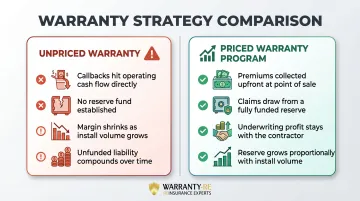
Without a priced structure, growth works against you — every additional install adds unfunded liability rather than building a reserve that works in your favor.
The Profit Model: Three Ways Warranties Generate Revenue
Revenue Stream 1: Warranty Markup on Every Install
Labor warranties can be priced as a line item. Here's how it works:
- Standard 1-year warranty: Included at cost in base pricing
- 3-year extended labor warranty: Sold at 2-3x expected claims exposure
- 5-year premium warranty: Higher markup with clearly defined scope—ideal for complex installs like repiping or water treatment systems
Example for a water heater install:
If your expected claims exposure over 3 years is $150 (based on callback probability and average labor cost), you might price the 3-year warranty upgrade at $400-$450. The $250-$300 spread becomes gross margin.
For an $8,000 repipe job, a 3-year warranty upgrade priced at $600-$750 provides significant margin while giving customers peace of mind on a major investment.
Revenue Stream 2: Increased Close Rates and Average Ticket
Presenting tiered options—"which warranty plan works best for you?"—instead of a binary yes/no shifts customer psychology. Contractors using good-better-best proposal formats report an average 21% revenue increase within the first two years.
Why tiered options work:
- Customers feel agency and control over their choice
- The question becomes "which one," not "whether"
- Mid-tier options anchor higher perceived value
- Average ticket lifts without adding new service lines
Tiered warranty options also fit naturally into flat-rate proposals—and flat-rate pricing already increases average ticket size by 20-30% compared to hourly billing. The two approaches reinforce each other.
Revenue Stream 3: Reactivating Past Customers with Warranty Offers
Here's a revenue stream most contractors miss: contact customers from the past 12-24 months and offer extended coverage on completed installs. This produces immediate revenue from an existing customer base with zero acquisition cost.
Because the relationship already exists and the install is in place, conversion rates on warranty upgrades tend to run higher than new customer sales—no advertising spend, no cold outreach required.
The Compounding Effect
These three streams don't operate in isolation—they build on each other. Each warranty sold funds a reserve. If claims don't exhaust the reserve, the surplus becomes profit. Over time, a contractor with 50-100 installs per month builds a growing pool of warranty premiums—and a growing pool of profit potential if the work is done well and callbacks are low.
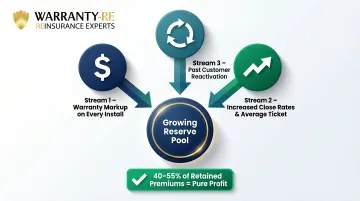
Well-managed extended warranty programs achieve loss ratios in the 45-60% range, meaning 40-55% of collected premiums are retained for administration, reserves, and profit. That's a better margin profile than most core plumbing services.
How to Price and Package Plumbing Warranties for Maximum Margin
Cost-Basis Pricing for Labor Warranties
To price warranties intelligently, you need to calculate true callback risk by job type. Start with these inputs:
- Average labor hours per callback (by job type)
- Callback probability (based on your historical data or industry benchmarks)
- Material exposure (parts that might need replacement)
Sample pricing model for a water heater install:
- Callback probability: 2%
- Average labor hours per callback: 1.5 hours
- Labor rate: $85/hour
- Overhead per visit: $250
- Expected cost per install: (1.5 × $85 + $250) × 0.02 = $7.55
For a 3-year warranty, multiply by 3 and add margin: $7.55 × 3 × 3 = $68 base cost, priced at $200-$250 to customers for healthy margin.
Tiered Warranty Packaging
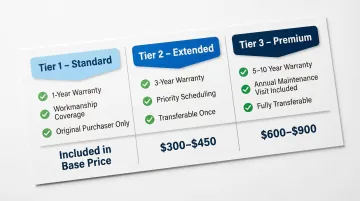
Recommend a 3-tier structure:
Tier 1 - Standard:
- 1-year labor warranty included in base price
- Covers installation workmanship
- Limited to original purchaser
Tier 2 - Extended:
- 3-year labor warranty upgrade ($300-$450)
- Covers all installation labor
- Priority scheduling for warranty calls
- Transferable once
Tier 3 - Premium:
- 5-year or 10-year labor warranty ($600-$900)
- Comprehensive labor coverage
- Annual maintenance visit included
- Fully transferable
Document the scope, exclusions, and transfer conditions for each tier before you present them in the field — ambiguity at the point of sale kills close rates and creates disputes later.
How to Present Warranty Options in the Field
Once you have defined tiers, presenting them becomes straightforward. After completing a diagnosis or closing an install, walk the customer through options on a tablet or written proposal — positioning the extended warranty as financial protection for the work they just paid for, not an add-on.
Frame the conversation around loss aversion:
- "This warranty protects you against a $1,500 labor bill if anything goes wrong"
- "For less than $1 per day, your investment is fully protected"
Drop phrases like "extra coverage" — they signal upsell, not value. Connect the warranty directly to the dollar cost of a return visit: a burst fitting, a faulty valve seat, a water heater element that fails at month 14.
The Importance of Written Terms
A clearly documented warranty does more than protect you legally — it makes the warranty feel like a real product, which is exactly what customers are buying:
- Limits dispute risk: defined scope and exclusions eliminate ambiguous callbacks that eat into your margin
- Accelerates close rates: a written certificate with clear terms reads as a professional product, not a verbal promise
- Supports higher pricing: customers pay more for a warranty they can hold, read, and transfer — the documentation itself is part of what they're buying
A warranty that looks like a real product—with a certificate or written agreement—commands a higher price than a verbal promise.
Turn Every Install Into Recurring Warranty Revenue
The Connection Between Extended Warranties and Maintenance Agreements
A customer with a 5-year labor warranty is a natural candidate for an annual maintenance plan. Plumbing customers with maintenance plans return at a 74% rate vs. 34% without one, and they generate 2.3x higher lifetime value over five years.
The warranty keeps them coming back to you specifically; the maintenance plan adds recurring touchpoints and revenue between warranty service events. Together, they transform a one-time install into a multi-year customer relationship.
Past-Customer Outreach Play
Segment your customer database by install date and job type, then reach out to customers within the warranty-eligible window (typically up to 2 years post-install) to offer extended coverage upgrades.
Here's a script that works:
"Hi [Customer], it's been about a year since we completed your water heater installation. We wanted to reach out and offer you the option to extend your labor warranty from 1 year to 5 years for just $X. This protects you from any future labor costs if something goes wrong."
The relationship already exists, so conversion rates are strong — existing customers require far less persuasion than cold leads.
Customer Retention Effect
Customers who purchase extended warranties have a concrete financial reason to call the same contractor when something goes wrong — they have coverage with you specifically. That loyalty shows up in the revenue numbers:
- Service agreement customers generate 1.8x to 2.2x more repair revenue than non-agreement customers
- Warranty holders follow the same pattern, returning for covered repairs and upsell opportunities
- Reduced churn means more predictable revenue across your service schedule
The Reinsurance Advantage: Stop Giving Away Underwriting Profits
The Core Problem with Third-Party Warranty Providers
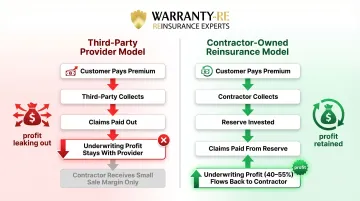
When you sell an extended warranty through a third-party company, that company collects the premium, manages the reserve, and keeps the underwriting profit—the money left over when claims don't exhaust the premium pool.
You get a small margin on the sale, but you give up the larger, longer-term profit on the float. Underwriting profit in plain terms: it's the difference between what customers pay for warranties and what actually gets paid out in claims. Well-managed programs keep 40-55% of collected premiums as underwriting profit.
That money stays with the warranty company—not with you.
The Reinsurance Model as the Alternative
By establishing your own administrator obligor reinsurance company (with the right support), you collect and control the warranty premiums, manage claims under your own brand standards, and capture 100% of the underwriting profit.
Owning the program means:
- Reserve funds are invested, generating additional ROI on held premiums
- Surplus flows back to your business, not a third-party provider
- Potential tax planning advantages on reserves reduce your overall liability
- Claims are adjudicated under your brand standards, not a corporate script
WarrantyRE has helped contractors across the country set up and manage their own reinsurance programs since 1994, bringing over 30 years of experience from the automotive industry into the home services space. They handle all legal forms, filings, tax returns, compliance, and claims adjudication—so you stay focused on running your plumbing business.
Claims Control Advantage
Owning the warranty program means you set the service standards and adjudicate claims using your own technicians. That eliminates the scenario where a third-party denies a legitimate claim and leaves your customer blaming you for it.
Quality work leads to fewer claims, and fewer claims mean more reserve profit stays with you.
Frequently Asked Questions
What is a good profit margin for a plumbing company?
Healthy plumbing businesses target 20-35% net profit margin and 50-60%+ gross margin on service and repair work. Adding priced warranty programs is one lever that improves net margin without adding job volume.
How do companies make money off warranty?
Warranty companies profit from underwriting margin—the difference between premiums collected and claims paid out. When contractors sell through third-party providers, that margin goes to the provider — not to you. Contractors who own their warranty programs keep it instead.
How much is a plumbing warranty?
Labor warranty upgrades typically range from a few hundred dollars for a 3-year plan on a single appliance to $600-$900 for comprehensive coverage. Price varies by coverage scope, job type, and duration.
What is the difference between a manufacturer's warranty and a labor warranty?
Manufacturer's warranties cover defective parts, while labor warranties cover the technician's time to diagnose and fix issues—which is often the more expensive component of a repair. Extended labor warranties fill the gap that parts-only coverage leaves.
Can a plumbing contractor run their own warranty program instead of using a third-party provider?
Yes. With a reinsurance program administrator like WarrantyRE, contractors can establish their own administrator obligor reinsurance company — collecting premiums, controlling claims, and capturing underwriting profits rather than handing them to a third party.