

Most electricians handle service work reactively. A homeowner Googles "electrician near me" when a breaker trips, you dispatch a truck, fix the problem, and send an invoice. The customer disappears until the next emergency, often calling whoever shows up first in search results. This approach creates unpredictable revenue, drives up customer acquisition costs five to seven times higher than retention costs, and leaves significant recurring revenue uncaptured.
This guide walks through everything you need to build a profitable service agreement program: designing legally sound agreements, structuring tier options and pricing, training your team to sell memberships, managing the program efficiently, and protecting your business from warranty claim risk through reinsurance.
TLDR:
- Service agreements convert one-time customers into recurring revenue streams, reducing the feast-or-famine cycle
- Legally sound agreements must specify covered services, payment terms, liability limits, and renewal clauses
- Offer 2-3 tier options with escalating value to enable customer self-selection and upsell opportunities
- Train technicians to pitch agreements at job completion when trust is highest—conversion rates reach 57% with structured asks
- Reinsurance structures allow contractors to capture 100% of warranty underwriting profits rather than paying third parties
Why Every Electrical Contractor Should Offer a Service Agreement Program
A one-time electrical contract closes a specific job—panel replacement, circuit addition, outlet installation. A recurring service agreement program builds a revenue stream by converting completed work into ongoing customer relationships with scheduled maintenance visits, priority service rights, and guaranteed response times.
Revenue Predictability and Cash Flow Stability
Service agreements replace unpredictable, seasonal billing cycles with steady monthly or annual income. According to the Bureau of Labor Statistics, only 44% of construction-related businesses survive to the five-year mark, and 82% of all business failures stem from poor cash flow management. Service agreements directly address this vulnerability by creating recurring revenue independent of weather, seasonal demand, or economic swings.
When you bill 100 customers $300 annually for preventive maintenance agreements, you lock in $30,000 in predictable revenue before the first service call. Monthly billing options reduce the barrier for customers while smoothing your cash flow throughout the year.
Customer Retention Economics
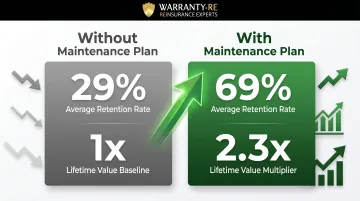
Acquiring a new customer costs 5 to 25 times more than retaining an existing one. For electrical contractors specifically, the retention challenge is stark: industry data shows the average electrical contractor retains only 29% of customers for a second job. Top-performing contractors reach 58% retention. With a maintenance plan in place, retention jumps to 69%.
Customers on maintenance plans demonstrate 2.3x higher lifetime value than non-plan customers. They call you first when problems arise because they've already invested in your relationship. They don't shop around—they're already members.
Premium Market Positioning
That retention advantage also reshapes how customers perceive your business. A formal maintenance program with priority scheduling and guaranteed response times positions you as a premium provider—not a commodity competing solely on price.
When a homeowner compares three electricians bidding a service upgrade, the contractor offering annual safety inspections and priority emergency response stands out on professionalism, not just hourly rate.
Business Valuation Impact
Recurring revenue models with low customer turnover command approximately 8x EBITDA valuation multiples, compared to roughly 5x EBITDA for businesses with non-recurring revenue. Private equity buyers seek residential service companies with flat-rate pricing, dispatched technicians, and recurring maintenance plans.
If you ever plan to sell your business or bring in investors, a well-structured service agreement program with hundreds of active members represents transferable, documented value—one of the clearest levers for increasing your sale price before you go to market.
What to Include in Your Electrical Service Agreement
Core Legal Components
Parties and Scope of Work
Identify both parties by full legal name—your licensed contracting company and the customer—and specify the exact service location (street address, unit number). Define precisely which electrical services are covered in each scheduled visit. For example:
- Annual electrical panel inspection including breaker testing
- GFCI and AFCI outlet verification and testing
- Surge protection system assessment
- Grounding system inspection
- Service entrance condition evaluation
Vague language like "general electrical inspection" invites disputes. The more precisely you define scope, the easier it is to price the visit accurately and train technicians to deliver consistently.
Payment Terms and Timeline
Spell out billing frequency (monthly or annual), accepted payment methods (credit card, ACH, check), late payment consequences (percentage penalty or service suspension), and the agreement start and end dates. Include auto-renewal language if applicable, and specify the notice period required for cancellation (30 days written notice).
Monthly billing lowers the barrier for customers — $25/month feels more accessible than $300 upfront. Annual billing improves your cash flow and cuts administrative overhead. Choose based on your customer base's preferences and your operational capacity.
Liability, Insurance, and Dispute Resolution
Name your liability insurance provider and policy limits. Define which party bears responsibility for damages — for instance, you're responsible for damage caused by technician negligence, but not for pre-existing conditions discovered during inspection. Outline dispute resolution steps (mediation before litigation) to avoid costly legal battles.
Most trade contractor agreements include indemnification clauses and limitation of liability clauses. Indemnification gives one or both parties the right to be compensated for losses caused by the other; limitation of liability caps the amount of damages recoverable. Both protect your business from disproportionate financial exposure.
Work with legal counsel familiar with electrical contractor operations in your state to ensure compliance with local requirements. Electrical licensing is state-specific, and while no state imposes separate licensing for service agreements, your standard contractor license governs all work performed under these contracts.
Program-Specific Components
Covered Services Per Visit
Detail exactly what each scheduled visit includes so customers understand what they're paying for and technicians know what to deliver. Example language:
Each annual visit includes: visual inspection of main electrical panel and subpanels, testing of all circuit breakers for proper operation, verification of GFCI and AFCI outlet functionality, surge protector assessment, grounding system inspection, and a written report of findings with priority recommendations.
This specificity eliminates "I thought that was covered" disputes and enables you to price accurately based on labor time required.
Priority Scheduling and Response Time Guarantees
Members should receive defined perks that justify the membership fee:
- Priority dispatching ahead of non-members
- Guaranteed response windows (e.g., 24-hour callback for non-emergency requests, 4-hour response for urgent issues)
- Discounted rates on repair work (10-15% off standard labor rates)
Write these terms explicitly into the agreement. Language like "Members receive priority scheduling with guaranteed next-business-day appointment availability" gives customers something concrete — and gives your dispatch team a standard to meet.
Renewal and Termination Clauses
Specify auto-renewal terms (e.g., "This agreement automatically renews annually unless either party provides 30 days written notice prior to the renewal date"). Include price escalation language tied to annual increases: "Annual membership fees may increase up to 5% per year with 60 days advance written notice."
Clarify termination rights. Customers should be able to cancel with written notice, and you should reserve the right to terminate for non-payment or abuse of service terms. State whether partial refunds apply if a customer cancels mid-term.
How to Design Your Service Plan Tiers and Pricing
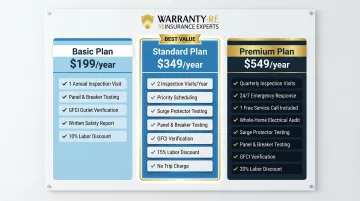
Build 2-3 plan tiers where each level adds real value, giving customers a natural upgrade path and a clear reason to choose the middle or top option. The tiered model follows a proven pattern across home services — Basic for essentials, Standard for priority access, Premium for comprehensive coverage.
Tier Structure Example:
Basic Plan ($199/year)
- One annual electrical safety inspection
- Panel and breaker testing
- GFCI outlet verification
- Written findings report
- 10% discount on repair labor
Standard Plan ($349/year)
- Two visits per year (spring and fall)
- Everything in Basic, plus:
- Priority scheduling (next-business-day appointments)
- Surge protector testing and battery backup check
- 15% discount on repair labor
- No trip charge for emergency calls
Premium Plan ($549/year)
- Quarterly electrical system reviews
- Everything in Standard, plus:
- 24/7 priority emergency response (4-hour window)
- One free service call per year (labor only, up to 2 hours)
- 20% discount on all repair work and materials
- Annual whole-home electrical audit with safety recommendations
Each tier needs clear, meaningful value separation. Add services customers genuinely want — not arbitrary features that cost you nothing to deliver.
What to Include at Each Tier
Define deliverables clearly:
- How often you visit: annual, semi-annual, or quarterly
- Inspection scope: panel only vs. whole-home electrical audit
- What's covered: labor-only vs. minor included parts (wire nuts, outlet covers)
- Emergency response: standard queue, priority scheduling, or guaranteed response window
- Discount structure: percentage off labor, materials, or both
Pricing Methodology
Calculate cost-per-visit first, then build in margin. The median electrician wage is $29.98 per hour (May 2024 BLS data). Your fully burdened labor cost is higher — typically $45-$55 per technician hour once you factor in benefits, workers' comp, vehicle costs, and insurance.
A thorough panel inspection, breaker testing, and GFCI verification takes roughly 1.5 hours. At $50 fully burdened cost, that's $75 in direct labor per visit. Build your full price from there:
- Direct labor: ~$75 per visit (1.5 hrs × $50 burdened rate)
- Materials: minimal per visit (test equipment wear, labels, documentation)
- Overhead allocation: typically 25-32% of revenue for electrical contractors
- Target profit margin: your goal determines final price
If your target gross profit margin is 65% — aligned with service and repair benchmarks of 62-70% — a visit costing $75 should be priced at approximately $214. For an annual agreement with one visit, $199-$249 is appropriate. For two visits, price at $350-$450 depending on market competitiveness and included perks.
Billing Structure Comparison
Annual upfront billing:
- Better cash flow for your business
- Reduces monthly administrative overhead
- May feel like a higher barrier for price-sensitive customers
- Typically requires a 5-10% discount vs. monthly equivalent to incentivize
Monthly billing:
- Lower psychological barrier ($25/month vs. $300/year)
- Increases administrative overhead (payment processing, failed payments)
- Creates consistent monthly recurring revenue
- Higher long-term revenue if customers remain active multiple years
Many contractors offer both: annual payment at a discounted rate ($299/year) or monthly payments ($27/month = $324/year). Let customers choose based on their cash flow preference.
Training Your Team to Sell and Deliver Service Agreements
Technician-Driven Sales
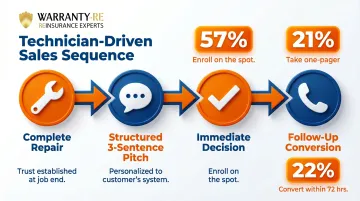
The most effective moment to sell a service agreement is at the end of a service call, after the repair works and trust is established. Asking after the job converts 3-4x higher than asking at the beginning.
Baseline service agreement attach rates for electrical contractors hover around 4%, with high performers reaching 15%. Train technicians with a structured three-sentence pitch that connects the agreement to the customer's actual situation:
"I noticed your panel is original to the house and showing some age. A lot of homeowners in this neighborhood are on our maintenance plan because it catches issues before they become expensive emergency repairs. For about a dollar a day, you get an annual safety inspection, priority scheduling if something goes wrong, and 15% off any future work. Would you like me to set that up for you today?"
This approach delivers 57% immediate enrollment. Another 21% take a one-pager to consider, and 22% of those convert during a 72-hour follow-up call.
New-install attach rates run higher, typically 32–38%, because customers are motivated to protect a brand-new investment.
Even with strong conversion rates, technicians will still hit resistance. Knowing how to respond keeps the sale alive without coming across as pushy.
Overcoming Common Objections
"I'll just call when something breaks"
Response: "I understand—most people think that way until they face a $2,000 emergency panel replacement that could have been caught early for $150. The plan pays for itself if it prevents even one emergency call, plus you get priority scheduling and discounted rates on anything we find."
"I don't need it—everything works fine"
Response: "That's exactly when it makes sense. Right now your system is in good shape. The annual inspection keeps it that way and documents everything for insurance purposes. If you wait until something fails, you're paying emergency rates with no discount."
"Let me think about it"
Response: "Absolutely—here's a one-pager with all the details. I'll have our office follow up in a couple days to answer any questions. Just so you know, we're running a special this month where we waive the enrollment fee if you sign up within the week."
Train technicians to ask confidently, not apologetically. The agreement delivers genuine value—you're offering a concrete financial backstop, not selling something unnecessary.
Internal Ownership and Process
Assign clear roles to prevent operational breakdown:
- Enrollment: Technician completes the form in the field; office staff processes and confirms within 24 hours
- Welcome packets: Office manager emails the agreement copy, membership card, and service schedule same day
- Renewal tracking: One dedicated admin monitors upcoming renewal dates and triggers outreach 60 days out
- Priority scheduling: Dispatcher maintains the member roster and flags priority requests at the time of booking
Without defined ownership, agreements get sold but never activated, renewal calls never happen, and the program dies from neglect.
How to Manage and Grow Your Service Agreement Program
Key Metrics to Track
Monitor these KPIs monthly to maintain program health:
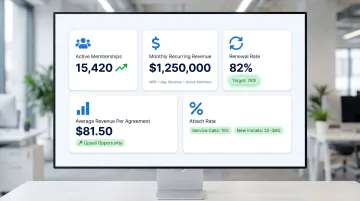
Active Memberships: Your baseline growth indicator — track the monthly count and rate of change, not just the total.
Monthly Recurring Revenue (MRR): Divide annual agreement revenue by 12 to normalize across contract types and get a true monthly picture.
Renewal Rate: Year-two retention of 78% is achievable with a structured enrollment ask. On 200 customers, the gap between 58% and 78% renewal equals 40 additional recurring contracts per year.
Average Revenue Per Agreement: Watch this number when you add tiers or adjust pricing — it tells you whether upsells are actually landing.
Attach Rate: Calculate separately for service calls (target 15%) and new installs (target 32-38%), since technician behavior differs significantly between the two.
Track these metrics in a dashboard reviewed monthly. Declining renewal rates signal service quality issues or unmet expectations. Falling attach rates usually point to training gaps or technician disengagement — both fixable problems once you can see them clearly.
Manual Management Pitfalls
Spreadsheets create predictable failure modes:
- Missed scheduled visits because renewal dates aren't flagged
- Forgotten renewals leading to silent churn
- Billing errors from manual invoice generation
- Inability to track which customers are due for service
- No automated reminders for upcoming appointments
At 20-30 active agreements, manual management is feasible but labor-intensive. Beyond 50 agreements, manual systems become unreliable and damage customer trust when visits are missed or billing errors occur.
Field service management platforms like ServiceTitan, Jobber, and 360e automate scheduling, send renewal reminders, process recurring billing, and generate performance reports. Contractors using ServiceTitan report an average 25% revenue increase in the first year.
Transition to software when manual tracking creates risk of missed renewals or scheduling gaps—typically around 50-75 active agreements depending on administrative capacity.
Scaling the Program
As membership grows, revisit your tier structure and pricing across four areas:
- Claim frequency: If surge protector failures spike, exclude them from coverage or raise Premium tier pricing to reflect actual cost.
- Tier profitability: Calculate cost-per-member (labor, parts, overhead) against revenue. If Basic members cost $180 to service but pay $199, that margin won't survive growth — raise pricing or trim included services.
- Complementary bundles: A customer paying $349/year for electrical maintenance may add $149/year for quarterly generator checks. Generator maintenance, whole-home surge protection, and EV charger inspections all extend contract value without adding complexity.
- Commercial tiers: Small business customers have distinct needs — monthly system reviews, emergency response guarantees, and priority scheduling during business hours can justify a separate, higher-priced tier.
Protecting Your Program from Warranty Risk with Reinsurance
As your service agreement program grows, so does your financial exposure. Every promise to cover parts or labor under a warranty obligation creates a liability on your balance sheet. If warranty claims spike unexpectedly—a batch of defective breakers, widespread connection failures—your profit margin evaporates and you're writing checks from operating cash flow to cover callbacks.
Most electrical contractors either absorb this risk directly (eating the cost of warranty callbacks) or pay third-party warranty administrators to manage coverage. Either way, the underwriting profits go somewhere other than your business.
The Hidden Risk
When you collect warranty fees built into job pricing or service agreement memberships, that revenue should offset the cost of future claims. But without proper risk management, unpredictable claim costs can overwhelm your reserves. Dispatching a licensed electrician to troubleshoot a tripping breaker, replace a failed connection, or correct a wiring issue consumes truck time, labor hours, and parts inventory—all eroding the profitability of the original job.
The Reinsurance Solution
Electrical contractors can replace third-party warranty administrators by establishing their own reinsurance company through a structured program designed specifically for home service contractors. This approach allows you to capture 100% of underwriting profits—the warranty fees collected that aren't used to pay claims—rather than paying those profits to an outside provider.
Here's how it works in practice: You build a warranty fee directly into your job pricing (for example, 2-3% on a $15,000 panel upgrade). That fee flows into your own reinsurance account rather than to a third party.
When warranty claims arise, they're covered from this account. Any unused funds remain with your reinsurance company as profit, and you earn investment income on the reserves.
The reinsurance structure operates as an administrator obligor model backed by A-rated insurers. Your reinsurance company is supported by established insurance carriers, providing claims-paying capacity and financial backing while you retain ownership and profits.
If claims exceed your accumulated reserves, the A-rated insurer assumes ultimate liability. Your personal exposure is limited to your formation costs and accumulated earnings, not the full value of unpaid claims.

Operational Benefits
WarrantyRE helps electrical contractors build and manage exactly this kind of reinsurance structure. The company handles the full administrative load, so you stay focused on running service calls and managing crews:
- Claims adjudication from initial contact through final resolution
- Compliance management to ensure IRS Code 831(b) adherence
- Financial bookkeeping with monthly statements
- Performance reporting and program analysis
The result: you stop writing checks to third-party warranty companies and stop absorbing unpredictable callback costs from operating cash. Instead, you build a tax-advantaged asset you own—one that generates underwriting profits, earns investment income, and shields your business from warranty claim volatility.
Frequently Asked Questions
Frequently Asked Questions
How to set up a service agreement?
Define the scope of services, calculate pricing based on fully burdened labor and overhead, and draft a contract covering payment terms, renewal clauses, and liability provisions. Then train technicians to present the program at job completion and assign internal staff to handle enrollment and renewal tracking.
What is an electrical maintenance program?
An electrical maintenance program is a recurring service arrangement where a contractor performs scheduled safety inspections and preventive checks on a customer's electrical system—such as panel inspections, breaker testing, and GFCI verification—in exchange for a regular membership fee, typically billed monthly or annually.
What are the four rules of electrical maintenance?
The four core principles are: inspect regularly to catch issues early, document all findings in written reports, correct identified hazards before they become failures, and follow applicable electrical codes throughout all work. A service agreement program gives contractors a repeatable framework to deliver on each one.
How much should I charge for an electrical service agreement?
Start with your fully burdened labor cost per visit (typically $45–$55/hour), add materials and overhead, then apply a 62–70% gross profit margin. Annual plans commonly range from $199 for basic single-visit coverage to $549+ for quarterly programs that include priority response and included service calls.
What should be included in an electrical maintenance agreement?
A solid agreement covers the scope of services per visit (panel inspection, breaker testing, outlet verification), billing frequency, priority scheduling rights, liability and insurance provisions, and renewal and cancellation terms including notice periods and price escalation language.