
Introduction
Most plumbing contractors run the same tightrope every year: revenue swings unpredictably between seasons and customers only call when something breaks. Slow months leave your schedule empty while overhead keeps running — and that makes it hard to plan ahead, invest in the business, or grow with any confidence.
A plumbing service agreement program addresses all of that directly. Customers pay an annual fee for scheduled maintenance visits, priority response when emergencies happen, and discounted rates on repairs.
For your company, the return is tangible: recurring revenue you can forecast, customers who stay instead of disappearing after one job, and off-peak periods filled with planned maintenance work rather than reactive crisis calls.
This guide walks plumbing company owners through every step of building that program, including:
- Structuring and pricing your tiers
- Training your plumbers to sell agreements in the field
- Handling the legal and contract framework
- Managing financial risk as enrollment grows
- Systematically increasing membership over time
TL;DR
- Service agreements convert one-time calls into retained accounts through annual plans covering scheduled maintenance, priority access, and repair discounts
- Involve your plumbers in defining coverage from the start — their buy-in makes the program far easier to sell and deliver
- Price agreements using marginal cost economics, not guesswork — the agreement price becomes your "value rate" while non-members pay a higher standard rate
- Legal contracts must define scope, payment terms, renewal and termination conditions, and exclusions — have an attorney review before launch
- As programs scale, protecting against large claim exposure requires a sound financial structure — reinsurance is how the most profitable contractors handle that risk
Why Plumbing Contractors Should Offer Service Agreements
The numbers tell the story: maintenance services represented 39% of all home service project requests in 2023, making it the single most popular category. In the HVAC space, 42% of homeowners already subscribe to a maintenance plan, and another 37% are interested in signing up—meaning nearly 80% of homeowners either have or want a maintenance agreement. Your plumbing customers aren't different, and competitors in your market may already be offering this.
The business case is straightforward. Service agreements:
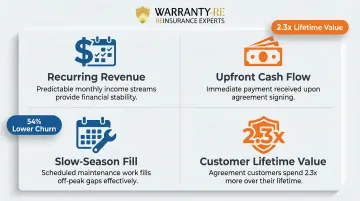
- Convert one-time customers into retained accounts with predictable revenue
- Generate upfront cash flow before a single wrench turns
- Fill slow-season schedules with planned visits instead of reactive emergency calls
- Build long-term loyalty: maintenance plan customers generate 2.3x the lifetime value of one-time service customers, while emergency repair customers have 54% lower retention than plan holders
From the customer perspective, service agreements are an easy sell when presented correctly. Customers get priority response when emergencies strike, lower repair costs when things break, and a monitored plumbing system year-round—all for a predictable annual fee.
How to Set Up Your Plumbing Service Agreement Program – Step by Step
Step 1 – Define the Scope of Services
The foundation of any successful service agreement is a clearly defined scope that separates preventive maintenance from repair work. Focus on preventive tasks with measurable customer value:
Core plumbing tasks to include:
- Water heater flush and anode rod inspection
- Faucet aerator cleaning and flow testing
- Toilet dye test and flapper replacement
- Water and gas pressure checks
- Drain camera inspection for main lines
- Backflow preventer testing (for applicable systems)
- Shut-off valve operation and lubrication
- Visual inspection of all fixtures for leaks or corrosion
These tasks align with maintenance standards established by the International Property Maintenance Code (IPMC), which requires all plumbing systems be maintained in proper operating condition per original design.
What to exclude from base coverage:
- Repair of broken components (fixtures, pipes, water heaters)
- Replacement of worn-out equipment
- Emergency service calls outside the scheduled visit
- Issues caused by customer negligence or code violations
The boundary between included maintenance and discounted repairs defines your scope and sets customer expectations from day one. Document it clearly — ambiguity costs you money and technician trust.
Step 2 – Get Your Plumbers to Build and Own the Agreement
Plumbers who didn't build the service agreement won't believe in it — and they won't sell it. Pricing and marketing won't save a program your technicians don't stand behind.
The team meeting approach:
Run a service meeting where you ask plumbers to define the "perfect" service agreement with no time constraints. Give them full authority to decide what tasks should be included based on what actually prevents problems and adds value for customers.
Next, have them assign a dollar value to each task based on what it would cost the customer to repair the problem if it went undetected, multiplied by the realistic probability that problem occurs within a year. For example:
- Water heater anode rod check: prevents $1,200 tank replacement × 15% annual failure probability = $180 value
- Toilet flapper inspection/replacement: prevents $300 water damage × 25% probability = $75 value
- Pressure testing: prevents $800 fixture damage × 10% probability = $80 value
When plumbers calculate the total value of all included tasks (often $400–600 combined) and then see the actual selling price of $250-350, they recognize the agreement is a genuine bargain for customers. This creates real confidence. They'll present the program because they believe customers are getting real value, not because they're being pushed to sell.
Step 3 – Create Your Contract Documents and Legal Framework
A legally enforceable plumbing service agreement contract must include specific elements to protect both your business and the customer:
Required contract elements:
- Scope of covered services (listed explicitly)
- Exclusions (what is not covered)
- Duration and automatic renewal terms
- Cancellation and termination process
- Payment schedule and accepted methods
- Insurance and liability clause
- Priority service guarantees (response time commitments)
- Dispute resolution process
Each element serves a legal and operational purpose. The scope prevents misunderstandings about what's included. Exclusions protect you from unlimited liability. Payment terms ensure cash flow. Cancellation clauses give customers an exit while protecting your annual revenue forecast.
State-Level Compliance Requirements
Several states regulate service contracts as insurance products, which means your agreement may require registration, financial backing, or both before you can legally sell it. Check your state before launch:
- Texas requires service contract providers to register with TDLR and maintain financial backing via reimbursement insurance, funded reserves, or minimum net worth
- New York mandates registration with the Department of Financial Services and evidence of reimbursement insurance
- New Hampshire requires registration and financial reserves or reimbursement insurance policies
Have a local attorney review your contract for compliance with state-level service contract regulations before launch. Skipping this step can expose you to regulatory penalties and unenforceable contracts.
Step 4 – Design Your Tiered Package Structure
Build 2-3 service tiers with clearly differentiated features at each level. This structure gives customers choice and makes it easier for plumbers to match the right plan to different household types and budgets.
Example tier structure:
Basic Tier ($180-250/year):
- Annual plumbing system inspection
- Water heater flush and inspection
- Toilet and faucet check
- 10% discount on parts and labor
Standard Tier ($300-400/year):
- Everything in Basic
- Priority scheduling (24-48 hour response)
- Waived trip/diagnostic fees
- 15% discount on parts and labor
- Drain camera inspection included
Premium Tier ($450-550/year):
- Everything in Standard
- Semi-annual inspections
- Emergency priority service (same-day response)
- 20% discount on parts and labor
- Transferable to new homeowner (increases home value)
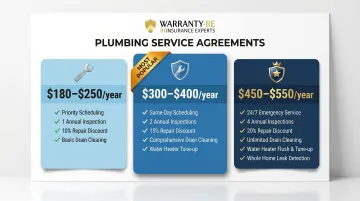
Each tier must be independently profitable when you account for labor cost, materials, and average discount usage. The tiered structure also supports organic upgrades at renewal time. Customers who dealt with an emergency mid-year tend to see the Premium tier's same-day response as a worthwhile step up when the conversation comes around again.
How to Price, Structure, and Back Your Agreement
Marginal Cost Pricing Method
Price your service agreements based on marginal cost, not arbitrary markup. The agreement price should cover the incremental cost of performing the work—truck cost, labor time, materials, and a spiff for the selling plumber—during periods of slow demand. Your real cost stays low, and the margin is healthy even at an attractive price point.
Example calculation:
- Labor time for annual visit: 1.5 hours × $40/hour loaded cost = $60
- Truck and fuel cost: $15
- Materials (aerators, flappers, test supplies): $10
- Plumber spiff/commission: $20
- Total marginal cost: $105
If you price the agreement at $250, your gross margin is $145 (58%). This margin holds because the work is performed during slow periods when the plumber would otherwise be unproductive.
Value Rate vs. Standard Rate Model
The service agreement price becomes your value rate—the rate you need to hit your target net profit. Non-agreement customers pay a standard rate that's higher.
If your value rate (the fully-loaded profitable rate) is $250/hour and you offer agreement members a 15% discount, the standard rate works out to:
Standard Rate = Value Rate ÷ (1 - Discount %)
Standard Rate = $250 ÷ 0.85 = $294/hour
The framing matters: agreement members pay your profitable rate as a reward for loyalty. Non-members pay a premium for opting out.
Calculate Perceived Customer Value
Add up the value your plumbers assigned to each included task, then factor in the discount value on the average service ticket. The total should be significantly higher than the selling price.
Example:
- Preventive task value (from Step 2): $450
- Average annual repair ticket: $800
- 15% discount value: $120
- Total perceived value: $570
- Selling price: $299
- Customer savings: $271
When a customer sees $271 in savings against a $299 price tag, closing the sale becomes straightforward.
Risk Management and Financial Exposure
When hundreds of customers are enrolled, a single bad year of claims or unexpected callback volume can wipe out margins. A Level CFO analysis of a contractor's $3.8M service agreement book found -23% margins because agreements priced in 2019 were never adjusted for inflation — destroying $876,000 in margin over 12 months.
Traditional pricing alone can't fully protect you from this exposure. The financial structure backing your agreements matters just as much as how you price them.
Reinsurance-Backed Model: Turning Agreements Into Profit Centers
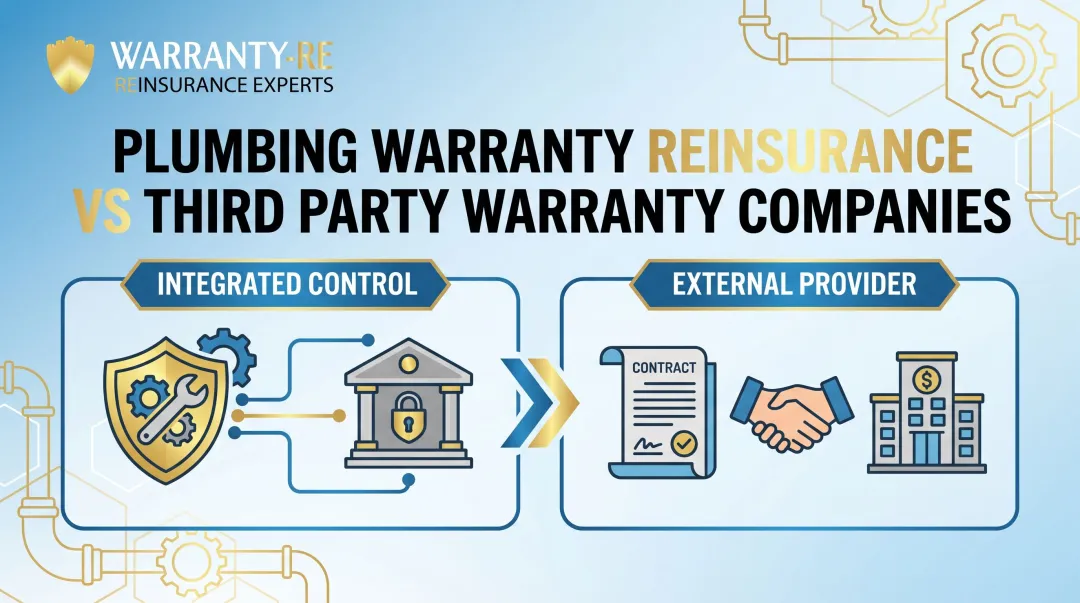
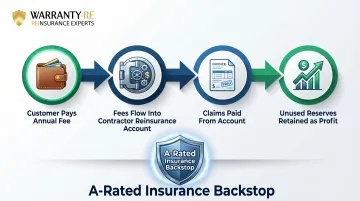
Rather than relying on third-party warranty providers that keep the underwriting profits, some contractors establish their own administrator obligor reinsurance companies through partners like WarrantyRE. This structure allows plumbing contractors to capture 100% of warranty profits while being protected by A-rated insurers.
Instead of paying third-party warranty companies, you establish your own reinsurance company that backs the labor warranties on all your service work. Warranty fees collected from customers flow into your reinsurance account, claims are paid from that account, and unused reserves remain yours.
The structure is backed by institutional A-rated insurance. If claims exceed your reserves, your personal liability is limited — the insurance company assumes ultimate responsibility.
The underwriting profits that once went to a third-party provider stay in your account instead — converting your service agreement program from a managed expense into a revenue-generating asset.
Selling, Enrolling, and Growing Your Program
When and How to Present the Agreement
The best moment to present a service agreement is during an active service call—after diagnosing a problem and before presenting the repair quote. Use a three-column invoice format:
| Service | Value Rate (Member Price) | Standard Rate (Non-Member) | Savings |
|---|---|---|---|
| Annual Agreement | $299/year | N/A | N/A |
| Today's Repair | $450 | $530 | $80 |
| Total with Agreement | $749 | $530 | You save $80 today + $299 value |
The customer sees the math immediately. They're already spending $530 on the repair. For an additional $299, they get an annual inspection plus priority service and discounts on future repairs.
Tools and Collateral Your Team Needs
Equip your plumbers with these materials to make the program feel tangible and trustworthy:
- Customer-facing brochure explaining benefits in plain language
- Three-column invoice showing value rate vs. standard rate
- Maintenance checklist with clearly marked checkboxes demonstrating thoroughness
- Membership card customers receive after enrollment (builds perceived value)
These tools make the agreement feel real, not abstract. Customers can hold the brochure, see the checklist, and understand exactly what they're purchasing.
Track the Metrics That Matter
Monitor these four KPIs to gauge whether your program is working:
- Enrollment rate — What percentage of customers sign up when presented the offer? Top performers hit 85%+; bottom quartile programs fall below 60%.
- Renewal rate — How many customers renew after year one? Below 70% signals a service quality, pricing, or communication problem worth investigating.
- Revenue per agreement — Track total revenue per enrolled customer (base fee + repair work + referrals). Median multipliers run 1.8-2.2x, with top quartile contractors reaching 3.0-4.0x.
- Claim cost per customer — Compare actual delivery cost against revenue collected. If costs consistently exceed 60% of revenue, adjust pricing or scope before scaling.
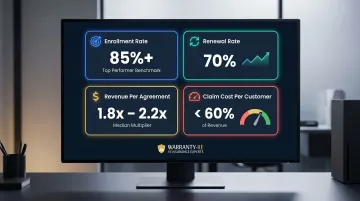
Use this data to refine pricing, scope, or presentation strategy before expanding the program.
Conclusion
A plumbing service agreement program changes how your business generates revenue, retains customers, and manages demand. Building it correctly means starting from the inside out — team buy-in, clear scope, sound pricing economics, and a financial structure that holds up as you scale.
When pricing and legal structure are treated as afterthoughts, service agreement programs underdeliver — or worse, become a financial liability. Get those foundations right, and your program generates recurring revenue that stabilizes cash flow year-round, regardless of seasonal slowdowns or emergency call volume.
Frequently Asked Questions
How to write up a plumbing contract?
A plumbing service contract should clearly define the scope of covered services, payment terms, duration and renewal/termination conditions, any discounts or perks included, and specific exclusions. Include priority scheduling terms, service call fee policies, and cancellation procedures. Legal review is recommended to ensure compliance with state service contract laws.
What should be included in a maintenance agreement?
A maintenance agreement should include annual inspection details (systems checked and tasks performed), specific included services like water heater flush and toilet inspection, priority scheduling terms, discount percentages on parts and labor, service call fee waivers, and clear renewal terms with pricing. Define exclusions explicitly to prevent disputes.
Are plumbing service contracts worth it?
Yes, when priced correctly. Service agreements generate predictable recurring revenue, reduce slow-season scheduling gaps, and increase customer lifetime value through natural upsell opportunities during annual visits. The key is keeping delivery costs well below the revenue each agreement generates.
What are the 5 C's of a contract?
The standard legal framework actually identifies six elements: offer, acceptance, awareness (meeting of the minds), consideration (exchange of value), capacity (legal ability to enter agreements), and legality. For plumbing service agreements, these mean the customer pays for defined services, both parties can legally contract, and both sides fully understand the terms.
What is the most common plumbing maintenance problem?
Water heater sediment buildup, running toilets, slow drains, and dripping faucets are the most commonly identified issues during maintenance visits. These problems are preventable through routine inspection, which is why annual agreements carry strong perceived value — customers sidestep costly emergency repairs through scheduled maintenance.
What are the 4 types of contracts?
The four main contract types are fixed-price (stipulated sum), cost-plus, time and materials, and design-build. For plumbing service agreements, the fixed-price annual structure works best. Customers get cost certainty with a defined annual fee, and contractors get predictable recurring revenue with clear scope boundaries.