
Done right, service agreements convert seasonal, transactional businesses into ones with stable recurring revenue, higher customer lifetime value, and a stronger foundation for growth. Done wrong, they create obligations that quietly drain margins without the contractor ever knowing why.
This post covers how service agreements generate recurring revenue, how to price and sell them profitably, and the one profit layer most contractors never tap. Whether you're in HVAC, plumbing, electrical, roofing, or general contracting, the principles here apply to building a more stable, profitable business.
TL;DR
- Service agreements convert one-time customers into predictable annual revenue, directly addressing seasonal cash flow gaps
- A well-managed HVAC service agreement program averages over $700 annually per customer with a target 80% renewal rate
- Underpricing is the most common reason agreements fail to generate profit — price from true cost, not competitor rates
- Convert customers immediately after a completed service call — that's when trust peaks and agreement sign-ups are highest
- Contractors using third-party warranty administrators are funding someone else's profit; ownership models let you keep that money instead
What Are Service Agreements for Contractors?
A contractor service agreement turns one-time customers into recurring revenue. Customers pay a monthly or annual fee for scheduled maintenance, priority service, and/or repair coverage on their home systems or equipment.
The Most Common Agreement Types
| Type | What It Includes |
|---|---|
| Maintenance agreement | Scheduled tune-ups and inspections at defined intervals |
| Full-service coverage plan | Maintenance plus covered repairs for specified components |
| Inspection-only contract | Annual or seasonal system checks with no repair coverage |
| Labor-only arrangement | Covers technician labor on repairs; customer pays parts |
Each model fits different trades and customer risk tolerances. HVAC contractors most commonly use maintenance and full-service plans; plumbing and electrical contractors often start with labor-only or inspection contracts.
What a Service Agreement Is NOT
This distinction matters for the profit discussion that follows:
- Not a one-time warranty — warranties are reactive; agreements are ongoing
- Not a home warranty — third-party home warranty products are sold by outside companies and cover multiple systems under a separate contract the contractor has no ownership of
- Not a reactive repair arrangement — service agreements are proactive by design
That proactive, recurring structure is exactly what creates predictable cash flow — and the margin opportunity covered in the next section.
How Service Agreements Directly Increase Contractor Profits
Recurring Revenue and Cash Flow Stability
HVAC service demand drops noticeably during temperate shoulder seasons. Plumbing and electrical work isn't immune to similar slowdowns. Service agreement fees arrive on schedule regardless of weather or season, giving contractors a revenue base that keeps overhead covered when call volume dips.
According to U.S. Bank research cited by Contractor Magazine, 82% of business failures trace back to poor cash flow management. Service agreements directly address that risk by creating a predictable monthly and annual revenue floor.
The DOE Better Buildings program cites 500 service contracts as a reasonable sustainability threshold for HVAC businesses — enough to cover overhead and reduce dependence on unpredictable service call volume.
Higher Customer Lifetime Value
A customer on a maintenance agreement doesn't shop around when equipment needs attention. They call you. That loyalty translates directly into higher spend per year.
HVACR Business reports that a properly managed residential service agreement program can generate an average of over $700 annually per customer. Agreement customers also receive regular visits — which creates natural opportunities for repairs, upgrades, and additional system coverage.
Key benchmarks to know:
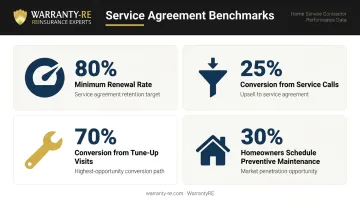
- 80% minimum renewal rate — the target for a well-run program
- 25% conversion from standard service calls to agreements
- 70% conversion from tune-up visits to full agreements
- Only 30% of U.S. homeowners currently schedule preventive HVAC maintenance — meaning the market opportunity remains largely untapped
Business Valuation Impact
Recurring revenue doesn't just stabilize cash flow — it directly increases what a buyer will pay when you're ready to exit.
According to Lake Country Advisors, service-driven HVAC companies typically command stronger EBITDA multiples than installation-focused businesses because buyers can see forward income. The benchmark cited: approximately 250 service agreements for every $1M in service revenue as a valuation indicator.
Breakwater M&A notes that a strong maintenance contract base can add 2x to 3x its annual value to the total purchase price of a business. A contractor with few agreements often finds their business worth far less than expected at sale — regardless of how many years they've been operating.
Reduced Emergency Callbacks
Preventive maintenance finds problems before they become emergencies. The DOE notes that neglected filters, coils, and condensate drains can cause premature equipment failure and water damage — the exact scenarios that generate expensive after-hours calls and warranty obligations.
Every emergency dispatch avoided is pure margin protection:
- Fewer overtime hours paid out
- No rush orders on parts
- Fewer customers demanding after-hours explanations
How to Build a Profitable Service Agreement Program
Tier Structure
Offering 2–3 pricing tiers gives customers a choice and increases average contract value. A common structure:
- Basic — one annual inspection, standard scheduling priority
- Comprehensive — two visits per year, priority scheduling, parts discount
- Premium — unlimited visits, same-day priority, full parts and labor coverage
Pricing varies by trade, geography, and scope — don't benchmark against competitors without knowing their actual cost structure.
Pricing for Profitability
Underpricing is the single most common reason service agreements fail to generate profit. Many contractors calculate what they want to charge, then knock off 20% to look competitive. That approach makes agreements busy and unprofitable at the same time.
Price each agreement using these components:
- Labor cost: technician time at fully loaded rate (wages, taxes, benefits)
- Parts and materials: a realistic per-contract estimate, not best-case
- Overhead allocation: proportional share of office, vehicles, and insurance
- Risk reserve: funds set aside for covered repairs under full-service plans
- Profit margin: the number your business actually needs — not one that just sounds reasonable
HVACR Business breaks down a real HVAC example this way:
| Component | Single System | Two Systems |
|---|---|---|
| Labor | $80 | $160 |
| Overhead | $120 | $200 |
| Materials | $15 | $30 |
| Target Price | $235/year | $415/year |
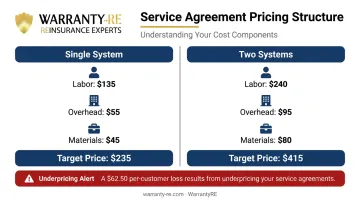
Underprice the second system without recalculating costs and you generate a $62.50 loss per customer — multiplied across hundreds of agreements, that's a significant drag on the business.
Customers aren't just buying a maintenance visit. They're buying priority access, peace of mind, equipment protection, and savings on future repairs. Price should reflect that full value — not just your cost to deliver it.
What to Include in the Agreement Document
A vague agreement document creates disputes that erode margins. Every well-structured agreement should include:
- Clear scope of services (what's included, what isn't)
- Service frequency and scheduling windows
- Covered and excluded components
- Billing terms and auto-renewal language
- Cancellation policy
- Priority service language (define what "priority" means)
Have agreement documents reviewed for legal compliance before rollout — particularly language around covered repairs, exclusions, and liability. Unclear exclusion language is the most common source of customer disputes and unexpected covered-repair costs.
Strategies to Sell and Retain Service Agreement Customers
The Post-Service Enrollment Window
The best moment to sell a service agreement is immediately after a completed service call — when the customer has just experienced your work firsthand, trust is high, and the equipment problem that prompted the visit is still fresh in their mind.
At this exact moment, a technician saying "Based on what I saw with your system today, you'd be a great candidate for our maintenance plan" lands very differently than the same pitch in an email two weeks later.
The offer works because it's relevant, timely, and tied to something the customer just lived through.
Involving Technicians in the Process
Field technicians are the most trusted people in a customer's home. Training them to present agreements as genuine recommendations — tied to the specific equipment they just worked on — is more effective than any marketing campaign.
Train technicians to:
- Mention the plan naturally during the close of every service call
- Tie the recommendation to something specific they observed ("Your capacitor is showing wear — catching that on a regular visit is exactly why this plan makes sense")
- Avoid scripted pitches; customers can tell the difference
Renewal and Retention
Agreements don't renew themselves. Build these into your process:
- Automated reminders 30–60 days before expiration
- Annual service summary showing work completed and value delivered
- Loyalty pricing for multi-year renewals
- Personal outreach for high-value accounts before auto-renewal triggers
Upsell Opportunities Service Agreements Create
Scheduled visits give you regular access to the customer and their systems. That access creates natural moments to:
- Identify aging equipment approaching end-of-life
- Recommend upgrades before failures occur
- Add coverage for additional systems (for example, adding plumbing coverage to an existing HVAC agreement)
Customers on a plan already trust your work. That makes them your most likely buyers when the next installation opportunity comes up.
The Next Level: Owning Your Warranty Reinsurance Structure
The Hidden Profit Leak
When contractors use third-party warranty administrators to back their service agreements, a meaningful portion of the premium collected flows out to that third party as underwriting profit. As WarrantyRE puts it directly: if your warranty company weren't making a profit from you, why would they continue doing business with you?
The contractor absorbs the customer relationship, the service delivery, and the brand risk. The third party keeps the underwriting margin.
Contractor-Owned Reinsurance
Rather than continuing to fund another company's profit, contractors can establish their own administrator obligor reinsurance company — owning the structure that collects and manages warranty reserves.
WarrantyRE has spent 30+ years helping contractors in HVAC, roofing, plumbing, and electrical build exactly this kind of structure. Warranty fees are priced into the job, flow into a reinsurance company the contractor owns 100%, cover claims as needed, and leave any unused funds with the contractor — not a third party.
Additional Benefits of the Ownership Model
The financial upside extends beyond recapturing underwriting profit:
- Contributions to the reinsurance account carry significant tax advantages, keeping more dollars inside a structure that builds long-term value
- Collected premiums are held in a custodial account and invested, with all investment income belonging to the contractor's reinsurance company
- A-rated insurers back the structure as the admin obligor, so if reserves fall short, the direct writing insurance company carries the ultimate liability

WarrantyRE handles claims adjudication, compliance, legal filings, tax returns, performance reporting, and bookkeeping. Contractors get the financial benefit of ownership without taking on the administrative work that comes with it.
Common Mistakes That Limit Service Agreement Profits
Most service agreement programs don't fail because of bad intentions — they fail because of avoidable operational gaps. These three mistakes show up repeatedly across contractors who struggle to make agreements profitable:
- Underpricing without accounting for true costs — leaving out overhead allocation or risk reserves turns profitable-looking agreements into loss leaders
- No systems for tracking, billing, and renewal management — agreements managed on spreadsheets produce missed renewals and billing errors, both of which quietly erode margin
- Vague agreement terms — over-promising coverage without defining exclusions creates disputes and repair obligations that were never priced in
Getting these fundamentals right is the foundation. From there, the real profit opportunity lies in how the agreement itself is structured.
Frequently Asked Questions
What is a contractor services agreement?
A contractor services agreement is a recurring arrangement where a customer pays a regular fee for scheduled maintenance, priority service access, and/or repair coverage on their home systems or equipment. It's distinct from a one-time warranty and has no connection to third-party home warranty products sold by outside providers.
What is a reasonable profit margin for a contractor?
An ACCA survey of 1,000+ HVAC contractors puts average net profit at 6%, with the ACCA's target for sustainable growth at 10%. Service agreements generally produce higher margins than one-time calls when priced correctly — the same survey found average margins of 27% on extended labor agreements.
How do I price a service agreement so it's profitable?
Start with your actual cost to deliver: labor per visit, parts budget, overhead allocation, a risk reserve for covered repairs, and your target margin. Then validate that price against the full value the customer receives — maintenance, priority access, and peace of mind — to confirm there's room for healthy margin.
How many active service agreements do I need to see a real profit impact?
The DOE cites 500 service contracts as a sustainability threshold for HVAC businesses. For smaller contractors, even 100–200 agreements create measurable cash flow stability, reduce dependence on unpredictable service call volume, and make slow months easier to manage.
Can service agreements help reduce seasonal cash flow problems?
Yes, directly. Agreement fees arrive on a fixed schedule regardless of weather or season. That predictable income offsets the revenue dips that hit contractors hardest in shoulder months, making annual cash flow more stable and easier to plan against.