

Introduction
Most electricians who hit $500K in revenue are technically excellent. The problem isn't their work — it's that they're still running a $200K operation at twice the size. Same manual scheduling, same word-of-mouth leads, same informal pricing, and no systems that function without them in the room.
Scaling an electrical business isn't about working more hours or hiring faster. It requires documented processes, consistent lead flow, protected margins, and revenue that carries forward — not revenue that starts over with every new job.
This guide covers the five pillars that separate contractors who scale from those who plateau: legal and financial foundation, operational systems, marketing, team building, and recurring revenue. The contractors who grow fastest build systems that work whether they're on a job site or not.
TL;DR
- Scaling means documented systems, steady lead flow, and protected margins — not just more headcount.
- Field service management software cuts the scheduling and invoicing drag that stalls growth.
- Google Business Profile, reviews, and LSA ads build predictable job volume beyond referrals.
- Hire when sustained demand exceeds capacity — not when you're already overwhelmed.
- Contractor-owned reinsurance programs turn warranty obligations into a profit center, not an expense.
Lay the Right Foundation Before You Scale
Growing without the right legal and financial structure creates compounding risk. Before adding trucks, crews, or markets, get these fundamentals in place.
Business Entity and Insurance
The two most common structures for electrical contractors are LLCs and S-corporations. According to the SBA's updated guidance, each serves a different purpose depending on your income level and growth stage:
- LLC: Separates personal assets from business liability and passes profits directly to personal income with minimal formality
- S-corp: Avoids the double taxation of a C-corp and can reduce self-employment tax at higher income levels, though it requires stricter operational structure and is capped at 100 shareholders
Neither structure protects you if your general liability or workers' compensation coverage has gaps. Before expanding into new service types or markets, verify that your policies actually cover the work you're doing.
Separate business banking and accounting aren't optional at this stage. Commingled finances make job-level profitability invisible and create serious problems at tax time.
Licensing and Compliance
Electrical licensing requirements vary significantly by state — and in many cases, by municipality. The NCSL's National Occupational Licensing Database tracks state-level licensing laws for electricians across the U.S., including exam requirements, renewal schedules, training hours, and reciprocity rules. If you're expanding into adjacent markets, check each jurisdiction before sending crews.
Operating unlicensed, even briefly, exposes you to fines, voided contracts, and denied insurance claims.
A Written Growth Plan With Actual Numbers
Most electrical contractors expand reactively: they get busy, hire someone, get busier, buy another truck. That cycle works until it doesn't.
A written business plan doesn't need to be formal. It needs to answer three questions:
- What revenue and net margin are you targeting this year and next?
- What job mix gets you there (residential service calls, panel upgrades, commercial work)?
- What does your cost structure look like at that volume?
Knowing your targets before you hire or expand prevents the reactive growth trap that stalls most contractors around $1M to $2M in revenue.
Streamline Operations with Systems and Technology
Operational bottlenecks are the most common reason electrical businesses plateau. The culprits are predictable: manual scheduling, phone-based dispatching, paper invoices, and untracked callbacks.
Research from Klipboard's 2022 field-service survey found that field-service professionals lose 5 to 6 hours per week to administrative tasks, with 30% citing incomplete forms and 29% citing duplicate data entry as major drains. That's a full day of billable time lost every week — before accounting for the errors those manual processes introduce.
What Field Service Management Software Actually Solves
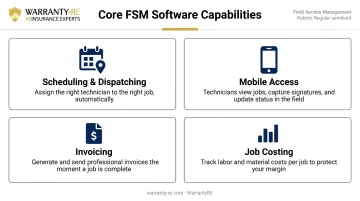
The right FSM platform centralizes the workflows that currently eat your time. Key features for growing electrical operations include:
- Scheduling and dispatching — assign jobs based on technician location, availability, and skill set
- Mobile access — field techs update job status, capture signatures, and submit photos from the job site
- Invoicing — generate and send invoices immediately on job completion, not two days later
- Job costing — track labor and material costs per job so you know actual margins, not estimated ones
Job-level cost visibility feeds directly into the next operational problem most electrical contractors underestimate: pricing.
Pricing Discipline Is an Operational Problem
Underpricing is common in electrical contracting, and it usually shows up as thin or negative net margins despite strong revenue. According to EC&M's 2023 estimating report, labor can account for 50% or more of the total bid price on some projects — which means even small errors in labor estimation compound across your job volume.
Flat-rate pricing with labor and material markup built in removes the guesswork. To make it work operationally, you need accurate job-costing data from your FSM software feeding your pricing model — so rates reflect real costs, not last year's estimates.
Document Your Workflows
Once your software systems are in place, the next step is documenting how work actually gets done. Standard operating procedures for estimate creation, job handoffs, quality checks, and callback handling reduce owner dependency and let new hires perform consistently without constant supervision.
Unmanaged callbacks are a silent margin killer. The 2023 Field Service Benchmark Report found that a failed first visit requires an average of 2.75 total visits and adds 13 days to resolution time. At scale, that's a significant cost that documented quality procedures can reduce.
Build a Marketing Engine That Generates Consistent Leads
Most electrical contractors depend entirely on word-of-mouth early on. That works at $300K. It breaks at $1M.
According to L.E.K.'s 2024 residential services research, 49% of electrical customers rely on recommendations from others when choosing a contractor — but 39% use online search and review sites. Referrals alone can't fill a growing schedule consistently. You need channels you control.
Local Search and Reviews
Your Google Business Profile is the single highest-leverage marketing asset for a local electrical business. Optimized correctly — with accurate service categories, consistent NAP citations, and regular photo updates — it drives inbound calls without ongoing ad spend.
Online reviews aren't a passive outcome; they're an active acquisition channel. BrightLocal's 2026 Local Consumer Review Survey found that:
- 97% of consumers read reviews for local businesses
- 47% will not use a business with fewer than 20 reviews
- 80% are more likely to hire a business that responds to every review

Contractors who build a review-request process into every completed job compound their lead volume over time. A simple ask at job completion — by text or in person — is enough to outpace competitors who leave it to chance.
Your Website and Paid Leads
A conversion-optimized website for electrical contractors doesn't need to be complex. It needs clear service pages (panel upgrades, EV charger installation, whole-home surge protection), a visible phone number on every page, and dedicated service area pages for each market you cover.
Once your site is set up, Google Local Services Ads are worth running. LSAs appear above organic results, charge per valid lead rather than per click, and carry the Google Guarantee badge — which matters for high-ticket jobs like service panel replacements. WordStream reports an average LSA cost per lead of roughly $60, compared to a $70.11 benchmark for standard search ads.
Referral Partnerships
Structure your referral relationships rather than leaving them informal. General contractors, property managers, real estate agents, and HVAC or plumbing contractors are natural referral partners for electrical work.
Make these relationships reciprocal and trackable:
- Track referral sources in your CRM
- Send leads back when you can
- Check in quarterly rather than waiting for the phone to ring
A handful of active referral partners can produce consistent monthly job volume without any ad spend.
Hire and Develop a Team That Grows With You
Most electrical business owners hire too late — only when they're already overwhelmed. The new hire then onboards into chaos, and the owner spends weeks managing someone who was supposed to reduce their workload.
SCORE's guidance is practical: hire when deadlines are being missed, when work is consistently steady beyond a few months, and when cash flow can reliably cover salary, insurance, and payroll taxes. The key word is consistently — one busy quarter doesn't justify a new hire that changes your fixed cost structure.
Structured Onboarding
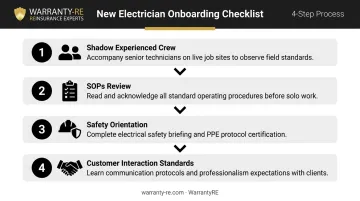
A new electrician without clear expectations adds management burden rather than capacity. Most early-stage performance problems trace back to one thing: no written process. A basic onboarding checklist should include:
- Shadow an experienced crew — two to four days before any solo work
- SOPs review — walkthrough of your estimate, job handoff, and quality check procedures
- Complete safety orientation — documented and signed off, not assumed
- Cover customer interaction standards — how to present at the door, explain scope, and handle callbacks professionally
Written role expectations eliminate the ambiguity that causes most early-stage performance problems.
Retention Is a Financial Issue
Replacing an employee is expensive. SHRM estimates replacement costs range from 50% to 200% of annual salary. For a journeyman electrician earning $65,000, that's $32,500 to $130,000 per departure — in recruitment time, training, and lost productivity.
Non-monetary retention factors that actually move the needle:
- Map out a career path from apprentice to journeyman to lead to foreman
- Cover paid training and licensing costs
- Schedule consistently — feast-or-famine hours drive turnover
- Build a crew culture people actually want to come back to Monday morning
Competitive pay opens the door — but these factors are what keep skilled electricians from walking out it.
Create Recurring Revenue with Warranty and Service Agreement Programs
Project-based revenue resets to zero after every job. That feast-or-famine cycle is manageable at $400K. It becomes a cash flow problem at $2M.
Warranty programs and service agreements are the most direct path to predictable recurring income for electrical contractors — and most contractors are leaving real money on the table by not structuring them correctly.
Where the Money Is Going Now
Most electrical contractors handle warranties one of two ways: they informally absorb callbacks out of pocket, or they pass the obligation to a third-party warranty provider. Neither captures the financial upside.
Third-party providers collect premiums from your customers, pay claims, and keep the underwriting profit — the surplus that remains when claims run below premiums collected. According to Warranty Week's service-contract industry analysis, retailers in the extended warranty space often retain 50% or more of the final warranty price as margin unrelated to actual failure risk. That's profit your installation generated — going to someone else's balance sheet.
Contractor-Owned Reinsurance: How It Works
The alternative is a contractor-owned reinsurance structure. Here's the basic model:
- A warranty fee is built into every job price — for example, a 2-year labor warranty included with an $18,000 service upgrade
- Those fees flow into a reinsurance account that is legally owned by the contractor
- When warranty calls come in, claims are covered through that account
- Unused funds — the underwriting surplus — stay with the contractor
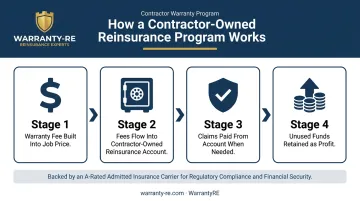
The structure is backed by A-rated insurers, which means customers are protected even if claims exceed the contractor's reserves. The liability for claim payments ultimately rests with the backing insurance carrier, not just the contractor's account.
WarrantyRE has been helping home service contractors — including electrical businesses — establish and manage these contractor-owned reinsurance programs since 1994. They handle company formation, claims adjudication, compliance filings, tax returns, and performance reporting. The contractor's electricians stay licensed, focused, and billable; WarrantyRE handles everything else.
Premium funds are held in a U.S. Trust Company and can be invested, starting with conservative instruments and expanding as reserves build, generating additional ROI beyond underwriting profits alone.
Beyond the financial upside, structured warranty programs also change how customers behave after installation:
- Enrolled customers are more likely to call the same contractor for their next job
- Referral rates increase when customers have a formal warranty backing their investment
- Churn drops when your offer includes something tangible beyond "we stand behind our work"
- In most markets, few competitors offer anything structured — which makes the contrast easy to sell
Frequently Asked Questions
How do I scale my electrical business?
Scaling requires building documented systems, implementing consistent marketing, hiring at the right stage, and adding recurring revenue streams. Growth without operational structure — written SOPs, job costing, and a repeatable lead flow — typically creates chaos rather than compounding results.
How much money can you make owning your own electrical company?
Income varies widely based on business size, service mix, and structure. IBISWorld projects the U.S. electrician industry at $347.5B in 2026 revenue, but individual owner earnings depend heavily on margins and overhead. Owners who add recurring revenue through warranty programs and service agreements tend to improve margins well beyond what project-based income alone can deliver.
What is the most profitable electrical service to offer?
High-margin services include panel upgrades, EV charger installations, whole-home surge protection, and generator hookups. Electrical Contractor Magazine notes that EV charger installations in new subdivisions can generate roughly $150 additional profit per home. Profitability depends as much on pricing discipline and overhead management as on the service type itself.
How do I get more customers for my electrical business?
The most reliable channels are Google Business Profile optimization, local SEO, Google Local Services Ads, and referral partnerships with HVAC contractors, plumbers, and property managers. Running two or three of these at once produces more predictable job volume than relying on any single source.
When should I hire my first employee as an electrician?
The clearest trigger is when demand consistently exceeds your capacity and you're turning down work or missing follow-ups for multiple consecutive months — not just a few busy weeks. Hiring before documenting your core processes makes onboarding considerably harder and often defeats the purpose of adding capacity.
How do electrical contractors build recurring revenue?
Two primary paths: service and maintenance agreements (annual panel inspections, surge protection checks) and contractor-owned warranty programs that return underwriting surplus to the contractor instead of a third-party provider. The reinsurance-backed model converts warranty obligations from a cost center into a retained profit stream, producing more consistent financial upside over time.