Introduction
Most electrical contractors treat labor warranties as a cost of doing business — something they absorb through unpaid callbacks, "good faith" return visits, and self-funded repairs that never appear on an invoice. When something goes wrong within the first year of an install, they roll a truck, spend two hours troubleshooting, and eat the cost without thinking twice.
The problem is straightforward: every untracked callback, every informal "we'll take care of it" promise, and every self-funded repair represents real money leaving your business with no revenue return. Forward-thinking electrical contractors are converting these warranty obligations into structured revenue streams — pricing them into service packages and selling them at healthy markups at the point of installation.
This article walks through why the traditional approach costs you more than you realize, and how you can turn labor warranties into a genuine profit center — one that strengthens customer relationships, locks in recurring service calls, and adds measurable value to your business.
TLDR
- Most electrical contractors never measure warranty callback costs — those untracked labor hours quietly drain profitability over time
- Labor warranties can be priced, packaged, and sold as standalone revenue products with healthy markup built in
- Presenting warranties as part of the initial quote (not an afterthought) improves close rates and customer trust
- Multi-year labor warranties lock in future service calls, build referral pipelines, and raise customer lifetime value
- The reinsurance model lets you own your warranty program, capture 100% of underwriting profits, and stop funding third-party providers
Why Electrical Labor Warranties Cost More Than You Think
The Invisible Cost of Unstructured Warranties
Most electrical contractors offer informal one-year guarantees on their work. If a customer calls back within that window, the contractor sends a technician, troubleshoots the issue, and covers the labor cost. The problem? Few contractors track the true cost of these callbacks.
Each callback carries three hidden cost drivers:
- Technician time billed at full labor burden (40-55% above base wages)
- Truck rolls with fuel, wear, and vehicle overhead
- Lost revenue from pulling a journeyman off billable work
Home services benchmarks reveal the scale. A 5% callback rate can cost a business over $100,000 in annual losses, with each callback costing approximately $650 in technician time, overhead, and lost opportunity. Top-performing companies target callback rates closer to 2-3% — anything above that is a direct profit leak.
No electrical-contractor-specific callback data exists from NECA, IEC, or IBEW, meaning most electrical contractors are flying blind on this cost center. But the underlying cost drivers are identical across trades: labor burden running 40-55% above base wages, truck costs, and journeymen tied up on non-billable work.
The Compounding Liability Problem
As your install base grows, so does your pool of customers who can call for covered repairs at any time. Without a funded warranty program, this becomes an unpredictable drag on profitability.
You might complete 500 installations this year, but warranty calls from last year's 400 jobs, the prior year's 350 jobs, and earlier continue to pile up: all unfunded, all cutting into current margins.
The challenge intensifies because electrical contractors typically earn net profit margins of just 5-6%, with top-quartile firms reaching 8-12%. When warranty callbacks eat into those already-thin margins, the annual impact can reach $150,000-$300,000.
The Balance Sheet Liability
Self-insured warranties with no underwriting support are viewed negatively by lenders and potential acquirers. They represent an unknown liability: future obligations with no reserve to fund them. That reduces your business's attractiveness to buyers and limits access to favorable lending terms.
When you informally absorb warranty costs, you're effectively subsidizing customer repairs that a properly structured program would fund. That's unrecoverable margin — and it compounds with every new installation you add to your base.
How to Structure Labor Warranties as a Revenue Product
The Distinction Between Guarantee and Product
A "guarantee" is an informal promise to stand behind your work. A "labor warranty product" is a defined, priced, sellable contract with specific terms, coverage duration, and clear inclusions/exclusions — one is a cost center, the other is a revenue product.
A warranty product has clearly defined parameters: what labor is covered, how long coverage lasts, what's excluded, and what the customer pays for that protection. This clarity makes the product financially predictable — which is what allows you to price it profitably.
Defining Coverage Terms That Protect Margin
Building a warranty product requires making specific decisions:
- Coverage duration: 1, 3, 5, or 10 years — longer terms command higher prices but extend your exposure window
- Labor scope: Troubleshooting only, or full repair and replacement labor? Be specific about what's included
- Exclusions: Acts of God, customer misuse, third-party modifications, or damage from non-covered events — well-defined exclusions make the product financially predictable
- Service call limits: Capped visits per year or unlimited service calls within the coverage window
Pricing for Profit, Not Just Break-Even
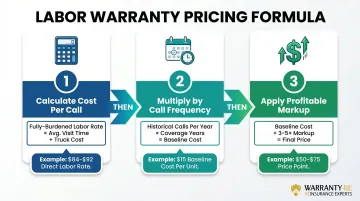
Price the warranty contract above your true cost baseline — and be disciplined about it:
- Estimate your average cost per covered service call — your fully-burdened labor rate multiplied by average visit time, plus truck cost
- Multiply by your historical or estimated call frequency per year
- Price the warranty contract above that baseline with meaningful markup
With median electrician wages at $29.98/hour and labor burden adding 40-55%, your fully-burdened cost runs $42-$46/hour. A two-hour callback costs $84-$92 in direct labor alone, before truck roll and overhead. If you estimate one callback per 20 jobs, and you're selling a 3-year warranty, your baseline cost is around $15 per job — meaning a $50-$75 price point delivers a 3-5x markup on expected cost.
Extended labor warranties on high-ticket electrical jobs — panel upgrades, EV charger installations, whole-home rewiring — carry particularly strong markup potential. The perceived risk to the customer is high, even though properly installed electrical work is statistically unlikely to fail after surviving its first year.
With sufficient volume, practitioners report warranty claims cost approximately 1-2% of job value per year. That math makes labor warranties structurally high-margin products when priced correctly.
Selling Labor Warranties Without Killing the Deal
Build It Into the Quote, Don't Tack It On
The single most important shift: warranty coverage should be a standard line item in your initial quote — not offered as an add-on after the price is presented.
Wrong approach: "Here's your quote for $8,500, and you can add a 5-year labor warranty for $400."
Right approach: "Here's your installation package for $8,900, which includes 5-year labor protection on all work performed."
When positioned as part of the package, the warranty increases trust and differentiates you from competitors who offer no post-install support. It doesn't scare customers away — it reassures them.
Frame It as Value, Not Cost
Once your pricing structure is set, the next step is how you talk about it. Focus on what the customer avoids: emergency labor bills, unexpected repair costs, and the hassle of tracking down a contractor years later. Lead with that, not the coverage cost.
Example language: "This warranty means if anything goes wrong with the installation in the next five years, you're covered. No surprise bills, no scrambling to find someone you trust — we handle it."
Offer Tiered Options to Guide Selection
Research on 200,000+ home services proposals shows contractors offering 4+ options achieve a 52% close rate vs. 42% for single-price quotes, with 60-70% of buyers selecting the middle tier. Structuring your tiers around warranty coverage is a direct way to capture that behavior:
- Good: 1-year standard warranty (entry-level protection, lowest price point)
- Better: 3-year enhanced warranty (where most customers land)
- Best: 5-year premium warranty (strongest margin, broadest coverage)

Customers feel in control of the decision. Most will self-select into the tier that works best for both of you.
Using Warranty Revenue to Build Long-Term Business Value
The Locked-In Customer Relationship
A customer who purchases a 5- or 10-year labor warranty is committed to your company for the duration. They know exactly who to call when something goes wrong, and that guaranteed future touchpoint creates opportunities for upsells, system upgrades, and referrals.
HVAC industry benchmarks estimate average customer lifetime value at approximately $15,340 over a 10-15 year relationship, with 55% of service revenue coming from recurring agreements. While electrical-contractor-specific CLV data isn't published, the structural economics are similar: repeat customers generate dramatically more revenue than one-time buyers.
The Lowest-Cost Lead Generation Tool
Warranty customers become your most effective referral source. Because they have an existing relationship and trust, their referrals convert at higher rates and carry near-zero acquisition cost. That combination — high conversion, no ad spend — makes warranty holders more valuable than any paid lead channel.
The Replacement Job Is Already Yours
When a covered system eventually reaches end of life, the contractor who has been servicing it under warranty has already earned the replacement job. Years of service visits build trust that no competitor can buy. The customer already knows your work and calls you first.
That relationship directly shifts your revenue mix. Top-performing electrical contractors derive 25-40% of revenue from service and maintenance work at 45-55% gross margins, roughly double the margin on commercial bid work. Warranty-driven repeat business is how contractors reach those numbers.
The compounding benefits of a mature warranty book include:
- Higher referral volume from loyal, satisfied customers
- Replacement jobs won without competitive bidding
- Steadier revenue tied to ongoing service agreements
- Margin expansion as service work displaces lower-margin installs
The Reinsurance Model: Stop Funding Someone Else's Profit
The Profit You're Giving Away
When you sell labor warranties through a third-party company, the unspent premium profit — the "underwriting profit" — goes to them, not you. You're running the marketing, doing the work, and managing the customer relationship. Someone else takes the financial upside.
Under traditional third-party programs, contractors receive only commissions or profit-sharing arrangements — a fraction of the actual underwriting profit being generated. The third party keeps the majority because they own the warranty program and assume the risk.
How the Reinsurance Model Works
The reinsurance model changes who owns the program — and who keeps the money. Instead of paying premiums to a third-party administrator, you establish your own administrator obligor reinsurance company, one backed by A-rated insurers. This structure:
- Holds the premiums you collect in your own reinsurance account
- Funds claims from that reserve when they arise
- Retains any underwriting profit within your company — not a third party's
- Allows you to invest those premiums conservatively and earn additional ROI on the reserves

The structure is tax-advantaged under IRS Code 831(b), which allows property and casualty insurance companies with less than $2.9 million in annual net premiums to be taxed only on investment income — not on underwriting profits.
How WarrantyRE Enables Contractor-Owned Warranty Programs
WarrantyRE handles the setup and ongoing management of your reinsurance program — company formation, compliance, tax filings, and claims adjudication. You capture the full underwriting profit your warranties generate, with none of the back-office overhead.
The company manages:
- Formation and licensing — company setup, state and federal regulatory compliance from day one
- Complete claims administration — from first call to final resolution, eliminating the need for in-house claims staff
- Tax filings and financial management — monthly financial statements, annual tax returns, and compliance reporting
- Ongoing optimization — continuous monitoring and adjustment to maximize profitability
You retain full ownership of your reinsurance company, control the warranty program, and keep all underwriting profits. That's a revenue stream most electrical contractors are currently handing to someone else.
Frequently Asked Questions
Frequently Asked Questions
How do contractors get paid for warranty work?
Under a WarrantyRE reinsurance-backed program, the contractor's reinsurance company funds claims from its own reserve pool. WarrantyRE handles all claims adjudication and administration, so contractors spend no time on claims paperwork — and retain 100% of unused premium reserves as profit.
What is an acceptable warranty rate?
"Warranty rate" refers to the markup or pricing on a labor warranty product. The key is pricing above your expected cost-per-claim with enough margin for profitability, not just break-even. Most contractors price warranties at 3–5% of job value for standard coverage, though rates vary by job type and duration.
Why do techs get paid less for warranty work?
Under most third-party warranty programs, labor reimbursement rates run below standard market rates. That's the core problem. When contractors own their program and set their own labor rates, technician compensation and contractor margins both improve.
What is the difference between a labor warranty and an extended service agreement?
A labor warranty covers only the labor cost for repairs on completed work. An extended service agreement (ESA) goes further, potentially including parts, preventive maintenance visits, or additional services. ESAs are broader in scope and typically command higher price points.
What types of electrical jobs benefit most from offering a labor warranty?
High-ticket, system-level installations — such as panel upgrades, EV charger installations, whole-home rewiring, and generator hookups — benefit most. The perceived risk is higher for the customer and the actual failure rate for quality work is low, creating strong margin potential.
Can an electrical contractor own their own warranty program?
Yes. Through an administrator obligor reinsurance structure, electrical contractors can establish their own warranty company — keeping premiums, controlling claims, and capturing 100% of underwriting profits instead of sending them to a third-party provider.