

Introduction
According to recent industry data, electrical contractors face callback rates averaging 6% of total jobs completed, while rework costs across the construction trades typically consume 4-10% of total project budgets. For electrical businesses already operating on thin margins, that translates to wasted technician hours, unnecessary truck rolls, and damaged customer relationships—before any legal exposure enters the picture.
Warranty liability extends far beyond honoring service calls. Every job you warrant creates compounding financial and legal exposure—impacting margins, pulling technicians off billable work, and in serious cases, escalating into litigation involving property damage or personal injury claims.
When warranty disputes become insurance claims, a $300 callback can become a multi-thousand-dollar legal exposure.
Warranty liability for electrical contractors is driven by decisions and processes, not by the nature of electrical work itself. This article covers how liability accumulates at each stage and three categories of proven strategies to reduce it—before the job begins, during execution and documentation, and through structural changes to how warranty risk is held and funded.
TL;DR
- Warranty liability accumulates through unclear terms, workmanship inconsistency, poor documentation, and outsourcing risk to third-party programs
- Most contractors face both express warranties (what you promise) and implied warranties (what state law assumes)—often without realizing it
- Pre-job strategies—clear written terms, scope definitions, and site documentation—prevent most warranty disputes before work begins
- Operational discipline during the job—quality checklists, technician standards, and photo documentation—creates defensible evidence and reduces callbacks
- Reinsurance models replace third-party warranty programs, converting warranty liability into a profit center backed by A-rated carriers
How Warranty Liability Builds Up for Electrical Businesses
Warranty liability rarely appears as a single line item on your financial statements. It accumulates gradually through:
- Service callbacks that pull technicians away from billable work
- Re-work labor that generates zero revenue while consuming real costs
- Parts replacements not covered by the original job price
- Administrative time spent managing disputes and documentation
Technician utilization rates already average only 66% across the electrical trades. Every unplanned callback makes that number worse.
Liability compounds when the scope of what was warranted was never clearly defined. Customers interpret verbal assurances broadly — "you said this would work perfectly for years" — while the contractor intended something narrower: warranting the installation against defects, not the equipment itself. When a system underperforms months later, that gap creates conflict a clear written agreement would have prevented.
Electrical work carries inherent safety implications that can turn a routine dispute into something far more serious. A warranty disagreement over a panel installation that later causes a fire or electrical injury stops being a service callback — it becomes a liability claim involving property damage or personal injury. At that point, your financial exposure multiplies well beyond the original service call, potentially involving legal fees, settlements, and insurance impacts that dwarf the cost of handling the callback properly from the start.
Key Drivers of Warranty Liability in Electrical Work
The Implied Warranty Gap
The single largest driver of warranty liability is the gap between implied warranty obligations and what is explicitly excluded in writing. Under common law in virtually every state, contractors are presumed to warrant that their work is fit for its intended purpose and performed in a workmanlike manner—regardless of whether they said so in writing. This implied warranty exists in every construction contract and generally cannot be disclaimed or waived through contract terms.
Several states have written these requirements into law with specific timelines for electrical work:
- Minnesota: 2 years specifically for electrical systems (longer than the 1-year general warranty)
- California: 2-5 years for electrical systems depending on defect type
- Most states: Statutes of limitations ranging from 2-6 years for contractor workmanship claims
If you're not explicitly defining what you're warranting in writing, state law is defining it for you—and that definition is almost always broader than what you intend.
Workmanship Inconsistency Across Technicians
Workmanship inconsistency is a major operational driver of warranty liability. When technicians follow different installation standards, quality levels vary across jobs, and some percentage will generate callbacks. The liability isn't random—it's directly correlated to the absence of enforced installation standards.
The highest-callback categories for electrical contractors follow a consistent pattern:
- Lighting controls: The #1 callback source, accounting for 30-40% of business volume—addressable systems and sensors trip up undertrained technicians fast
- Generators: Brand-specific operational quirks cause recurring issues when techs aren't trained to the equipment
- Grounding and bonding: Frequently misunderstood, often installed inconsistently
- Panel installations: Two-thirds of arc flashes result from worker error, making this one of the highest-liability job types
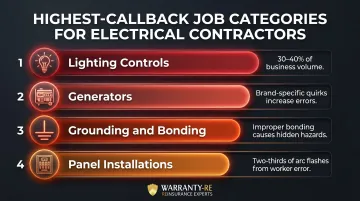
A disproportionate share of callbacks typically traces back to a small number of technicians or specific job types. Without tracking callbacks by technician and job category, those recurring failure points stay invisible—and keep costing you.
Over-Reliance on Third-Party Warranty Administrators
When electrical contractors bundle third-party service warranties into their offers, they surrender control over claims handling, cannot influence resolution speed or cost, and typically receive no share of the underwriting profit. Third-party warranty companies operate on a simple economic principle: they wouldn't do business with you if they weren't profiting from the arrangement.
Data from publicly traded warranty companies makes the economics concrete:
- Frontdoor (parent of American Home Shield) reported an 18% profit margin in Q3 2024, generating $223 million in net income over nine months
- Lowe's paid out approximately 33.5% of service contract premiums in claims—retaining roughly two-thirds
These are consumer-facing products, but the business model is identical: warranty administrators profit by keeping the spread between premiums collected and claims paid.
That spread is money electrical contractors are already collecting from customers—and handing to a third party. The liability stays with you. The profit doesn't.
Strategies to Reduce Warranty Liability for Your Electrical Business
Reducing warranty liability requires intentional action at three levels: the decisions made before work begins, the processes used during and after the job, and the structural arrangements that govern how warranty risk is held and funded. Each level compounds the one before it — and neglecting any one of them leaves exposure the others can't cover.
Strategies That Reduce Liability by Changing Pre-Job Decisions
A significant share of warranty disputes originate the moment a job is sold. Vague verbal commitments, assumptions about what's included, and failure to separate workmanship liability from equipment manufacturer liability all create exposure before a single wire is run.
Draft precise, written warranty terms for every job. Define the duration of the workmanship warranty, specify what types of failures are covered versus excluded (customer modifications, acts of nature, pre-existing conditions), and outline the resolution process.
California's contractor warranty framework offers a useful model. A well-structured warranty should include:
- Clearly articulated assurances for each aspect of the project
- Specific timeframes for corrections
- Legal outlines of contractor obligations
- Consequences for violating terms
- Responsibilities of both parties
Separate workmanship warranty from equipment warranty in all customer-facing materials. Equipment failures that are actually the manufacturer's obligation frequently land on the electrical contractor's desk. Major electrical component manufacturers provide varying warranty terms:
| Manufacturer | Product Type | Warranty Duration |
|---|---|---|
| Eaton | BR Loadcenters & Breakers | 10 years |
| Eaton | CH Electronic (AFCI/GFCI) | 10 years |
| Square D | QO Loadcenters & Breakers | Limited Lifetime |
| Leviton | Standard wiring devices | 1 year |
| Leviton | Load Centers (mechanical) | 10 years |
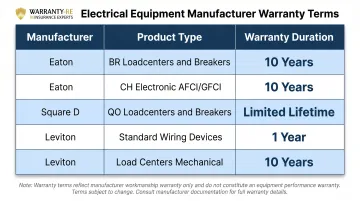
Clearly distinguishing workmanship warranty from equipment warranty in writing protects you from absorbing costs that belong to the equipment supplier.
Conduct and document pre-job site assessments. Before beginning electrical work, assess and photograph existing conditions—panel age, wiring condition, existing code violations. If a post-installation issue arises, documented proof that the problem pre-dated your work demonstrates it falls outside warranty scope.
Strategies That Reduce Liability by Improving Job Execution and Documentation
Once work is sold, liability reduction shifts to how consistently and verifiably the work is performed. The best warranty defense an electrical contractor has is a job done right and fully documented.
Implement standardized technician quality checklists for each job type. Electrical work that follows a consistent, documented inspection checklist—covering panel connections, circuit load, grounding, and code compliance—produces fewer callbacks and creates a paper trail demonstrating workmanlike execution if a warranty dispute arises. Field service management software platforms like ServiceTitan and Jobber make digital checklists standard practice, with forms that technicians complete before closing each job.
Research shows that companies with consistent QA/QC processes are 56% likely to keep rework costs under 5% of project budget and 25-28% more likely to achieve profit margins above 3%. That's a meaningful return on what amounts to a process change, not a capital expenditure.
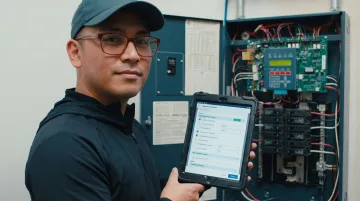
Maintain thorough job-level documentation as standard practice. Photos taken before, during, and after installation, combined with customer sign-off at job completion, serve as powerful evidence in any warranty dispute. This practice resolves the majority of ambiguous claims without requiring re-work or legal escalation. When a customer claims your panel installation caused damage to pre-existing wiring, timestamped photos of the original conditions end the dispute immediately.
Invest in technician training tied to installation standards and code compliance. Warranty callbacks are not evenly distributed. A disproportionate share often comes from a small number of technicians or job types. Regular skills reviews, updated code training, and performance tracking by callback rate identify and correct recurring failure points. Given that lighting accounts for 30-40% of electrical contractor business and represents the single largest callback source, targeted training on lighting controls and addressable systems delivers measurable liability reduction.
Strategies That Reduce Liability by Changing the Structure Around How Warranty Risk Is Held
Even well-run electrical businesses face warranty exposure because of how their warranty programs are structured. Strong execution reduces claim frequency — but it doesn't change who controls the money when claims do come in. When a third party holds the warranty obligation, the contractor loses control over cost, customer experience, and profit. Restructuring that relationship is the highest-leverage change available.
Replace third-party warranty programs with a self-funded reinsurance model. Rather than paying warranty premiums to a third-party provider who keeps the underwriting profit, electrical contractors can establish their own administrator obligor reinsurance company. WarrantyRE helps electrical contractors build exactly this structure: warranty fees are built into job pricing (the homeowner pays for it as part of the total cost), those fees flow into a contractor-owned reinsurance account, and unused funds remain with the contractor as profit.
In practice, on an $18,000 service upgrade (200-amp panel replacement, full meter base, new grounding system), you include a 2-year labor warranty—something already offered to stay competitive. That warranty fee goes into your reinsurance account, not to an outside company. When warranty calls come in, claims are covered from your account, and any money not used stays yours. Meanwhile, your reinsurance company is supported by A-rated insurers, providing ultimate liability protection if claims exceed reserves.
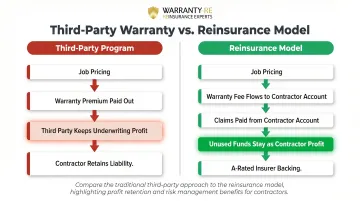
The contractor captures 100% of underwriting profits, controls the claims experience, and protects the business from large or unexpected warranty claims through A-rated insurer backing—all while WarrantyRE handles all claims administration, compliance, and regulatory management.
Build maintenance and service agreement programs that convert warranty cost into recurring revenue. Instead of treating the warranty period as pure liability, structure service agreements that customers pay for annually. This funds future service calls from premium revenue rather than from margin, and turns ongoing customer relationships into a revenue stream rather than a cost center. Combined with a reinsurance structure, this approach transforms warranty work from a business expense into a profit-generating service line.
Conclusion
Warranty liability for electrical businesses is shaped by the decisions contractors make long before a callback ever happens — in how they write their terms, execute their work, and structure their warranty programs.
The most effective approach works across all three levels. Pre-job agreements define scope and separate workmanship from equipment liability. Job documentation creates defensible evidence and reduces callbacks. And a structural warranty model keeps risk and reward inside the business, rather than handing both to a third-party provider. That last piece is where contractors often leave the most money on the table — programs like WarrantyRE's captive reinsurance structure are specifically designed to help electrical contractors own that profit instead.
By addressing warranty liability across every phase — before, during, and after the job — electrical contractors protect their margins, reduce legal exposure, and turn warranty from a financial liability into a revenue stream they control.
Frequently Asked Questions
What is a method to reduce electrical risk?
Electrical risk can be reduced through code-compliant installation practices, regular system assessments, and standardized technician quality checklists that catch issues before they become failures or warranty claims. Implementing consistent inspection protocols across all jobs creates both operational consistency and consistent documentation across jobs.
How long is an electrician liable for his work?
Liability duration depends on state law and written warranty terms. Most states impose statutes of limitations on contractor workmanship claims ranging from 2–6 years, though some states — like Minnesota — statutorily require 2-year warranties for electrical systems specifically. Written warranty terms and implied obligations can extend or complicate this timeline further.
What are the two implied warranties that a contractor may be responsible for?
Contractors are typically subject to the implied warranty of workmanlike performance (that work is completed to an acceptable professional standard) and the implied warranty of fitness for a particular purpose (that the work will accomplish the specific function the customer needed). Both apply even without a written contract and generally cannot be waived.
Do electrical items have a 2 year warranty?
Equipment warranty duration varies by manufacturer. Many electrical components carry 1-year manufacturer warranties, though major brands like Eaton and Square D offer 10-year or lifetime warranties on panels and breakers. The 2-year standard is more common in EU consumer electronics regulations than in U.S. electrical components specifically.
What invalidates a warranty?
Common invalidators include customer modifications, failure to perform required maintenance, misuse or overloading, third-party damage, and installation by an unlicensed party. Each of these should be explicitly listed in your written warranty exclusions to prevent disputes.
Is warranty payable a liability?
Yes — warranty obligations represent a liability on a contractor's balance sheet. Under U.S. GAAP, the estimated future cost of honoring outstanding warranties must be recognized as a liability. Reinsurance programs help manage this exposure by converting it into a controlled, predictable cost rather than an open-ended financial risk.