
Introduction
Callbacks are expensive. According to financial analysis of 200+ home services acquisitions, a callback rate above 3% is a red flag indicating excessive rework costs in plumbing operations. Each callback consumes technician hours that could generate billable revenue and damages customer trust in the process.
The reviews compound that damage fast. With 82% of consumers reading online reviews and 57% refusing to use businesses with fewer than 4 stars, a single callback can cost far more than the truck roll itself.
The average truck roll costs approximately $1,000 or more, with labor accounting for 90% of that expense. But the real damage accumulates in hidden costs: 60% of consumers stop doing business with companies after unfriendly service, and businesses focusing on retention are 60% more profitable than those that don't. Callbacks and warranty claims are largely preventable. The sections below break down the operational, managerial, and structural moves plumbing contractors can make to reduce them systematically.
TLDR:
- Callbacks cost more than the truck roll: lost billable hours, customer attrition, and compounding warranty liability
- Most trace to predictable causes: incomplete diagnosis, poor communication, skipped checklists, and inadequate documentation
- Reduction requires action at three levels: pre-job decisions, field execution quality, and how warranty risk is structured
- Tracking callback patterns systematically catches recurring failures early and turns field data into preventive training
How Callback and Warranty Claim Costs Build Up for Plumbing Contractors
Callback costs don't appear as a single line item on your P&L. They accumulate across labor, dispatch time, parts, missed billable jobs, and the downstream cost of customer loss—making the true expense easy to underestimate until it becomes severe.
Cost build-up is partly episodic: a bad install series, a faulty parts batch, or a new tech onboarding period can spike callback rates temporarily. It's also gradual, as small workmanship gaps and communication failures compound across hundreds of jobs over months.
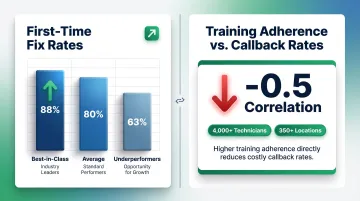
Those numbers add up fast. A first-time fix rate of 80% means 20 out of every 100 jobs generate a follow-up call. Best-in-class field service organizations achieve 88% first-time fix rates; underperformers fall to 63%.
Visible vs. Hidden Costs
Visible costs are straightforward:
- Repeat labor and unpaid technician hours
- Additional parts and materials
- Fuel and vehicle wear for return trips
- Dispatch and coordination time
Hidden costs often exceed visible ones:
- Reputation damage: nearly 90% of consumers share negative experiences with others, and 78% trust online reviews as much as personal recommendations
- Lower repeat and referral rates: plumbing businesses average just 28% customer retention within 12 months—the lowest among 10 home service trades
- Increased warranty reserve requirements: each unresolved claim raises future risk exposure
- Lost lifetime value: losing a single customer can mean losing $10,000 to $100,000 in future revenue and referrals
These hidden costs compound quietly — and they're what separates profitable plumbing businesses from ones that constantly chase their tail. Customers will spend 17% more with companies offering high-quality service, but only when they experience that quality on the first visit.
What Drives Plumbing Callbacks and Warranty Claims
Callbacks aren't random—they cluster around a small set of predictable failure modes. Understanding these root causes is the first step to fixing them.
Most Common Callback Drivers
Survey respondents ranked these as the top drivers of wasted truck roll time:
- Lack of accurate diagnosis prior to dispatch (ranked #1)
- Having to return for correct tools or parts
- Issues not getting fixed first time, requiring callbacks
Most callbacks trace to incomplete initial diagnosis: fixing the obvious complaint while missing the related failure. A technician repairs a leaking supply line but doesn't check the shut-off valve that caused the problem. A water heater replacement goes smoothly, but the pressure relief valve wasn't tested. These aren't workmanship failures in the traditional sense; they're incomplete system evaluations.
Communication gaps amplify the problem. Broken handoffs from customer intake through dispatch create mismatched expectations — the CSR captures "slow drain" but doesn't note it's a recurring issue.
Dispatch sends a junior tech expecting a simple clog, but the real problem is a venting failure three floors up. The technician arrives unprepared, completes a partial fix, and the callback is inevitable.
Warranty Claim-Specific Drivers
Warranty claims stem from overlapping but distinct factors:
- Unclear scope in original warranty terms: Ambiguous language about what's covered leads to disputes when claims arise
- Poor documentation of what was and wasn't covered: Without clear records, customers assume everything is warranted
- Failure to track which job types or technicians generate disproportionate claims: Without data, recurring failure modes go undetected
Predictive parts inventory management can reduce parts-related callbacks by up to 60%, yet many contractors still rely on ad-hoc parts runs. Organizations with structured technician training achieve first-time fix rates 15-20% higher than those relying solely on on-the-job learning.
Training data from over 4,000 technicians across 350+ locations showed a negative correlation of -0.5 between training adherence and callback rates: technicians who completed structured training had measurably fewer callbacks.
Cost Drivers Vary by Business Stage
Early-stage contractors lose more to workmanship callbacks: newer techs, inconsistent processes, and lack of standardized procedures. Larger operations accumulate risk through warranty program structure: unclear terms, third-party provider limitations, and lack of visibility into claims patterns. The fix in each case looks different: smaller contractors need checklists and training; larger ones need data systems and warranty program control.
Cost-Reduction Strategies for Plumbing Callbacks and Warranty Claims
Effective callback and warranty cost reduction requires action across three distinct leverage points: decisions made before work begins, practices executed during the job, and the structural environment in which warranty risk is held.
Strategies That Reduce Costs by Changing Decisions
Pre-job decisions—scope capture, communication handoffs, and materials specification—set the probability of a callback before a technician arrives on site.
Improve Intake Accuracy with Standardized Handoffs
Broken communication at intake is a documented leading cause of callbacks. Survey data shows that between 5% and up to 75% of emergency truck rolls could be avoided with pre-dispatch issue diagnosis, with 54.2% of respondents putting the figure at 15% or higher.
A strong intake-to-dispatch-to-tech handoff process includes:
- CSR captures complete symptom description: Not just "leak under sink," but "leak under sink, started two days ago, customer reports recent faucet replacement"
- Dispatch reviews and flags complexity: If the job involves recent work, prior service history, or unusual symptoms, flag it for senior techs
- Technician receives full context before arrival: Send photos, previous service records, and customer notes via mobile app or dispatch system
When handoffs are standardized, technicians arrive prepared with the right tools, parts, and diagnostic mindset.
Implement Pre-Job Inspection Checklists
A significant share of callbacks occur because a secondary issue was present at the first visit and missed. The technician fixes the immediate complaint—a clogged aerator—but doesn't inspect the supply lines showing early corrosion. Two weeks later, the line fails, and the customer calls back.
Pre-job inspection checklists force technicians to evaluate the full system rather than the stated complaint only. Formal checklists, like those maintained by the New York City Department of Buildings, structure inspections in three phases:
- Pre-permit checklist: Verify system conditions before work begins
- Ongoing project work checklist: Document each stage of installation or repair
- Project completion close-out checklist: Confirm system function and customer walkthrough
For service calls, a simplified version works: inspect upstream and downstream components, test water pressure, check for corrosion or wear indicators, and verify fixture operation before leaving.
Specify Materials Quality Standards and Avoid On-Site Substitutions
Survey data ranked "having to return for correct tools/spares" as the #2 driver of wasted truck roll time. Parts-related return visits aren't just about forgetting to bring the right fitting—they're also driven by using off-spec or substitute parts that fail prematurely.
Establish clear materials quality standards for every job type:
- Approved manufacturers and product lines
- Minimum grade specifications (e.g., no plastic shut-off valves on high-pressure lines)
- Prohibited substitutions without approval
When techs know the standard and have the right parts stocked, callbacks from premature part failure drop significantly.
Define Warranty Scope Clearly and in Writing Before Work Begins
Ambiguous scope is a primary driver of warranty claim disputes. Customers assume everything is covered; contractors assume only specific components are warranted. The gap creates friction, negative reviews, and unplanned costs.
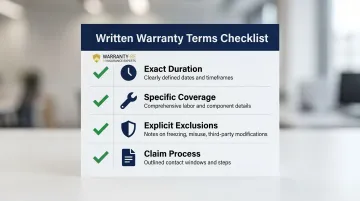
Clear written warranty terms at the point of sale include:
- Exact duration: "One-year labor warranty from date of completion" (not "limited warranty")
- Specific coverage: "Covers labor to repair or replace the installed water heater and associated connections" (not "covers all plumbing")
- Explicit exclusions: "Does not cover damage caused by freezing, misuse, or modifications by others"
- Claim process: "Contact [company name] within 30 days of discovering an issue"
Document these terms on the invoice, estimate, and completion paperwork. Both parties sign. When a claim arises, there's no ambiguity.
Strategies That Reduce Costs by Changing How Work Is Managed
Field execution practices reduce callback risk during and immediately after the job, independent of what was decided beforehand.
Require a Mandatory Job-Completion Checklist
A job-completion checklist reviewed before the technician leaves the site consistently catches problems that would otherwise become callbacks. For plumbing work, the checklist should include:
- Pressure checks: Verify system pressure matches specifications
- Fixture function verification: Run water, flush toilets, test drains, check for leaks
- Leak point inspection: Visual inspection of all connections, joints, and fittings under load
- Customer walkthrough: Show the customer what was done, explain how to operate new fixtures, and answer questions
Albuquerque Plumbing, Heating & Cooling reduced customer concerns by 35% after implementing systematic recall tracking and completion protocols. The checklist forces techs to catch issues before they leave, not after the customer calls back.
Document Every Job Completely
Incomplete documentation both causes callbacks (missing information on re-dispatches) and creates warranty claim disputes. Full job documentation includes:
- What was found: Original diagnosis and system condition
- What was repaired: Specific work performed, materials used
- What the customer declined: Recommended work not authorized
- Model and serial numbers: For installed equipment and major components
- Photos of key points: Before, during, and after shots of critical areas
Field service management platforms let techs upload photos directly from their phones, with notes syncing to the job record automatically. When a callback or claim comes in, the full history is already there — no reconstruction, no disputes.
Train Technicians in Structured Customer Exit Communication
Customers who don't understand the outcome of a visit are disproportionately likely to call back. They expect instant results from a repair, don't know what's normal, or misunderstand warranty coverage.
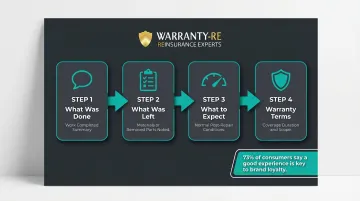
Structured exit communication covers:
- What was done: "I replaced the pressure regulator and tested the system"
- What was left: "The old regulator is in the bag on your porch"
- What to expect from the repair: "You may notice slightly lower pressure for the first day as air clears"
- Any warranty terms that apply: "This repair is covered under our one-year labor warranty"
A 60-second conversation prevents a callback. 73% of consumers say a good experience is the key factor influencing brand loyalty—customer exit communication is where that experience is cemented.
Establish a Gut-Check Culture
Technicians should feel empowered to delay departure if diagnosis feels incomplete rather than leave and hope for the best. This behavioral norm reduces both immediate callbacks and downstream warranty claims.
"Gut-check culture" means:
- Techs can call dispatch or a senior tech for a second opinion without penalty
- Time spent on thorough diagnosis is valued, not penalized
- Leaving a job with unresolved questions is unacceptable
When techs know they won't be blamed for taking extra time to get it right, they stop rushing and start catching problems on the first visit.
Strategies That Reduce Costs by Changing the Context Around the Work
The business environment, systems, and structures determine how quickly callback and warranty claim patterns are detected and corrected.
Build a Callback Tracking Log by Technician, Job Type, and Root Cause
Without data, patterns that could be solved in a training session remain invisible for months. A callback tracking log captures:
- Technician name: Who performed the original job and the callback
- Job type: Water heater install, drain clearing, repiping, fixture repair
- Root cause: Incomplete diagnosis, parts failure, communication gap, workmanship issue
- Resolution: What fixed the problem on the second visit
Track this in a spreadsheet or field service management software. Review it weekly or monthly in team meetings. Patterns emerge quickly: one tech generates callbacks on drain work but not installs. A specific parts supplier has a high failure rate. Communication breakdowns spike on jobs booked after 4 PM.
That visibility is what makes the next step possible — turning raw callback data into targeted training.
Convert Callback Data into Training Material
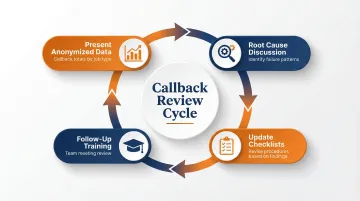
A recurring callback review process uses field failures to prevent recurrence rather than assign blame. A practical format looks like this:
Weekly or Monthly Callback Review:
- Present anonymized callback data: "We had three callbacks on water heater installs this month"
- Root cause discussion: "Two were pressure relief valve tests skipped, one was a venting issue missed"
- Resolution documentation: "We updated the water heater install checklist to include PRV test and vent inspection"
- Follow-up training: "Next team meeting, we'll review proper PRV testing procedure"
This approach transforms mistakes into learning opportunities and prevents the same error from repeating across the team.
Restructure How Warranty Risk is Carried at the Business Level
Contractors who rely entirely on third-party warranty providers have no visibility into or control over claims decisions. They pay premiums that fund someone else's underwriting profit — and every dollar leaves the business permanently, even when claims never materialize.
An alternative is an **administrator-obligor reinsurance structure**, which WarrantyRE helps plumbing contractors build. Here's how it works:
- You collect warranty fees directly from customers by building them into every job estimate
- Premiums flow into your own reinsurance account, which you legally own
- WarrantyRE handles all claims administration from first contact through resolution, eliminating paperwork and adjuster coordination
- Unused warranty reserves remain with you, not a third-party provider
- An A-rated insurer backs the structure, covering claims that exceed your reserves
This structure gives contractors direct control over claims adjudication and aligns warranty terms with actual workmanship capability. Instead of paying ongoing premiums to third parties, you build a customer-funded warranty reserve pool.
For plumbing contractors running serious volume, the cost differential can be substantial. Rather than surrendering 100% of warranty premiums to external providers, you retain underwriting profits and earn investment income on accumulated reserves. The structure also provides significant tax advantages under IRS Code 831(b), reducing tax liability on every job closed.
Conclusion
Reducing plumbing callback and warranty claim costs depends on correctly identifying where the cost originates—whether in pre-job decisions, field execution, or business structure—rather than applying generic fixes across the board.
Each layer of your operation plays a distinct role:
- Pre-job decisions set the probability of success before the tech arrives — standardized intake, inspection checklists, materials standards, and clear warranty terms eliminate the most common failure modes
- Field execution — completion checklists, documentation, structured customer communication, and a gut-check culture — catches issues before they become callbacks
- Business structure determines whether warranty costs accumulate as expenses or convert into a profit center
Contractors who build systems for tracking, reviewing, and acting on callback data create a compounding advantage over those who treat each repeat call as an isolated incident. Patterns in your data point directly to fixable problems. Fix those problems systematically, and the result is fewer callbacks, better margins, and customers who stay loyal because the work was done right the first time.
Frequently Asked Questions
What are the best practices for callbacks?
The highest-impact practices are:
- Standardize intake with clear CSR-to-dispatch-to-tech handoffs
- Inspect the full system at the first visit, not just the stated complaint
- Complete a job-close checklist before leaving, and document all work performed
- Walk the customer through warranty terms before you go
What are common plumbing mistakes that can be avoided?
The three most common avoidable errors are fixing only the visible complaint without inspecting related components, skipping pressure and function verification at job close, and failing to document work scope and materials. Each one creates callbacks and warranty disputes that cost more to resolve than they did to prevent.
How can plumbing contractors reduce warranty costs?
Tackle it from two angles. On the workmanship side, reduce claims through checklists, technician training, and thorough documentation. On the financial side, evaluate whether a self-owned warranty program with reinsurance backing gives you better cost control than third-party premiums that never return to your business.
What is a plumber's call out fee?
A call out fee is the base charge for dispatching a plumber to a location before any labor or parts costs are applied. Callbacks under warranty typically eliminate this fee recovery, making callback prevention directly linked to protecting call out fee revenue on every job.
What is the 135 rule in plumbing?
The 135-degree rule refers to the maximum total horizontal change of direction in a drainage line before an additional cleanout is required. Using long-sweep elbows rather than sharp 90-degree turns promotes smoother drainage and cuts callbacks from drain flow problems.