
What administrators charge varies widely based on trade type, volume, coverage terms, and service tier. Most contractors accept the first fee structure they're quoted without benchmarking it against alternatives or understanding how multiple fee types stack together.
This article breaks down how warranty administrators typically charge contractors, the different fee structures in play, what drives costs up or down, and what contractors often miss when evaluating total cost.
TL;DR
- Warranty administrators charge contractors through multiple fee types that compound quickly at volume
- Fees vary significantly based on trade, claim complexity, contract volume, and the administrator's service tier
- Higher fees don't guarantee better service — low-fee arrangements often come with gaps in claims support and compliance
- Understanding the full fee structure helps contractors negotiate better terms or evaluate whether owning their own warranty company makes more financial sense
What Do Warranty Administrators Charge Contractors?
Most contractors focus on the per-contract fee — then get surprised when per-claim fees, annual minimums, and compliance charges stack on top. The real cost of a warranty administrator relationship only becomes clear after a few months of operation, once all fee types are running in parallel.
What any given administrator charges depends on their pricing model, trade category, and what's actually included in the agreement.
According to Warranty Week's analysis of service contract economics, service contract providers typically suggest a 50% margin for the selling entity, meaning less than 50% of the total contract price relates to actual equipment failure risk. The remainder covers administration, commissions, and profit.
Fee Structure by Tier
Fee structures are privately negotiated — no published standard exists. Programs differ primarily on labor reimbursement rates, claims turnaround, coverage scope, and how much operational work stays with you versus transfers to the administrator.
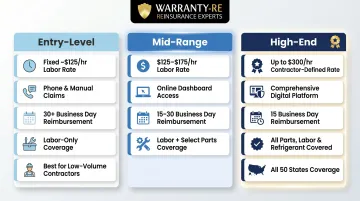
The table below summarizes how the three common tiers compare at a glance:
| Entry-Level | Mid-Range | High-End | |
|---|---|---|---|
| Labor Rate | ~$125/hr fixed | $125–$175/hr | Up to $300/hr (contractor-defined) |
| Claim Filing | Phone/manual | Online dashboard | Comprehensive online platform |
| Reimbursement Timeline | 30+ business days | 15–30 business days | 15 business days |
| Coverage Scope | Labor only | Labor + select parts | Parts, labor, and refrigerant — all brands, all 50 states |
| Best For | Low-volume contractors | Growing contractors | High-volume, turnkey programs |
Entry-Level Programs
Basic arrangements keep fees lower, but the contractor absorbs more of the service burden. Claims are filed by phone or manually, reimbursements take 30 or more business days, and customer-facing support is minimal. These programs work best for contractors with low warranty volume who handle most customer issues themselves and want minimal administrative overhead.
Mid-Range Programs
Mid-tier administrators take on claims adjudication and customer support, with an online platform replacing manual filing. Reimbursements arrive in 15–30 business days, and labor rates typically fall between $125–$175/hour depending on the program. Coverage expands to include select parts across multiple trades. Growing contractors who sell warranties consistently — but don't need a fully managed back office — tend to fit this tier best.
High-End / Full-Service Programs
Premium programs shift nearly all operational weight off the contractor. This includes full claims management, compliance filings, tax returns, staff training, bookkeeping, and detailed financial reporting — all backed by A-rated insurers. Contractors can set their own reimbursement rates up to $300/hour (JB Warranties), with 15 business day reimbursement and coverage across all brands and all 50 states. High-volume contractors who want to focus on selling and servicing — not managing warranty back-office operations — get the most value from this tier.
What's Typically Excluded Across All Tiers:
Most administrators exclude branded marketing materials, customized contract language, and proactive claims trend reporting unless specifically negotiated. Before signing any agreement, ask for a written breakdown of what is and isn't included — what looks like a full-service program at the quote stage often carries add-on costs once claims start flowing.
Key Factors That Affect Warranty Administration Fees
Pricing depends on a combination of operational, contractual, and trade-specific variables—understanding each one helps contractors evaluate whether the fee they're paying is fair.
Trade Type and Claim Complexity
Not all trades carry the same claims risk, and administrators price accordingly. Key differentiators include:
- HVAC: Higher-value components, refrigerant costs, and complex failure modes drive up claims costs
- Roofing: Warranty terms stretch up to 50 years for some products, with ongoing weather-related exposure risk
- Plumbing and electrical: Generally lower claims complexity, which typically means lower administration fees
Only **38% of warranty-offering contractors cover commercial unitary HVAC systems**, compared to 98% covering residential unitary and 84% covering ductless systems (ACHR News). Commercial systems carry meaningfully higher risk exposure—and administrators price for it.
Contract Volume and Frequency
Most administrators offer volume-based pricing—contractors selling higher volumes of warranties per month can negotiate lower per-contract fees or better percentage splits. The Service Roundtable/Equiguard program incorporated a "rebate based on usage" where rebates for contractors purchasing a moderate amount of warranties could exceed association membership costs (ACHR News).
Coverage Term Length and Scope
Longer coverage periods and broader coverage scope increase an administrator's risk exposure and are priced accordingly. The most common warranty length among HVAC contractors is 10 years (ACHR News). Coverage scope compounds this effect. Programs covering only labor carry lower risk exposure than those covering parts, labor, and refrigerant—and broader scope increases the actuarial reserve requirement, which flows directly into the fee you pay.
Geographic Coverage and Compliance Requirements
Approximately 37 states have enacted specific laws governing service contracts (SCIC). The NAIC's Service Contracts Model Act has been reflected in 42 states and jurisdictions (NAIC).
Under this framework, all administrators must:
- File registration with the state insurance commissioner
- Maintain either a Contractual Liability Insurance Policy (CLIP) or tangible net worth of at least $100 million
- Pay annual registration fees (e.g., $200 in Maine)
That compliance infrastructure costs money to maintain across dozens of states. It gets embedded in the administration fee—but rarely broken out as a line item on the quote you receive.
Breaking Down Warranty Administrator Fee Structures
The total cost a contractor pays to a warranty administrator is rarely one number. It's the sum of several fee types that look small individually but compound significantly across an active warranty book.
The Economics Behind the Premium
Warranty premiums are structured to fund far more than claims. An insurer/administrator with a typical 25% expense ratio must maintain a 65% loss ratio to hit a 10% profit target on a combined basis (Warranty Week).
| Cost Component | Approximate Share of Contract Price |
|---|---|
| Actual risk of failure (claims) | Less than 50% |
| Administrator expense ratio | Approximately 25% |
| Distributor/retailer margin | Up to 50% (suggested) |
| Administrator/insurer profit target | 10-20% |
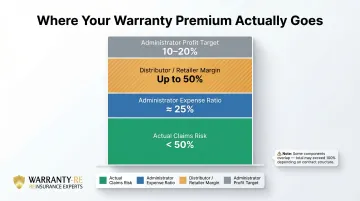
These components overlap — but contractors paying for warranty administration are funding multiple cost layers beyond claims reserves.
Specific Fee Types
Most programs layer several fee types. Here's what to expect across the most common structures:
Per-Contract Administration Fee: The most visible charge — applied each time a contractor registers a customer warranty. Specific dollar ranges are not publicly disclosed and are negotiated privately. This fee is separate from the cost of the warranty itself.
Percentage of Premium or Retail Price: Some administrators charge a percentage of the warranty's retail or premium price instead of a flat fee. The contractor's cost scales with what they sell, which benefits administrators most on higher-ticket contracts.
Per-Claim Handling Fee: Many administrators charge a separate fee each time a claim is submitted and processed, regardless of whether it's approved. High-claim trades like HVAC can see this cost accumulate quickly.
Transfer Fees: CoolCare/Trinity charges a $30 fee to transfer coverage to a new homeowner (CoolCare Protection), and the transfer must occur within 90 days of home sale.
Monthly Minimum or Platform Access Fee: Some administrators require a monthly minimum payment regardless of warranty volume — effectively a platform or access fee that runs even in slow months.
Setup and Onboarding Fees: An initial fee to configure the contractor's program, integrate systems, or train staff. Often negotiable or waived for contractors committing to volume.
Cancellation Fees: Maine caps administrative cancellation fees at 10% of the provider fee (Maine Bureau of Insurance). Other states impose different caps or none at all.
What Most Contractors Get Wrong About Warranty Administration Costs
The most common mistake is evaluating administrators based only on the per-contract fee. Per-claim fees, monthly minimums, and compliance surcharges stack on top — and what looks cheap on paper often isn't in practice.
The Hidden Cost of Poor Claims Service
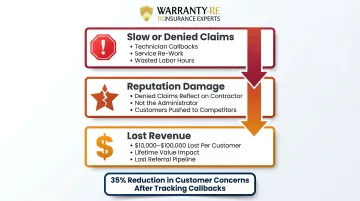
A low-fee administrator that approves claims slowly or denies them frequently creates downstream costs that never appear in a fee comparison:
- Customer callbacks and service re-work absorb technician time
- Denied claims damage the contractor's reputation, not the administrator's
- Unresolved warranty issues push customers toward competitors
A single lost customer due to poor warranty handling can represent $10,000 to $100,000 in lost lifetime revenue and referrals (ServiceTitan). Albuquerque Plumbing, Heating & Cooling reduced customer concerns by 35% after systematically tracking recalls and callbacks.
The Bigger Strategic Miss
Contractors who focus on minimizing what they pay an administrator are solving the wrong problem. The premiums and underwriting profits flowing through a third-party administrator represent income that contractors could be capturing for themselves — through a reinsurance structure that turns warranty costs into a profit center rather than an expense.