Introduction
Every plumbing contractor knows the sinking feeling: a customer calls back three weeks after a $4,500 water heater install because a fitting is leaking. You pull a licensed plumber off a paying job, burn two hours of billable time plus fuel and parts, and absorb every dollar of that loss yourself.
Warranty callbacks like this erode margins job by job. Yet most plumbing businesses keep handing that risk, and the revenue opportunity that comes with it, to third-party warranty providers without questioning the math.
According to the extended warranty market research, the global extended warranty market is expected to reach $159.38 billion in 2025, growing at 8.60% annually through 2030. While that market includes everything from consumer electronics to automobiles, a growing segment serves home service contractors who've recognized that warranty programs aren't just risk management—they're profit centers.
That growth matters for plumbing contractors because it signals how much premium revenue is flowing out of trade businesses into third-party pockets every year. This guide clarifies what "warranty companies for plumbing businesses" means: we're covering warranty program administrators and reinsurance models designed specifically for contractors, not consumer-facing home warranty brands. You'll learn the difference between reselling someone else's service contract versus owning your warranty entity entirely, and how to evaluate which model fits your business size, install volume, and profit goals.
TLDR
- Warranty programs for plumbing contractors go beyond coverage certificates — they're tools for managing risk and building recurring revenue
- Two primary models exist: third-party administrators where you resell existing programs, and reinsurance structures where you own the warranty entity and capture 100% of underwriting profits
- Strong warranty partners handle claims management, compliance, and program structure — not just paperwork
- Evaluation criteria include profit structure, claims control, administrative support, and multi-state compliance handling
- WarrantyRE's reinsurance model lets plumbing contractors capture warranty profits inside their own tax-advantaged company
Overview of Warranty Programs for the Plumbing Industry
When plumbing contractors talk about "warranty companies," they're usually referring to one of two very different business models. Understanding the difference matters because it determines who keeps the profits.
These aren't companies that sell home warranty plans to homeowners. They're program administrators, reinsurance partners, or software platforms that help plumbing contractors structure, sell, and manage service agreements and labor warranties on completed work.
The Two Core Models
Model 1: Third-Party Service Contract Administrators
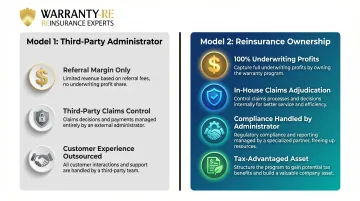
The contractor resells or participates in a warranty program run by an outside company. In this model:
- Claims processing, compliance, and customer service are handled by the administrator
- The contractor earns a referral margin or revenue share — not underwriting profits
- Claims decisions and the customer experience remain under third-party control
Model 2: Administrator-Obligor or Reinsurance Models
The contractor establishes and owns their own warranty entity — typically structured as an administrator-obligor reinsurance company backed by A-rated insurers. This structure shifts the economics significantly:
- The contractor captures 100% of underwriting profits (premiums collected minus claims paid)
- Claims adjudication stays in-house, giving the contractor full control over the customer experience
- A reinsurance administrator manages compliance, filings, and regulatory requirements
- The structure builds a tax-advantaged asset over time
Market Context and Growth
The home warranty service market was valued at $9.12 billion in 2024, projected to reach $12.5 billion by 2029 and $17.23 billion by 2034. This growth reflects rising demand for service agreements across home services — including plumbing, HVAC, and electrical work.
For contractors, service agreements have become a proven revenue driver. One HVAC contractor with 1,600 maintenance agreements reported an 83% annual renewal rate — showing that well-managed warranty programs generate predictable, recurring revenue that make the business more valuable and easier to scale.
Best Warranty Companies for Plumbing Businesses
These companies were selected based on their ability to serve plumbing contractors—not homeowners—with structured programs, compliance infrastructure, and measurable business impact.
WarrantyRE
Founded in 1994 and operating nationwide, WarrantyRE helps plumbing contractors establish and manage their own administrator-obligor reinsurance companies. Instead of reselling a third-party warranty program, contractors own the warranty entity entirely, redirecting underwriting profits back into their business.
WarrantyRE is the only warranty partner that helps plumbing businesses own their warranty entity outright—backed by A-rated insurers—rather than resell someone else's program.
Key advantages include:
- Capturing 100% of premium profits instead of paying a third-party administrator
- Tax planning benefits through IRS Code 831(b) structure
- Full claims control while WarrantyRE handles claims processing and approval
- Comprehensive administrative support: training, compliance, state filings, bookkeeping, and performance reporting
- No hidden fees; transparent pricing structure
| Program Model | Administrator-obligor reinsurance — contractor owns their warranty company, supported by A-rated insurers | | Best For | Established plumbing contractors ready to scale recurring revenue and eliminate third-party warranty costs | | Key Support Services | Full-service administration: claims processing, compliance, tax returns, staff training, performance reporting |
JB Warranties
JB Warranties operates as a third-party administrator (TPA) of extended service contracts through a dealer/contractor model. Plans are fully insured by an A+-rated insurance underwriter, with the obligor being Dealers Alliance Corporation (Columbus, OH) in most states.
JB Warranties explicitly covers both HVAC and plumbing systems across four plan tiers: Parts Only, Labor Only, Labor Plus, and Parts & Labor Plus. Labor reimbursement runs up to $300 per hour and is issued within 15 business days. Contractors can build their own margin at the point of sale or bundle warranties with maintenance agreements.
Key features:
- Available in all 50 states with state-specific obligor entities for compliance
- All brands covered with no deductibles
- Free warranty transfer to new homeowners
- Online dealer portal for purchasing agreements, filing claims, and ordering branded marketing materials
- "No Lemon Guarantee" (replacement after fourth repair for the same problem)
| Program Model | Third-party administrator; contractor sells the plan, JB Warranties processes claims and handles compliance | | Coverage Scope | Water heaters, boilers, internal plumbing components (pipe systems, fixtures, valves); excludes calcium buildup, clogged drains, and pre-existing conditions | | Best For | Plumbing contractors seeking turnkey extended warranty plans with fast reimbursement and low administrative burden |
ServiceTitan (Service Agreement Software)
ServiceTitan is a cloud-based service agreement and membership management software platform for plumbing, HVAC, electrical, and other field service contractors. Founded in 2012, ServiceTitan doesn't function as a warranty administrator—it's a platform that enables contractors to build, sell, and manage their own service agreements.
The platform covers the full service agreement lifecycle—from proposal generation through automated renewals. Contractors can create tiered "Good-Better-Best" proposals, track equipment-based contracts, and generate Membership Summary reports to monitor active memberships over time.
Key features:
- Equipment-based contract tracking tied to customer properties
- Automated renewal reminders and scheduling
- Integrated financing options for customers
- Covers plumbing, septic, water treatment, HVAC, electrical, and related systems
- Contractors using ServiceTitan report +16% increase in annual revenue on average
| Program Model | SaaS platform enabling contractors to create and manage their own service agreements (not a TPA) | | Key Features | Tiered proposal creation, automated renewals, equipment tracking, membership reporting, integrated customer financing | | Best For | Plumbing contractors who want to self-administer service agreements and need software to manage the entire lifecycle |
Centricity
Centricity is a B2B2C warranty administrator formed in 2017 by combining Bankers Warranty Group and Bonded Builders Warranty Group. It operates as a wholly owned affiliate of Bankers Financial Corp, which brings 45+ years of warranty industry experience.
Centricity services more than 3 million service plans through a network of over 25,000 service providers across all 50 U.S. states, Puerto Rico, and Canada. Its focus is primarily on builders, retailers, and manufacturers—not individual plumbing contractors.
Key features:
- Insurance-backed structural warranties and extended service contract administration
- White-label approach acts as "extension of the client's brand"
- Offering product protection increases purchase conversion by an average of 11%, according to Centricity research
- Strong builder warranty focus (successor to Bonded Builders Warranty Group)
| Program Model | B2B2C warranty administrator; partners with builders, retailers, and manufacturers to offer extended service contracts | | Compliance and Licensing | Operates in all 50 U.S. states, Puerto Rico, and Canada with insurance-backed plans | | Best For | Builders and large-scale retailers; plumbing contractors may interact with Centricity as service network providers rather than direct warranty sales partners |
What Plumbing Businesses Should Look for in a Warranty Partner
The right warranty partner shapes your customer experience, determines how much profit you keep, and decides how much regulatory burden lands on your desk. These three factors matter far more than a coverage checklist.
Coverage and Claims Control
Plumbing-specific coverage matters, but so does who controls how claims are adjudicated. Your warranty partner should cover core components including interior water supply lines, drain and waste lines, water heaters, toilets, valves, and faucets.
In third-party administrator models, the TPA decides whether a claim is valid and how quickly it gets paid. In reinsurance models, you own the entity making those decisions—giving you control over customer experience and claims outcomes while the administrator handles the paperwork.
Profit Model and Transparency
That claims control connects directly to profit. Many plumbing contractors underestimate how much revenue they're leaving behind with standard third-party programs — and the difference between a referral margin and full underwriting profit is substantial.
| Model | What You Earn | Who Keeps Underwriting Profits |
|---|---|---|
| Third-party reseller | 20–40% commission on premium | The warranty company |
| Reinsurance ownership | 100% of underwriting profits | You |
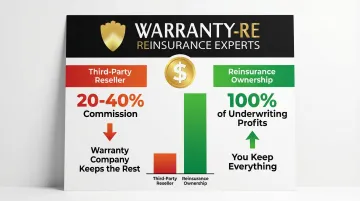
In a reinsurance structure, warranty fees are built into job pricing, claims are paid from your own account, and unused funds remain with you in a tax-advantaged structure.
According to NAIC research, distributor markups on service contracts are often as high as 100%—illustrating the margin opportunity contractors leave behind when they don't own the program.
Administrative Support and Compliance
Warranty programs carry real regulatory complexity — state filings, consumer contract requirements, and compliance with the NAIC Service Contracts Model Act. States handle service contracts differently; some require provider registration, others treat them as quasi-insurance. A strong partner absorbs this infrastructure so you don't have to. Look for partners that:
- Manage all state licensing and filings for multi-state operations
- Prepare and file annual tax returns for warranty entities
- Process claims from first customer contact through final resolution
- Provide monthly financial statements and performance reporting
- Coordinate with CPAs and legal counsel to ensure IRS compliance
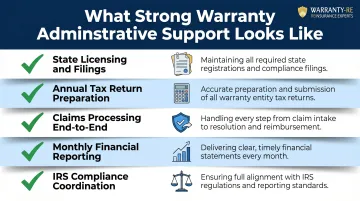
This support keeps your plumbers on jobs instead of managing adjusters, paperwork, and regulatory filings.
How We Chose the Best Warranty Companies for Plumbing Businesses
Not every warranty company on the market is built for plumbing contractors. We evaluated each company on its ability to serve contractors directly — not homeowners — weighing program structure, profit potential, compliance support, and track record in the home service space.
That distinction matters, because most plumbing businesses run into the same avoidable problems when picking a warranty partner.
Common mistakes plumbing businesses make when choosing a warranty partner:
- Focusing only on coverage breadth rather than profit structure
- Choosing consumer-facing home warranty brands instead of contractor-serving program administrators
- Failing to evaluate whether the program scales with business volume
- Ignoring the tax implications of different program structures
- Not considering who controls claims decisions and customer experience
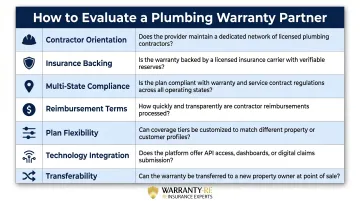
Key evaluation dimensions:
| Dimension | What to Assess |
|---|---|
| Contractor vs. consumer orientation | Does the company sell through contractors (B2B) or directly to homeowners? |
| Insurance backing | Are plans backed by an A-rated or higher insurer? |
| Multi-state compliance | Does the provider handle obligor licensing across states? |
| Reimbursement terms | Labor rate caps, reimbursement speed, claims process efficiency |
| Plan flexibility | Parts only, labor only, or combined? Customizable coverage? |
| Technology integration | Online portal, service platform integrations, reporting tools |
| Transferability | Can warranty transfer to new homeowner at property sale? |
Conclusion
Plumbing businesses that treat warranties as a compliance checkbox are giving up recurring revenue and customer retention they've already earned. The right warranty partner turns each install into a structured, ongoing service relationship — one that generates profit long after the job is done.
Research shows that contractors lose an average of 11% of their customer database annually, with 7% leaving specifically because the company "didn't care enough." Service agreements with regular maintenance visits directly address this retention gap by creating structured touchpoints with your customers.
Before committing to any warranty program, decide whether to resell a third-party program or own the economics entirely. That retention gap makes the stakes clear — every customer who leaves is margin walking out the door. Reinsurance-based models like WarrantyRE let plumbing businesses capture 100% of warranty profits, control their claims experience, and build a business that compounds rather than just transacts.
Ready to explore whether a reinsurance program is right for your plumbing business? Reach out to WarrantyRE at (804) 824-9533 to request an Owner Analysis and evaluate the financial impact for your specific operation.
Frequently Asked Questions
What are the best plumbing warranty companies?
The answer depends on whether you're a homeowner or a plumbing contractor. For plumbing businesses, the best options are program administrators and reinsurance partners like WarrantyRE, JB Warranties, or platforms like ServiceTitan—not consumer-facing home warranty brands like American Home Shield or Choice Home Warranty.
How does a warranty program work for a plumbing business?
A contractor warranty program allows plumbing businesses to offer service agreements or protection plans to their customers. The contractor either resells plans through a third-party administrator and earns a commission, or uses a reinsurance model to own the entity that administers and profits from those plans. In the reinsurance structure, the administrator handles claims and compliance.
What is the difference between a service contract administrator and a reinsurance model for plumbing warranties?
A service contract administrator processes claims and collects premiums on behalf of the contractor for a fee or revenue split, retaining underwriting profits. A reinsurance model lets the contractor establish their own warranty entity and keep 100% of underwriting profits. The administrator handles compliance and claims adjudication, while the contractor controls the customer experience.
Can a plumbing contractor own their own warranty company?
Yes—through administrator-obligor reinsurance structures, plumbing contractors can establish their own warranty entity supported by A-rated insurers, capturing profits that would otherwise go to a third-party provider. Companies like WarrantyRE specialize in setting up and managing these programs for contractors.
What plumbing components are typically covered under contractor warranty programs?
Coverage varies by program but typically includes interior water supply lines, drain and waste lines, water heaters, toilets, valves, and faucets. Contractors should verify which components are covered and whether exclusions for pre-existing conditions, calcium buildup, clogged drains, or improper installation apply.
How much does it cost for a plumbing business to set up a warranty program?
Costs vary by model. Third-party administrator programs typically have low setup costs but thinner margins. Reinsurance-based programs carry higher upfront fees, offset by long-term profit capture. WarrantyRE offers a business analysis to model ROI based on your install volume and service mix.