Introduction
Poorly trained roofing crews generate callbacks on 10–20% of jobs, according to GAF's CARE Training Manager. That translates to one in five installations requiring unpaid return trips, crews pulled from revenue-generating work, and negative reviews that slow referral generation for months.
The financial damage accumulates fast. Roofing contractors operate on gross margins of 35–40% and net margins of 12–15%, meaning a single $500 callback can erase the profit from an entire job.
When warranty claims push into the $2,000+ range — or trigger disputes with third-party providers — the damage compounds across multiple projects and threatens annual profitability.
Most of these costs are avoidable. Callbacks and warranty claims trace back to decisions made before installation begins, during execution, and in how warranty obligations are structured. Contractors who tighten all three stages can reduce callback rates to 1–3% of jobs and turn warranty programs into a profit center instead of a liability.
TLDR:
- Poor material matching, rushed installation, weak contracts, and inadequate communication drive most callbacks
- Well-trained crews cut callback rates from 10–20% down to 1–3%, protecting margins directly
- Prevention starts at the estimate stage: material selection, contract clarity, and honest expectations
- SOPs, post-install inspections, and timely follow-up catch errors before they become complaints
- Owning your warranty program — rather than paying third-party providers — captures underwriting profits and reduces claim exposure
How Callback and Warranty Claim Costs Build Up
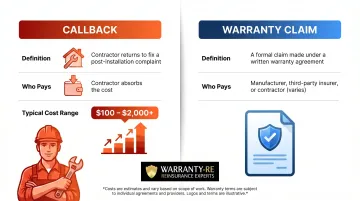
Callback and warranty claim costs rarely appear as a single budget line. They accumulate gradually across multiple jobs, often untracked until the losses show up on a job cost report. GAF estimates callback costs range from around $100 for cleanup visits to $200–$300 for simple leaks, escalating to $500–$2,000+ for major failures.
Direct costs include labor, materials, fuel, and truck expenses — but indirect costs often exceed the visible spend. Every callback consumes 2–3 hours of foreman or technician time, plus travel. Crews pulled from new installations lose revenue from jobs that actually generate profit.
Callbacks vs. warranty claims:
| Type | What It Is | Who Bears the Cost |
|---|---|---|
| Callback | Contractor returns to fix a post-install complaint | Contractor absorbs it to protect reputation |
| Warranty claim | Formal claim under a written warranty | Manufacturer, third-party administrator, or contractor depending on coverage |
Warranty claims carry higher financial exposure and can trigger systemic liability if the root cause repeats across jobs. On top of repair costs, administrative time spent on disputes, documentation requests, and claim denials quietly drives up total overhead — a cost most contractors never track separately.
Reputation damage is the slowest to appear and the hardest to recover from. Consumers are strongly influenced by star ratings, and negative reviews deter selection, slowing lead generation and reducing close rates even after the callback is resolved.
Key Drivers Behind Roofing Callbacks and Warranty Claims
Material Selection Mismatched to Site Conditions
Choosing materials by price rather than performance creates failures homeowners correctly attribute to the contractor. Code-compliant doesn't mean performance-adequate — the two are not the same standard.
Ring-shank nails nearly double roof deck uplift resistance versus smooth nails, and sealed roof decks reduce water intrusion by up to 95% if covering is lost. UV exposure, thermal cycling, wind uplift, hail, and ice dams all demand materials matched to local climate and specific site conditions.
Installation Shortcuts at High-Risk Details
Poor fieldwork accounts for most roof failures, according to NRCA. Flashing, ridge caps, vent penetrations, and valleys generate a disproportionate share of leak complaints when installers rush critical details. These areas require precise technique, and shortcuts here create predictable callbacks that were entirely preventable on-site.
Crew Inconsistency Across Jobs
When different crew members follow different techniques, quality varies unpredictably. GAF's training data shows poorly trained crews generate callbacks on 10–20% of jobs, while well-trained crews reduce that to 1–3%. Without documented procedures, each installer uses personal technique, making callbacks impossible to forecast or systematically prevent.
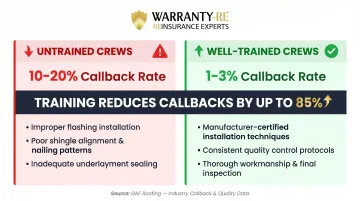
The gap between trained and untrained crews comes down to three factors:
- Documented installation procedures each crew member follows consistently
- Regular quality checks at high-risk details (flashing, valleys, penetrations)
- Accountability tied to individual job performance, not just crew output
Miscommunication Between Sales, Crew, and Homeowner
Many callbacks have nothing to do with workmanship — homeowners expected something different and call because expectations were never properly set. IKO's contractor guidance emphasizes that many callbacks are tied to unrealistic client expectations, making proactive expectation-setting during the sales process — and fast response when issues surface — essential to preventing most of these complaints.
Warranty Terms the Contractor Can't Fulfill
Manufacturer warranties typically exclude workmanship, leaving contractors exposed when they over-promise coverage. Third-party warranty providers frequently deny claims on technicalities, forcing contractors to absorb costs to preserve customer relationships. Poor documentation prevents contractors from defending their workmanship when disputes arise.
Manufacturers commonly void warranties for:
- Improper installation not following manufacturer specifications
- Inadequate attic ventilation
- Unauthorized modifications or repairs
- Use of mixed-brand components not approved by the manufacturer
- Failure to register warranty or transfer within required periods
Cost-Reduction Strategies for Roofing Callbacks and Warranty Claims
Effective strategies address the problem at its source: before installation, during execution, and through how warranty obligations are structured.
Strategies That Reduce Costs by Changing Decisions
These approaches reduce callback and claim costs by changing choices made at the estimate, specification, and contract stage — before a single shingle is installed.
Match materials to site conditions:
Selecting materials based on climate zone, roof pitch, sun exposure, and local weather patterns reduces performance failures. IBHS FORTIFIED standards demonstrate that enhanced nailing, sealed roof deck, and performance-rated components reduce wind uplift and water intrusion risk that often underlie callbacks and leaks. Code-compliant doesn't mean performance-adequate.
Write contracts with specific scope and exclusions:
Vague contracts create disputes when homeowners interpret verbal promises differently than contractors intended. Roofing Contractor magazine emphasizes warranty role clarity (manufacturer vs. workmanship) to manage expectations. Specificity prevents "that's not what I was told" callbacks by documenting exactly what was agreed to, in writing.
Set honest expectations at the sale — not after complaints:
Over-promising during sales (especially on appearance, noise, or timeline) creates a gap between expectation and reality that generates calls even when installation is technically correct. Trust built through honest scoping prevents callbacks that have nothing to do with workmanship quality.
Audit warranty commitments before offering them:
Only offer workmanship warranties for the scope and duration you can reliably deliver. Understand exactly what manufacturer warranties cover and what voids them to avoid being caught between a homeowner expectation and a denied claim.
Strategies That Reduce Costs Through Better Job Management
Consistency during installation — not just material selection — determines how often crews return to fix avoidable problems.
Standardize checklists and SOPs for every crew:
Without documented procedures, each crew member uses personal technique, creating variable quality across jobs. Enforcing consistency through checklists — especially for flashing, fastening patterns, and ridge detailing — reduces callbacks most dramatically in companies with multiple crews.
Invest in crew training, especially for foremen:
Proper training can reduce callback rates from 10–20% of jobs to 1–3%, according to GAF. Foremen must be trained as leaders, not just skilled installers — their role is to enforce standards and catch errors before the homeowner does.
Conduct a formal post-installation inspection before leaving:
Assign a crew member — ideally the foreman — to systematically check all high-risk details (flashing, valleys, vents, ridge caps, gutters, cleanup) before the truck leaves. This is the last line of defense against the "we could have caught this" callback.
Follow up with the homeowner within 1–2 weeks:
This catches small concerns before they become formal complaints or negative reviews, demonstrates professionalism that increases referral likelihood, and creates a documented record of customer satisfaction that protects the contractor if a later warranty claim arises.
Strategies That Reduce Costs by Restructuring Warranty Risk
Even contractors with excellent installation quality can face significant warranty claim costs when coverage terms are over-committed or when third-party providers deny claims — leaving the contractor to absorb costs just to protect the customer relationship.
Establish your own warranty program:
Roofing contractors who establish their own warranty programs gain direct control over claim adjudication, coverage terms, and underwriting profits. WarrantyRE's administrator-obligor reinsurance model lets contractors build warranty companies they own — capturing profit margins that currently flow to third-party providers.
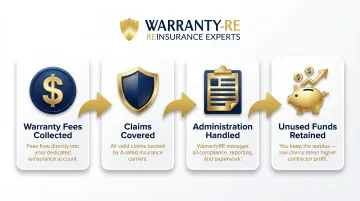
On a $15,000 roof replacement with a 5- or 10-year labor warranty, the mechanics work like this:
- Warranty fees flow into the contractor's own reinsurance account, not a third party
- Claims are covered by the reinsurance structure, backed by A-rated insurers
- Unused funds remain with the contractor as profit at year-end
- WarrantyRE handles all claims administration, compliance, and reporting
Build proper documentation infrastructure:
Job photos, material specs tied to each address, signed contracts, and warranty terms accessible in a single record function as both a callback prevention system and a legal defense when warranty claims arise, regardless of how the warranty is structured. Roofing Contractor magazine recommends funding a warranty reserve at 1–2% of each job's sale price to ensure warranty work doesn't come out of operating cash flow.
Conclusion
Reducing callback and warranty claim costs depends on identifying where cost originates — at the decision stage, the execution stage, or the structural warranty stage — rather than applying blanket fixes that treat symptoms rather than root causes.
The tactics that move the needle most:
- Material selection matched to site conditions
- Clear contracts that define labor scope and exclusions
- Standardized crew procedures with documented sign-offs
- Post-install inspections before the customer call
- Timely homeowner follow-up in the first 30 days
Execution discipline handles the frequency side. Smarter warranty structures handle the cost side. The two work together.
Contractors who own their warranty programs shift the financial equation entirely. Rather than paying third-party providers to absorb underwriting profits, they capture those margins directly — while keeping full control over claim decisions and the customer experience. That combination turns warranty risk into a recurring revenue stream and a differentiator in competitive bids.
Frequently Asked Questions
What is the difference between a roofing callback and a warranty claim?
A callback occurs when a contractor voluntarily returns to address a post-install complaint, often at their own cost to protect reputation. A warranty claim is a formal claim under a written warranty, which may involve the manufacturer, a third-party administrator, or the contractor depending on how coverage is structured.
What can void a roof warranty?
Common warranty-voiding factors include improper installation not following manufacturer specifications, inadequate attic ventilation, unauthorized modifications or repairs, and using mixed-brand components not approved by the manufacturer. Failure to register or transfer the warranty within required periods can also void coverage.
How much does a roofing callback typically cost a contractor?
Callback costs range from around $100 for cleanup visits to $200–$300 for simple leaks, escalating to $500–$2,000+ for major failures. Indirect costs — crew diversion, reputation damage, and lost referrals — often exceed the direct repair cost, and worst-case scenarios can escalate to full replacement.
How can roofing contractors reduce the financial risk of warranty claims?
Start with these four practices:
- Commit only to warranty terms you can reliably deliver
- Understand exactly what manufacturer warranties cover and exclude
- Keep detailed per-job documentation for every install
- Consider owning your own warranty program to control claim decisions and costs, rather than depending on third parties who absorb your profits and may deny claims on technicalities
Can a roofing contractor own their own warranty program?
Through administrator-obligor reinsurance structures, roofing contractors can establish their own warranty companies. This lets them control claims, set coverage terms, capture the underwriting profits third-party providers currently pocket, and reduce exposure to denied claims and administrative delays.