
Introduction
Warranty costs hit plumbing contractors harder than most business owners realize. Industry benchmarks place acceptable callback rates at 2%-3% of completed jobs, with best-in-class companies maintaining rates below 1.5%. Yet many plumbing businesses absorb callbacks at 5%-10% of monthly jobs, which translates into serious money. At a 10% callback rate on 500 monthly jobs, a contractor faces approximately $32,500 per month in pure loss—labor paid twice, revenue collected once.
For plumbing businesses, warranty liability doesn't appear as a single catastrophic line item. It accumulates gradually—through repeat visits to the same property, undocumented callbacks absorbed as "goodwill," materials replaced at contractor expense, and disputes that escalate when warranty scope was never clearly defined in writing.
Each callback—a leak under the sink, a fitting that failed, a water heater that wasn't seated properly—pulls a technician off paying work and converts profitable capacity into pure cost.
Reducing that cost starts with understanding where exposure actually comes from. This article breaks down three dimensions of warranty liability: the upfront decisions that define your exposure, how you manage active warranties to minimize claims, and how to structure your business so warranty risk stops eroding your margins.
TL;DR
- Warranty liability builds through callbacks, unclear contracts, and uncontrolled claims — not a single visible expense
- The biggest drivers: installation errors, vague warranty scope, and lack of documentation to defend against invalid claims
- Define precise warranty language, choose materials carefully, and price warranty cost into every job from the start
- Catch systemic problems early with documentation protocols, technician training, and consistent callback tracking
- Formalize your warranty structure: separate labor from parts, offer tiered coverage, and use reinsurance to capture costs rather than absorb them
How Warranty Liability Builds Up for Plumbing Businesses
Warranty costs rarely appear as catastrophic single events. Instead, they compound over time through repeat visits to the same property, undocumented callbacks absorbed as goodwill, and disputes that escalate when scope was never clearly defined. A single plumber might absorb two or three callbacks per month without noticing the pattern, but a growing company with ten technicians faces a multiplied version of the same problem.
The build-up is often invisible until a business reaches scale. Most plumbing companies set aside 1%-2% of service revenue for warranty work, but contractors without formal reserves or tracking systems absorb these costs directly from operating cash. For a company generating $200,000 per month in service revenue, even a conservative 1.5% reserve rate equals $3,000 per month—$36,000 annually.
That reserve math only accounts for claims contractors are actually obligated to pay. The most expensive warranty liability often comes from honoring claims they were never contractually required to honor, because they had no written terms to point to. Without clear warranty documentation, customers interpret "we stand behind our work" as covering everything: pre-existing conditions, post-installation modifications, even normal wear and tear.
The legal exposure compounds this further. Most contractors assume a one-year callback period caps their risk, but warranties covering materials and workmanship typically remain enforceable until the statute of limitations or statute of repose expires, which can be six years or longer depending on state law.
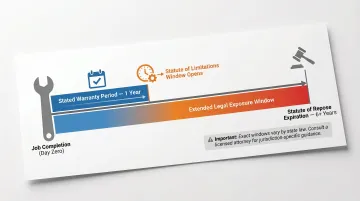
As a contractor grows, each additional job extends this trailing window of outstanding exposure. The business that closes 500 jobs this year carries six-plus years of potential liability from every one of them.
Key Drivers of Warranty Liability for Plumbers
Installation Error
Installation error is consistently the leading cause of warranty claims across all plumbing systems, and it's entirely within the contractor's control. While 65% of all plumbing system failure insurance claims are attributed to material failure, every manufacturer warranty in the plumbing industry excludes failures caused by installation error. This means contractors bear full liability for installation-related failures with no manufacturer recourse.
Between 4% and 6% of total project costs go to reported rework across construction trades, with the figure approaching 9% when indirect costs are included. For plumbing contractors, the most common triggers are:
- Improper joining at connections and fittings
- Incorrect torque on threaded or compression fittings
- Inadequate pipe support causing stress over time
- Skipped steps during pressure testing or commissioning
Material Selection
Material selection creates liability from factors outside the contractor's control. Certain pipe materials and fittings carry manufacturer warranties with exclusions for water chemistry, incompatible building materials, and installation methods. When these exclusions are triggered, the claim shifts back to the installer—even though the failure resulted from factors the contractor never controlled.
Most warranties from PEX and copper piping manufacturers contain exclusions for damage caused by water conditions. If a system fails due to chlorine degradation or aggressive water conditions, the manufacturer warranty will not cover repairs. Contractors who don't understand these exclusions absorb costs they shouldn't.
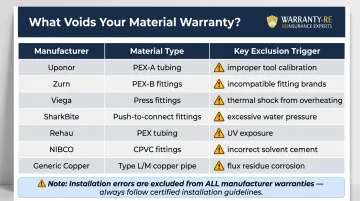
Common Manufacturer Warranty Exclusions:
| Manufacturer | Material | Key Exclusion |
|---|---|---|
| Uponor | PEX | External and internal physical or chemical conditions |
| Zurn | PEX | Any form of corrosion, damage from normal operating process |
| Viega | PEX | Chemically corrosive or aggressive water conditions |
| SharkBite | PEX | Exposure to harmful, unauthorized chemicals or corrosive water |
| Rehau | PEX | Harmful chemicals, aggressive or corrosive water conditions |
| NIBCO | PEX | Exposure to damaging chemicals or corrosive water |
| Generic copper | Copper | External, physical or chemical qualities such as aggressive water |
Since 2001, there have been at least 22 class-action lawsuits regarding failures of PEX, galvanized pipe, and copper systems caused by water condition incompatibility. Failures due to water conditions often occur in less than 10 years after installation.
Warranty Scope Ambiguity
Warranty scope ambiguity compounds both installation and material liability. When a contractor's warranty terms aren't written down, customers interpret "we stand behind our work" as covering everything — and courts often agree with them.
Every contractor impliedly warrants that work will be performed in a "good and workmanlike manner" and will be sufficiently free of major defects. This implied warranty exists in virtually every construction contract, whether written or not. In one documented case, a contractor was held to a 20-year warranty found in a product brochure they had provided to a customer, even though the signed contract specified only a standard one-year term.
The exposure from vague language is real and specific:
- Oral assurances like "we stand behind our work" can create enforceable obligations
- Implied workmanship warranties apply automatically in nearly every state
- Brochures, emails, and verbal representations can all be treated as warranty terms
- Without written scope limits, customers and courts fill in the gaps — usually not in the contractor's favor
Cost-Reduction Strategies for Plumbing Warranty Liability
Strategies differ based on where in the warranty lifecycle the contractor is trying to intervene. Upfront decisions carry the most leverage, but process and structural changes also reduce total liability over time.
Strategies That Reduce Liability by Changing Decisions
Choices made before or at the time of the job define the shape of your liability. These decisions offer the largest reductions in warranty cost because they set the terms before any claim can arise.
Define warranty scope in writing before every job
Specify what is covered (labor for the installed repair or system), what is excluded (pre-existing conditions, customer-caused damage, third-party modifications, wear and tear), and how long coverage lasts. A signed scope document is your primary defense against disputed claims.
Recommended elements include:
- Quality standards (materials "new" and "of good quality")
- Conformity to contract documents
- Standard of performance ("good and workmanlike manner")
- Specific remedy/callback provision with duration
- Exclusions for abuse, modifications by others, improper maintenance, or normal wear
- Survival clause stating warranty obligations survive completion
Select materials based on their manufacturer warranty profile
Research which piping systems and components carry the fewest exclusion triggers for typical residential water conditions in your service area. Default to materials where failures are controllable by installer behavior rather than factors outside your control.
CPVC systems like FlowGuard Gold are marketed with warranties that apply regardless of water treatment methods, positioning them as having fewer water-chemistry exclusions than PEX or copper. CPVC failure risks are primarily tied to installation and chemical compatibility—factors within your control.
Be aware of specific manufacturer requirements: Charlotte Pipe's cast iron warranty does not apply if products are joined with unshielded hubless couplings, and its FlowGuard Gold CPVC warranty excludes use with other manufacturers' products that don't meet ASTM standards.
Price warranty cost into every job
Estimate the expected callback rate for each job type, assign a dollar cost to that probability, and include it in your pricing. Contractors who offer warranties without pricing them are self-funding an insurance product without reserving for it.
Most plumbing companies set aside 1%-2% of service revenue for warranty work. For a company generating $200,000 per month in service revenue, a 1.5% reserve rate equals $3,000 per month. Build this cost into your estimates systematically rather than absorbing callbacks reactively from operating cash.
Strategies That Reduce Liability by Changing How Warranties Are Managed
These approaches reduce liability not by limiting what's covered, but by reducing the frequency of legitimate claims and strengthening your position when disputed claims arise.
Implement mandatory photo documentation at job completion
Photograph the finished installation, the materials used, and the condition of surrounding components before leaving the property. This record becomes your baseline for evaluating whether a future callback is a workmanship issue or a post-installation event outside warranty scope.
Build a structured technician training program
The most common warranty claims trace back to improper joining, incorrect torque, inadequate support, or skipped steps. Formalized training—not informal mentorship—reduces callback frequency and demonstrates due diligence if a claim is contested.
Contractors who implement regular training programs reduce rework costs by 11% to 22%, according to research from the Islamic University of Gaza and Berlin School of Technology. The study found a direct inverse relationship: higher training investment correlates with lower rework costs.
Resources include:
- PHCC Educational Foundation workforce development programs
- NCCER standardized craft training and certification
Track every callback by job type, technician, material, and age of original install
Look for patterns. If one material, one job type, or one technician generates a disproportionate share of callbacks, that's a systemic issue that compounds at scale.
Classify callbacks into distinct categories:
- True callback (work failed or caused the problem)
- Missed diagnosis (wrong issue identified initially)
- PM fallout (incomplete maintenance caused failure shortly after)
- Member return trip (plan language converted billable repair into free visit)
- Coincidental failure (new, unrelated issue)
Don't relabel callbacks as "warranty," "follow-up," or "member service" to mask their true nature. Track first-call resolution rate (target above 85%) and revenue per technician ($200,000-$300,000 annually) alongside callback rates.

Strategies That Reduce Liability by Changing the Structure Around Warranties
These approaches address how warranty risk is held at the business level. In many cases, the real driver of cost isn't how often claims occur but the fact that the contractor has no financial structure to absorb or transfer them without it coming directly out of operating cash.
Separate labor warranties from parts/material warranties
Warrant only the labor (the work your technicians performed), and direct parts failures explicitly to the manufacturer warranty. This structural change transfers a category of risk back to the party best positioned to control it.
Make this distinction clear in every customer-facing agreement. Your warranty covers defects in installation—improper joining, incorrect torque, missed steps. Product failures fall under manufacturer warranty, and your customer should contact the manufacturer directly for those claims.
Establish tiered warranty offerings
Create a standard tier (labor warranty, defined term, clearly scoped) and a premium tier (extended duration, broader coverage). The premium tier should be priced to fund its own claims reserve. This allows customers to self-select their coverage level rather than receiving undefined "we'll make it right" guarantees.
Tiered structures also create a revenue opportunity: customers who value extended protection will pay for it, and those premiums fund the additional risk you're assuming.
Consider replacing ad hoc warranty self-insurance with formalized reinsurance
For plumbing businesses at scale, formalized reinsurance structures allow contractors to establish their own administrator obligor reinsurance companies. The mechanics are straightforward: premiums go into a dedicated reserve, claims draw from that reserve, and any underwriting profit stays with the contractor instead of flowing to an outside administrator.
Programs like those offered by Project Warranty use micro-captive models under IRC Section 831(b). Under this structure:
- The contractor owns the reinsurance entity and its associated bank accounts
- When warranty claims occur, the contractor reimburses their own business from the captive entity
- When warranty policies expire and funds are released, the entity can provide low-interest loans back to the primary business
- Warranty fees built into job estimates flow to the contractor's reinsurance account rather than to a third-party provider
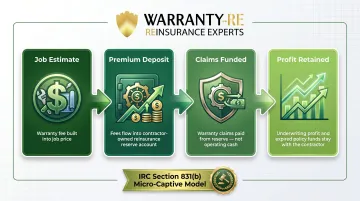
Companies using this structure report capturing 100% of underwriting profits previously paid to third parties—money that was leaving the business on every job.
Historically, creating a single-parent captive required several million dollars in annual premium volume and upward of $100,000 in yearly operating costs. Micro-captive models have reduced these barriers significantly, making reinsurance a practical option for mid-sized plumbing contractors who couldn't have accessed this structure a decade ago.
Conclusion
Reducing warranty liability for a plumbing business is not primarily about offering less coverage. It is about being precise and intentional at three levels: what you agree to before the job, how you document and manage work during the warranty period, and how your business is structured to absorb or transfer risk when claims arise.
The contractors with the lowest effective warranty costs treat warranty management as a deliberate business practice, not a back-office nuisance. They define scope in writing, train technicians systematically, and track claim patterns rigorously.
That discipline lets them control warranty costs proactively instead of absorbing them from operating cash after the fact.
Whether you implement tighter warranty language, formalize your training program, or establish a reinsurance structure (something WarrantyRE helps plumbing contractors set up without the overhead of managing it alone)— the goal is the same: turn warranty from an unpredictable drain on your margins into a function you manage on your own terms, one that protects profit and strengthens your position with customers.
Frequently Asked Questions
How to reduce plumbing warranty liability?
Reduction starts with written warranty scope on every job, technician training to minimize installation errors, and documentation protocols that create a defensible record. For higher-volume operations, reinsurance programs allow contractors to fund claims from dedicated reserves rather than operating cash, further reducing exposure.
What actions can void a plumbing warranty?
Post-installation modifications, use of incompatible components, deferred maintenance, and physical damage to the installed system are common warranty-voiding conditions. These exclusions must be written into the original warranty agreement to be enforceable—oral representations or vague language leave you exposed to claims you never intended to cover.
How long should a plumbing contractor warranty last?
Industry standard labor warranties typically range from 30 days to 1 year depending on job type, while extended warranties of 2+ years are offered as a premium option. Duration should reflect your actual callback risk for that work type and be priced accordingly — keep in mind that legal liability can extend beyond your stated warranty period under state statutes of limitation.
What is the difference between a workmanship warranty and a parts warranty?
A workmanship warranty covers defects in your labor—improper installation, incorrect torque, missed steps. A parts warranty covers product failure and is typically the manufacturer's responsibility. Contractors should warrant their labor separately and direct parts failures to the manufacturer to avoid assuming liability for defects outside their control.
Can a reinsurance program help plumbing contractors manage warranty costs?
Yes. A reinsurance structure lets contractors collect warranty premiums, hold them in a dedicated reserve, and fund claims from that reserve instead of absorbing them from operating cash — stopping payments to third-party administrators and capturing the underwriting profit themselves, often with meaningful tax advantages.