Introduction
According to ServiceTitan's Contractor Playbook, best-in-class electrical contractors should maintain a callback rate at or below 1% of all service and maintenance calls. Yet many contractors struggle to reach this benchmark, and each callback carries stacked costs that go far beyond the obvious.
The costs stack fast:
- Unbillable labor at $40–$100/hour per electrician
- Fuel and vehicle time eating into already-thin margins
- Lost revenue from displaced jobs averaging $575 per ticket
- Scheduling disruption rippling across your entire operation
When callbacks cluster around undertrained technicians, unclear job scopes, or inconsistent installation protocols, they erode margins many electrical contractors already run at 2–3% net profit, according to ServiceTitan's 2023 margin analysis.
Callbacks and warranty claims are not inevitable. They are largely the product of decisions made before, during, and after a job — and each decision point is one you can control. This guide breaks down all three so you know exactly where to act.
TL;DR
- Most callbacks trace back to preventable causes: incomplete diagnosis, skipped verification steps, and broken communication between office and field
- Material choices, scope documentation, and code compliance set your risk profile before work begins
- In-field management—standardized checklists, precise testing, and structured customer communication—is the highest-leverage area for reducing callbacks
- Warranty claim costs appear weeks or months after installation, making them harder to manage without processes already in place
- A well-structured warranty program turns claims from a pure cost into a managed, profitable line
How Callback and Warranty Claim Costs Build Up for Electrical Contractors
These costs rarely appear as a single visible expense. Each callback stacks multiple losses at once:
- Unbillable labor hours spent revisiting completed jobs
- Fuel and drive time that generates zero revenue
- Rescheduling disruption that pushes back paying customers
- Lost capacity that could have generated $575 in new work — ServiceTitan's benchmark for electrical service average ticket
The build-up tends to cluster. One undertrained technician, one inconsistently followed installation protocol, or one unclear scope agreement can generate a cluster of claims across multiple jobs before the pattern becomes visible in your data.
That delayed visibility compounds another problem: timing. Problems with electrical installations often manifest weeks or months after completion, meaning the financial hit arrives long after the job was considered closed. This compresses already-tight margins at unpredictable intervals, making cash flow management more difficult for contractors operating at 2-3% net profit.
Key Cost Drivers Behind Electrical Callbacks and Warranty Claims
Technician Skill Gaps
The U.S. faces an electrician shortage with real consequences. The Bureau of Labor Statistics projects employment to grow 9% from 2024 to 2034—much faster than average—with approximately 81,000 annual openings driven by both growth and retiring worker replacement.
Fortune reports that more than 300,000 new electricians are needed over the next decade, yet nearly 30% of union electricians are between ages 50 and 70.
This shortage means many contractors hire less experienced electricians and struggle to provide adequate training. Skill gaps often go undetected until a callback reveals them—particularly around:
- Panel work and load calculations
- Wire connections and terminations
- Arc fault circuit interrupter (AFCI) requirements, which the NEC 2023 edition expanded to all 120-volt, single-phase, 15- and 20-ampere branch circuits supplying dwelling unit kitchens and laundry areas
- Grounding system testing and verification
ServiceTitan reports that 50% of home service businesses struggle to find skilled talent, and 43% cite training as their biggest IT challenge—directly limiting their ability to use job tracking and performance tools to catch problems before they become callbacks.
Absence of Standardized Processes
When each technician approaches a job using their own method rather than a company-defined protocol, quality becomes inconsistent and callbacks become unpredictable rather than manageable.
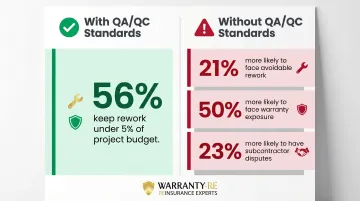
Construction industry data provides insight into the cost of this inconsistency. PlanRadar's 2025 analysis found that 56% of companies with consistent quality assurance and quality control (QA/QC) processes keep rework costs under 5% of budget, compared to only 37% of companies without such standards. Firms without QA/QC standards are:
- 21% more likely to experience avoidable rework
- 50% more likely to face warranty exposure
- 23% more likely to have subcontractor disputes
The National Electrical Contractors Association (NECA) maintains 46 ANSI-approved National Electrical Installation Standards (NEIS) that define what constitutes "good workmanship" in electrical construction. The NEC requires installations to be "professional and skillful" but does not define those terms—NEIS bridges this gap. Yet many contractors fail to implement these standards systematically.
Communication Failures Between Dispatch, Office, and Field
Process gaps don't stay in the office—they follow technicians into the field. A joint study by PlanGrid and FMI found that miscommunication causes 26% of all construction rework and bad or inaccurate data causes another 22%. Together, those two factors account for nearly half of all rework.
For electrical contractors, communication failures show up as:
- Incomplete job histories when technicians arrive on-site
- Unclear scopes that leave ambiguity about what is and isn't covered
- Missing prior-visit notes that force technicians to re-diagnose problems
- Lack of documented customer sign-off on completed work and deferred recommendations
When technicians arrive unprepared because critical information didn't transfer from the office, error rates increase and disputed warranty claims become more likely.
Warranty Program Structure as a Cost Driver
Many contractors assign all warranty risk to a third-party provider, which means relinquishing control over claims adjudication while also losing the underwriting profit. Third-party warranty companies profit from the premiums they collect but don't pay out in claims—creating a financial incentive that may not align with fair claims handling.
Contractors with no formal warranty program face a different problem: they absorb 100% of claim costs out of pocket, with no reserve, no structure, and no predictability. Every callback becomes an unplanned hit to cash flow. The program structure itself—not just the quality of the work—determines how much a warranty claim actually costs your business.
Cost-Reduction Strategies for Electrical Callbacks and Warranty Claims
The most effective strategies depend on where in the process cost is being generated: before the job, during execution, or in the structural setup around how work is warranted and governed.
Strategies That Reduce Costs by Changing Pre-Job Decisions
Better pre-job decisions are often the cheapest form of callback prevention — before a technician ever leaves the shop.
Specify materials and components upfront
Establish company standards for grade of materials, breakers, connections, and components used on electrical jobs—and document these standards in writing so deviations are visible and correctable. When one job uses Square D and another uses an off-brand breaker without documentation, you lose the ability to track whether material choices contribute to callback patterns.
Define and document scope clearly before work begins
Vague job scopes create the conditions for disputed warranty claims. Require written scope agreements that specify what is and is not covered. When a customer calls back three months later claiming "you said you'd fix everything," a signed scope document eliminates ambiguity and protects your margin.
Run a pre-job code compliance check
Research applicable local codes and permit requirements before scheduling the work, not after. Code violations discovered post-installation are among the costliest callbacks because they require rework and may void warranty coverage entirely.
HomeAdvisor reports that electrical panel replacement averages $1,343 (range: $518-$2,187), while full house rewiring averages $1,565 (range: $603-$2,594). For a 2,000-square-foot home, a full rewire can run $6,000-$10,000. The cost of proactive code compliance before work begins is almost always lower than the cost of remediation callbacks after the fact.
Match job complexity to technician skill level
Assign electricians based on demonstrated competency with the specific type of work involved. Assigning a less experienced technician to a complex panel upgrade or service entrance job increases callback probability. Track which technicians generate callbacks on which job types, and use that data to inform dispatch decisions.
Strategies That Reduce Costs by Changing How Jobs Are Managed in the Field
Once a technician is on-site, consistency and verification determine whether the job stays closed — or comes back as a callback.
Implement job-specific checklists with mandatory completion steps
Create checklists for electrical service, installation, and panel work that require verification at job start, mid-point, and before leaving the site. Include items like:
- Confirming correct breaker sizing
- Testing all circuits activated during the job
- Checking for exposed connections or loose terminations
- Verifying voltage, load, and continuity readings
- Documenting all measurements taken
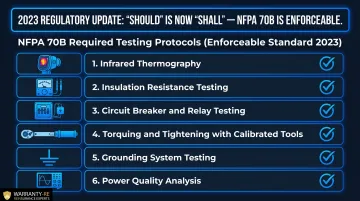
NFPA 70B transitioned from a recommended practice to an enforceable standard in 2023, changing language from "should" to "shall." Facilities must now develop and document a written Electrical Maintenance Program (EMP) with specific testing protocols:
- Infrared thermography
- Insulation resistance testing
- Circuit breaker and relay testing
- Torquing and tightening with calibrated tools
- Grounding system testing
- Power quality analysis
Require measurement and testing over assumption
Technicians should test and document actual readings rather than assuming equipment is operating correctly. For electrical work, this means verifying voltage, load, and continuity rather than visually inspecting and moving on.
NFPA 70B documentation requirements are explicit: every maintenance visit must produce a service report containing date/time, personnel involved, work performed and measurements taken, deficiencies found (with severity ratings), corrective actions, and future recommendations. The standard states: "If it's not documented, it didn't happen."
Establish a structured communication handoff protocol
The office should provide the technician with complete job history, prior service notes, and customer-reported symptoms before dispatch. The technician should provide a written summary of all work performed, all issues found, and all recommendations declined before leaving the site.
This two-way communication eliminates the scenario where a technician arrives unprepared or a customer calls back claiming work wasn't explained.
Require customer sign-off and written documentation before departure
Have the customer acknowledge what was completed and what was deferred. This documentation both reduces disputed warranty claims and creates a record if the customer calls back claiming the problem was not addressed.
Strategies That Reduce Costs by Changing the Context Around Warranty Risk
Some callback and warranty costs aren't caused by field mistakes — they're built into how contractors structure their warranty programs in the first place.
Build a callback tracking system and use the data
Create a log of every callback with the cause, the technician, the job type, and the resolution. Review this data regularly to identify patterns that indicate a training gap, a process failure, or a recurring material/equipment issue rather than isolated incidents.
Contractors who track callbacks systematically can identify whether callbacks cluster around specific technicians, specific job types, or specific phases of installation—and address the root cause rather than treating each callback as a random event.
Invest in continuous technician training tied directly to real callback data
Training programs that are anchored to actual callback patterns are far more effective than generic technical refreshers. If your callback data shows that 40% of panel upgrade callbacks trace to incorrect load calculations, your next training session should focus specifically on load calculation methodology.
Consider structured ride-along evaluations, peer reviews, and regularly updated technical guides that reflect real failures your company has experienced.
Rethink the structure of your warranty program
Contractors who rely on third-party warranty providers pay premiums that fund the provider's underwriting profit while accepting claims adjudication terms they didn't set and can't change.
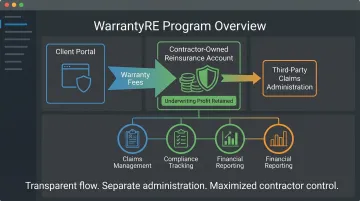
Electrical contractors who establish their own reinsurance-backed warranty company through a program like WarrantyRE gain direct control over how claims are handled, reduce financial exposure, and capture underwriting profit that would otherwise leave the business. Warranty obligations shift from a pure cost line into a managed, potentially profitable program.
When warranty fees are built directly into job pricing and flow into the contractor's own reinsurance account—rather than to a third-party provider—unused funds remain with the contractor. WarrantyRE handles all claims administration, compliance, and bookkeeping, allowing contractors to keep their electricians focused on billable work — and turning what used to be a write-off into a revenue line that builds with every job closed.
Conclusion
Reducing electrical callbacks and warranty claims starts with knowing where the costs actually originate. Pre-job decisions, in-field execution, and the structural setup around warranty risk each contribute differently — and each requires a different fix.
Contractors who track callbacks by root cause and treat them as a systems problem — not a technician problem — find patterns faster and fix them more permanently. That discipline, applied consistently across scoping, installation, and warranty structure, is what separates contractors who manage costs from those who absorb them.
For contractors looking to go further, restructuring how warranty risk is held and funded can turn a recurring expense into a recoverable one. That's the structural layer most electrical contractors haven't addressed yet.
Frequently Asked Questions
How can I prevent electrical failures and reduce callbacks?
Callbacks drop when you combine in-field diagnosis with standardized installation checklists and documented customer sign-off. Contractors who hit the 1% benchmark treat these practices as an integrated system—not isolated fixes.
What is covered under an electrical warranty?
Workmanship warranties cover the contractor's own labor and materials for a specified period (typically one year), while product or equipment warranties come from manufacturers like Square D, Leviton, or Siemens. Coverage scope varies depending on whether the contractor uses a third-party warranty provider or a self-funded reinsurance program.
How can I reduce warranty costs?
On the operational side, improve installation practices through checklists, testing protocols, and technician training tied to real callback data. On the financial side, owning or reinsuring your warranty program lets you capture underwriting profits instead of paying them to a third party.
How much does it cost to bring electrical work up to code?
Costs vary widely based on the scope and age of the installation. Panel replacement averages $1,343 ($518-$2,187 range), while full house rewiring averages $1,565 ($603-$2,594 range), with 2,000-square-foot homes running $6,000-$10,000. The cost of proactive code compliance before work begins is almost always lower than the cost of remediation callbacks after the fact.
What is an acceptable callback rate for electrical contractors?
ServiceTitan's published benchmark sets the target callback rate at 1% or less of service calls. Best-performing contractors use callback tracking systems to drive that rate even lower over time by identifying and addressing root causes rather than treating callbacks as isolated incidents.
How do reinsurance programs help electrical contractors manage warranty claims?
A contractor-owned reinsurance company replaces third-party warranty providers, allowing the contractor to control claims adjudication, set reserve levels, and capture the underwriting profit that would otherwise be paid to an outside insurer. WarrantyRE provides full-service administration including claims handling, compliance management, and financial reporting while the contractor retains ownership and profitability of the warranty program.