As competition among electrical contractors intensifies and customers demand warranty protection on everything from whole-home rewires to smart panel installations, the choice between relying on a third-party warranty provider versus owning a reinsurance company has direct consequences. One model keeps you dependent and profit-starved. The other transforms warranty work from a liability into a controlled revenue stream you own.
TL;DR
- Third-party warranty companies keep the underwriting profit — you do the marketing, they take the financial upside
- Electrical warranty reinsurance lets you own your warranty company and retain 100% of premiums not paid in claims
- A-rated insurer backing protects you from catastrophic claims, so you're never exposed without a financial backstop
- You control claim outcomes and service quality under reinsurance — third-party providers make those calls for you
- For electrical contractors with consistent volume, reinsurance delivers more profit and stronger customer satisfaction than any third-party arrangement
Electrical Warranty Reinsurance vs. Third-Party Warranty: Quick Comparison
| Dimension | Third-Party Warranty | Electrical Warranty Reinsurance |
|---|---|---|
| Profit Retention | Premiums go to the third party; contractor earns a small commission at best | Contractor retains underwriting profit after claims in their own reinsurance company |
| Claims Control | Claims approved or denied by third party following their internal standards | Contractor (supported by administrator) controls claims and service quality decisions |
| Customer Relationship | Loyalty flows to the warranty brand, not the contractor | Contractor is the warranty provider, deepening brand trust and repeat business |
| Financial Risk | No financial upside; reputational risk if provider denies claims | Actuarial risk backed by A-rated insurers; unspent premiums generate additional ROI |
What Is a Third-Party Warranty for Electrical Contractors?
Third-party warranty companies are external providers that back workmanship and parts warranties sold by electrical contractors to homeowners. The contractor collects premiums, the third party manages claims independently, and the contractor has no share of the margin.
What These Warranties Typically Cover
Third-party electrical warranties usually cover:
- Defects in workmanship on wiring, panels, and fixtures
- Specified parts failures for a set term
- Labor costs to correct covered defects
Coverage scope varies by provider. Electrical system complexity — from main panels and meter bases to EV chargers, smart home systems, and grounding work — creates ambiguity that third-party adjusters often resolve in their own favor, not yours.
The Business Model Tension
You invest in sales, customer trust, and service quality. The third-party company profits from the premium spread: the gap between premiums collected and claims paid.
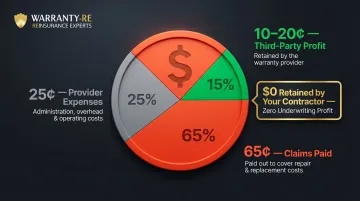
According to Warranty Week, third-party warranty administrators typically target profit margins of 10 to 20 percent, with loss ratios around 65 percent. That means roughly 65 cents of every premium dollar goes to claims, 25 cents covers expenses, and 10 to 20 cents is pure profit — kept by the third party, not you.
You do the work and absorb the reputational risk. When a customer has a bad claim experience, they call you — not the warranty company that denied it.
Use Cases for Third-Party Warranty Providers
Third-party warranties are most common among newer or smaller electrical contractors who lack the volume or infrastructure to run their own warranty program. They provide a quick, low-setup way to offer a warranty product without administrative burden.
The trade-off is real, though: you give away the financial upside and hand control of the customer experience to a company whose incentive is to pay out as little as possible.
What Is Electrical Warranty Reinsurance?
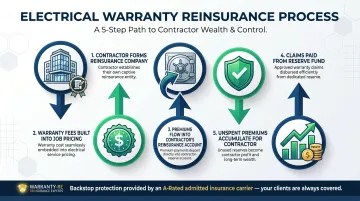
Electrical warranty reinsurance gives the contractor control of the whole structure. You establish your own administrator-obligor company — supported by an A-rated insurer — that issues warranties directly to customers, collects premiums, adjudicates claims, and retains underwriting profit. The fees stay with you instead of flowing to a third party.
The Administrator-Obligor Structure:
Your reinsurance company is the obligor on the warranty contract, meaning you're legally responsible for fulfilling it. The risk is backed by a licensed A-rated insurer, so this isn't bare self-insurance.
Here's how it works:
- You form a reinsurance company you own 100%
- Warranty fees are built into job pricing and flow into your reinsurance account
- Claims are paid from that fund
- Unspent premiums belong to you
- A-rated insurer backing protects you if claims exceed reserves
WarrantyRE manages setup, compliance, claims adjudication, bookkeeping, and filings, so you don't need to hire in-house expertise or learn a new back-office function.
Revenue Mechanics:
On an $18,000 service upgrade — 200-amp panel replacement, full meter base, new grounding system — you include a 2-year labor warranty. You're already offering it to stay competitive. A warranty fee is built into the job price. The homeowner pays for it. That fee flows into your reinsurance account, not to an outside company.
When a claim arises — a loose neutral, missed ground, connection failure — it's covered from your account. The administrator handles everything from first call to final resolution. You don't manage adjusters or paperwork. Your electricians stay billable.
Any unused funds? They remain in your reinsurance company, accumulating year over year.
Warranty as a Profit Center:
Instead of paying a third party for coverage you're already providing, your warranty program generates recurring revenue on every job. That adds up across a full year of panel upgrades, rewires, and service agreements — revenue that would otherwise leave your business entirely.
Tax Planning Advantages:
That recurring revenue also creates a tax planning opportunity. A properly structured reinsurance company under IRC Section 831(b) allows qualifying businesses to be taxed only on investment income — not underwriting profits — provided annual net premiums stay below $2.85 million. Contributions to the reinsurance account carry significant tax advantages, keeping money inside your structure instead of sending it to the IRS.
Use Cases for Electrical Warranty Reinsurance
Best suited for electrical contractors doing consistent volume — panel upgrades, EV charger installs, whole-home rewires, and service agreements at scale. The program grows more financially powerful as the premium pool builds, which is why it works best for contractors running $1M+ in annual installation revenue across residential and commercial work.
How They Compare: What Matters Most for Electrical Contractors
Profit and Long-Term Wealth Building
For a contractor running consistent volume, the cumulative underwriting profit retained through reinsurance versus surrendered to a third party represents a significant difference in business valuation and owner net worth over five to ten years.
The Compounding Effect:
Third-party providers retain underwriting profits that could otherwise accumulate on your balance sheet. According to Union Risk Services, buyers and investors pay more for companies that control risk and preserve capital. A well-managed reinsurance company converts warranty spending from a sunk cost into a strategic asset, building surplus, reserves, and investment income over time.
Claims Experience and Customer Satisfaction
With third-party warranties, a denied claim or slow resolution damages your reputation even though you had no control over the decision. You end up defending a process you never managed.
Reinsurance puts that control back in your hands. You set response time standards, quality expectations, and customer communication — the exact touchpoints that determine whether a client refers you or leaves a one-star review.
Setup Complexity and Ongoing Administration
Reinsurance requires more initial structure than signing up with a third-party provider. Company formation, compliance filings, and regulatory coordination are all part of the setup — but that barrier largely disappears when working with a dedicated reinsurance program manager who handles legal forms, filings, tax returns, and renewals.
WarrantyRE, for example, manages all administration end-to-end — you own the structure, they run the operations.
Initial capitalization typically ranges from $100,000 to $250,000, with annual operating expenses around $100,000 (insurance manager, actuary, tax adviser, auditor, legal counsel). A feasibility study costs $15,000 to $25,000.
Financial Risk and Stability
Some contractors worry that owning the warranty obligation means absorbing claim volatility. Three structural elements keep that risk in check:
| Risk Control Element | How It Works |
|---|---|
| A-Rated Insurance Backing | If your reserves fall short, the A-rated insurer assumes ultimate liability. Per AM Best, an A-rated carrier has an "excellent ability to meet ongoing insurance obligations." Your personal exposure is capped at your initial investment plus accumulated earnings. |
| Actuarial Pricing & Premium Pooling | Warranty fees are priced actuarially. As job volume grows, so does the reserve pool — claims are paid from accumulated premiums, not your operating cash. |
| Reinsurance vs. Third-Party Risk Profile | Third-party arrangements give you reputational exposure with no financial upside. A reinsurance structure gives you both upside and a defined risk ceiling through insurance backing. |
Scalability and Competitive Differentiation
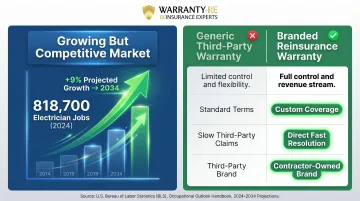
A contractor who owns their warranty program can design coverage that competitors using generic third-party products can't match:
- Custom terms tailored to your service offerings
- Faster claim service with direct customer contact
- A branded warranty product that reinforces your value proposition in the electrical market
This differentiation matters. According to the Bureau of Labor Statistics, there are 818,700 electrician jobs in 2024, with 9 percent growth projected through 2034. The market is growing, but so is competition. Contractors who control their warranty experience have a sustainable competitive advantage.
Making the Switch: Is Reinsurance Right for Your Electrical Business?
The Contractor Profile That Benefits Most
Electrical businesses doing enough volume to build a meaningful premium pool stand to gain the most. As a rule of thumb, a stand-alone captive typically needs to write at least $750,000 in annual premiums to be viable, according to Captive Insurance Times.
If you're already offering labor warranties to stay competitive — on panel upgrades averaging $1,500 to $4,000+ or EV charger installs averaging $2,442 (per EnergySage) — you're already funding a warranty program. Contractors who want to stop sending those profits to a third party and own the customer relationship instead are the right fit for reinsurance. The question isn't whether you have a warranty program. It's whether you own it.
What the Transition Looks Like
Working with a reinsurance program manager, the process typically involves:
- Setting up the company structure (legal formation, compliance, filings)
- Training staff on warranty presentation and program benefits
- Migrating from third-party contracts to your own warranty product
- Beginning to accumulate underwriting profit
WarrantyRE's onboarding model is designed to be fast and supported end-to-end, allowing electrical contractors to get up and running without disrupting operations. They handle claims administration, regulatory management, financial bookkeeping, and tax preparation — you focus on running your business.
Addressing the Hesitation Around Risk
Some contractors worry about owning the financial obligation. Here's how the structure actually works:
- Ultimate liability sits with an A-rated insurer, not you personally
- Professional administrators handle all claims from first notice to final resolution — no adjusters to manage, no disputes to field
- Customer-funded reserves cover claims; you're not paying out of pocket
The structure is regulated and insurer-backed — a meaningful difference from the informal verbal guarantees many contractors currently rely on. Reserves accumulate over time, building equity you actually own.
Clear Situational Recommendation
If you're running consistent installation volume, already offering labor warranties, and losing control over both claims and profits to a third party — reinsurance is worth a direct conversation.
Want to explore whether your business qualifies? Contact WarrantyRE at (804) 824-9533 to start an owner analysis and determine if reinsurance is right for your electrical contracting business.
Frequently Asked Questions
What does a third-party warranty cover for electrical work?
Third-party electrical warranties typically cover defects in workmanship and specified parts (wiring, panels, fixtures) for a set term. Coverage scope, exclusions, and claim approval standards vary significantly by provider — contractors should review terms carefully before selling these products to customers.
What are the main types of warranties?
For electrical contractors, the three most relevant types are manufacturer/product warranties on parts, workmanship warranties on labor, and extended service contracts. Reinsurance is the mechanism that lets a contractor fund and own the financial backing behind those workmanship or extended warranty programs.
What is third-party reinsurance?
Reinsurance is insurance purchased by an insurer (or an administrator-obligor company) to protect against large or unexpected claims. In the contractor context, it means the warranty company you own is supported by a licensed A-rated insurer, so you're not absorbing 100% of claim risk yourself.
Should an electrician be bonded and insured?
Bonding and general liability insurance protect against property damage and negligence claims, which is separate from a warranty program. A warranty is a proactive promise of quality that builds customer loyalty and can generate profit, whereas bonding/insurance is a reactive safety net required for licensing and contracting purposes.
How can an electrical contractor start their own warranty reinsurance company?
The process involves forming an administrator-obligor entity, securing A-rated insurer backing, and setting coverage terms. WarrantyRE handles the legal setup, compliance filings, and ongoing administration — so contractors can focus on running their business.
What profits can an electrical contractor capture by switching from third-party warranties to reinsurance?
Contractors typically capture the underwriting spread — premiums minus claims — that currently flows to the third-party provider. Premium investment ROI adds another layer: the reinsurance company invests reserves conservatively, and all investment income flows back to the contractor. Actual results vary based on premium volume and claims experience.