
Introduction
Most HVAC contractors face the same structural problem: revenue drops sharply in the off-season. When your business runs primarily on emergency calls and new installs, income becomes wildly unpredictable. 60% of HVAC contractor revenue arrives between May and August, leaving the remaining eight months to generate less than half of annual income. For a typical $2M HVAC company, monthly revenue swings from $250,000 in July to just $85,000 in October—a 66% drop in 90 days.
A service agreement program fixes this. It's a recurring revenue model where customers pay annually or monthly for scheduled maintenance, priority service, and discounts—keeping technicians busy year-round and building the customer loyalty that sustains a business through slow months.
This guide covers everything you need to build one from scratch:
- Designing service plan tiers and pricing
- Drafting contracts that protect your business
- Building a sales process your team can actually use
- Tracking retention and measuring program health
- Going beyond agreements to capture full warranty profits
TL;DR
- Service agreements are recurring maintenance plans customers pay for annually or monthly in exchange for scheduled tune-ups, priority scheduling, and repair discounts
- Done right, they stabilize income during slow seasons, cut emergency callbacks, improve technician utilization, and raise customer lifetime value
- Companies with 30%+ of revenue from maintenance contracts see 40-60% less revenue volatility year-over-year, per 2026 HVAC benchmarks
- Setting up a program requires defining plan tiers, building a clear contract, pricing for profitability, and training your team to sell
- Success comes from disciplined execution: honest pricing, consistent renewals, and delivering value at every service visit
What Is an HVAC Service Agreement Program?
An HVAC service agreement program is a formal arrangement where customers pay a set fee for scheduled preventive maintenance visits, priority scheduling, and agreed-upon perks. Unlike one-time repair calls, service agreements create ongoing relationships where customers receive regular system care in exchange for predictable payments.
How you structure that ongoing relationship depends on your business goals and what your customers expect. Most programs fall into one of these formats:
- Basic maintenance plan: Two tune-up visits per year—one before cooling season, one before heating season
- Standard membership: Adds repair discounts and filter changes on top of scheduled maintenance
- Premium plan: Includes emergency response windows and parts coverage up to a defined dollar amount
- Club membership: Packages all of the above with extras like extended warranties or free service calls
The tiered approach lets you offer an entry point for budget-conscious customers while giving higher-margin options to those who want full-coverage peace of mind.
Why HVAC Service Agreement Programs Are Worth Building — and What to Know First
Service agreements address the HVAC industry's core structural weakness: feast-or-famine seasonality. Contractors add 75%-80% of their new business during summer and winter seasons, while shoulder months (March-April and September-October) produce only 15-20% of annual revenue despite spanning a full third of the year.
Business benefits include:
- Well-run HVAC companies generate approximately 55% of total service revenue from maintenance contracts, creating reliable income during slow seasons
- Scheduled maintenance visits fill calendar gaps, reducing technician downtime and maximizing labor efficiency
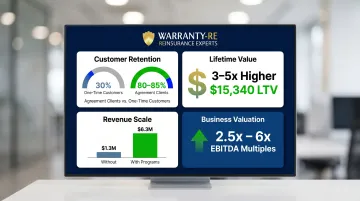
- Service agreement customers retain at 80-85% annually versus 30% for one-time customers — dramatically lower acquisition costs over time
- HVAC companies typically sell for EBITDA multiples of 2.5x to 6x, with higher recurring revenue percentages commanding the premium end because they reduce buyer risk
Service agreement customers are worth approximately 3-5x more over their lifetime than non-agreement customers, with HVAC customer lifetime value estimated at $15,340. Companies with service agreement programs generate average revenue of $6.3M versus $1.3M for companies without — five times higher.
Those numbers are compelling — but they depend on getting the program structure right from the start.
What many contractors get wrong: Pricing and coverage decisions made without modeling actual costs. Missed visits, callbacks, and claims erode margins quickly if pricing is too low or coverage is too broad. Before promising coverage, model out expected claim costs, fully-loaded service delivery expenses, and administrative overhead. Financial discipline matters more here than enthusiasm.
Contractors at every stage can make this work. Sole operators can start with a small base of loyal customers and scale gradually. Established companies can formalize what they're already doing informally — capturing value that's currently slipping through operational gaps.
How to Design Your HVAC Service Agreement Program
Decide What Each Plan Tier Covers
Most successful programs offer three tiers with increasing coverage and perks:
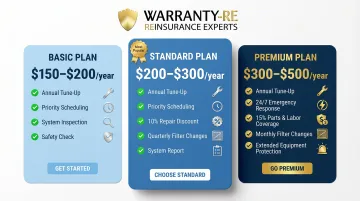
Basic Plan ($150-$200/year):
- Two preventive maintenance visits annually (pre-cooling and pre-heating season)
- System inspections and performance checks
- Priority scheduling over non-members
- Filter checks and airflow assessments
Standard Plan ($200-$300/year):
- Everything in Basic, plus:
- 10-15% discounts on repairs and parts
- Seasonal filter changes included
- Coil cleaning and minor part replacements
- Extended service hours availability
Premium Plan ($300-$500/year):
- Everything in Standard, plus:
- Emergency response within defined windows (4-6 hours)
- Parts coverage up to $500-$1,000 per year
- No overtime charges for emergency calls
- Annual thermostat calibration and duct inspection
According to an ACHR News industry survey, 44% of contractors charge $200 annually, 29% charge $300, and 19% charge $400 or more. The same survey found 87% of homeowners willing to pay $100 or $200 annually — a useful benchmark when setting your entry-level price point.
Exclusions matter as much as inclusions. State clearly in writing what falls outside the agreement:
- Pre-existing equipment failures or conditions
- Refrigerant costs (especially R-410A and newer refrigerants with volatile pricing)
- Equipment over 15 years old or outside manufacturer warranty
- Ductwork repairs or modifications
- Electrical panel upgrades
Customers who understand the limits upfront are far less likely to dispute a declined claim later.
Define Coverage Boundaries and Risk Exposure
Service agreements that include repair or parts coverage carry real financial risk. If a unit fails and repairs exceed what the customer paid into the plan, you absorb the loss. That distinction separates maintenance-only plans from repair-inclusive agreements.
When you offer repair coverage, you're functioning as a warranty provider. Model expected claim costs before promising coverage — track your historical callback rates, average repair costs, and failure patterns by equipment age to build realistic projections.
Key risk factors to model:
- Equipment age distribution in your service base
- Average annual repair cost per system type
- Percentage of systems requiring major repairs annually
- Seasonal claim concentration (claims often spike during peak use periods)
Contractors offering repair-inclusive agreements need to price and structure those plans with actuarial discipline — set premiums against projected claim costs, not against what competitors charge. You're carrying the financial exposure of a warranty provider, and your pricing has to reflect that.
Price for Profitability, Not Just Enrollment
Calculate pricing from the bottom up, not by copying competitors.
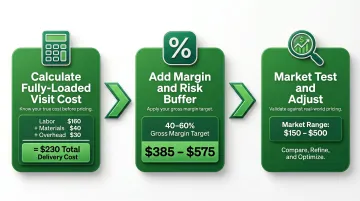
Step 1: Calculate fully-loaded cost per maintenance visit
- Technician labor: Median HVAC technician hourly wage is $28.75, but fully-loaded cost (wages + benefits + payroll taxes + insurance + vehicle) runs 1.25x-1.5x base wage, or approximately $36-$43/hour
- Visit time: Average maintenance visit takes 1.5-2 hours including travel
- Materials and consumables: Filters, cleaning supplies, minor parts typically $15-$25 per visit
- Overhead allocation: Office, insurance, licensing, software
Example calculation for two annual visits:
- Labor (2 visits × 2 hours × $40/hour): $160
- Materials (2 visits × $20): $40
- Overhead allocation: $30
- Total cost to deliver: $230
Step 2: Add margin and risk buffer
Target 40-60% gross margins on maintenance visits. If delivery costs $230, price the plan at $385-$575 to achieve this margin. For basic maintenance-only plans, pricing around $385 ($320 annual) provides healthy margins. For plans with repair coverage, add risk premium based on your modeled claim costs.
Step 3: Market-test and adjust
Compare your calculated price against the $150-$500 range where most residential plans fall. If your costs force pricing above market tolerance, reduce scope or improve operational efficiency rather than cutting margins below what your business can sustain.
How to Launch, Sell, and Grow Your Program — Step by Step
Step 1 – Finalize Your Plans and Build Your Contract
Write a simple, plain-language service agreement specifying:
- Scope of coverage: Exactly what services are included (tune-ups, inspections, filter changes)
- Exclusions: What's not covered (refrigerant, pre-existing conditions, equipment age limits)
- Service frequency: Number of visits and seasonal timing
- Payment terms: Annual vs. monthly, auto-renewal provisions, accepted payment methods
- Cancellation conditions: Notice requirements, refund policies, prorated refunds
- Response commitments: Guaranteed scheduling windows, emergency response times for premium tiers
Avoid industry jargon customers won't understand. Instead of "evaporator coil inspection and condensate drain flushing," say "cleaning and checking key system components to prevent breakdowns."
Have a business attorney review your contract, especially if the plan includes repair or parts coverage. This protects both parties and ensures your terms are enforceable.
Step 2 – Set Up Billing and Scheduling Systems
Recurring billing and automated reminders keep the program running without constant manual follow-up — and directly protect your renewal rates.
Billing automation:
- Offer monthly auto-pay options (lowers price resistance compared to annual lump sums)
- Set up annual auto-renewal with 30-day advance notice
- Use field service software or basic CRM with invoicing capabilities
Scheduling automation:
- Send appointment reminders 2 weeks and 48 hours before scheduled visits
- Provide service summaries after each visit documenting work performed
- Send renewal notices 30-45 days before expiration with easy online renewal links
Field service software can handle this, but even basic tools like QuickBooks paired with a calendar system work for small operators starting out.
Step 3 – Train Your Team to Sell During Service Calls
Once your systems are in place, selling becomes the growth lever. The highest-converting moment is during or immediately after a repair or install visit — the customer is engaged, the technician has credibility, and the cost of a breakdown is top of mind.
Script the conversation naturally:
"Mrs. Johnson, I just replaced your contactor and got your system running again. This is the second repair you've needed this year. Have you considered a maintenance plan? For about $17 a month, we'd come out twice a year to catch small issues before they become expensive breakdowns like this one. You'd also get priority scheduling and 15% off any future repairs."
Focus on what the customer avoids (surprise bills, long wait times, system failures during heat waves) rather than what they're buying.
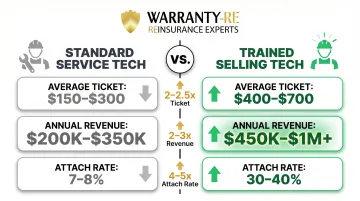
Technician incentives drive enrollment. Industry recommendations include $15 spiffs per complete system sold. Typical HVAC attach rates run 7-8%, but best-in-class operators reach 30-40% — a 4-5x gap driven by trained selling techniques and incentive alignment.
The revenue difference compounds fast. Service-only techs average $150-$300 tickets and $200K-$350K in annual revenue. Trained selling techs average $400-$700 tickets and $450K-$1M+.
Step 4 – Launch to Existing Customers First
Start the rollout with loyal, established customers rather than cold prospects. They already trust your company, are more likely to say yes, and provide useful early feedback on pricing and plan structure.
Simple rollout approach:
- Make personal follow-up calls after recent service visits
- Send targeted emails to customers who've used your services multiple times
- Offer limited-time introductory rates (10-15% discount for first-year sign-ups)
- Host a "VIP customer appreciation" event introducing the program
This generates early enrollment and social proof before you market to cold prospects.
Step 5 – Manage Renewals and Track Program Health
A service agreement program only compounds in value if renewal rates stay high. Industry data shows 80-85% annual retention for agreement customers, with 14% average cancellation rates.
Renewal management best practices:
- Track renewal dates in your CRM or field service software
- Send reminders 30-45 days before expiration with easy renewal options
- Follow up personally with customers who don't renew to understand why
- Offer modest discounts or perks for multi-year commitments
Key metrics to track:
| Metric | What It Measures | Target |
|---|---|---|
| Active agreements | Total enrolled customers | Grow month-over-month |
| Renewal rate | Customers renewing annually | 80%+ |
| Attach rate | Service calls converting to agreements | 25-30%+ |
| Revenue per agreement | Annual revenue including visit upsells | Track vs. prior year |
30-40% of tune-up visits result in paid repairs or equipment recommendations, meaning maintenance visits generate additional revenue beyond base agreement fees.
Volume benchmarks: Without dedicated maintenance staff, target approximately 250 agreements per $1M of service sales. With dedicated maintenance technicians, target 1,000 agreements per $1M of residential sales, with best-in-class reaching 1,500.
Going Beyond Service Agreements: Capturing the Full Profit From Your Warranty Program
Most HVAC contractors offering repair-inclusive service agreements are effectively running a warranty product—but they're absorbing the financial risk while third-party warranty providers keep the underwriting profit.
When you collect warranty fees on every job and build a customer-funded reserve pool, those accumulated premiums represent real money. With a third-party provider, you receive only a small commission while the provider retains the underwriting profit from unused reserves.
The alternative is owning your own warranty reinsurance company. Rather than paying a third-party provider to back your service agreements, contractors can establish their own administrator-obligor reinsurance structure that captures the premium income and underwriting profits.
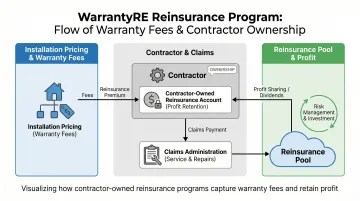
This is what WarrantyRE helps HVAC contractors set up and manage. Instead of warranty fees flowing to an external company, they accumulate in a reinsurance account you own 100%. When warranty claims arise, they're paid from your reinsurance pool. Any unused funds remain yours as profit—not a middleman's.
How the Structure Works
You build warranty fees directly into your installation proposal pricing—the homeowner is already paying for coverage. Those fees flow into your tax-advantaged reinsurance company, backed by A-rated insurers. WarrantyRE then handles the operational side so your team stays focused on installations:
- Claims adjudication and resolution
- Compliance management across all applicable regulations
- Program administration, financial reporting, and bookkeeping
- Legal forms, filings, and annual renewals
This approach is more profitable over time and gives you full control over claims handling, customer experience, and program pricing. Contractors who make the switch stop subsidizing a third party's margins and start building a reinsurance asset that grows with every installation they complete.
Conclusion
Setting up an HVAC service agreement program is one of the highest-leverage moves a contractor can make. It solves the seasonality problem, builds customer loyalty, and creates a business asset that grows in value over time.
Success comes down to executing the fundamentals correctly:
- Clear plan tiers that customers can easily understand and choose between
- Honest pricing built from your actual delivery costs — not a competitor's template
- A solid contract that protects both parties
- Consistent follow-through on renewals so the program compounds over time
Don't rush the launch. Build a program that's financially sustainable, operationally deliverable, and valuable to customers.
Once your service agreement program is running, the next question worth asking is where the warranty profit goes. Most contractors hand that margin to third-party providers. A reinsurance structure — like the programs WarrantyRE builds for HVAC contractors — puts that underwriting profit back in your own company instead.
Frequently Asked Questions
What does an HVAC service contract include?
Typical contracts include scheduled tune-ups (usually twice per year), system inspections, priority scheduling, and in higher-tier plans, repair discounts or parts coverage up to a set dollar amount. Basic plans focus on preventive maintenance, while premium plans add emergency response commitments and financial protection.
What is the 20 degree rule for HVAC?
The 20-degree rule refers to the expected temperature differential between return air entering the system and supply air exiting the vents during a cooling cycle. A properly functioning system should achieve approximately 18-22 degrees F temperature difference. Technicians check this during maintenance visits to assess system performance efficiency.
How much should an HVAC service agreement cost?
Typical residential agreements range from $150-$500 annually depending on scope and region. Basic maintenance-only plans typically cost $150-$200, while premium plans with repair coverage and emergency response run $300-$500. Pricing should be built from your actual cost of delivering service, not guessed at based on competitors.
How do you sell HVAC service agreements to customers?
The best time to sell is during or right after a service call, when the customer's trust in your technician is highest. Focus on what the customer avoids—surprise bills, long wait times, breakdowns during extreme weather—rather than what they're buying. Trained technicians can convert 25-50% of demand service calls into agreement sales.
What is the difference between an HVAC service agreement and a home warranty?
A service agreement is a contractor-managed plan covering scheduled visits, priority service, and optional repair discounts. A home warranty is a third-party product covering multiple home systems, where the warranty company controls pricing and service delivery — meaning the contractor loses control over both the customer experience and the profit.