

Introduction
Most contractors who lose a job assume it came down to price. Sometimes it does. But more often, the customer chose someone else because they weren't confident the work would hold up — and nobody gave them a reason to feel otherwise.
Warranties solve that problem directly. A well-structured warranty tells a homeowner the contractor believes in this installation enough to stand behind it for years. That kind of commitment is one of the most persuasive things you can say in a sales conversation.
The gap most contractors have isn't in the warranty itself — it's in how they use it. They mention coverage near the bottom of the proposal, treat it like a cost disclosure, and then wonder why customers are shopping around.
The contractors who close more jobs lead with the warranty. They bundle it into the total value and use it to reframe every price objection.
This article covers what contractor warranties actually mean, why homeowners care about them more than most contractors realize, how warranty presentation directly affects close rates, and who ends up profiting from your warranty program.
TL;DR
- Homeowners spending $7,500+ on HVAC or $10,000+ on a roof are managing risk — a strong warranty is your clearest signal.
- Contractors who bundle warranty coverage into the total job price see ~30% margins versus ~24% when offering it as a separate line item.
- Presenting four or more proposal options closes at 52% versus 42% for fewer options — warranty scope is one of the most effective variables to differentiate tiers.
- Every dollar paid to a third-party provider that doesn't fund a claim is profit you gave away.
What Are Contractor Warranties?
Manufacturer vs. Workmanship Coverage
Most homeowners assume manufacturer warranties cover everything that could go wrong after an installation. They don't.
A manufacturer warranty covers defects in the equipment itself: a failed compressor, a cracked heat exchanger, a defective control board. Trane's base limited warranty typically covers parts for five years; registered coverage can extend that to ten years. Lennox offers up to 20-year or limited lifetime coverage on heat exchangers depending on the model.
In most cases, labor is explicitly excluded unless an optional extended warranty is purchased separately.
That exclusion has real consequences. If a Trane system fails in year three due to a refrigerant leak caused by improper installation, the manufacturer covers the part. The homeowner pays for the technician's time, the return trip, and any associated labor costs.
That's where contractor workmanship warranties come in. They cover the quality of the installation itself: ductwork, refrigerant connections, hangers, startup procedures, and any custom work performed on-site.
Homeowners can't see whether ductwork was properly sealed or refrigerant was correctly charged. The workmanship warranty is what protects them from an out-of-pocket repair bill if it wasn't.
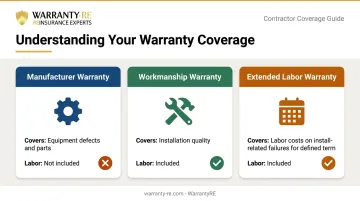
| Coverage Type | What It Covers | Labor Included? |
|---|---|---|
| Manufacturer warranty | Equipment defects (parts) | No — unless separately purchased |
| Workmanship warranty | Installation quality | Yes |
| Extended labor warranty | Labor costs on install-related failures | Yes, for defined term |
Extended Labor and Correction Period Warranties
Two additional warranty types come up frequently:
- Extended labor warranties — contractor-offered coverage that protects customers against labor costs on installation-related failures for a defined number of years, commonly five to ten years beyond the standard period.
- Correction period warranties — the contractual obligation to return and fix non-conforming work within a defined period after completion. This is often called the "one-year warranty," but that framing is misleading. As the AIA notes, it's technically a one-year correction period, not a one-year warranty — a contractor's broader quality obligation can extend well beyond it under law.
Why Customers Care About Warranties More Than You Think
When a homeowner spends $7,500 on an HVAC replacement — or closer to $9,500 on a roof — they're not making a simple purchase decision. They're making a risk decision. They're asking: what happens if something goes wrong?
Most homeowners can't evaluate installation quality. They can't see whether refrigerant was properly charged or whether flashing was correctly installed. So they rely on proxies. And according to a BNP/ACHR survey, 49% of homeowners rated the HVAC equipment warranty as extremely important in their purchasing decision — almost as many as those who rated contractor reputation extremely important (56%).
Warranty length and scope function as a stand-in for workmanship confidence. A contractor offering ten years of labor coverage is implicitly saying: we're good at this, and we'll prove it.
The "Living Room" Effect
Butch Welsch of Welsch Heating & Cooling put it plainly in ACHR News: warranties have "kept us in the living room or on the kitchen table because some of the other contractors have been offering them." He wasn't certain warranties alone won jobs, but he was certain they kept the conversation alive, even when competitors were bidding lower.
That's the real function of a strong warranty in a competitive market. It doesn't just close deals; it keeps you in consideration long enough to make your case.
Trust, Risk, and Referrals
A warranty does something more direct than list coverage terms: it shifts the risk of something going wrong from the customer back to the contractor. For a homeowner with no way to verify workmanship quality, that shift matters enormously.
That trust compounds over time. In the roofing industry, 79% of homeowners sought contractors through word-of-mouth, and referrals drove trust for 88% of them. Customers who feel protected tend to:
- Call the same contractor for future service
- Recommend that contractor to neighbors and family
- Leave stronger reviews that attract the next customer
A warranty isn't just a sales tool. It's a loyalty mechanism that keeps working after the job is done.
The Direct Link Between Warranties and Close Rates
What the Numbers Say
The clearest data on contractor warranties and close rates comes from the ACCA/Farmington Consulting "Contractor of the Future" study, as reported by ACHR News:
- ~58% of HVAC contractors currently offer extended labor warranties
- Contractors who bundle the warranty into the total job price achieve approximately 30% margins
- Contractors who offer the warranty as a separate line-item add-on average approximately 24% margins
- Contractors presenting four or more proposal options close at 52%, versus 42% for those with fewer options
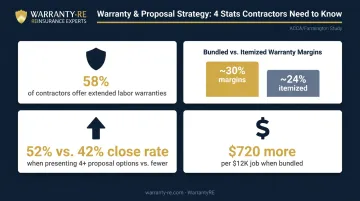
The margin difference alone is worth paying attention to. Six percentage points on a $12,000 install is $720 per job. Multiply that across a busy season and bundling becomes one of the highest-leverage decisions in your proposal process.
The Cost-Per-Close Math
Here's why close rate improvements have a disproportionate effect on business profitability:
Assume your lead generation and sales costs run $2,500 per week. At a 25% close rate on ten leads, you close 2.5 jobs — meaning your cost per closed job is $1,000. At a 50% close rate on the same ten leads, you close five jobs — and your cost per closed job drops to $500. Same spending. Same leads. Half the cost per sale, simply from closing more of what you're already seeing.
Warranties are among the most controllable factors that move customers from hesitation to yes — and how you present them matters as much as whether you offer them at all.
Differentiation Against Low-Bid Competitors
Price comparison only works when two bids look similar. When one proposal includes ten years of labor coverage and the other doesn't mention it, customers aren't comparing two prices anymore — they're evaluating two different offers.
The higher bid suddenly feels like the lower-risk option. Making warranty coverage prominent in your proposal reframes the conversation before price ever becomes the deciding factor.
Warranties as a Bridge to Recurring Revenue
Beyond closing the initial job, strong warranty coverage creates a natural path to maintenance agreement conversions. According to ACCA, recurring service agreements represent 55% of HVACR industry revenue. A customer with an active ten-year labor warranty has a direct reason to maintain a service relationship with the same contractor — their coverage may even require staying with the same contractor. That's not just a closed install; it's the beginning of a long-term revenue relationship.
How to Present Warranties During the Sales Conversation
How you present a warranty matters as much as what the warranty covers. The same ten-year labor warranty can feel like a compelling differentiator or an afterthought, depending entirely on when and how it comes up.
Lead Early, Not at the Close
Introduce warranty coverage in the first third of the conversation — not as a closing tactic at the end. When you bring up warranty terms early, alongside financing options, it positions you as a contractor who's confident in the work rather than one who's trying to justify a price. By the time you get to cost, the customer has already anchored to the value.
Waiting until the customer pushes back on price to mention the warranty makes it feel like a last-ditch sweetener. That's the opposite of what you want.
Use Tiered Options with Warranty as a Variable
The ACCA data shows that four or more proposal options close at 52% versus 42% for fewer options. Warranty scope is one of the most effective variables for separating tiers:
| Tier | Coverage | Labor Warranty |
|---|---|---|
| Good | Standard equipment | 1-year workmanship |
| Better | Higher-efficiency equipment | 5-year extended labor |
| Best | Premium equipment + add-ons | 10-year extended labor |
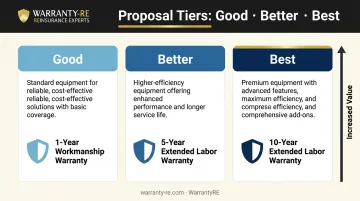
This structure gives customers a meaningful choice — and makes the warranty, not just the equipment, a reason to move up a tier.
Bundle, Don't Itemize
When a warranty appears as a separate line item, customers evaluate whether to buy it. When it's part of the total package, they evaluate the overall offer. That framing shift is where the margin difference shows up: 30% when bundled versus 24% when itemized.
Be Specific About What's Covered
Vague warranty language doesn't build confidence. Tell customers exactly what the warranty covers: all labor performed during the installation, including ductwork, hangers, insulation, electrical connections, refrigerant charging, and any custom work. The more specific you are, the more credible the offer sounds.
Reframe Price Objections with Total Cost of Ownership
When a customer says the price is too high, redirect the conversation:
"What would a service call cost you in year four with no labor coverage? At current rates, you're looking at $300–$500 just for the trip and labor, before parts. This warranty eliminates that exposure for ten years."
You're shifting the comparison from upfront price to ten-year cost of ownership — and that's a much easier number to win on.
Who Profits from Your Warranty Program?
If you're using a third-party warranty provider, someone is making money from every job you close. The question is whether it's you or them.
Third-party providers work like this: you pay a premium per job, they absorb claims, and whatever's left after claims — the underwriting profit — stays with them. For quality contractors with low callback rates, that spread can be significant. If they weren't profitable on your business, they'd stop doing business with you.
The Contractor-Owned Alternative
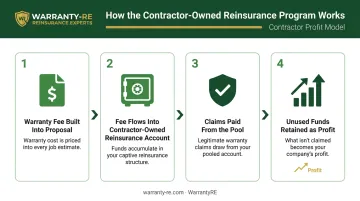
Contractors can structure their own warranty program through a reinsurance model — collecting warranty fees built into job pricing, covering claims from that pool, and retaining what isn't used as underwriting profit.
The mechanics are straightforward:
- A small warranty fee is built into every proposal — the homeowner already pays it
- That fee flows into a reinsurance account owned by the contractor
- Claims are covered from the pool when they arise
- Unused funds stay with the contractor
Beyond profit retention, the structure comes with meaningful tax advantages — contributions to the reinsurance account can reduce taxable income, keeping money inside a structure that builds value rather than going to the IRS.
WarrantyRE has helped HVAC, roofing, plumbing, and electrical contractors replace third-party warranty arrangements with contractor-owned reinsurance programs since 1994. The company handles all program administration — claims adjudication, compliance, tax filings, financial reporting — so contractors don't take on operational burden.
If you're paying a third-party provider and running low callback rates, calculating what you could be keeping is a straightforward exercise. Learn more about contractor-owned reinsurance programs at WarrantyRE.
Frequently Asked Questions
What is the difference between a manufacturer's warranty and a contractor's labor warranty?
A manufacturer's warranty covers defects in the equipment itself — a failed compressor or faulty heat exchanger. A contractor's labor warranty covers the installation: ductwork, connections, startup procedures, and workmanship. The manufacturer's coverage doesn't include what the contractor did on-site.
Should I include the warranty cost in the job price or offer it as a separate add-on?
Include it in the total price. The ACCA/Farmington survey data, as reported by ACHR News, shows contractors who bundle the warranty into the job price achieve ~30% margins versus ~24% for those who offer it as a line-item add-on. Customers are also less likely to decline it when it's built into the overall value package.
How long should my extended labor warranty be to actually influence customers?
Ten years is the most common extended labor warranty length in HVAC, and matching or exceeding competitors is the floor. Warranty length should also align with the system's expected service life, so a ten-year warranty on a system built to last 15–20 years reads as credible and proportionate.
How do extended warranties help me compete against lower-priced contractors?
When warranty coverage is prominently featured, customers stop comparing prices and start comparing risk. A ten-year labor warranty on a higher bid makes the lower bid feel like the riskier choice — especially when customers can't evaluate installation quality themselves.
What work should a contractor's workmanship warranty cover?
It should cover all labor performed during the installation — ductwork, insulation, hangers, electrical connections, refrigerant charging, and any custom work. The warranty should protect the homeowner against failures caused by how the job was done, not just what was installed.
Can contractors actually profit from their warranty program rather than just using it as a sales tool?
Yes. Through a contractor-owned reinsurance structure, warranty fees flow into an account the contractor owns. Claims are paid from that pool, and unused funds (the underwriting profit) stay with the contractor instead of going to a third-party provider.