
Introduction
Homeowners are asking tougher questions before they sign roofing contracts. More often than not, those questions center on workmanship warranties — specifically, what happens if installation errors cause leaks or structural issues years down the road. Contractors without a formal warranty program face an uncomfortable choice: make vague verbal promises that create liability without protection, or lose competitive bids to contractors who offer documented guarantees.
According to a 2006 survey by Roofing Contractor magazine, 71% of contractors who won the job offered an enhanced warranty, compared to only 30% of contractors who merely quoted. Winning often comes down to whether you can confidently stand behind your work with a formal, financially backed program.
What follows is a practical, step-by-step guide for roofing company owners who want to build a warranty program that holds up — both for customers and for the business — without creating unfunded liabilities or open-ended repair exposure.
TL;DR
- A workmanship warranty program is a contractor-managed guarantee covering installation quality for a defined period
- Setup involves defining scope and duration, drafting legal documents, and building a structured claims process
- Without financial backing, warranty obligations can expose your company to serious out-of-pocket costs
- A well-structured program helps win competitive bids, build customer trust, and generate repeat business
What Is a Workmanship Warranty Program for Roofing Contractors?
A workmanship warranty program is a contractor-managed system that guarantees installation quality — separate from manufacturer coverage on materials. It creates a direct accountability relationship between your roofing company and the customer, covering defects that result from installation errors rather than product failures.
The Critical Distinction: Workmanship vs. Manufacturer Warranties
CertainTeed states clearly: "Contractors warrant their workmanship. Manufacturers, on the other hand, warrant the roofing material against defects in manufacturing." Both warranties protect the customer's roofing investment, but they cover different types of risk.
Workmanship warranties cover:
- Flashing failures at valleys, dormers, and chimneys from improper installation
- Incorrect nailing patterns that fail to meet manufacturer specifications
- Poor shingle overlap causing water infiltration
- Faulty pipe boot installation leading to leaks
- Repair costs — labor and materials — for installation-related damage
- Interior damage traced back to installation failures
Manufacturer warranties cover:
- Defective shingles (premature granule loss, manufacturing flaws)
- Product failure under normal use conditions
- Material replacement (but often not labor)
Owens Corning explains that workmanship warranties "should protect you against material failures that occur because of worker errors or improper installation techniques" — typically covering the cost of labor and any materials needed to repair the roof.
Program Formats: From Simple to Fully Backed
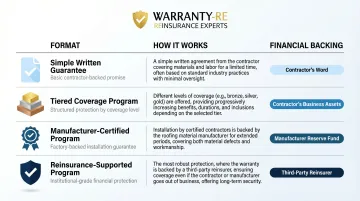
Workmanship warranty programs range in structure and financial backing:
| Format | How It Works | Financial Backing |
|---|---|---|
| Simple written guarantee | Documented labor promise for 1-5 years | Contractor's own capital |
| Tiered coverage program | Standard, premium, or extended levels tied to scope and price | Contractor's own capital |
| Manufacturer-certified programs | Coverage backed by GAF, CertainTeed, or Owens Corning; requires certification and full-system installs | Manufacturer reserves |
| Reinsurance-supported program | Contractor establishes their own warranty company funded by customer premiums, controlling claims and keeping underwriting profits | Customer premium pool |
What to Know Before You Build Your Program
The Gap Between Verbal Promises and Legal Protection
Most roofing companies already offer some form of workmanship guarantee. The problem: without documentation, defined terms, and a claims process, informal warranties provide no legal protection for the contractor and no real assurance for the customer. Worse, many states impose implied warranties of workmanship on contractors regardless of whether a written warranty exists.
State-specific examples:
- Florida and Texas: Implied warranty of "good workmanship and habitability." Contractors can disclaim warranties only if contract language "leaves no doubt about what's covered and what's not."
- New York: Implied warranty that work be done with "reasonable care and competence." Disclaimers are "unlikely to work."
- Kansas: Implied warranty of "fitness for purpose" cannot be disclaimed. Violations may result in fines up to $10,000.
Source: Craftsman Book Company, "Construction Warranty in 50 States"
Three Realities That Shape Program Design
Three factors will define how sustainable your program actually is:
- Liability accumulates over time. A 10-year workmanship warranty creates a decade of repair exposure on every roof you install. Without a reserve fund or backing mechanism, that obligation grows alongside your business.
- Installation quality is your best cost control. Poor documentation standards, inconsistent crew training, and weak quality control drive claim frequency. Rigorous installation practices reduce exposure more than any warranty language.
- Reserves determine whether promises get kept. Offering a warranty without financial backing is a promise you may not honor. Contractors who go out of business leave homeowners with worthless paper — and expose themselves to liability under consumer protection laws.
Legal and Regulatory Requirements
Those financial and operational realities don't exist in a vacuum — they intersect directly with legal compliance requirements. State contractor licensing laws, consumer protection regulations, and warranty language requirements vary significantly by jurisdiction. Before finalizing any warranty document, consult a legal professional familiar with construction warranty law in your service area. Generic templates may not comply with local requirements and can create enforcement problems later.
How to Set Up a Workmanship Warranty Program – Step by Step
Step 1 – Define What Your Warranty Covers (and What It Doesn't)
Vague warranty language is the fastest path to a claim dispute. Spell out exactly what's covered and what isn't — before a homeowner ever calls.
Installation errors your warranty should cover:
- Improper flashing installation causing leaks at roof penetrations
- Incorrect nailing patterns that fail to meet manufacturer specifications
- Poor shingle overlap allowing water infiltration
- Faulty pipe boot installation resulting in leaks
- Inadequate ventilation causing premature shingle failure (if part of your scope)
- Structural damage caused by installation errors
GAF workmanship coverage specifically protects against "misapplication" of products and installation errors involving "Covered Flashings" at valleys, dormers, chimneys, and plumbing vents. If GAF determines an application error occurred, they arrange repair or provide replacement products and reimburse "the full reasonable cost of labor and materials."
Define clear exclusions to prevent disputes:
- Storm damage (wind, hail, tornado)
- Acts of God and natural disasters
- Ice dams and snow load damage
- Damage from third-party work (HVAC installers, satellite dish installers)
- Normal wear and tear after warranty expiration
- Pest-related damage (raccoons, squirrels)
- Damage from lack of maintenance
- Pre-existing conditions not disclosed before installation
Owens Corning workmanship warranties generally exclude "storms, high winds, ice dams, alterations made after installation, foot traffic, or falling debris/tree limbs." These exclusions align with industry norms and allow objective claim assessment.
Case study: What happens without clear language
In Kapper v. Valantine Roofing (2026-Ohio-103), a contractor provided a "ten-year labor warranty" but failed to specify transferability terms. When the home was sold, the new owner filed a claim for flashing installed on top of shingles rather than beneath — a clear IRC violation. The court ruled the warranty was freely transferable because the contract didn't state otherwise, and the contractor was liable for $6,000 under the Ohio Consumer Sales Practices Act.
Every exclusion, coverage limit, and transferability term must be explicitly stated in the warranty document. Ambiguity in your language becomes the homeowner's leverage in a dispute.
Step 2 – Set Your Warranty Duration and Tier Structure
Industry Duration Benchmarks
CertainTeed states that "contractor workmanship warranties typically are for one to five years." This represents the baseline for independent contractors offering self-funded warranties.
Manufacturer-certified programs extend workmanship coverage significantly:
- GAF Silver Pledge: 10 years
- GAF Golden Pledge: 25 years (30 years for Timberline UHDZ)
- CertainTeed SELECT ShingleMaster 5-Star: 25 years
- Owens Corning Preferred Protection: 10 years
- Owens Corning Platinum Protection: Limited Lifetime (reduced after 25 years)
Use these benchmarks to position your program competitively. A 5-year self-funded warranty is credible for most residential installations. A 10-year warranty differentiates you from competitors offering shorter coverage. Programs extending beyond 10 years typically require manufacturer backing or reinsurance support.
Tiered Warranty Structure
GAF's tiered model provides a practical template:
| Tier | Workmanship Coverage | Contractor Certification | Min. Accessories |
|---|---|---|---|
| Shingle & Accessory | None | None | 0 |
| System Plus | None | GAF Certified or higher | 3 |
| Silver Pledge | 10 years | GAF Certified Plus or Master Elite | 4 |
| Golden Pledge | 25 years | GAF Master Elite | 5 |
| President's Club | 40 years | GAF 3 Star President's Club Award Winner | 5 |
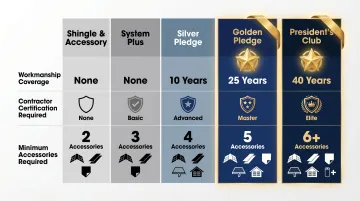
Source: GAF Residential Roof Warranty Comparison Guide
How to structure your own tiers:
- Standard (1-3 years): Basic installations, economy shingles, minimal accessory coverage
- Premium (5-7 years): Mid-tier installations, architectural shingles, full system components
- Extended (10+ years): Premium installations, designer shingles, enhanced underlayment, backed by manufacturer certification or reinsurance
Tie warranty duration to price point and installation scope. Homeowners paying for premium materials expect longer workmanship coverage. That creates a natural sales conversation where the warranty becomes a value justification rather than a cost objection.
Consumer behavior supports tiered pricing
In the Roofing Contractor 2006 survey, homeowners consistently chose contractors whose bids were on average 17% higher than the lowest quote. Value-based purchasing is real — documented warranty programs reduce buyer risk perception and justify premium pricing.
Step 3 – Draft a Clear, Legally Sound Warranty Document
Core Components of the Warranty Document
- Covered party identification — Property owner name and address, installation date, job completion date, signature and date fields for both parties
- Covered scope and exclusions — Specific installation errors covered (per Step 1) and explicit exclusions; use bullet lists, not paragraph blocks
- Warranty duration — Start date, end date, and any reduction schedules (e.g., "coverage reduces to 50% after year 5")
- Claims process — How to file, required documentation, response timeline, inspection procedure, repair authorization; include phone, email, and mailing address
- Transferability terms — State explicitly whether the warranty transfers, under what conditions, and whether a transfer fee applies; if non-transferable, write: "This warranty is non-transferable and terminates upon sale of the property"
- Signature and date fields — Both contractor and homeowner must sign; deliver a copy to the homeowner at job closeout
Legal Requirements: Magnuson-Moss Warranty Act
The FTC's Magnuson-Moss Warranty Act applies to written warranties on consumer products. When a contractor warranty covers both parts and labor (which roofing warranties typically do), the Act applies.
Key requirements:
- Warranties covering products over $15 must include specific disclosures
- Warranties covering products over $10 must be titled "Full" or "Limited"
- A "Limited" warranty may restrict implied warranties to match the written warranty period
- A "Full" warranty may not limit implied warranties at all
- Tie-in sales are prohibited (you cannot require homeowners to use a specific repair service to maintain the warranty unless provided free)
Avoid vague language that creates disputes
Terms like "lifetime coverage," "full protection," or "complete guarantee" without defined parameters create legal risk. Courts interpret ambiguous warranty language against the drafter — that's you.
Better alternatives:
- "Lifetime" → "Coverage for 10 years from installation date"
- "Full coverage" → "Covers labor and materials for installation-related defects as defined in Section 2"
- "Complete guarantee" → "Limited warranty covering workmanship defects excluding storm damage and normal wear"
Final step: Legal review
Have a construction attorney in your state review the final document before use. State-specific consumer protection laws, contractor licensing regulations, and warranty enforceability standards vary. A $500 legal review prevents $50,000 liability exposure.
Step 4 – Build a Claims Handling Process
End-to-End Claims Workflow
Customer submits claim:
- Homeowner contacts your claims line (dedicated phone/email)
- Intake form captures: homeowner contact info, property address, warranty number, description of issue, photos if available
- Acknowledgment sent within 24 hours confirming receipt
Assessment and documentation:
- Schedule on-site inspection within 5-7 business days
- Document issue with photos (100+ images showing damage, surrounding context, installation details)
- Compare installation photos from original job to current condition
- Determine whether issue is covered under warranty terms or falls under exclusion
- Provide written determination within 3 business days of inspection
Repair authorization and timeline:
- If covered: Issue repair authorization, assign crew, schedule repair within 14 days
- If excluded: Provide written explanation citing specific warranty exclusion clause, offer paid repair estimate
- For disputes: Escalate to owner/manager for review before final denial
Job documentation standards that support claims adjudication:
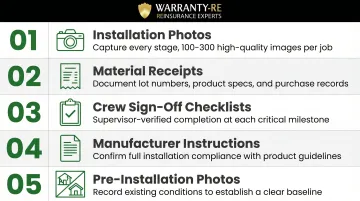
Without thorough documentation at installation, you cannot defend against fraudulent or unjustified claims. Establish these minimum standards:
- Installation photos: 100-300 images per job showing every critical detail (flashing, valleys, penetrations, starter course, ridge caps, drip edge, underlayment overlap)
- Material receipts: Proof of manufacturer specifications, product lot numbers, and quantities
- Crew sign-off checklists: Field supervisor confirms each installation step meets manufacturer requirements and company standards
- Manufacturer installation instructions: Document which instructions were followed and any deviations approved by manufacturer
- Pre-installation condition photos: Document existing roof condition to distinguish pre-existing damage from installation-related issues
Store all documentation for the duration of the warranty period plus one year. Use cloud storage with job number indexing for fast retrieval.
Claims cost benchmarks (for budgeting purposes):
Understanding typical repair costs helps you budget reserves and assess claim validity.
| Repair Type | Average Cost Range |
|---|---|
| Flashing repair/replacement | $200 - $500 |
| Vent/pipe boot repair | $75 - $250 |
| Roof leak repair | $360 - $1,550 |
| Hole patching | $100 - $1,000 |
| Partial re-roofing (100 sq ft) | $350 - $1,200 |
Source: Angi, "How Much Does Roof Repair Cost? [2026 Data]"
These are retail homeowner-facing costs. Your internal warranty work costs exclude markup but include labor, so actual exposure per claim is typically 40-60% of these figures.
Step 5 – Train Your Team and Launch the Program
Connecting Training to Warranty Exposure
Every crew member needs to understand the financial link between their work and warranty claims. One improperly installed pipe boot can cost $500 to fix. At 100 jobs annually, poor training becomes a $50,000 liability — one that comes straight off your margin.
Field crew training checklist:
- Manufacturer installation requirements for every product used
- Company quality standards exceeding manufacturer minimums
- Critical inspection points before sign-off (flashing, valleys, penetrations)
- Documentation responsibilities (photos, checklists, material verification)
- Consequences of quality failures (warranty claims reduce profitability)
Field supervisor responsibilities:
- Final quality inspection before job closeout
- Photo documentation verification (100+ images minimum)
- Crew sign-off checklist completion
- Warranty document delivery to homeowner at final payment
Customer-facing launch process:
Update proposal templates — Add warranty section highlighting coverage duration, scope, and claims process. Frame as a value differentiator, not just a legal requirement.
Sales team training — Brief every salesperson on how to present the warranty as risk reduction. Script: "Our 5-year workmanship warranty means if anything goes wrong due to installation error, we fix it at no cost to you. Most contractors offer verbal promises. We put it in writing."
Warranty issuance at job closeout — Every completed job includes a signed warranty document delivered to the homeowner with final invoice. File a copy in the job folder and digital archive.
How to Protect Your Business from Warranty Financial Risk
The Unfunded Liability Problem
The biggest operational risk of a workmanship warranty program is unfunded liability. A contractor who offers a 10-year warranty but has no reserve or backing mechanism is personally exposed to every future claim. As your company grows and the volume of warranted installations increases, this exposure compounds.
Example: A roofing company completing 100 jobs annually with 10-year workmanship warranties creates 1,000 active warranty obligations after 10 years of operation. If just 5% of those roofs require warranty work averaging $800 per claim, that's $40,000 in unfunded liability in a single year.
Two Common Approaches (and Their Limitations)
Self-funding through warranty reserve
Set aside 1-2% of every job's sale price into a dedicated warranty reserve account. According to Roofing Contractor magazine, contractors should bill warranty repairs at normal service rates and draw payment from the reserve fund, ensuring the service department operates as a profit center.
Limitations:
- Reserves can be depleted by higher-than-expected claims
- No external backing if claims exceed reserves
- Funds sit idle rather than generating returns
- No tax advantages
Third-party warranty insurance
Purchase coverage from a third-party warranty provider who assumes the risk and handles claims.
Limitations:
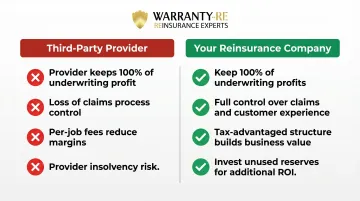
- Third-party providers capture 100% of underwriting profit
- Loss of control over claims process and customer experience
- Monthly or per-job fees reduce margins
- Provider may go out of business, leaving warranties unfunded
Reinsurance: The Advanced Option for Growing Roofing Contractors
Reinsurance allows contractors to establish their own administrator obligor reinsurance company — a structure you own and control. Rather than paying a third-party provider to hold warranty risk, you fund warranty obligations through customer premiums, retain control over claims, and capture the underwriting profit.
How the structure works:
You build a warranty fee into every job ($500-$1,000 depending on job size and warranty duration). That fee flows into your reinsurance company rather than to an external provider. When warranty claims arise, they're covered from the reserves accumulated in your account. Any premiums not used for claims remain your property — captured as underwriting profit in a tax-advantaged structure.
Key advantages over third-party providers:
- Keep 100% of underwriting profits instead of paying them to an external company — over 10 years, that compounds into a significant business asset
- Control the claims process directly, protecting the customer relationship and your reputation
- Capture meaningful tax benefits by redirecting money that would otherwise go to tax obligations into a structure that builds business value
- Invest unused reserves for additional ROI rather than letting funds sit idle with a third party
Financial backing and protection
The reinsurance structure is backed by an A-rated insurance carrier, providing the same institutional credibility as manufacturer-backed programs. If your reinsurance company's reserves prove insufficient, the A-rated carrier covers the shortfall — protecting both you and the homeowner.
WarrantyRE: Full-Service Reinsurance for Roofing Contractors
Since 1994, WarrantyRE has helped roofing contractors stop funding third-party warranty providers and start building their own. The full-service program covers everything needed to get your reinsurance company running and compliant:
- Company formation and regulatory compliance
- Legal filings, tax returns, and annual renewals
- Claims adjudication and performance reporting
- Ongoing administration and staff training
Contractors stay focused on roofing. WarrantyRE handles the rest.
Turning Your Warranty into a Sales and Customer Retention Tool
Incorporate the Warranty into Your Sales Process
Present during estimates as risk reduction
When you hand a homeowner your proposal, include a dedicated warranty section that highlights coverage duration, scope, and claims process. Frame it as protection: "Our 5-year workmanship warranty means you're covered if anything goes wrong due to installation error. We stand behind our work in writing."
Frame warranty tiers as customer choice
Offer three options:
- Standard (3 years): Basic protection for budget-conscious homeowners
- Premium (5 years): Most popular, balanced coverage and value
- Extended (10 years): Full coverage through the most claim-prone years, ideal for premium installations
Train salespeople to present tiers as choice rather than upsell. Script: "Most homeowners choose the 5-year premium warranty because it covers the critical period when installation issues typically appear. Which level of protection makes sense for you?"
Address objections from price-conscious prospects
When homeowners push back on price, redirect to warranty value. Script: "The lowest bid might save you $1,500 today, but if there's a leak in year two and the contractor won't fix it, you'll pay $2,000 out of pocket. Our warranty eliminates that risk. You're not just buying a roof — you're buying protection."
Post-Installation Touchpoints That Reinforce Warranty Value
Welcome packet with warranty documentation
Within 48 hours of job completion, mail or email a welcome packet containing:
- Signed warranty certificate
- Claims contact information
- Maintenance tips to maximize roof lifespan
- Referral request card with incentive
Annual check-in or maintenance reminder
At the one-year anniversary, send a maintenance reminder email:
- "Your roof warranty is in year 1 of 5 — here's how to keep it in top condition"
- Offer optional inspection for a nominal fee
- Include referral request
These touchpoints keep your company top of mind without feeling intrusive — and they set up a natural moment to ask for referrals.
Six months post-installation, send a satisfaction survey: "Are you confident your roof is covered? If you're satisfied with our warranty program, we'd appreciate a referral."
According to a long-standing Roofing Contractor industry survey, 95% of homeowners said they would recommend their contractor to others, and 75% of all leads come from friends, neighbors, and relatives. A formal warranty program gives satisfied customers a concrete reason to refer.
Transferable Workmanship Warranty as a Home Value Asset
A transferable workmanship warranty can be positioned as a home value asset during property sales. When a homeowner sells their property, the warranty transfers to the new buyer — giving the seller a reason to mention your company to their real estate agent, buyers, and neighbors.
How to structure transferability:
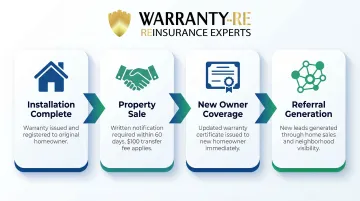
- State explicitly in the warranty document: "This warranty is transferable to one subsequent owner within the warranty period upon written notification and payment of a $100 transfer fee."
- Require new owner to notify you within 60 days of sale
- Update records and issue new warranty certificate to new owner
- Market this feature: "Our transferable warranty adds value when you sell your home."
This approach keeps your company visible in the homeowner's network and generates future leads from home sales.
Frequently Asked Questions
What is the standard workmanship warranty on a roof?
Standard contractor workmanship warranties typically range from 1 to 10 years, with most independent contractors offering 1-5 years. Premium programs offered by manufacturer-certified contractors can extend to 25 years or more, depending on the installation scope and backing structure.
How long is a contractor liable for a roof?
Written warranty terms, state statutes of limitations, and implied warranty protections under local consumer protection law all determine how long a contractor remains liable. A clearly drafted warranty document with defined duration and exclusions is essential to limit exposure.
Do you need to activate a warranty?
Workmanship warranties should be formally issued and signed at job closeout. For manufacturer extended warranties, registration within a specified timeframe — often 60 days — is typically required to keep coverage valid.
What should a roofing workmanship warranty document include?
A complete warranty document must include:
- Covered party name and property address
- Covered scope and exclusions
- Warranty duration and start date
- Claims process and contact details
- Transferability terms
- Contractor and customer signatures with installation date
Can offering a workmanship warranty help a roofing company win more jobs?
Yes. A formal workmanship warranty is a credibility signal that differentiates contractors during competitive bids. Industry data consistently shows that contractors who present documented, tiered warranties close more bids — especially when the program includes a clear claims process homeowners can verify.