Introduction
HVAC contractors face a critical decision that shapes their profit margins, customer loyalty, and long-term growth: how they structure their warranty programs. Here's the problem: every time you outsource warranty administration to a third-party provider, you're funding someone else's profit center with money that could remain in your business. 58% of HVAC contractors currently offer extended labor warranties, yet most don't realize they're leaving substantial underwriting profits on the table.
That profit gap comes down to program structure. Manufacturer-backed coverage, third-party service contracts, and reinsurance-backed programs differ significantly in who owns the risk, who captures the margin, and how much administrative control stays with your business.
The right structure doesn't just protect customers from repair costs — it creates recurring revenue and builds long-term business value for you.
This guide covers what an HVAC warranty program actually is, the key factors to evaluate when choosing one, and how to identify a structure that keeps more profit in your business.
TL;DR
- An HVAC warranty program is a service agreement covering equipment repairs or replacements after installation—structured either as a third-party contract or one you own and profit from
- Choosing the right program comes down to coverage scope, profit model, claims management, and whether it scales with your business
- With a reinsurance-backed program, you recapture the underwriting profits that third-party providers otherwise keep
- Done right, your warranty program becomes a recurring revenue stream that reduces liability and keeps customers coming back
What Is an HVAC Warranty Program for Contractors?
An HVAC warranty program is a structured agreement you offer customers that covers the cost of repairs or replacements on installed systems for a defined period. This differs from manufacturer warranties, which cover equipment defects, and homeowner warranty plans, which consumers purchase independently. Contractor programs are business tools designed to protect your revenue and customer relationships.
Types of HVAC Warranty Programs
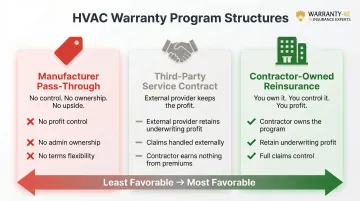
HVAC contractors typically work with one of three program structures:
Manufacturer pass-through warranties simply relay coverage from the equipment brand. You have no control over terms, administration, or profitability. In practice, you're administering someone else's program without sharing in its profits.
Third-party service contracts involve an external company that administers coverage in exchange for premiums. The third party handles claims and keeps all underwriting profit—the difference between premiums collected and claims paid. Every dollar they earn from your customers' premiums is a dollar your business doesn't see.
Contractor-owned reinsurance programs position your business as the obligor, supported by an A-rated insurer. You retain underwriting profits, control claims processes, and build a parallel revenue stream. The key difference: you profit from the premium collected instead of paying someone else to do it.
Understanding which structure fits your business starts with knowing why contractors invest in these programs in the first place.
Why HVAC Contractors Rely on Warranty Programs
Contractors invest in warranty programs for measurable business reasons:
- Reduce out-of-pocket exposure for post-installation service calls
- Increase close rates on new equipment sales—offering 4+ proposal options (including warranty tiers) boosts close rates from 42% to 52% and premium equipment sales from 26% to 42%
- Create customer loyalty and repeat business—recurring service agreements now represent 55% of total HVACR industry revenue
Warranty programs differentiate your business in competitive markets. Customers comparing bids are more likely to choose a contractor offering post-installation protection over one who doesn't. Contractors with automated warranty tracking achieve 81% renewal rates versus 58% for manual processes—proof that program structure directly impacts retention.
Key Factors to Consider When Choosing an HVAC Warranty Program
Selecting a warranty program involves more than comparing price. Each factor below connects directly to measurable business outcomes—margins, customer churn, legal risk. The right combination depends on your business size, service volume, and growth goals.
Coverage Scope and Exclusions
Coverage depth matters to your reputation, not just the customer. Programs with excessive exclusions generate claim denials that damage your customer relationship, even when you followed all guidelines. Look for programs that clearly define covered components:
Typically covered:
- Compressors, heat exchangers, electrical components
- Condensers, evaporator coils, blower motors
- Control boards, gas valves, thermostats
- Labor costs for repairs
Common exclusions:
- Improper installation or unlicensed work—the #1 reason warranty claims are denied
- Lack of routine maintenance (dirty coils, clogged drains, old filters)
- Acts of nature (lightning, floods, power surges)
- Cosmetic damage or minor adjustments
Map coverage terms against equipment you commonly install. A warranty covering high-failure components on mid-range systems protects both your business and the customer far better than vague coverage language.
Profit Model and Premium Ownership
The profit model is the most consequential selection factor for long-term business health. In standard third-party arrangements, you collect premiums from customers and pass them to a provider—that provider earns the underwriting profit (premiums minus claims). You're funding a competitor's revenue stream.
The reinsurance-backed alternative works differently. You establish your own administrator obligor company supported by an A-rated insurer, retain premium income, and capture underwriting profits directly. Warranty offerings stop being a cost center and start generating profit.
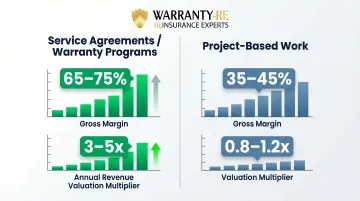
Consider the numbers: service agreements carry 65-75% gross margins versus 35-45% for project work. Recurring agreement revenue is valued at 3-5x annual revenue when selling a business, compared to 0.8-1.2x for project-based revenue. The structural difference compounds over time.
WarrantyRE helps HVAC contractors set up and manage exactly this type of program—turning installs into recurring, profit-generating revenue rather than one-time transactions.
Claims Administration and Process
Poor claims handling loses customers permanently, even when equipment failure wasn't your fault. Evaluate how quickly claims are adjudicated, whether the program uses a dedicated claims team or automated system, and whether you maintain visibility into claim decisions.
Look for programs providing performance reports and claims data. This allows you to monitor warranty exposure, identify recurring failure patterns, and make better-informed decisions about equipment selection and installation practices. Contractors with excellent warranty experiences generate 2.75x more referrals than those with poor experiences—proof that claims quality directly affects growth.
Legal Compliance and Administrative Support
Warranty products are regulated at the state level—non-compliant programs expose you to significant legal and financial liability. Approximately 37 states have enacted specific service contract laws, with varying requirements for licensing, filings, and consumer protections.
Verify whether a program handles:
- State-level licensing and renewals (annual or biennial)
- Required filings and contract language
- Tax returns and regulatory updates
- Consumer protection requirements (free-look periods, cancellation terms)
Penalties for non-compliance are severe: California imposes fines up to $50,000 plus potential imprisonment; Florida classifies unauthorized activity as a felony; New York has levied fines in the millions for unlicensed warranty operations.
This factor becomes critical when scaling. A program that works in one state may require additional approvals in others. Choose a provider that manages compliance updates as regulations change.
Customer Retention and Brand Differentiation
Warranty programs directly influence whether a customer calls back for tune-ups, renewals, or future equipment replacements. Programs with clear terms, fast claims responses, and positive customer touchpoints reinforce your brand long after installation day.
The financial impact is measurable: a 5% increase in customer retention can increase business profits by 25% to 95%, while acquiring a new customer costs 5 to 25 times more than retaining an existing one. Service agreement customers generate $8,700-$17,000 in lifetime revenue over an average 7.2-year relationship.
Evaluate whether the program allows your brand to remain front and center in the customer relationship. Programs where a third-party brand appears on all customer-facing documentation dilute your brand equity and weaken the connection with your customers.
Program Scalability and Flexibility
A program that fits your business today may create real bottlenecks at twice the revenue. Evaluate whether the program can:
- Accommodate growth in install volume
- Expand to additional service areas or states
- Adapt to new equipment categories or service types
Flexibility in coverage design matters equally. High-end residential contractors may need longer coverage windows and broader component coverage, while commercial contractors may need customized service level terms. A rigid, one-size-fits-all program leaves little room to compete on terms that matter to your customers.
Companies with automated agreement management grow recurring revenue at 8-12% annually versus 1-3% for manual processes. That gap widens every year you stay on the wrong system.
How WarrantyRE Can Help You Build a Better Warranty Program
WarrantyRE is a reinsurance partner helping business owners establish and manage their own administrator obligor reinsurance companies since 1994. Originally serving auto dealerships, the company now brings that same expertise to HVAC and home services contractors.
The core proposition: instead of paying a third party to administer your warranty and keep the profit, WarrantyRE helps you own the program, control the claims experience, and capture 100% of the underwriting profits your customers' premiums generate.
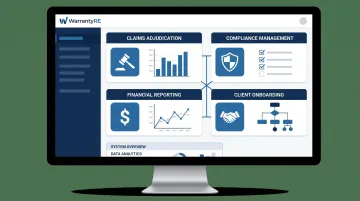
WarrantyRE handles the full administrative burden so you can focus on core business operations:
- Complete company setup and legal formation
- Training and onboarding for your staff
- Claims adjudication from first call to final resolution
- Legal filings and state compliance management
- Bookkeeping, tax returns, and financial reporting
- Regular performance reports and analysis
All programs are backed by A-rated insurers, removing the financial risk of self-insuring while preserving profit ownership.
You build warranty fees directly into your job pricing. Those fees flow into your own reinsurance account rather than to an external provider — keeping that revenue inside your business.
For HVAC contractors specifically, a few things set WarrantyRE apart:
- 30+ years of reinsurance expertise applied directly to home services
- Full-service administration covering setup, compliance, and financial reporting
- Admin Obligor structure backed by A-rated insurers for credibility and financial security
- No hidden fees — what you see is what you pay
- Programs designed to turn warranty costs into a revenue stream, not just an expense
- Dedicated onboarding and support, not a self-serve software platform
The company serves 400+ clients across the United States, providing coast-to-coast services and experience in managing compliant, profitable warranty programs.
Conclusion
Choosing a warranty program is one of the most financially significant structural decisions an HVAC contractor can make. The wrong program donates profit to a third party and leaves your customer relationship in someone else's hands. The right one creates loyal customers, reduces service cost exposure, and builds a parallel revenue stream that grows with your install volume.
No single program fits every business stage. The right choice depends on your current volume, growth goals, and how much administrative support your operation can realistically absorb. Use these six factors to evaluate your current program or any one you're considering:
- Coverage scope — what labor, parts, and failure types are included
- Profit model — whether you keep underwriting margins or pay them to a third party
- Claims administration — who handles disputes and how quickly
- Legal compliance — state-level service contract and insurance licensing requirements
- Customer retention value — whether the program drives repeat calls and referrals
- Scalability — how the program performs as install volume increases
Contractors who treat warranty programs as strategic assets rather than administrative checkboxes recover more revenue per install, reduce out-of-pocket service exposure, and build customer relationships that outlast the equipment itself. That's the difference between a warranty program that costs you money and one that makes you money.
Frequently Asked Questions
What is the difference between a manufacturer warranty and a contractor-offered HVAC warranty program?
Manufacturer warranties cover equipment defects and are issued by the brand. Contractor warranty programs cover labor, service calls, and repairs after installation—and can be structured so the contractor controls the terms, administration, and profit.
How does a reinsurance-backed warranty program differ from a standard third-party warranty for HVAC contractors?
In a third-party program, the provider keeps the underwriting profit. In a reinsurance-backed model, the contractor owns the program entity, retains premium income above claims costs, and is supported by an A-rated insurer for risk backing.
Can a small HVAC business afford to start its own warranty program?
Yes. Reinsurance programs are designed to scale with business size, and the initial setup cost is typically offset by the profits recaptured from what would otherwise go to a third-party provider. WarrantyRE handles setup and administration so owners don't need in-house expertise.
What happens to customer warranties if a third-party warranty provider goes out of business?
Customers may be left without coverage, and the contractor's reputation suffers even though the contractor isn't at fault. This is a key reason some contractors choose to own their own administrator obligor company backed by A-rated insurers.
How do HVAC warranty programs help improve customer retention?
Customers with active coverage are more likely to call the same contractor for tune-ups, repairs, and equipment replacements because there's an ongoing service relationship. Look for a program that keeps your brand visible throughout the coverage period.
What regulatory requirements should HVAC contractors understand before offering warranty products?
Warranty products are regulated differently by state and may require licensing, specific contract language, or filing with state insurance or consumer protection agencies. Contractors should choose a program provider that manages compliance obligations on their behalf to avoid penalties that can include fines, license revocation, or legal liability.