Introduction
Picture this: your tankless water heater starts throwing error codes 18 months after installation. You call the manufacturer, confident the warranty has you covered. Then the bill arrives — $400 in labor costs that aren't covered because the labor warranty expired at 12 months.
It happens more than you'd think. Tankless water heater warranties are among the most layered of any home appliance, splitting coverage across three separate tiers with different expiration dates, conditions, and exclusions for each. Most homeowners don't study the fine print until something breaks.
This guide covers everything you need to know before that happens: what tankless warranties actually include, how major brands compare side by side, what kills your coverage, and what to do when manufacturer protection falls short.
TLDR
- Tankless warranties split into three tiers: heat exchanger (longest), parts, and labor (typically just 1 year)
- Rinnai, Navien, and A.O. Smith offer 15/5/1 years; Rheem/Ruud offers 12/5/1; Noritz EZ leads at 25 years on the heat exchanger
- Improper installation, skipped maintenance, and unauthorized repairs are the most common grounds for claim denial
- Register your unit promptly and document every maintenance visit to protect your coverage
- When manufacturer coverage ends, contractor-backed warranty programs can fill the labor cost gap
What Tankless Water Heater Warranties Typically Cover
The Three-Tier Structure
Virtually every major brand structures tankless coverage the same way:
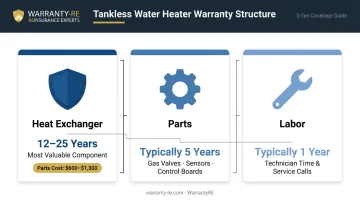
- Heat exchanger warranty: the longest tier, covering the primary heating component inside the unit. This is the most valuable piece of coverage because heat exchanger replacement costs $600–$1,300 in parts alone, not counting labor.
- Parts warranty: covers components like gas valves, flow sensors, and control boards. Typically runs 5 years across major brands.
- Labor warranty: covers technician time for diagnosis and repair. Usually expires after just 1 year, leaving homeowners paying labor costs for the remaining life of the unit.
What "Defects in Materials or Workmanship" Actually Means
Manufacturer warranties cover failures that originate from the factory : a heat exchanger that cracks due to a manufacturing flaw, a control board that fails prematurely, a gas valve that never worked correctly. Failures caused by installation errors, lack of maintenance, or operating conditions fall outside that coverage entirely.
Common Exclusions Across All Major Brands
The distinction matters in practice. Here's what manufacturers consistently exclude from coverage:
- Labor costs after the first year
- Scale, sediment, and mineral buildup damage
- Damage from improper installation or venting
- Flooding, freezing, or environmental damage
- Repairs using non-original replacement parts
- Maintenance items like filters and anode rods
- Failures caused by incorrect gas pressure or supply line sizing
Residential vs. Commercial Coverage
The same unit, installed in a commercial setting, often carries significantly shorter coverage. Rinnai's SENSEI drops from 15 years residential to 8 years commercial on the heat exchanger. A.O. Smith's X3 goes from 15/5/1 residential to just 1/1/1 in commercial or centralized multifamily applications. If you're a contractor installing units in anything other than a standard single-family home, verify the applicable warranty tier before quoting customers.
Tankless Water Heater Warranty Terms by Major Brand
Brand Comparison Table
| Brand | Heat Exchanger | Parts | Labor | Registration | Transferable? |
|---|---|---|---|---|---|
| Rinnai SENSEI | 15 years (residential) | 5 years | 1 year (up to 5 with registration) | Required for extended labor coverage | Yes, at original site |
| Navien NPE-A2/S2 | 15 years (residential) | 5 years | 1 year | Available; not required in most states | Not stated |
| Noritz EZ | 25 years or 15,000 burn-hours | 5 years | 1 year | Available; no deadline stated | No |
| Rheem/Ruud | 12 years (residential) | 5 years | 1 year | No specific deadline; install date controls | No |
| A.O. Smith X3 | 15 years (residential) | 5 years | 1 year | Registration page exists; no stated window | No |
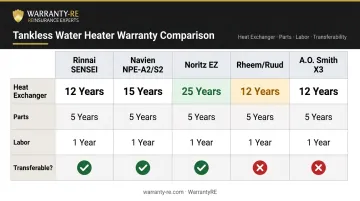
Terms above reflect standard single-family residential use. Commercial, combi, uncontrolled recirculation, and high-temperature applications reduce coverage significantly for all brands.
Why the Heat Exchanger Term Is the Most Important Number
The heat exchanger is the most expensive component in the unit. A 12-year versus 15-year difference isn't minor — it's three additional years of protection against a repair that can cost over $1,000 in parts before any labor charges. The Noritz EZ's 25-year term stands out, though its non-transferability is a meaningful trade-off for homeowners who may sell.
Installation Requirements by Brand
Most brands require installation by a licensed professional to validate full warranty coverage:
- Navien — must be installed by a licensed professional per local codes
- A.O. Smith — requires a licensed plumber, gas installer, or contractor
- Rinnai — recommends a trained professional; repairs must use genuine Rinnai parts
- Rheem/Ruud — requires a licensed, state-qualified contractor trained on Rheem tankless units
Keep the installer's license number, permit, and invoice on file — they may be required to process a claim.
What Can Void Your Tankless Water Heater Warranty
Improper Installation
This is the most serious voiding condition. Wrong venting type, undersized gas lines, improper electrical connections, or failure to follow the installation manual all give manufacturers grounds to deny claims. When a claim is filed, manufacturers inspect for installation compliance — and if the unit wasn't installed correctly, coverage disappears regardless of what actually failed.
Skipped Maintenance
Scale buildup on the heat exchanger reduces efficiency and can cause premature failure. Every major brand excludes scale-related damage, and manufacturers can deny claims if there's no maintenance record to demonstrate the unit was properly cared for.
What to keep records of:
- Descaling and flushing dates
- Inlet filter cleaning
- Annual professional inspections
- Any repairs, including technician name and license number
Noritz explicitly excludes scale damage when water hardness exceeds 12 gpg / 200 mg/L. A.O. Smith limits pH to 6.5–8.5. If you're in a hard water area, water treatment records matter as much as flushing records.
Unauthorized Repairs and Non-OEM Parts
Any repair performed by an unlicensed technician voids coverage, as does using non-original replacement parts. Brand-specific rules include:
- Rinnai — genuine Rinnai parts required
- Navien — non-approved components excluded
- Rheem/Ruud — unapproved parts and devices excluded
Verify approved parts and authorized service providers before scheduling any repair.
Ownership Transfer and Relocation
Warranty transferability varies significantly:
- Rinnai — transferable if the unit stays at the original installation address
- Noritz, Rheem/Ruud, A.O. Smith — non-transferable; original purchaser only
- Navien — transferability not stated in published materials; verify directly
If you're buying or selling a home with a tankless unit, check brand-specific terms before assuming coverage transfers.
How to Register and File a Warranty Claim
Registration Steps
- Locate the model and serial number (usually on a label on the unit's front or side panel).
- Visit the brand's registration portal within the required window. Rinnai requires registration within 90 days for extended labor coverage; most other brands don't publish a hard deadline but recommend doing it at installation.
- Save your confirmation along with the installation receipt and proof of licensed installation.
The Claim Filing Process
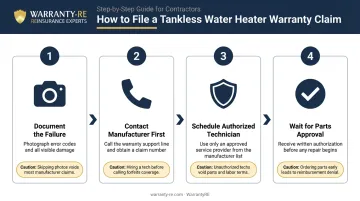
Once a failure occurs, the order in which you act matters as much as what you do.
- Photograph error codes, visible damage, or failure symptoms before anything is touched.
- Call the manufacturer's warranty support line first and get a claim number before scheduling any service.
- Use only an authorized technician. Filing a claim and then using an unauthorized provider can result in denial, even on a qualifying failure.
- Wait for parts approval and repair authorization before the repair begins.
Timelines to Know
Processing speed varies by brand, so know what to expect before you file.
- Rinnai — warranty claim reimbursement must be submitted within 30 days of the repair date
- Navien — approved replacement parts are typically shipped to the service provider within one business day
- Other brands — processing timelines are rarely published; if you haven't heard back within 5–7 business days, follow up directly with the warranty support line
Common pitfalls that delay claims:
- No proof of registration or installation
- Maintenance records unavailable
- Non-authorized service provider used
- Unit diagnosed or repaired before contacting the manufacturer
Maintenance That Keeps Your Warranty Intact
Annual Descaling and Flushing
Scale accumulation on the heat exchanger is the leading cause of preventable tankless failures. Every major brand publishes flushing procedures, and all of them exclude scale-related damage from warranty coverage. In hard water areas, flushing every six months is often practical guidance — though confirm with your specific model's manual.
Rinnai, Navien, Rheem, and Noritz all publish descaling instructions. Rheem's use and care manual even allows setting maintenance reminders at 500, 750, or 1,000 combustion hours.
Keep a simple log: date of flush, method used, technician name if a pro performed it.
Inlet Filter Cleaning
Tankless units have inlet water filters that restrict flow when clogged. Navien recommends cleaning them regularly; Rheem's manual requires monthly checks; A.O. Smith manuals include cold-inlet filter cleaning in their maintenance instructions.
A clogged filter can cause component failures — and manufacturers will deny claims when they can link a failure to neglected maintenance. Don't give them the opening.
Annual Professional Inspection
A documented annual inspection by a licensed technician serves two purposes: it catches problems early and creates the paper trail that supports a warranty claim if something fails later.
A documented annual inspection by a licensed technician serves two purposes: it catches problems early and creates the paper trail that supports a warranty claim if something fails later.
A thorough inspection should cover:
- Venting condition and clearances
- Gas pressure at the unit
- Water inlet and outlet connections
- Control board function and error code history
Keep those inspection reports with your maintenance log. If a claim gets disputed, dated documentation from a licensed technician is often what resolves it.
Going Beyond the Manufacturer Warranty
The Labor Cost Gap
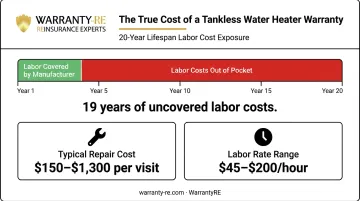
According to the U.S. Department of Energy, most tankless water heaters last more than 20 years. Manufacturer labor warranties typically expire after 1 year. That leaves homeowners paying technician costs for roughly 19 years while parts may still be covered.
Tankless water heater repairs run $150–$1,300 per visit, with labor rates of $45–$200 per hour. A single service call in year 5 can cost $300–$600 in labor alone, with nothing from the manufacturer to offset it.
Options When Manufacturer Coverage Isn't Enough
| Option | What It Covers | Watch Out For |
|---|---|---|
| Home warranty plans | Mechanical/electrical failures from wear and tear | Coverage caps, exclusions (sediment damage often excluded), claim delays |
| Extended manufacturer warranties | Varies by brand; some offer purchase-time upgrades | Not available for all models or regions |
| Contractor-backed service agreements | Labor, callbacks, ongoing maintenance coverage | Quality depends entirely on the contractor |
The Contractor-Owned Warranty Advantage
The third option deserves more attention than it typically gets. When the contractor who installed your unit offers a service agreement backed by their own warranty program — rather than a large third-party company — you get faster claim response, no middleman, and service from the same technician who knows your installation.
This model is increasingly available because of reinsurance structures that let contractors own and administer their own warranty programs. Rather than paying a third-party warranty company, contractors collect a warranty fee on installations that flows into a reinsurance account they control. Claims are paid from that account; unused funds stay with the contractor.
WarrantyRE works with HVAC and plumbing contractors across the country to set up exactly this kind of program — giving contractors a way to offer competitive labor warranty coverage on installations like tankless water heaters while building a profitable, contractor-owned structure instead of funding someone else's margins. WarrantyRE serves contractors, not homeowners directly. But when your installer is backed by this kind of program, you're working with someone who owns the claims process — not a national company routing your call through a contact center.
Frequently Asked Questions
What is the typical warranty on a tankless water heater?
Most major brands split coverage into three tiers: heat exchanger coverage runs 12–15 years (Noritz EZ reaches 25 years), parts coverage is typically 5 years, and labor coverage is usually 1 year. Registration and professional installation are generally required to receive the full warranty period.
What does a tankless water heater warranty cover?
Manufacturer warranties cover defects in materials and workmanship — heat exchanger failures, control board defects, and faulty components caused by manufacturing issues. They don't cover labor beyond the first year, scale or sediment damage, or failures caused by improper installation.
What voids a tankless water heater warranty?
The most common voiding conditions are improper or unlicensed installation, skipped descaling and maintenance, repairs by unauthorized technicians, and use of non-OEM replacement parts. Any of these can result in full claim denial.
How do I register my tankless water heater warranty?
Locate the model and serial number, visit the manufacturer's registration portal, and complete registration promptly after installation — Rinnai references 90 days for extended labor coverage. Save your confirmation along with proof of licensed installation.
Does a home warranty cover a tankless water heater?
Most home warranty plans do cover tankless units for mechanical and electrical failures from normal wear and tear. Coverage limits vary, sediment and scale damage is frequently excluded, and claim processes differ by provider. Read the specific policy language carefully before purchasing.
Can a tankless water heater warranty be transferred to a new homeowner?
It depends on the brand. Rinnai allows transfer if the unit stays at the original installation address. Noritz, Rheem/Ruud, and A.O. Smith are non-transferable. Navien does not publicly disclose transfer terms — contact them directly to confirm. Check the manufacturer's warranty documentation before buying or selling a home with a tankless unit installed.