Introduction
Water filtration system warranties are one of the most misunderstood documents in a contractor's installation package. Customers assume comprehensive protection. Manufacturers write narrow defect coverage. And contractors end up caught in the middle when expectations don't match reality.
Customer confusion is only part of the problem. The deeper issue is liability exposure: when a system fails and the cause is disputed, the installer is usually the first call. If warranty terms weren't communicated clearly at the time of sale, that conversation rarely goes well.
This guide breaks down what water filtration warranties actually cover, where the gaps are, how terms differ by system type, and what contractors can do to turn warranty offerings into a sales differentiator rather than a recurring headache.
TL;DR
- Warranty periods range from 1 year on basic RO systems to lifetime coverage on tanks and control valves in premium systems
- Most warranties cover manufacturing defects only — filtration media, labor, and improper installation are commonly excluded
- Coverage terms vary significantly by system type: RO, whole-house, UV, and iron filter systems each follow different patterns
- Contractors carry real liability when manufacturer coverage gaps aren't communicated upfront
- Contractors can ditch third-party manufacturer terms, run their own warranty program, and keep the underwriting profits
What Water Filtration System Warranties Typically Cover
Most manufacturer warranties share a common foundation: coverage for defects in materials and workmanship under normal use conditions. That phrase is narrower than most contractors — and their customers — anticipate.
Structural vs. Component Coverage
Virtually every major manufacturer distinguishes between structural components and smaller parts, covering them for different periods:
- Tanks and housings receive the longest terms — EcoWater's ECR3700 offers lifetime coverage on salt and mineral tanks for the original owner; Aquasana's Rhino WH-1000 covers defects for 10 years or 1,000,000 gallons
- Control valves and electronics sit in the middle tier — EcoWater covers its valve body for 10 years and the electronic faceplate for 7 years
- Membranes, filters, and O-rings receive the shortest coverage — often just 1 year, or none at all
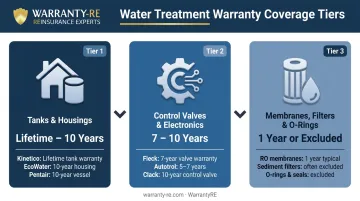
This tiered structure means a customer might have "lifetime" warranty language on their paperwork while the part most likely to need replacement (the membrane, the filter housing, the electronic controller) has already aged out of coverage.
What "Normal Use" Actually Means
Manufacturers use "normal use and service conditions" to define the baseline for any valid claim. In practice, this means:
- The system was installed exactly per the manufacturer's specifications
- Water pressure, pH, TDS, and temperature fall within the specified operating range
- The homeowner followed the maintenance schedule in the owner's manual
- Installation was performed by a qualified professional
APEC, for example, ties warranty validity directly to operating conditions including pressure, pH range, maximum TDS, and temperature. If the feed water falls outside those parameters at any point, a claim may be denied regardless of when the failure occurs.
Documenting feed water conditions and confirming operating parameters at job completion creates a record that protects both the customer and the installer when a claim arises later. That's a step worth building into every installation process.
NSF Certification and Warranty Terms
Those operating parameters connect to another point that comes up often in the field: NSF certification does not set or extend warranty terms. NSF/ANSI standards cover water treatment performance, materials, and product construction — not warranty duration. A certified system may carry stronger design standards, but the warranty is entirely the manufacturer's decision. Don't quote NSF certification as a warranty benchmark to customers.
Key Warranty Exclusions That Catch Customers Off Guard
The exclusions are where customer disputes actually originate. Most homeowners focus on the coverage headline; contractors need to know what isn't covered — and communicate it before installation.
Filtration Media Is Commonly Excluded
Filter cartridges, membranes, carbon media, and O-rings are excluded from warranty coverage by most major brands:
- Kinetico excludes filter cartridges and carbon, calcite, and SRS media
- iSpring explicitly excludes "membranes, filters, O-rings, and all other parts or components that require regular replacement"
- A.O. Smith excludes media from softener coverage
- Aquasana excludes filter cartridges from the Rhino WH-1000 warranty
EcoWater's ERR3702 is one exception — it covers media for the lifetime of the original owner, but only for municipal chlorine taste and odor reduction service. That's a narrow condition, not a broad precedent.
The practical problem: customers who paid for a whole-house system often assume the filters are covered. When they're not, and the contractor didn't flag it at sale, the relationship takes the hit.
Improper Installation Voids Coverage
This exclusion carries the most direct liability for contractors. APEC excludes defects caused by improper storage, installation, maintenance, or handling. VIQUA excludes products not installed as outlined in the owner's manual.
Any deviation from manufacturer installation specifications can void the entire warranty — shortcuts during rough-in, skipped pressure checks, or bypass configurations not in the manual all qualify. Protect yourself:
- Document your installation process thoroughly
- Follow manufacturer specs precisely on every job
- Keep records in case a warranty dispute arises
Labor Is Almost Never Covered
Parts may be warrantied. The technician's time to diagnose and replace them is not.
iSpring states explicitly that "all labor is excluded, including removal, replacement, installation, adjustment, maintenance, and repair." Kinetico excludes freight and labor charges. Aquasana excludes both labor and shipping costs.
Customers typically find out about this exclusion after a failure, when they're already expecting the warranty to cover everything. The system gets a free replacement part; the service call costs them $150–$250 out of pocket. If the contractor didn't explain this at the time of sale, that bill becomes a reputation problem.
Other Common Exclusions
| Exclusion | Examples |
|---|---|
| Abnormal water conditions | Kinetico excludes changes in influent water characteristics; APEC requires water to meet pressure, pH, TDS, and temperature specs |
| Freezing or environmental damage | Aquasana voids coverage for freezing exposure and non-potable water |
| Consequential damages | Kinetico, VIQUA, and iSpring all disclaim incidental, consequential, and special damages — including lost revenue and property damage |
How Warranty Terms Differ by System Type
Warranty coverage varies significantly across system categories. Contractors who install multiple system types need to set different client expectations for each — and the table below shows exactly where those differences land.
| System Type | Typical Tank/Structure Term | Component/Electronics | Media/Consumables |
|---|---|---|---|
| Whole-house carbon/sediment (POE) | 10 years (Aquasana); 5 years tank/valve (Pentair) | 1 year comprehensive (Pentair) | Excluded |
| Reverse osmosis | 1 year (APEC, iSpring, Watts) | Membranes excluded | Excluded |
| UV disinfection (VIQUA) | 10 years (UV chamber) | 3 years electrical/controller | 1 year (lamps, sleeves, sensors) |
| Iron filters (Pentair POE) | 5 years tank/valve | 5 years municipal, 1 year well water (media) | Varies by water source |
| Water softeners/refiners | Lifetime tanks (EcoWater); 10 years (A.O. Smith) | 7 years electronics (EcoWater); 3 years (A.O. Smith) | Excluded (most brands) |
| Water pumps | 3 years (Liberty Pumps wholesale) | Defect-based coverage | Varies |
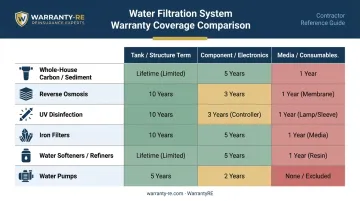
Three structural patterns repeat across nearly every category:
- RO systems consistently receive the shortest coverage — 1 year across APEC, iSpring, and Watts, with membranes and filters excluded entirely
- UV systems split coverage three ways — long-term on the chamber, medium-term on electronics, and short-term on the consumable components (lamps, sleeves) that actually require regular replacement
- Premium softener brands offer the most generous structural terms — but lifetime tank coverage still excludes electronics and media
The practical takeaway for contractors: the components most likely to fail mid-cycle — membranes, lamps, electronics — are also the least likely to be covered. That's where client conversations need to focus before installation.
What Warranty Liability Means for Contractors
Manufacturer warranties cover product defects. Contractor workmanship warranties cover installation quality. These are legally distinct — and they don't overlap cleanly when something goes wrong.
When Fault Is Unclear
The scenario that creates real financial exposure: a system fails six months after installation. The cause isn't immediately obvious. Is it a defective valve, or a pressure spike from a water hammer event the contractor didn't account for? Manufacturer or installer responsibility?
In that gray area, the contractor is typically the first call. To protect the customer relationship, many contractors absorb the repair cost rather than spend two weeks navigating a manufacturer warranty claim. That's a defensible business decision, but it's an unplanned expense with no clear path to recovery — and no mechanism to offset it without a defined warranty cost structure in place.
Documentation and Registration Responsibilities
Contractors carry real administrative responsibility when it comes to warranty validity:
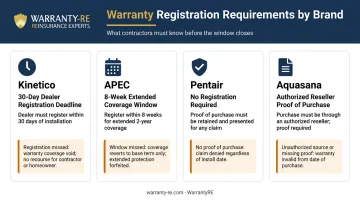
- Kinetico requires the authorized dealer to complete registration within 30 days of installation
- APEC extends coverage from 1 year to 2 years only if registered within 8 weeks
- Pentair no longer requires registration but requires proof of purchase for any claim
- Aquasana requires proof of purchase from an authorized reseller
If a contractor doesn't complete registration, hand off documentation, or retain records of the installation, a valid claim can be denied — and the customer will look to the person who installed the system for answers.
The Water Quality Association recommends asking about warranty terms and product certification at the point of sale. Contractors who make this part of their standard job completion checklist prevent the most common warranty disputes before they reach the customer.
Transferability at Home Sale
Warranty transferability varies significantly by brand, which directly affects perceived system value during real estate transactions:
- Kinetico: Transferable if the system stays at the original installation site
- APEC: Original purchaser only — not transferable
- Aquasana: Void if the system is moved; restricted to the original homeowner at the original address
- EcoWater: Uses "original owner" language throughout — transferability not explicitly documented
For contractors building relationships with real estate agents or property investors, transferable coverage is a concrete differentiator — one that can influence which system a buyer selects before installation ever begins.
Building a Stronger, More Profitable Warranty Program for Your Business
Manufacturer warranties cover product defects under narrow conditions — excluding labor, subject to water quality restrictions, and completely silent on the contractor's workmanship. That gap creates real liability. It also creates an opening for contractors who recognize it early.
The Problem With Relying on Manufacturer Terms Alone
When you install a water filtration system and tell a customer it carries a manufacturer warranty, you've handed control of their post-sale experience to a company that:
- Doesn't cover labor
- Can deny claims based on water quality conditions
- Has no stake in your customer relationship
- Requires your customer to navigate their own claim process
Every manufacturer warranty dispute that ends badly becomes a review problem for your business, not theirs.
A Contractor-Owned Warranty Structure
Water treatment and plumbing contractors who move beyond manufacturer coverage can offer their own workmanship warranty — one they control, fund, and administer. That shift changes the business model in a concrete way.
Rather than absorbing callback costs out of pocket or relying on third-party warranty administrators who keep the underwriting profit, contractors can establish their own administrator obligor reinsurance company — a structure WarrantyRE has been helping home service contractors build since 1994.
Here's how it works in practice:
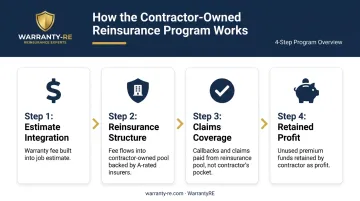
- A warranty fee is built into every job estimate, paid by the customer as part of the project cost
- That fee flows into a reinsurance structure the contractor legally owns, backed by A-rated insurers
- When callbacks occur, claims are paid from the reinsurance pool — not from the contractor's pocket
- Unused funds stay with the contractor, the same underwriting profit that third-party warranty companies currently keep
For a water treatment contractor installing whole-house systems, RO units, and UV systems across dozens of jobs per month, those unused premiums accumulate into a meaningful revenue stream. The contractor retains full control over the customer experience and stops subsidizing someone else's profit margin.
WarrantyRE handles all claims administration, compliance, and program management, so contractors keep their technicians in the field on paying work rather than managing warranty paperwork.
Third-party warranty companies profit because contractors don't own the structure. A contractor-owned reinsurance program changes who keeps that money — and over time, that difference compounds.
Frequently Asked Questions
What is the warranty period on water filtration systems?
Warranty periods vary by brand and system type, typically ranging from 1 year on basic RO systems (APEC, iSpring, Watts) to lifetime coverage on tanks and control valves in premium systems like EcoWater. Filtration media and consumables are commonly excluded regardless of how long the structural warranty runs.
Will a water pump be covered under warranty?
Most pump warranties cover manufacturing defects in the housing and mechanical components. Liberty Pumps covers wholesale products for 3 years against factory defects; Grundfos warrants consumer products against defects in design, materials, and workmanship. Damage from abnormal water conditions and regular-wear components are typically excluded.
What does a water filtration system warranty typically cover?
Most warranties cover defects in materials and workmanship for structural components — tanks, housings, and control valves — under normal use conditions. Filtration media, labor costs, shipping, and damage from improper installation or unusual water quality are commonly excluded.
What voids a water filtration system warranty?
Common voiding factors include improper installation not matching manufacturer specifications, failure to register the product within required timeframes, lack of documented maintenance, and damage caused by abnormal water conditions such as unusual pH, TDS levels outside operating specs, or freezing.
Does a home warranty cover water filtration systems?
Most standard home warranty plans exclude water filtration equipment. American Home Shield and Choice Home Warranty both explicitly exclude these systems; First American offers water softener coverage only as a paid add-on. Review policy terms carefully before assuming any coverage exists.
Can a water filtration warranty be transferred to a new homeowner?
Transferability depends on the manufacturer. Kinetico allows transfer if the system stays at the original installation site; APEC and Aquasana restrict coverage to the original purchaser at the original address. New homeowners frequently inherit no warranty coverage, even on recently installed systems.