Introduction
When your water heater fails at 6 AM on a Tuesday, the brand you choose becomes more than just a name on a box. Homeowners face a choice that affects daily comfort, energy bills, and repair costs for the next 20+ years. Many discover too late that not all tankless brands deliver the same efficiency, warranty protection, or installer support.
With dozens of manufacturers competing for attention, the performance gap is real. Choosing poorly means higher operating costs and frequent service calls. The right brand, properly sized and installed, eliminates standby energy loss and can deliver reliable hot water for 20 years or more.
Here's a breakdown of what separates the top performers—and how to match the right brand to your home.
TLDR
- Tankless units heat water on demand, cutting standby energy loss by 24–34% for homes using 41 gallons daily
- Top brands include Rinnai, Navien, Rheem, Noritz, and A.O. Smith—each suited to different household sizes and priorities
- Key factors: flow rate (GPM), energy efficiency (UEF), heat exchanger material, warranty terms, and installer availability
- Gas models outperform electric for whole-home demand; condensing units deliver 0.87–0.95 UEF vs. 0.80–0.86 for non-condensing
- Proper sizing and professional installation prevent the most common performance failures
What Is a Tankless Water Heater?
Unlike storage tank heaters that keep 40–50 gallons hot around the clock, tankless units heat water instantly when you open a tap. Cold water flows through a heat exchanger activated by water flow, and either a gas burner or electric element heats it to your set temperature. That on-demand design eliminates standby heat loss — the energy a storage tank burns just to keep water warm between uses.
That difference adds up. According to the Department of Energy, tankless units are 24–34% more energy efficient for homes using 41 gallons or less daily, and 8–14% more efficient for homes using around 86 gallons. ENERGY STAR-certified gas tankless models save families $95 per year compared to standard gas storage heaters—$1,800 over the unit's lifetime.
Fuel Type and Technology Differences
Gas and electric models serve different applications:
- Gas tankless units deliver 10–11.2 GPM, handling whole-home demand including simultaneous showers and appliances
- Electric models typically produce 2–5 GPM, suited for point-of-use applications or small homes with minimal simultaneous demand
For gas models, the condensing vs. non-condensing distinction affects both efficiency and installation:
| Type | UEF Range | Venting | Mechanism |
|---|---|---|---|
| Condensing | 0.87–0.95 | PVC, CPVC, polypropylene | Captures exhaust heat via secondary exchanger |
| Non-Condensing | 0.80–0.86 | Stainless steel | Exhausts combustion gases directly |
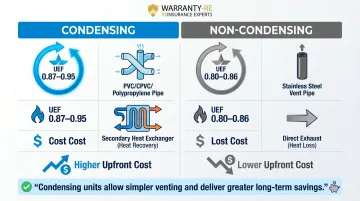
Condensing models cost more upfront but deliver higher efficiency and allow simpler venting. Either way, tankless units outlast storage tanks by a wide margin — the DOE puts average lifespan at 20+ years versus 10–15 years for storage models.
Top Tankless Water Heater Brands
These five brands were evaluated on reliability, energy efficiency, heat exchanger quality, warranty coverage, contractor support, and overall value.
Rinnai
Rinnai describes itself as the "leading tankless water heater in the US," with over 30 million units installed globally since 1920. The company opened a North American manufacturing facility in Griffin, Georgia in 2018, assembling condensing units domestically.
Rinnai's commercial-grade heat exchangers and industry-leading efficiency ratings make it the first recommendation from many professional plumbers. Strong installer familiarity nationwide ensures parts availability and service support in most markets.
| Attribute | Details |
|---|---|
| Key Features | Flagship RU199iN condensing model delivers 11 GPM at 0.95 UEF; PVC venting; 15,000–199,000 BTU range |
| Best For | Premium whole-home performance; medium to large households prioritizing long-term reliability and strong installer support |
| Warranty | 15-year heat exchanger, 5-year parts, 1-year labor (5 years with registration within 90 days) |
Navien
Founded in 1978, Navien developed the world's first stainless steel condensing heat exchanger in 1998. The brand is known for dual stainless steel exchangers that resist corrosion and scale buildup, plus built-in recirculation technology that reduces fixture wait time.
Navien's NPE-240A2 flagship model includes ComfortFlow recirculation with a buffer tank, eliminating the "cold water sandwich" effect common in tankless systems. Energy Star certification and compact sizing make it popular among contractors serving efficiency-focused homeowners.
| Attribute | Details |
|---|---|
| Key Features | Dual stainless steel heat exchangers; built-in recirculation pump and buffer tank; 11.2 GPM at 35°F rise; 0.95 UEF; 15:1 turndown ratio |
| Best For | Large or active households; buyers wanting faster hot-water delivery and premium condensing efficiency |
| Warranty | 15-year heat exchanger, 5-year parts, 1-year labor (drops to 5-year heat exchanger with uncontrolled recirculation) |
Rheem
Founded in 1925 and headquartered in Atlanta, Georgia, Rheem offers the broadest tankless product lineup—gas, electric, and propane models across residential and commercial applications. Wide retail availability through Home Depot and a robust installer network make service accessible nationwide.
Rheem's IKONIC series features integrated EcoNet Wi-Fi control, enabling smart-home integration, remote monitoring, and proactive maintenance alerts. This appeals to homeowners who want connected features alongside premium performance.
| Attribute | Details |
|---|---|
| Key Features | Integrated EcoNet Wi-Fi; 11.2 GPM at 35°F rise; 0.96 UEF on IKONIC ECOHS200iN; stainless steel heat exchanger; PVC venting |
| Best For | Homeowners wanting smart-home integration, broad installer availability, and premium brand with gas and electric options |
| Warranty | 15-year heat exchanger (with registration within 90 days), 5-year parts, 1-year labor |
Noritz
Noritz introduced the first modern, electronically controlled tankless water heater in 1981. Headquartered in Fountain Valley, California, the brand emphasizes durability and safety with dual stainless steel heat exchangers and built-in scalding prevention.
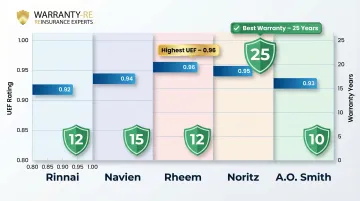
That durability focus extends to the numbers: the EZ Series PRO achieves 0.98 UEF, the highest among the five brands reviewed, paired with a 25-year heat exchanger warranty that's nearly double the industry standard. Newer models also include Bluetooth connectivity for app-based monitoring and diagnostics.
| Attribute | Details |
|---|---|
| Key Features | Dual stainless steel heat exchangers; 0.98 UEF (highest efficiency); built-in Bluetooth; Energy Star certified; EZ71 model delivers 6.9 GPM at 45°F rise |
| Best For | Larger families; buyers prioritizing durability, eco-friendly performance, and long product lifespan |
| Warranty | 25-year heat exchanger (industry-leading); parts and labor terms not specified in available sources |
A.O. Smith
A.O. Smith manufactures residential and commercial tankless models at its Tennessee facility, distributing primarily through plumbing wholesalers and contractors. The brand offers indoor and outdoor configurations with maximum flow rates up to 10 GPM on top models.
A.O. Smith's proprietary X3 Scale Prevention Technology eliminates annual descaling maintenance, protecting the 15-year heat exchanger warranty — a meaningful advantage given that scale buildup is the most common cause of warranty voids on competing models.
The company pairs a copper primary heat exchanger (A.O. Smith claims copper transfers heat 25x faster than stainless steel) with a Type 316L stainless steel secondary exchanger for a hybrid approach to efficiency and corrosion resistance.
| Attribute | Details |
|---|---|
| Key Features | X3 Scale Prevention Technology; copper primary + 316L stainless secondary exchangers; 10.0 GPM max flow; 0.95 UEF on Adapt+ Premium and Adapt SC models; iCOMM app connectivity |
| Best For | Medium to large homes; buyers working with a contractor who want dependable whole-home output without premium smart-feature pricing |
| Warranty | 15-year heat exchanger (X3 covers scale-related failures), 5-year parts, labor terms not specified |
How We Chose the Best Tankless Water Heater Brands
Brand selection came down to six criteria:
- Energy efficiency (UEF ratings and condensing technology)
- Flow rate relative to household demand
- Heat exchanger material and durability
- Warranty coverage depth
- Installation ease
- Local service availability
One common mistake buyers make is choosing based on price alone without evaluating installer familiarity or long-term service support. A low upfront cost means nothing if local contractors won't service the unit or parts take weeks to arrive.
Condensing models (0.87–0.95 UEF) outperform non-condensing units (0.80–0.86 UEF) and justify the higher upfront cost through long-term energy savings. Tankless units last 15–20 years with proper maintenance — double the lifespan of storage tanks — making heat exchanger warranty terms (10–25 years on premium brands) a reliable proxy for expected product life.
For plumbing contractors who install and recommend these brands, warranty terms carry additional weight. Contractors absorb callback and labor costs when products underperform, so brand reliability and warranty structure directly affect business profitability — not just homeowner satisfaction. Contractors managing warranty claim exposure may benefit from structured reinsurance programs like WarrantyRE, which help offset claim costs while keeping profits within the business.
Selection is also highly context-dependent. Large households with high simultaneous demand need different specs than single-person condos, and a brand that excels in whole-home gas performance may be entirely wrong for a small electric point-of-use installation.
Conclusion
Choosing the right tankless water heater brand means balancing efficiency, flow capacity, warranty coverage, and the practical reality of who will install and service the unit. Brand reputation matters, but fit to household demand and local installer support matter just as much.
Before committing, get multiple quotes from licensed plumbing professionals and ask the right questions:
- What are the heat exchanger warranty terms, and what voids coverage?
- What does annual maintenance (especially descaling) cost and who handles it?
- What is the total installed cost, not just the unit price?
- Is the contractor familiar with this brand and able to source parts quickly?
For plumbing contractors, the brand recommendation is just the starting point. Every install carries warranty exposure — and that risk adds up. Contact WarrantyRE to learn how a reinsurance program can turn that exposure into profitable recurring revenue.
Frequently Asked Questions
What's the best brand of tankless water heaters?
Rinnai, Navien, and Rheem consistently rank highest, but "best" depends on household size, fuel type, and priorities. Rinnai leads in installer familiarity and reliability; Navien excels in recirculation and efficiency; Rheem offers the broadest product lineup and smart-home integration.
What are the top 5 brands of water heaters?
- Rinnai — premium whole-home reliability
- Navien — recirculation technology and efficiency
- Rheem — smart features and broad availability
- Noritz — industry-leading 25-year warranty and 0.98 UEF
- A.O. Smith — scale prevention and contractor-grade durability
What brand of water heaters do plumbers recommend?
Plumbers most frequently recommend Rinnai, Navien, Noritz, A.O. Smith, and Rheem. These brands are distributed through professional channels, carry reliable parts availability, and offer strong installer training — making them the go-to choices for contractors nationwide.
What do plumbers say about tankless water heaters?
Professional plumbers confirm tankless units deliver excellent long-term value when properly sized and installed. However, they caution that undersizing, skipping annual descaling, and DIY installation are the most common mistakes leading to poor performance and voided warranties.
How long do tankless water heaters last?
Quality tankless units typically last 15–20 years with proper maintenance—significantly longer than traditional tank heaters (10–15 years). Heat exchanger warranty terms (10–15 years on most brands, 25 years on Noritz) are a useful proxy for expected product lifespan.
Are tankless water heaters worth it?
Tankless units make financial sense for households with high hot-water demand or long-term homeownership plans. However, homes with low demand or those requiring costly gas-line or electrical upgrades may find the payback period — 12–27.5 years per Consumer Reports — harder to justify.