Introduction
A customer calls six months after installation. There's a leak. A system isn't heating right. Shingles are lifting. The first question — before you've even dispatched a tech — is whether this falls on you or the manufacturer. Get that answer wrong, and you're either eating costs that aren't yours or pointing fingers at a manufacturer who turns around and points them right back.
This confusion isn't just inconvenient. It creates real financial exposure. According to ACCA's 2025 callback cost analysis, a mid-sized $2M revenue contractor can lose roughly $80,000 per year from callbacks and rework — with installation-related callbacks running approximately $850 each.
Contractor warranties and manufacturer warranties cover different failures, involve different parties, and carry different financial consequences. Knowing which is which — before a customer calls — is how contractors protect their margins.
TL;DR
- Contractor warranties cover defects in how work was installed — issued and funded by the contractor
- Manufacturer warranties cover defects in the product itself — issued by the maker
- Poor installation can void the manufacturer warranty entirely, making the contractor liable for everything
- Gaps between the two warranties leave homeowners unprotected and contractors exposed to disputes
- Contractors who understand this boundary can reduce liability, protect profits, and run a tighter warranty program
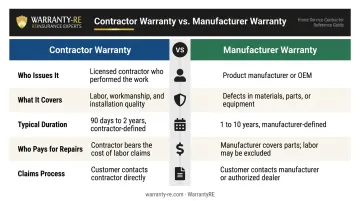
Contractor Warranty vs. Manufacturer Warranty: Quick Comparison
| Contractor Warranty | Manufacturer Warranty | |
|---|---|---|
| Who Issues It | The contractor who performed the work | The company that manufactured the product |
| What It Covers | Installation defects, workmanship errors, improper technique | Material defects, faulty components, premature product failure |
| Typical Duration | 1–5 years (varies by contractor and trade) | 5–20+ years; some "lifetime" warranties exist |
| Who Pays for Repairs | The contractor (labor and often materials) | The manufacturer (usually parts only; labor rarely included unless enhanced) |
| Claims Process | Homeowner contacts contractor directly | Contact manufacturer directly; submit documentation for review |
What Is a Contractor Warranty?
A contractor warranty — also called a workmanship or labor warranty — is a legally binding commitment that the work was performed correctly. It covers failures that result from how something was installed, not from the product itself.
Under FAR 52.246-21, the federal standard for construction contractors, work must conform to contract requirements and be free of defects in workmanship. The default warranty period under that benchmark is one year from final acceptance.
State standards vary, but the pattern is consistent. Minnesota statute requires:
- 1 year for defects from faulty workmanship or materials
- 2 years for faulty installation of plumbing, electrical, heating, and cooling systems
- 10 years for major structural defects
What Contractor Warranties Typically Cover
Common workmanship failures include:
- Improper flashing or sealing around penetrations
- Incorrect ductwork sizing causing uneven heating or cooling
- Shingles nailed outside the designated nailing zone
- Pipe fittings not properly soldered or seated
- Electrical connections that pass inspection but arc months later
Duration and Financial Risk
Knowing what gets covered is only part of the picture — how long that coverage lasts determines the contractor's financial exposure. Most contractor warranties run 1–5 years, though some contractors extend terms to stand out from local competition. Longer warranties tend to attract customers who prioritize quality; shorter ones narrow the window of accountability after job completion.
The financial stakes are direct. When a valid workmanship claim comes in, the contractor pays for labor — and often materials — out of pocket. For HVAC contractors, that means rolling a truck and pulling a technician off a paying job to absorb parts costs at their own expense.
Roofing, plumbing, and electrical contractors face the same math: every callback on a flashing issue, an improper nail pattern, or a loose fitting comes straight off the margin from the original job.
What Is a Manufacturer Warranty?
A manufacturer warranty is a guarantee issued by the product's maker. It covers material defects, faulty components, and premature failure caused by the product itself — not by how it was installed.
What Manufacturer Warranties Cover
Standard manufacturer warranties typically cover:
- Defective parts or components
- Premature failure under normal operating conditions
- Structural failures resulting from manufacturing errors
Labor costs are almost never included. Most base manufacturer warranties are parts-only.
Duration and Proration
Manufacturer warranties run significantly longer than contractor warranties, but the fine print matters:
- HVAC examples: Carrier's unregistered standard warranty is 5 years parts-only. Registered within 90 days, customers can choose 10-year parts-only or 5-year parts plus 3-year labor. Trane's base warranty is 5 years for unregistered equipment; registration within 60 days extends it to 10 years. Lennox's Signature series offers up to 20 years on heat exchangers with registered coverage.
- Roofing examples: GAF's Smart Choice Protection Period is non-prorated; after it expires, the remedy is reduced to reflect the use already received. A "lifetime" warranty doesn't mean full replacement value in year 40.
A 20-year warranty doesn't deliver 20 years of equivalent coverage. GAF's own documents show that in years 51+, their contribution under Golden Pledge drops to 20%. That gap matters when a homeowner files a claim expecting full value decades down the line.
But coverage duration is only half the story. Even a generous warranty term means nothing if an installation compliance issue voids the claim before it's ever processed.
The Installation Compliance Trap
This is the most important clause in any manufacturer warranty. Most require that installation follow the manufacturer's exact guidelines. If a contractor deviates — even slightly — the manufacturer can deny the claim entirely.
Trane's warranty covers parts that fail due to manufacturer defect, not failures caused by other factors. GAF's Golden Pledge won't even take effect unless the contractor registers the job and is paid in full.
Key Differences: What Each Warranty Actually Covers
The fundamental split is straightforward:
- Contractor warranty → triggered by how the work was done
- Manufacturer warranty → triggered by what was installed
In practice, identifying the actual cause of failure determines who pays.
The Dangerous Overlap
The most financially risky scenario sits between a clear workmanship failure and a clear product defect: improper installation that causes a product to fail in ways that look like a manufacturing defect.
When that happens, a manufacturer's inspector can determine the failure was installation-related and deny the warranty claim entirely — redirecting full liability back to the contractor, who may then face a bill covering both parts and labor.
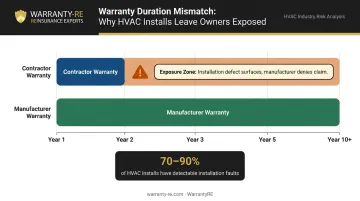
A 2018 DOE study cited by ACHR News found that 70–90% of new residential HVAC systems had significant, detectable faults at installation. That's a substantial pool of latent disputes — most of which don't surface until well after the job is complete.
The Duration Mismatch
Contractor warranties typically expire in 1–2 years. Manufacturer warranties run 5–20+ years. That gap creates a window where:
- The contractor warranty has expired
- The manufacturer warranty is still active
- An installation defect surfaces — but the manufacturer denies the claim on compliance grounds
- The homeowner is unprotected, the contractor is blamed, and no formal structure exists to manage the dispute
How Certified Contractors Access Extended Coverage
Certified contractors can close this gap. Manufacturers reward contractors who meet their installation and training standards with access to warranty tiers that cover both materials and labor:
- GAF Golden Pledge is tied to Master Elite contractors and adds misapplication coverage beyond standard product defects
- Owens Corning Platinum Protection includes limited lifetime workmanship coverage for Platinum Preferred contractors
- CertainTeed SureStart PLUS 5-Star requires SELECT ShingleMaster credentialing
- Carrier's Factory Authorized Dealer designation unlocks a factory-backed satisfaction guarantee within one year of installation
- Lennox Comfort Shield labor coverage is available exclusively through participating Premier Dealers
Certification also reduces a contractor's exposure to one of the most common claim denials: the manufacturer ruling a failure installation-related rather than product-related.
When Warranty Gaps Leave Contractors Exposed — and How to Close Them
The scenario plays out like this: a claim arrives after the contractor warranty has expired but well within the manufacturer warranty period. The homeowner assumes it's covered. The manufacturer says installation was non-compliant. The contractor is now in a dispute with no formal structure to manage it and no financial buffer to absorb the cost.
Out-of-pocket repair costs, callback expenses, and damaged customer relationships get absorbed directly into the operating budget — with no mechanism to offset those losses.
More contractors are moving past the informal workmanship promise toward a funded, contractor-owned warranty program. WarrantyRE helps home service contractors (HVAC, roofing, plumbing, and electrical) establish reinsurance programs that replace third-party warranty providers entirely.
The model works in three steps:
- Collect: Warranty fees are built directly into job pricing
- Reserve: Those fees flow into a reinsurance structure owned by the contractor
- Pay claims: When a warranty call comes in, it's covered by funds already collected on past jobs
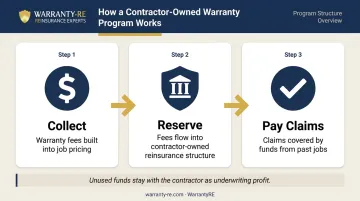
Any unused funds stay with the contractor as underwriting profit rather than flowing to a third party. WarrantyRE handles all administration, claims adjudication, compliance management, and reporting, so the program runs without adding operational burden to the contractor's core business.
For contractors caught in the gap between their workmanship coverage and the manufacturer's warranty, this is the structural fix — not a workaround.
Conclusion
Contractor warranties and manufacturer warranties are not interchangeable. One covers how work was done; the other covers what was installed. Understanding where each one begins and ends — and what happens when a claim falls in the gap between them — is the difference between managing warranty risk and being blindsided by it.
That risk clarity also opens a real business opportunity. Contractors who pursue manufacturer certification unlock enhanced warranty tiers that cover both labor and materials. Contractors who formalize their programs through a structure like WarrantyRE capture underwriting profits they're currently sending to third parties. Either path produces fewer unmanaged disputes, cleaner customer conversations, and a stronger bottom line.
Warranties handled strategically stop draining margin and start building it. That's a different business — and a more durable one.
Frequently Asked Questions
What is the difference between a contractor warranty and a manufacturer warranty?
A contractor warranty covers defects in installation or workmanship — issued and funded by the contractor. A manufacturer warranty covers defects in the product itself, issued by the company that made it. Both are needed for complete protection, since neither covers the other's failure type.
How long does a contractor warranty typically last?
Contractor warranties most commonly run 1 to 5 years. Regulatory benchmarks often set 1 year for general workmanship and 2 years for HVAC, plumbing, and electrical defects. Always get warranty terms in writing before work begins.
Can a manufacturer's warranty be voided by improper installation?
Yes. Most manufacturer warranties include explicit clauses requiring installation to follow their published guidelines. If a contractor deviates from those standards, the manufacturer can deny a claim even when the product itself has a genuine defect.
What happens when neither warranty covers a repair?
When coverage lapses or both parties dispute responsibility, the homeowner typically absorbs the cost. The best protection is choosing a contractor with clearly documented warranty terms and understanding both coverage timelines before work starts.
Do contractors need to be certified to offer manufacturer warranties?
Standard manufacturer warranties are generally available regardless of certification. Enhanced or "system" warranties — which typically cover labor in addition to materials — require the contractor to be certified or credentialed by the manufacturer.
How can contractors protect their business from costly warranty claims?
Proper installation training and manufacturer certification reduce the risk of claims. Formalizing a warranty program through a structured, funded model, such as the contractor-owned reinsurance programs WarrantyRE administers, creates a financial reserve for claims and keeps underwriting profits in-house rather than paying them to third-party providers.