Introduction
Picture this: a commercial building owner calls you three years after you completed a roof coating job. There's a leak. They expect you to fix it under warranty. What happens next depends entirely on what warranty you offered, what it actually covers, and whether either party met the requirements to keep it valid.
Many contractors discover these gaps at the worst possible moment — when a claim is already in front of them. By then, the dispute is expensive, the reputation hit is real, and the legal exposure was entirely avoidable.
This guide covers what roofing contractors need to understand about roof coating warranties: the main types, what they cover, what voids them, maintenance requirements, and what the warranty structure you offer means for your business financially.
TLDR
- Roof coating warranties fall into three types: material (manufacturer), workmanship (contractor), and system (combined coverage).
- Most material warranties are prorated — coverage value decreases annually after an initial full-replacement period.
- Common voidance triggers: lack of documented maintenance, ponding water, unauthorized modifications, and missed claim notice windows.
- Keep coverage valid by completing bi-annual inspections and maintaining written records of each visit.
- Contractors using manufacturer warranty programs give up profit and control; owning the warranty structure changes that.
Types of Roof Coating Warranties
Most roofing projects involve multiple warranty layers, each covering something different. Before making any warranty promise to a customer, you need to know which layer covers what.
Manufacturer Material Warranty
A material warranty is issued by the coating manufacturer and covers defects in the product itself — delamination, premature degradation, loss of waterproofing properties. It does not cover labor costs to repair or replace the failed material.
Nearly all material warranties are prorated. The GacoRoof Coating Pro-Rata Limited Material Warranty (a 50-year form) provides full replacement product in year one, then reduces coverage on a prorated yearly basis after that.
GAF's liquid-applied coating warranty ties term length directly to dry film thickness: GAF Unisil qualifies for a 20-year term at 40 mil DFT, while GAF Acrylic Top Coat earns a 15-year term at 34 mil DFT. The practical implication: the same product applied incorrectly may earn a shorter warranty — or none at all.
Labor/Workmanship Warranty
A workmanship warranty is issued by the installing contractor and covers defects from improper installation — failed seams, incorrect adhesion, poor flashing details. It does not cover material failure.
According to Benchmark Inc., contractor workmanship warranties typically run 2 to 5 years, with some extended offerings reaching 5 to 10 years. Here's the business reality: a workmanship warranty is only as valuable as the contractor's financial existence. A 10-year warranty from a contractor who closes in year four provides zero protection. That risk is worth raising directly when a customer is comparing your bid against a cheaper competitor's.
System Warranty
A system warranty combines material and workmanship coverage into a single document — typically offered through manufacturer-approved contractor programs. There's no gray area between "was this a material failure or an installation failure?" disputes.
Examples from major manufacturers:
- Polyglass: 20-year Coating System Limited Non-Prorated, No Dollar Limit warranty — available to Polyglass Registered Contractors
- Uniflex: Labor and material warranties tiered from 10 to 20 years based on contractor authorization level
- Mule-Hide: 10- or 15-year NDL system warranties covering manufacturing defects, premature weathering, and contractor workmanship — exclusively through Warranty Eligible Contractors
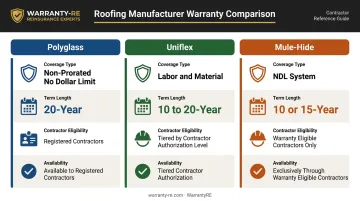
System warranties typically carry a premium in project pricing, but they provide cleaner claims processes and stronger risk transfer.
Prorated vs. Non-Prorated Warranties
The distinction matters more than most customers realize:
- Prorated: Coverage value decreases over time after the initial full-replacement period
- Non-prorated: Coverage remains consistent throughout the full warranty term
Polyglass's 20-year system warranty is explicitly "Non-Prorated, No Dollar Limit." GacoRoof's 50-year material form is prorated after year one. Many disputes arise because customers assume they have full replacement coverage when prorated terms actually apply. Address it before signing — not after a claim.
What Roof Coating Warranties Typically Cover
Across all warranty types, coverage hinges on one condition: the failure must trace back to a defect in materials or workmanship — not an external cause, normal aging, or owner neglect.
Material Defects and Premature Degradation
Warranties cover coating failure that occurs before the product's specified lifespan under normal conditions — cracking, flaking, peeling, or adhesion loss that exceeds manufacturer tolerances. For acrylic coatings, ASTM D6083/D6083M-18 sets minimum performance benchmarks including 100% elongation and 200 psi tensile strength. These standards inform what "premature" failure looks like, though warranty eligibility is determined by the warranty form itself, not the ASTM standard alone.
Application documentation matters here. GAF ties warranty terms to gallons per square and dry film thickness — meaning your application records can be the difference between a valid warranty and a denied claim.
Seam and Joint Failures from Installation
Failed seams or joints caused by improper welding, incorrect adhesive application, or wrong installation sequencing fall under workmanship or system warranties. These are also frequent dispute points — proving whether a seam failure stems from a material defect or an installation error is rarely straightforward. Strong installation documentation helps defend against manufacturer attempts to redirect blame.
Flashing and Detail Failures
Improperly installed flashings at penetrations, edges, and transitions are covered under workmanship warranties when the failure is caused by installation rather than physical damage, building movement, or owner neglect. The key phrase in most warranty forms is "as determined by [manufacturer]" — which underscores why installation records and photos taken at completion matter.
Coating Performance Failures (Paint/Finish)
Coated metal roofing systems carry a separate warranty layer entirely. Paint/finish warranties address appearance-related failures — chalking and fading — that fall outside the scope of adhesion or installation coverage. Manufacturers measure fading in Delta E Hunter color units and chalking under ASTM D4214, Method A. Coverage periods are often shorter than the primary adhesion warranty. Sherwin-Williams' Flurothane Coastal, for example, offers a 20/20/20 coastal warranty — 20 years each for film integrity, color/fade, and chalking — subject to specific conditions.
Common Exclusions That Can Void Your Coverage
Exclusions are where most real-world warranty claims fall apart. Both you and your customers need to understand these before any warranty promise is made.
Lack of Maintenance and Neglected Repairs
Failure to maintain the roof per manufacturer specifications is the single most common reason warranties are voided. Polyglass requires at least two visual inspections per year by a qualified party and excludes leaks resulting from lack of maintenance. GAF similarly excludes leaks from maintenance failures.
The practical exposure: a building owner who ignores a clogged drain for six months, allows ponding to develop, and then files a claim for coating degradation will likely face denial — regardless of whether the coating itself was defective.
Ponding Water
Most warranties exclude damage from water that remains standing beyond 48 hours after rainfall. This exclusion applies even on flat commercial roofs where some ponding is almost expected. GAF's coating warranty is void in areas of ponding water unless a GAF silicone coating is specified. Polyglass has a similar carve-out for select silicone products.
Building owners almost universally assume ponding is a covered event. It isn't — and contractors who explain this upfront avoid difficult conversations later.
Acts of God, Extreme Weather, and Unauthorized Modifications
Key exclusions across most warranty forms:
- Extreme weather: GAF excludes wind speeds over 55 mph; Polyglass excludes gale force winds as defined by the Beaufort Scale
- Unauthorized modifications: New HVAC penetrations, solar installations, or additions made without warranty provider approval void coverage — even if the work itself was competent
- Non-approved products: Henry's Pro-Grade 988 warranty is void if the coating is covered, patched, or treated with a non-Henry product; Gaco excludes third-party flashings, adhesives, and surfacing materials
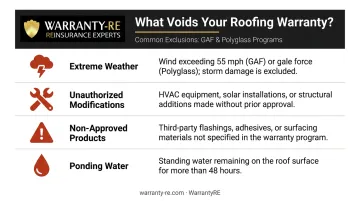
Contractors should build unauthorized modification warnings directly into customer handoff conversations and post-installation documentation.
Physical Damage and Consequential Losses
Damage from foot traffic, dropped equipment, or trades working on the building is excluded — it represents physical abuse, not material or installation failure.
No roof warranty covers consequential damages. Interior damage, mold remediation, business interruption, and content loss resulting from a roof leak are explicitly excluded. Gaco's warranty disclaims "consequential, special, incidental, or other damages, including loss of profits or damage to the building or contents."
Set this expectation before the job closes — not after a claim is filed.
Maintenance and Documentation Requirements to Keep Coverage Valid
Missing a maintenance step can void a roof coating warranty even when the coating itself is still performing. Most commercial warranties impose active obligations — and non-compliance is one of the most common reasons legitimate claims get denied.
Scheduled Inspections and Written Records
Most system warranties require bi-annual professional inspections by qualified parties, with written reports retained for the life of the warranty. Polyglass requires at least two visual inspections per year and mandates that inspection or rooftop activity records be maintained.
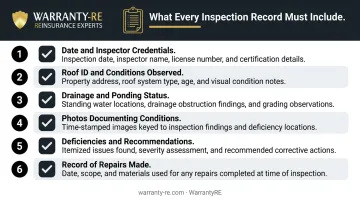
"We maintain the roof regularly" is legally insufficient when a claim is filed. Each inspection record needs to be specific and verifiable. A proper record should include:
- Date and inspector credentials
- Roof identification and current conditions observed
- Drainage and ponding status
- Photos documenting conditions
- Any deficiencies identified and follow-up recommendations
- Record of repairs made
Uniflex's L&M warranty documentation requirements go further — requiring before photos, scope of work, adhesion peel test results, daily application logs, environmental conditions during installation, and product batch numbers.
Prompt Repair and Claim Notification Windows
Warranties typically require identified deficiencies to be repaired within 30 to 90 days. Documenting a problem without following through on repairs voids coverage if conditions worsen. The longer a known deficiency sits unaddressed, the stronger the insurer's case for denial.
Notification windows are equally unforgiving — and easy to miss in the middle of a busy project schedule:
- Polyglass: Written notice within 10 days of discovering a defect (registered or certified mail required)
- GAF: Written notice within 30 days of discovering a leak
- Gaco: Written notice with claim description and original purchase receipt; may require three 12″ × 12″ material samples
Include claim notification windows in your project handoff documentation. Missing the deadline can invalidate an otherwise legitimate claim — regardless of the defect's cause.
What Roofing Contractors Should Know About Warranty Structure and Profitability
Understanding how warranties work is one thing. Understanding what your warranty structure means for your business is another conversation entirely.
Third-Party Programs vs. Contractor-Backed Structures
When a roofing contractor participates in a manufacturer-approved warranty program, the manufacturer controls the claims process, sets coverage decisions, and captures the underwriting profits built into the program fees. The contractor is the installer. The manufacturer is the beneficiary.
The question worth asking: who actually profits from the warranty program you're currently offering?
An alternative structure exists. Contractors can establish their own contractor-owned reinsurance company that collects warranty fees built directly into job pricing. When a claim occurs, it's covered by the reinsurance account. When claims don't materialize, the unused premium dollars stay with the contractor instead of flowing to a third-party provider.
WarrantyRE works with roofing and exterior contractors to establish exactly this kind of structure. The program is backed by A-rated insurers through an admin obligor arrangement, so the contractor owns the program without bearing unlimited financial exposure. Key features include:
- 5- and 10-year labor warranty options
- Full claims administration from first call to final payout
- All legal filings, tax returns, compliance, and bookkeeping handled by WarrantyRE
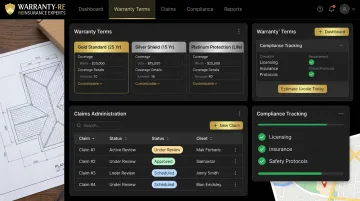
The financial result is direct: warranty fees that previously left your business now stay in an account you own. That shift compounds over time as claim-free years build retained premium.
Warranty as a Competitive Differentiator
In markets where multiple roofing contractors are bidding the same job, warranty clarity is often the deciding factor. A contractor who can explain exactly what their warranty covers, how long it lasts, what maintenance is required, and how claims are handled — will consistently outperform one offering vague assurances.
A structured warranty program also supports customer retention. Ongoing maintenance requirements create a natural reason to stay in contact with customers throughout the warranty term. Contractors who offer maintenance programs as part of the warranty package turn a compliance requirement into a recurring revenue opportunity and a reason customers call them first when additional work is needed.
Frequently Asked Questions
How long is a roof covered under warranty?
Coverage length depends on warranty type. Material warranties for fluid-applied coatings typically run 10 to 20 years; contractor workmanship warranties run 2 to 5 years (some reach 10); system warranties can extend to 15 to 25 years. Prorated terms reduce practical coverage value significantly as years pass.
What is the difference between a material warranty and a workmanship warranty for roof coatings?
A material warranty is issued by the manufacturer and covers defects in the coating product itself — premature degradation, adhesion failure, loss of waterproofing. The installing contractor issues a workmanship warranty covering defects caused by improper installation. Both are typically needed for complete protection, since each excludes what the other covers.
What voids a roof coating warranty?
The most common causes include:
- Missing documented bi-annual maintenance
- Ponding water that exceeds the 48-hour drainage standard
- Unauthorized repairs using non-approved products
- Physical damage from foot traffic or trades
- Failure to submit written claim notice within the required window (as short as 10 days for some manufacturers)
Does a roof coating warranty transfer to a new property owner?
Transferability varies by manufacturer. Polyglass allows one transfer with written notice and a $500 fee; GAF's liquid-applied coating warranty is non-transferable; Gaco warranties are not transferable or assignable. Most workmanship warranties are tied to the original contract and don't transfer automatically — confirm terms before any property transaction.
What maintenance is required to keep a roof coating warranty valid?
Most warranties require two professional inspections per year with written documentation, prompt repair of defects within 30 to 90 days using approved materials, and organized records covering the full warranty term. Drainage must prevent standing water beyond 48 hours after rainfall.
Can roofing contractors offer their own warranty program instead of relying on a manufacturer's?
Yes. Contractors can issue their own workmanship warranties directly. More advanced structures — like the contractor-owned reinsurance programs WarrantyRE helps establish — allow contractors to back those warranties financially, capture underwriting profits that would otherwise go to third-party providers, and maintain full administrative control over the claims experience.