Roofing warranty contracts are legally binding performance agreements. They specify exactly who owes what, under which conditions, and what either party must do to keep that obligation alive. Most disputes don't arise because the damage isn't real — they arise because someone didn't read what they signed.
This article breaks down the contract terms that govern coverage scope, the exclusion clauses that kill most claims, and the structural decisions roofing contractors can make to control their own warranty obligations rather than outsourcing them.
TL;DR
- A warranty's headline term (e.g., "20 years") means almost nothing without reading the proration schedule underneath it
- Manufacturer and workmanship warranties are separate contracts with separate parties — both must be understood independently
- Most claim denials trace back to exclusion clauses, undocumented maintenance, or unauthorized modifications
- "Lifetime" is a marketing term; coverage value declines sharply after year 10
- Contractors who own their warranty structure keep the underwriting profit — routing through third parties means giving that money away
What Roofing Warranty Contracts Actually Govern
A roofing warranty is not a blanket performance guarantee. It is a contract that defines which party — manufacturer, contractor, or property owner — must perform under specific conditions, for a defined period, and under terms that can be triggered or voided by actions on either side.
Two Separate Contracts, Two Separate Parties
The NRCA draws a clear line here: a manufacturer warranty covers defects in the roofing material itself, while a contractor workmanship warranty covers installation errors. These are distinct legal documents with distinct obligated parties.
- Manufacturer warranty: issued by the material supplier (GAF, Owens Corning, IKO, etc.), covering product defects
- Workmanship warranty: issued by the installing contractor, covering errors made during installation
- Neither party is responsible for the other's failures — IKO's warranty explicitly states the contractor is not IKO's representative, and IKO is not bound by contractor guarantees
In practice, that distinction determines who pays. A roof that leaks due to a manufacturing defect in a shingle is the manufacturer's obligation. A roof that leaks because flashing was improperly set is the contractor's. When the leak cause is disputed, the claim process turns adversarial fast.
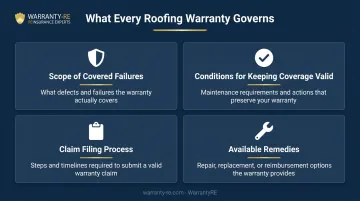
Four Things Every Warranty Contract Governs
Every roofing warranty controls these four things:
- Scope of covered failures — which types of damage or defects qualify
- Conditions for keeping coverage valid — maintenance, notice, approved materials
- Claim filing process — deadlines, documentation, inspection rights
- Available remedies — repair, replacement, prorated cash value, or nothing
Contractors issuing workmanship warranties are entering a contract that exposes their business to repair liability. Vague language doesn't protect them. It creates open-ended obligations with no defined ceiling.
The Core Terms That Define Coverage Scope
Proration: Where Coverage Value Actually Goes
The coverage period headline is the most consistently misread term in any roofing warranty. A "30-year warranty" does not mean 30 years of full replacement coverage. It almost never does.
Owens Corning's 2026 standard product warranty illustrates how this works in practice:
| Period | Coverage Level |
|---|---|
| Years 1–10 | 100% (full TRU PROtection) |
| Years 11–40 | 80%, reduced by 2% annually |
| Year 41+ | 20% |
GAF's structure follows a similar pattern — a 10-year non-prorated Smart Choice Protection Period, then declining coverage. By year 20 on many warranties, a property owner filing a claim may recover less than half the replacement cost.
The practical implication: a major repair at year 15 on a "lifetime" warranty could still leave the property owner funding most of the bill out of pocket.
NDL vs. Capped Warranties
No Dollar Limit (NDL) warranties appear to offer unlimited coverage, and in some commercial programs that holds up. Johns Manville's Peak Advantage Guarantee covers materials and labor required to maintain a watertight system with no stated dollar ceiling.
But NDL is conditional, not unlimited. The Johns Manville guarantee requires:
- Timely notice after discovering a problem
- Documented maintenance throughout the warranty period
- Approved contractors for any repairs
- Transfer fee payment within 30 days of ownership change
Capped warranties work differently. A capped or prorated warranty limits total payout, often tied to remaining material value. For a claim filed 12 years into a 20-year capped warranty, the covered amount may reflect depreciated value rather than current replacement cost.
Transferability and the Registration Deadline Problem
Most warranties allow one transfer at property sale. What most buyers and sellers don't realize: missing the registration deadline voids the warranty entirely for the new owner.
| Manufacturer | Transfer Registration Window |
|---|---|
| GAF | Within 1 year after property transfer |
| Owens Corning | Within 60 days after transfer |
| IKO | Within 30 days after transfer |
| Johns Manville | Within 30 days after transfer |
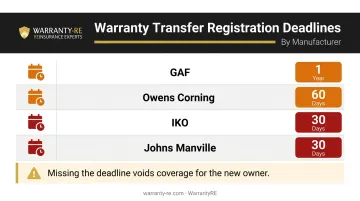
Coverage terms also often change post-transfer. GAF reduces a transferred warranty to two years of coverage if it transfers after the non-prorated period has ended. A buyer relying on a "25-year warranty" disclosed in a real estate transaction may receive two years of actual coverage if the transfer wasn't properly registered.
Claim Filing Deadlines Are Binding
GAF, Owens Corning, and Johns Manville all require written notice within 30 days of discovering a problem. Miss that window or start repairs before notifying the warrantor, and the claim will likely be denied outright. Common triggers for automatic denial include:
- Starting repair work before the warrantor issues written authorization
- Submitting notice by phone rather than in writing
- Waiting to report until after the 30-day window has passed
Key Provisions That Can Void or Limit a Claim
Standard Exclusion Clauses
Exclusions are where most claims die. The following appear consistently across major manufacturer warranties:
- Ponding water / improper drainage — excluded by both Owens Corning and Johns Manville
- Severe weather — GAF excludes acts of nature including hail; Johns Manville excludes wind exceeding 55 mph
- Biological growth — algae, mold, lichen, and fungi excluded unless specific add-on coverage (StainGuard, AR shingles) applies
- Chemical contamination — fertilizers, solvents, and cleaning products not applied per manufacturer instructions
- Foot traffic damage — excluded by GAF, Owens Corning, and Johns Manville
- Consequential / interior damage — water damage to interiors, contents, or structure is explicitly excluded
None of these exclusions are unusual or unreasonable. But they catch property owners off guard when they assume "roof warranty" means comprehensive protection against any roof-related damage.
Unauthorized Modifications
Any work performed on a warranted roof must use manufacturer-approved contractors and specified materials. That includes:
- HVAC penetrations and new vents
- Solar installations and overlays
- Vegetative roofing systems
- Sealant reapplication
Johns Manville explicitly excludes leaks resulting from changes, alterations, or repairs to any of these systems unless handled per the guarantee requirements.
This creates direct risk for roofing contractors. Performing work on a property with an existing manufacturer warranty using non-approved materials or methods voids coverage for that area, and in some cases, the entire roof.
Documentation Failure Is a Coverage-Voiding Event
Many warranty contracts state explicitly that failure to produce maintenance records when filing a claim is grounds for denial. Oral representations that maintenance was performed won't satisfy the contract's documentation requirement.
A roof that was properly maintained but never documented is treated identically to a neglected one. Contractors advising property owners on warranty compliance should treat documentation as part of the maintenance work itself, not an afterthought.

Common Misinterpretations of Roofing Warranty Terms
Four misunderstandings show up repeatedly when contractors and property owners read warranty documents — and each one carries real financial consequences.
What Gets Misread (and Why It Matters)
"Lifetime" coverage has a narrower definition than it implies. GAF defines "Lifetime" as coverage lasting only as long as the original owner occupies the property, and caps non-residential structures at 40 years. Coverage still prorates after the non-prorated window closes. A warranty that reads "50-year coverage" on paper may reimburse only 20–30% of replacement cost by year 20.
Manufacturer warranties are not a substitute for insurance. They cover material defects and, in some cases, installation errors — nothing more. Storm damage, acts of nature, and theft fall outside warranty scope entirely. Contractors who allow clients to conflate the two leave them underinsured.
The next two misinterpretations specifically affect ownership transitions and ongoing coverage:
- Warranty transfer requires active registration. Coverage does not pass automatically at closing. Most manufacturers require registration within 30 to 60 days of the sale. A missed deadline voids coverage for the new owner, regardless of what was disclosed during the transaction.
- Maintenance requirements are contract conditions, not guidelines. Inspection and maintenance language embedded in warranty documents is contractually binding. When a claim is filed years later, an undocumented maintenance history gives the warrantor grounds to deny it outright.
Contractors who understand these distinctions are better positioned to set accurate expectations — and to structure their own workmanship warranties around terms that hold up.
How Roofing Contractors Can Strengthen Their Warranty Program Structure
Most roofing contractors either avoid issuing workmanship warranties to limit liability exposure, or issue them informally with language vague enough to create disputes rather than prevent them. Neither approach serves the business well.
A third path exists: contractors can establish their own administrator obligor reinsurance company, backing their workmanship warranty through a structure they own rather than paying a third-party provider to hold that risk.
How the Structure Works
When a roofing contractor sets up a contractor-owned reinsurance program:
- A warranty fee is built into every job price and flows into the contractor's reinsurance account
- Claims are paid from that account rather than from operating capital
- Funds not used for claims remain with the contractor as retained underwriting profit
- The structure is backed by A-rated insurers, providing financial backstop if reserves prove insufficient
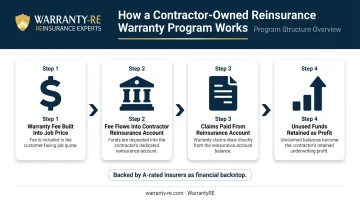
This converts warranty exposure from an open-ended liability into a controlled, funded program — and the unused premium stays with the contractor rather than a third party.
What WarrantyRE Provides
WarrantyRE has been setting up contractor-owned reinsurance programs since 1994, serving roofing, HVAC, plumbing, and electrical contractors nationwide. For roofing contractors ready to move away from third-party arrangements, WarrantyRE manages the entire program:
- Program setup, company formation, and all legal filings
- Claims adjudication from first call to final payout
- Compliance management under IRS Code 831(b) and applicable state licensing requirements
- Staff training and ongoing performance reporting
- Financials and bookkeeping for the reinsurance entity
Contractors who make the switch typically find that the warranty fee they were already building into job pricing begins generating retained profit within the first year — money that previously left the business through third-party provider margins.
Frequently Asked Questions
Are roofing contingency agreements enforceable?
Roofing contingency agreements — where contractor payment depends on insurance claim approval — are enforceable in most U.S. states. Validity depends on how the contract is written, whether it complies with state contractor and insurance laws, and whether obligations are clearly defined. Texas, Illinois, Minnesota, and Florida each have specific rules governing these contracts.
What should a roof warranty include?
A complete roofing warranty should cover:
- Coverage period and whether it is prorated or non-prorated
- Which failure types are included — material defects vs. installation errors
- Specific exclusions and maintenance requirements the owner must meet
- Claim filing process and deadlines
What is the difference between a manufacturer warranty and a workmanship warranty?
A manufacturer warranty is issued by the material supplier and covers defects in the roofing materials themselves. A workmanship warranty is issued by the installing contractor and covers errors made during installation. Each is a distinct contract with a different issuing party and a different cause of failure it addresses.
What voids a roofing warranty?
Common warranty-voiding actions include failure to perform and document required maintenance, repairs or modifications performed by unauthorized contractors or using non-approved materials, and failure to file a claim within the required window after discovering a problem — typically 30 days for most major manufacturers.
Can a roofing warranty be transferred to a new homeowner?
Most manufacturer warranties allow a one-time transfer, but the new owner must complete registration within a short window — typically 30 to 60 days after closing. Coverage terms may also change post-transfer. Missing the registration deadline voids the warranty for the new owner entirely.
How long should a contractor's workmanship warranty last?
Workmanship warranty lengths vary from 1–2 years to 10+ years, with reputable residential contractors typically offering 5–10 years. Longer warranties signal confidence to customers, but only hold value when backed by a sound financial structure and proper program administration.