This scenario plays out more often than it should. TPO warranty terms contain layers of conditions, exclusions, and obligations that the number on the cover page doesn't convey.
This guide breaks down how TPO warranties actually work — covering warranty types, what's excluded, documentation requirements, maintenance obligations, and how roofing contractors can build a more defensible warranty program for their clients.
TL;DR
- TPO warranties fall into three types — material, workmanship, and system/NDL — each covering a different risk category
- Warranty term length means little without knowing whether it's prorated, conditional, or limited to membrane defects only
- Common claim denial triggers include ponding water, foot traffic damage, third-party penetrations, and documented maintenance gaps
- Missing a registration deadline can drop coverage from a full system warranty to basic material-only protection
- Contractors using a reinsurance structure for workmanship warranties keep underwriting profits rather than paying them to a third party
Types of TPO Roofing Warranties Explained
Most TPO roofs carry more than one warranty simultaneously. Understanding which warranty covers which risk is the foundation of any credible warranty conversation.
Manufacturer (Material) Warranties
Manufacturer warranties cover defects in the TPO membrane or other supplied components that cause premature failure — not weather events, foot traffic, or installation errors. If the membrane itself was defective coming off the production line, this is the warranty that responds.
Coverage terms vary by membrane thickness and contractor certification status:
| Manufacturer | 45 mil | 60 mil | 80 mil |
|---|---|---|---|
| Carlisle Sure-Weld TPO | Up to 15 years | Up to 20 years | Up to 30 years |
| GAF EverGuard TPO | 15 years | 20 years | 25 years |
| Elevate UltraPly TPO | ~15–20 years | ~20–25 years | Up to 30 years |
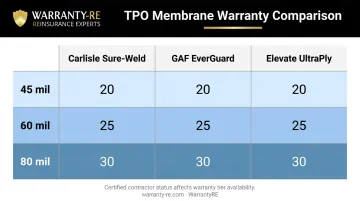
A basic material warranty covers membrane replacement for manufacturing defects. An upgraded system warranty — requiring certified installation of specified components — adds labor, leak investigation, and repair costs. These are very different products, even when issued by the same manufacturer.
Contractor certification determines which tier is available. Carlisle's Golden Seal requires a Carlisle Authorized Roofer. GAF's longer system guarantees (30–35 years) are only available through PlatinumElite Commercial Contractors. If the installer isn't certified, the upper-tier warranty terms aren't on the table — regardless of membrane thickness.
Workmanship (Contractor) Warranties
Workmanship warranties come from the installing contractor and cover failures caused by installation errors — poor seam welds, improper flashing, inadequate drainage design. A perfect membrane installed incorrectly will still fail. This warranty is what addresses that risk.
Terms typically range from 1 to 10+ years. Length matters, but so do two other factors:
- Whether the contractor has a reliable service process for handling claims
- Whether any financial structure backs the commitment
A one-page letter with a contractor's signature is a different product than a warranty backed by a reinsurance structure.
NDL (No Dollar Limit) System Warranties
An NDL warranty means the manufacturer will pay the full reasonable cost to repair a covered failure — labor and materials — with no maximum payout cap. Carlisle's Golden Seal and Elevate's Red Shield both operate as NDL warranties for qualifying systems.
NDL coverage still has conditions. The roof must be installed as a complete approved system by a certified contractor and maintained per warranty terms.
The difference from prorated coverage is worth understanding:
- NDL warranties pay full reasonable repair costs at any point in the coverage term — coverage doesn't shrink over time
- Prorated warranties (like GAF's material-only warranty) reduce maximum liability based on remaining months — a claim in year 18 of a 20-year term yields a fraction of full-cost coverage
What TPO Warranties Cover — and What They Don't
Most warranty disputes don't stem from ambiguous coverage language. They stem from property owners and contractors who didn't read the exclusions before assuming coverage applied.
What Is Typically Covered
- Material/manufacturer warranties: Manufacturing defects causing premature membrane degradation
- System/NDL warranties: Qualifying leaks tied to approved system components and installation, with full labor and material costs
- Workmanship warranties: Leaks and failures directly caused by the contractor's installation errors
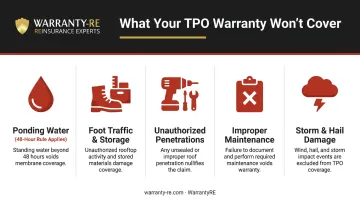
Common Exclusions That Void or Limit Claims
Every major TPO manufacturer — Carlisle, GAF, and Elevate — identifies similar exclusion categories in their warranty documents:
- Ponding water: Water remaining on the roof for more than 48 hours after the most recent rain event, as defined by SPRI citing NRCA guidance, is excluded under most manufacturer warranties
- Foot traffic and storage: Damage from workers, equipment, or stored materials on the roof surface
- Unauthorized penetrations: Alterations, repairs, or new penetrations made without prior written manufacturer authorization
- Improper maintenance: Failure to meet the maintenance obligations written into the warranty terms
- Storm and hail damage: Wind above 55 mph and hail are excluded under standard Carlisle, GAF, and Elevate warranties — that category of risk belongs to property insurance, not the roofing warranty
When an HVAC technician, solar installer, or electrician accesses a TPO roof and damages the membrane — or adds an unsealed penetration — warranty claims for resulting leaks are frequently denied, even under NDL policies. Establishing a written rooftop access protocol before any trade touches the membrane is one of the most practical steps a property owner can take to protect coverage.
Proration and Coverage Degradation
Not all warranties maintain consistent protection across their full stated term. A prorated warranty reduces the manufacturer's financial contribution as the roof ages. Filing a claim in year 18 of a 20-year prorated warranty may yield significantly less assistance than the same claim in year 3.
NDL system warranties avoid this degradation. Covered claims receive full-cost support whether the roof is 2 years old or 18 years old. Before committing to a warranty tier, contractors should confirm in writing whether proration applies — and at what rate coverage declines over the term.
Key Documentation Every TPO Warranty Holder Should Have
Poor documentation is one of the most preventable reasons warranty claims get complicated. The following should be secured at project completion and retained for the life of the roof:
- Written warranty certificate — includes manufacturer name, warranty type, coverage term, and building address
- Contractor's workmanship warranty — in writing, with clear start and end dates
- Manufacturer inspection report or system approval confirmation — confirms the installation qualified for the selected warranty tier
- Installation records — materials used, installation date, contractor certification documentation
- Maintenance logs, photos, and inspection records — especially critical if the property changes hands
Collecting those documents is only part of the obligation — registration timelines matter just as much. Many system and NDL warranties require registration within 30 to 60 days of installation completion. Missing that window can drop coverage from a full system warranty to a basic material warranty, a significant reduction in protection. Contractors should handle registration on behalf of clients as a standard part of project closeout.
Elevate's system warranties, for example, require an Electronic Pre-Installation Notice and approved roof drawing submitted 14 days before project start for warranted systems. The documentation obligations begin before the first membrane roll is unloaded.
Rooftop modifications after installation require the same documentation discipline. Change orders, penetration additions, and any other alterations should be captured with photos and written records. When a claim is filed years later under new ownership or management, that paper trail is what determines whether the claim moves forward or stalls.
Maintenance Requirements That Keep TPO Warranties Valid
System and NDL warranties include maintenance obligations that property owners must meet to keep coverage active. These are binding conditions, not recommendations.
Standard maintenance requirements across major manufacturers include:
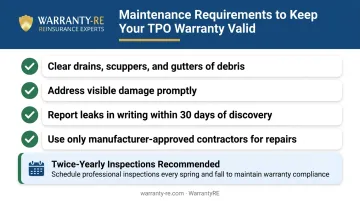
- Keep drains, scuppers, and gutters clear of debris
- Address visible damage (seam separations, punctures, blistering) promptly
- Provide written notice of any leak within 30 days of discovery — this requirement appears in Carlisle, GAF, and Elevate warranty terms
- Use only manufacturer-approved contractors for repairs and modifications
The "prompt repair" obligation matters more than most property owners realize. Delayed repairs allow water to migrate into insulation and deck components, expanding the damage scope. Manufacturers and contractors can — and do — deny original claims when evidence shows the damage worsened due to neglect after discovery.
Both NRCA guidance and Elevate's roof inspection documentation recommend inspections at least twice per year — spring and fall — plus after any severe weather event.
Even when a warranty doesn't specify inspection frequency, documented maintenance history directly strengthens claim outcomes. A property owner presenting three years of signed inspection logs gives adjusters far less room to attribute damage to neglect.
How Roofing Contractors Can Build a Stronger Warranty Program
Property owners increasingly evaluate warranty terms when selecting a roofing contractor. The quality of a workmanship warranty — not just its length — has become a differentiator in competitive commercial bids.
The Problem with Third-Party Warranty Reliance
When contractors rely entirely on third-party warranty administrators to handle claims and service, they give up two things: control over the claims experience and the financial reserves tied to their warranty program. Third-party providers profit from the arrangement. Those underwriting profits — generated by the contractor's own jobs and customer relationships — go to someone else.
The contractor takes the installation risk, performs the work, and pays someone else to hold the money. That's a structural problem worth solving — and it's why more roofing contractors are building their own warranty programs.
The Reinsurance-Backed Workmanship Warranty Model
Some roofing contractors are moving beyond basic warranty letters by backing their workmanship commitments with a contractor-owned reinsurance structure. This is the model WarrantyRE has helped home service contractors build since 1994.
Here's how it works in practice:
- The contractor collects a warranty fee on every job — built into the contract price, typically covering 5- or 10-year workmanship terms
- Fees flow into a reinsurance account the contractor legally owns — held in a US-based trust, invested conservatively in government bonds
- When a claim comes in, the reinsurance account covers it. WarrantyRE handles intake, adjudication, and payout from first call to resolution
- Unused funds stay with the contractor — building long-term financial value within the business rather than enriching a third-party provider
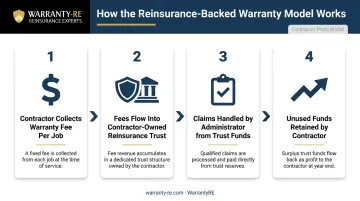
Contractors can withdraw excess funds (above 125% of required reserves) for reinvestment, distributions, or tax planning. The structure also provides significant tax advantages on contributions.
The Credibility Advantage
That financial structure translates directly into credibility. A contractor who can show their workmanship warranty is backed by an A-rated insurer, rather than a signed letter, offers something meaningfully different to the commercial property owners and institutional clients who scrutinize long-term warranty commitments before awarding bids.
WarrantyRE's program operates as an administrator obligor arrangement, where the contractor's reinsurance company is supported by A-rated carriers. If the contractor's reinsurance reserves are ever insufficient, the direct writing insurance company carries the ultimate liability for claim payments. That backstop is what separates a credible warranty program from a verbal promise.
For roofing contractors evaluating this model, the real question is straightforward: how much have you paid third-party providers to hold your warranty profits over the last five years, and what would retaining that capital do for your business?
Frequently Asked Questions
What is the warranty on a TPO roof?
TPO roof warranties typically range from 10 to 30 years depending on warranty type, membrane thickness, and whether the installer holds manufacturer certification. The number on the document is only part of the picture: a 20-year prorated material warranty and a 20-year NDL system warranty are fundamentally different products.
How often do TPO roofs need to be replaced?
A properly installed and maintained TPO roof typically lasts 20 to 30 years, with high-quality membranes reaching the upper end of that range when regularly serviced. Climate, drainage conditions, foot traffic, and maintenance frequency all affect where a specific roof lands within that range.
What does NDL mean in a TPO roofing warranty?
NDL stands for No Dollar Limit, meaning the manufacturer covers the full cost of qualifying repairs, including labor and materials, with no payout cap. Coverage still contains exclusions and only applies when the roof was installed as a complete approved system by a certified contractor and maintained per warranty terms.
What voids a TPO roof warranty?
Common reasons TPO warranty claims are denied or voided include unauthorized penetrations or modifications, damage caused by other trades without rooftop access protocols, neglected maintenance, ponding water beyond 48 hours, and installation that didn't meet manufacturer specifications.
Can a TPO roof warranty be transferred to a new property owner?
Some manufacturer warranties allow a one-time transfer, though fees and notice windows vary. GAF's Diamond Pledge NDL requires written notice within 60 days of sale and a $500 fee; Carlisle's process requires a $1,500 non-refundable payment to initiate. Workmanship warranty transferability depends on the contractor's policy, so buyers should confirm terms before closing.