That gap creates real problems. A building owner assumes their roof is fully protected. A contractor assumes their liability ends at project closeout. Then a claim surfaces — and the details buried in the warranty document determine who pays.
This guide covers the four main warranty types, what's actually covered (and what isn't), standard durations, the most common voiding conditions, and how contractors can structure their workmanship warranty to protect — and build — their business.
TL;DR
- Commercial roofing warranties are legally binding contracts that allocate repair responsibility — not guarantees of roof longevity
- Four main types: material, workmanship, labor-and-material, and No Dollar Limit (NDL)
- Most warranties exclude interior property damage, severe weather events, and unauthorized modifications
- Contractor workmanship warranties are backed by the contractor's own finances — a single large claim can strain cash flow
- Contractors can replace third-party warranty providers with a reinsurance structure — and keep the underwriting profits they're currently giving away
What Is a Commercial Roofing Warranty?
A commercial roofing warranty is an express contractual promise — a legally binding document between the warrantor (manufacturer or contractor) and the building owner. It specifies what the warrantor will do when defined roof conditions occur, within a stated coverage period.
Under UCC 2-313, express warranties arise from affirmations of fact, promises, or descriptions that become part of the basis of a transaction. For roofing materials as goods, UCC 2-314 also establishes an implied warranty of merchantability — meaning materials must be fit for ordinary use.
Installation workmanship, notice deadlines, and exclusions are governed by the specific warranty documents and applicable state law.
Warranty vs. Insurance: Not the Same Thing
Confusing the two can leave building owners without coverage when they need it most:
- Warranty — covers defects in materials or installation workmanship; typically provides a repair remedy when covered leak events occur
- Insurance — covers unforeseen external events such as storms, fire, or vandalism
As IIBEC notes, the industry standard is for roof warranties to disclaim consequential damages — meaning interior losses from a roof leak fall under property insurance, not the warranty. Carrying both gives you full coverage; relying on one to cover the other's territory is where gaps appear.
The Main Types of Commercial Roofing Warranties
Commercial roofing warranties fall into four distinct types — each issued by a different party, covering different risks, and carrying different financial implications for contractors. Knowing how they differ helps you set accurate client expectations and select the right coverage structure for each project.
Material Warranty
Issued by the manufacturer. Covers defects in the roofing materials themselves — not labor costs or installation errors. Typically runs 10–30 years and is often included at low or no additional cost. It covers what the manufacturer controls — nothing more.
Contractor (Workmanship) Warranty
Issued by the installing contractor. Covers problems resulting from installation errors — not material defects. This warranty is backed entirely by the contractor's own financial capacity — meaning a large claim comes directly out of pocket, with no insurer absorbing the loss. Common durations run 2–10 years, with some contractors offering up to 15 years depending on project scope and materials used.
Labor and Material Warranty
A combined warranty covering both material defects and installation-related issues, often up to a capped dollar amount. Coverage terms vary by manufacturer — always confirm whether proration applies and what the dollar cap covers before quoting clients on this option.
No Dollar Limit (NDL) Warranty
NDL warranties cover both material defects and workmanship failures with no cap on repair costs for covered events — making them the broadest protection a manufacturer offers. Major manufacturers offering NDL coverage include GAF (Diamond Pledge), Carlisle (Golden Seal), Elevate (Red Shield), Johns Manville (Peak Advantage), and Sika Sarnafil.
Critical requirement: NDL warranties are not universal entitlements. They require:
- Installation by a manufacturer-approved or certified contractor
- Project registration and pre-qualification
- Documented maintenance compliance
- Written leak notification within required timeframes (commonly 30 days)
GAF's 2025 single-ply matrix, for example, limits NDL eligibility to GoldElite or PlatinumElite commercial contractors, with coverage terms ranging from 10 to 35 years.
What Commercial Roofing Warranties Cover — and What They Don't
Most warranties are designed to remedy leaks traceable to covered material defects or installation workmanship errors — and the typical remedy is repairing the roof membrane and flashing to restore a weathertight condition. That scope is narrower than most building owners anticipate.
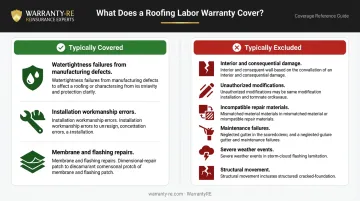
What's Typically Covered
- Watertightness failures caused by manufacturing defects
- Installation workmanship errors (under contractor or NDL warranties)
- Membrane and flashing repairs to restore a weathertight condition
What's Typically Excluded
| Exclusion | Examples |
|---|---|
| Interior/consequential damage | Damaged equipment, inventory, furnishings, mold |
| Unauthorized modifications | Adding HVAC units or solar panels without approval |
| Incompatible repair materials | Non-manufacturer materials used during repairs |
| Maintenance failures | Skipped inspections, no maintenance records |
| Severe weather events | Hurricanes, hail, tornadoes, winds above specified speeds |
| Structural movement | Building settlement, structural shifts |
GAF's standard terms exclude winds over 55 mph unless you purchase a wind addendum. Elevate's pricing guide lists extended wind coverage up to 120 mph, with hail protection available at $0.01–$0.03 per sq ft and cut/puncture coverage at $0.02 per sq ft. These riders add cost, so quote them separately for projects where wind or hail exposure genuinely justifies it.
Expressed vs. Implied Warranties
Understanding how exclusions are enforced comes down to one legal distinction: expressed vs. implied warranties. Commercial roof warranties are expressed warranties — they explicitly define coverage scope and limit the warrantor's liability. When a claim is disputed, the expressed terms govern.
Implied merchantability under UCC 2-314 — the baseline legal guarantee that goods are fit for their ordinary purpose — still applies to roofing materials. In practice, though, the expressed warranty terms and any valid disclaimer will control the outcome of a dispute.
How Long Do Commercial Roofing Warranties Last?
Duration varies by manufacturer, system type, contractor certification level, and warranty tier. Here's a summary of verified ranges from major manufacturers:
| Manufacturer | Material/System Warranty Terms |
|---|---|
| GAF | 10, 15, 20, 25, 30, 35 years (single-ply) |
| Carlisle SynTec | 5, 10, 15, 20, 30 years |
| Elevate / Holcim | 5 years to Platinum 30-year |
| Johns Manville | 5–30 years (system-dependent) |
| Sika Sarnafil | Up to 30 years |
Contractor workmanship warranties are shorter. According to RoofersCoffeeShop, installing contractor warranties are commonly 2 years, with some 5–10 year offerings. Sika's RoofPro registration form explicitly assigns workmanship-related repairs to the applicator for at least 2 years.
A 20-year warranty does not mean the roof will last 20 years without maintenance. It provides a contractual remedy for covered events during that period — and that's the extent of the commitment. Roof service life is a separate question from warranty duration.
What Can Void a Commercial Roofing Warranty?
Warranty claims get denied far more often over missed procedures and documentation gaps than over actual roof failure.
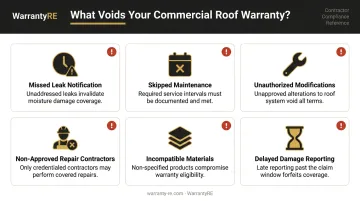
Common Voiding Conditions
- Missed leak notification deadlines — GAF, Elevate, and JM all require written notice within 30 days; Sika's labor-and-material sample requires notice on the first business day after discovery
- Skipped or undocumented maintenance — GAF requires regular inspections, maintenance, and record-keeping; Facility Executive reports that owners who stay current on maintenance average only $0.14 per sq ft annually in upkeep costs
- Unauthorized modifications — adding rooftop equipment, penetrations, or solar without manufacturer approval voids coverage with both GAF and Elevate
- Non-approved repair contractors — repairs performed by contractors outside the manufacturer's approved network, even for minor fixes
- Incompatible materials — GAF excludes leaks from non-GAF or incompatible materials; Elevate excludes non-Amrize materials unless accepted in writing
- Delayed reporting of known damage — waiting weeks or months to report visible deterioration, giving manufacturers grounds to deny coverage
Build a documented maintenance file from day one. Include inspection dates, findings, and completed repairs. When a claim is filed, that file is often the only thing standing between reimbursement and a flat denial.
Warranty Terms Are Negotiable
Once your maintenance documentation is in order, the next step is making sure the warranty terms themselves work in your favor — because they're not fixed. Commercial roof warranties are contracts, and before signing, contractors and building owners should request specimen copies and review every clause. Terms worth negotiating include:
- Legal jurisdiction
- Wind and hail coverage addenda
- Coverage for specific system components
- Maintenance obligation specifics
How Roofing Contractors Can Turn Their Warranty Into a Business Asset
Every workmanship warranty a contractor issues is backed by their own cash flow. A leak, a flashing problem, an improper nail pattern — that callback comes straight out of the contractor's pocket. No upside, just cost.
For smaller commercial contractors without a structured financial reserve, one large warranty claim on a multi-year project can create serious cash flow strain. The workmanship warranty — something contractors offer to win business — becomes an unmanaged liability.
Third-Party Warranty Arrangements vs. Contractor-Owned Structures
Most contractors currently send warranty premiums to a third-party administrator. That administrator collects the fees, pays claims, and keeps whatever's left. The question worth asking: if your warranty provider weren't consistently profitable from your business, would they continue offering the program?
A contractor-owned reinsurance structure changes that math entirely. Instead of premiums leaving the business, they flow into a reinsurance company the contractor legally owns. Claims are paid from that reserve. Unused funds stay with the contractor.
How WarrantyRE Helps Roofing Contractors Own Their Warranty
WarrantyRE helps roofing contractors establish their own administrator obligor reinsurance companies — legally owned entities that replace third-party warranty providers and capture the underwriting profits those providers were keeping.
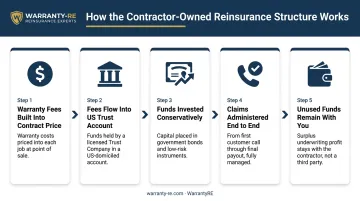
The structure works like this:
- Warranty fees are built into every job's contract price — the building owner pays for it as part of the project cost
- Fees flow into a trust account in the US, held by a Trust Company under a formal Trust Agreement
- Funds are invested conservatively (typically government bonds), with all investment income belonging to the contractor's reinsurance company
- Claims are administered by WarrantyRE from the first call to the final payout, with no extra paperwork required from the contractor
- Unused funds remain with the contractor rather than a third party
That commitment differentiates bids in commercial roofing work, where building owners weigh long-term risk alongside upfront price.
Frequently Asked Questions
How long are commercial roofing workmanship (labor) warranties?
Contractor workmanship warranties typically run 2–10 years, with some contractors extending to 15 years on larger projects. The duration depends on the contractor's certification level, the roofing system used, and the scope of the installation.
What is a No Dollar Limit (NDL) commercial roof warranty?
An NDL warranty is a manufacturer-issued warranty that covers repair costs for covered leak events with no cap on the dollar amount. It requires installation by an approved contractor, proper project registration, and documented maintenance compliance to remain valid.
What voids a commercial roofing warranty?
Common causes include failing to report leaks within the required window (often 30 days), skipping required maintenance, making unauthorized rooftop modifications, and using non-approved contractors or incompatible materials for repairs.
What is the difference between a commercial roof warranty and insurance?
A warranty covers defects in materials or installation quality and provides a repair remedy. Insurance covers unexpected external events like storms, fire, or vandalism. Building owners need both — one doesn't substitute for the other.
Can a commercial roof warranty be transferred if the property is sold?
Many manufacturer warranties are transferable with written notification and a fee. Common transfer fees: GAF charges $500, Elevate charges $1,000, and JM charges $500–$1,000 depending on whether an inspection is required. Contractor workmanship warranties may or may not transfer depending on the original agreement terms.
Who is responsible if a contractor goes out of business before the workmanship warranty expires?
If the contractor closes, their workmanship warranty becomes practically uncollectable. It is only as strong as the contractor's continued ability to perform it. A properly issued manufacturer-backed system warranty may still respond to covered conditions.