
Most contractors can recite the basics: "we offer a 10-year workmanship warranty." But far fewer can explain what prorated coverage actually means at year 18, why a missed registration can collapse an entire warranty, or how state construction defect statutes can extend liability well beyond the written warranty period.
This guide is written for roofing contractors who want to understand the key warranty types, terminology, coverage limits, and what happens when a claim arises — so they can offer warranties confidently and protect their businesses from unexpected financial exposure.
TL;DR
- Roofing warranties come in three layers — manufacturer material, contractor workmanship, and extended/system — each with a different obligor
- Terms like "prorated," "limited lifetime," and "transferable" carry precise legal meaning that determines what customers actually receive at claim time
- Contractors bear direct out-of-pocket liability for workmanship warranties — typically 1–10 years — making this the warranty most likely to generate real financial exposure
- Most coverage losses trace back to documented exclusions like installation deviations or neglected maintenance, not disputed defects
- Through a reinsurance structure, contractors can retain underwriting profits instead of sending premiums to third-party warranty companies
The Three Types of Roofing Warranties Every Contractor Should Know
Most roofing projects involve multiple warranty layers covering different parts of the installation, with different parties bearing financial responsibility for each. Contractors who understand all three can speak clearly with customers and manage their own liability correctly.
Manufacturer's Material Warranty
This warranty is issued by the roofing material manufacturer and covers defects in the materials themselves — shingles that crack, curl, blister, or lose granules ahead of their rated lifespan. The contractor is not the obligor here; the manufacturer bears financial responsibility for material failures.
One important condition: material warranties are typically valid only when installed by a manufacturer-certified contractor following approved methods. If installation deviates from manufacturer specs, the material warranty can be voided — shifting liability back to the contractor.
Coverage periods for residential shingles commonly range from 20 years to lifetime, per NRCA guidelines. But "lifetime" or "50-year" language doesn't mean full coverage for the entire period. GAF's Roofing System Limited Warranty, for example, includes a 10-year non-prorated Smart Choice Protection Period — after which remedies become prorated.
Workmanship (Installation) Warranty
This warranty is issued by the contractor and covers labor defects — faulty flashing, improper nailing, misaligned shingles, ventilation failures — that cause leaks or premature failure. This is where contractors carry direct, out-of-pocket liability.
Per CertainTeed's warranty guidance, contractor warranties most often run one or two years, though extended workmanship coverage can reach 25 years. Most roof failures trace back to installation error rather than material defects. That makes this the warranty most likely to generate actual claims.
Extended or System Warranty
When contractors want to offer customers a single, unified coverage document, extended warranties combine material and workmanship protection into one product — available only through certified installers. Examples include:
- GAF Golden Pledge — requires Master Elite contractor status; registration within 45 days of installation
- Owens Corning Platinum Protection — requires Platinum Preferred contractor; registration within 60 days
- CertainTeed SureStart PLUS — requires a credentialed contractor and a complete Integrity Roof System
These warranties often include tear-off coverage, underlayment protection, and transferability provisions. The tradeoff: compliance requirements are strict. Missed inspections, unauthorized repairs, or non-certified contractors performing future work can void the entire coverage.
Key Warranty Terms Decoded
Warranty documents use specific legal and industry terms that carry significant meaning. Misunderstanding this language leads to unmet customer expectations, denied claims, and disputes.
Prorated vs. Non-Prorated Coverage
- Non-prorated: The manufacturer or contractor covers the full repair or replacement cost regardless of roof age during this window
- Prorated: Coverage decreases as the roof ages — the customer's out-of-pocket share increases each year
A practical example: a warranty that's non-prorated for the first 10 years (as with GAF's Smart Choice period), then prorates after that. A homeowner filing a claim in year 18 may receive only partial reimbursement rather than full replacement value.
"Limited Lifetime" Warranty
This term does not mean the product lasts indefinitely or that coverage is unlimited. Per GAF, Owens Corning, and CertainTeed's own warranty language, "limited lifetime" means coverage lasts for as long as the original homeowner owns the home — not the life of the roof or any future owner.
Additional limits typically apply:
- Applies only to detached single-family residences owned by individuals
- Townhomes, commercial buildings, and rentals are frequently excluded
Transferability
A transferable warranty can be passed from the original homeowner to a future buyer — often a selling point when a home goes on the market. Transfer windows vary by manufacturer:
| Manufacturer | Transfer Window | Fee |
|---|---|---|
| IKO | Within 30 days of sale | Not specified |
| Atlas | Within 60 days of sale | $100 |
| Owens Corning Platinum | Within 60 days of sale | $100 |
| GAF Golden Pledge | Within 1 year of sale | Not specified |
| CertainTeed | Not specified | None |
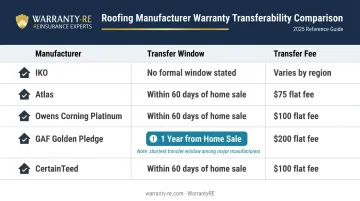
Most warranties allow only one transfer. Contractors should confirm transferability terms before using this as a sales point — GAF's one-year window is a documented exception to the common 30–60 day rule.
Warranty Registration Requirements
Transferability terms matter at the point of sale, but registration deadlines affect coverage from day one. Some manufacturers require the contractor to register the warranty within a fixed window after installation. GAF Golden Pledge requires registration within 45 days; Owens Corning Platinum Protection within 60 days. A missed registration can default coverage to a lower tier or eliminate enhanced coverage entirely.
Build warranty registration into your standard post-installation checklist. Treating it as optional creates unnecessary exposure for both you and your customer.
Obligor vs. Administrator
These terms appear frequently in warranty documents:
- Obligor (warrantor): The entity legally responsible for fulfilling warranty obligations
- Administrator: The entity managing the claims process — intake, review, and payment coordination
In third-party warranty arrangements, the external warranty company holds both roles. In a contractor-owned reinsurance structure, the contractor's own reinsurance company functions as the obligor, with a program administrator like WarrantyRE managing the claims process.
What Roofing Warranties Cover — And What They Don't
Contractor-customer disputes often trace back to one root cause: what the customer assumed was covered versus what the warranty actually covers.
What's Typically Covered
Material warranties generally cover:
- Manufacturing defects in roofing products
- Premature granule loss, curling, or cracking not caused by external damage
- Wind resistance up to a specified MPH rating
Workmanship warranties generally cover:
- Improper nailing or fastening patterns
- Flashing installation failures
- Ventilation errors
- Leaks caused directly by installation mistakes
Common Warranty Exclusions
Documented exclusions across major manufacturers include:
- Storm and weather damage beyond specified wind ratings (GAF excludes wind above maximum speed; Owens Corning Platinum excludes hail and strong winds)
- Installation spec deviations — IKO excludes damage from improper application or failure to follow printed instructions
- Post-installation alterations — GAF excludes rooftop equipment damage; Owens Corning Platinum excludes solar panel removal/replacement costs
- Maintenance neglect — see section below; CertainTeed explicitly lists this as an exclusion
- Consequential damages — GAF explicitly excludes consequential, punitive, and incidental damages; interior building damage falls outside coverage
Maintenance Neglect: The Exclusion That Creates the Most Disputes
Most warranties require "reasonable maintenance" — but the term is rarely defined. When a claim is filed, the warranty provider inspects for signs of neglect and can deny coverage if gutters were clogged, a known leak was left unrepaired, or no inspection records exist.
Walk customers through their maintenance obligations at the time of installation. Documenting that conversation protects both parties.
Consequential Damages
Roofing warranties cover the roof system — not water-damaged ceilings, flooring, mold remediation, or business interruption caused by a leak. Customers expecting warranty coverage for interior damage will need a separate homeowners insurance claim. Make this boundary explicit at job completion — ideally in writing — so customers aren't blindsided when a claim gets redirected to their homeowners insurer.
How Long Is a Roofer Liable?
"Warranty duration" and "contractor liability" are related but not the same thing. A warranty defines when a customer can make a claim; liability is the legal exposure a contractor faces if the work fails.
State construction defect statutes and implied warranty laws vary significantly:
| State | Contractor Liability Period |
|---|---|
| Pennsylvania | 12 years after completion (actions in years 10–12 may extend to 14 years) |
| Maryland | 10 years after improvement first becomes available for use |
| Arizona | 8 years after substantial completion; 9-year absolute limit |
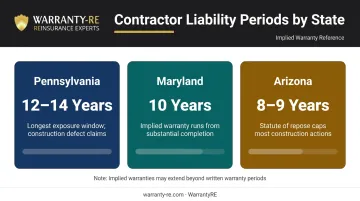
In Arizona, legal commentary confirms that the implied warranty of workmanship and habitability requires builders to construct homes to industry standards and cannot be waived or disclaimed — even when an express warranty is provided.
In several states, homeowners can pursue contractors for defective work beyond the written warranty period. Contractors should consult legal counsel to understand the specific exposure in their operating states.
The Unfunded Liability Problem
Every workmanship warranty a contractor issues is an unfunded promise. If a surge of claims arrives in years 3–5, the contractor absorbs that cost from operating cash flow — with no reserve pool in place.
That's the liability gap WarrantyRE's reinsurance model addresses. Contractors can build warranty fees directly into job pricing, with those funds flowing into a contractor-owned reinsurance account — creating a customer-funded reserve that covers claims instead of draining cash flow.
How Roofing Contractors Can Offer Stronger Warranties
Contractors who understand warranty terms can offer coverage that earns customer trust and holds up financially over time. The challenge is that longer workmanship warranties increase financial exposure — and most contractors fund claims entirely from operating cash flow or use third-party warranty companies that capture all the premium income.
The Contractor-Owned Reinsurance Model
The alternative: a structure where the contractor collects warranty premiums from customers, builds funded reserves, and pays claims from those reserves — retaining underwriting profits that would otherwise go to a third-party warranty company.
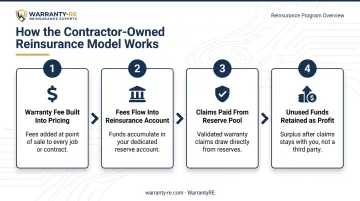
Here's how it works in practice:
- Warranty fee is built into job pricing — On a $15,000 roof replacement with a 5 or 10-year labor warranty, a warranty fee is included in the contract price. The homeowner is already paying for it.
- Fees flow into the contractor's reinsurance account — Funds are held in a U.S.-based Trust Company, invested conservatively in government bonds. Investment income belongs to the contractor's reinsurance company.
- Claims are paid from the reserve pool — When leaks, flashing failures, or nail pattern issues arise, claims are covered from the pool — not from operating cash flow.
- Unused funds stay with the contractor — Any money not used for claims remains in the reinsurance account, creating a profit opportunity from what was previously only a cost center.
informal guarantees. A documented, funded warranty program signals professionalism — and gives customers a concrete reason to choose one contractor over another.
Frequently Asked Questions
How long is a roofer liable for his work?
Written workmanship warranties typically run 1–10 years, but state construction defect statutes and implied warranty laws can extend legal liability beyond the written warranty period, sometimes 10 years or more, depending on jurisdiction. Contractors should consult legal counsel to understand the rules specific to their operating states.
What is the difference between a material warranty and a workmanship warranty?
A material warranty is issued by the manufacturer and covers defects in the roofing products themselves. A workmanship warranty is issued by the contractor and covers errors made during installation. Both are needed for full protection — neither covers the other's scope of failure.
What does prorated warranty coverage mean?
Prorated coverage means the percentage of repair or replacement costs covered by the warranty decreases as the roof ages. A homeowner filing a claim in year 18 of a 10-year prorated warranty, for example, may receive only partial reimbursement rather than full replacement value.
What voids a roofing warranty?
The most common causes: using non-certified contractors for repairs, failing to register the warranty within the required window, skipping required maintenance, allowing unauthorized modifications (satellite installations, HVAC penetrations), and storm damage exceeding the warranty's specified wind rating.
Can a roofing warranty be transferred to a new homeowner?
Many warranties are transferable, but usually only once and within a defined timeframe after sale. Transfer windows range from 30 days (IKO) to one year (GAF Golden Pledge). Confirm transferability terms with the manufacturer before using this as a sales point with customers.
What is a "limited lifetime" roofing warranty?
"Limited lifetime" typically means coverage lasts for as long as the original homeowner owns the home — not the life of the roof or any future owner. It generally applies only to detached single-family residences, not commercial or multi-family structures.