
This gap between acceptable and actual callback rates represents one of the most destructive margin leaks in the HVAC industry. Every unplanned return visit consumes technician labor, fuel, and parts at zero revenue—directly eroding the already-thin median net profit margin of 5.8% that HVAC contractors operate within. When you consider that truck roll costs reach $136.61/hour after adjusting for typical 60% labor utilization, the financial damage compounds quickly across dozens of jobs each month.
The critical insight: HVAC installation callbacks are not primarily random misfortune—they're the result of controllable decisions made before, during, and after installation. This article examines three dimensions where contractors can intervene: the technical and operational decisions surrounding each installation, how work is managed and documented, and the financial structure around warranty obligations.
TL;DR
- Callbacks cost HVAC contractors on two fronts: direct expenses (labor, fuel, parts) with zero revenue, plus hidden damage to scheduling, morale, and customer trust.
- Top callback drivers are controllable: improper equipment sizing, skipped commissioning steps, poor communication, inadequate documentation, and wrong-tech-for-job dispatch decisions.
- Pre-installation work pays the most: run Manual J load calculations, assign the right technician, and complete full system commissioning before leaving the job.
- Process discipline reduces callbacks through mandatory checklists, digital documentation, and technician-level callback tracking that drives continuous improvement.
- Reinsurance programs let contractors fund warranty reserves from customer premiums, turning unpredictable callback costs into claims against a pool they own.
How Callback Costs Build Up in HVAC Installation Businesses
Callback costs rarely announce themselves as a crisis—no single invoice labeled "callbacks" appears on your P&L. Instead, they accumulate gradually across dozens of jobs, invisible until they've consumed a material portion of annual profitability. The damage hits twice: once immediately, and again as errors repeat.
The immediate hit is straightforward: a callback triggered by a defective install sends a technician back to the job site, consuming hours and fuel to correct an issue that generates no revenue. According to FieldEdge's analysis, callbacks cost approximately $150 per event in direct labor and expenses at minimum—though fully-loaded costs including overhead allocation can easily exceed $1,000 per truck roll.
The compounding effect is harder to see. When the same mistake repeats across your job volume—oversized systems on emergency replacements, technicians skipping refrigerant charge checks, dispatch sending undertrained crews to heat pump installs—the error multiplies fast. A contractor running 150 calls monthly with a 16% callback rate who eliminates just five callbacks per month saves over $9,000 annually in direct costs alone.
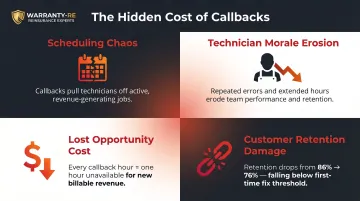
Hidden costs don't appear on any invoice but erode business value nonetheless:
- Scheduling chaos — callbacks disrupt planned dispatch, forcing service managers to pull technicians off paying jobs to handle warranty work
- Technician morale erosion — as HVAC School founder Bryan Orr notes, callbacks "destroy customer satisfaction and reduce technician morale by causing long hours"
- Lost opportunity cost — every hour spent on a callback is an hour unavailable for new customer acquisition or higher-margin work
- Customer retention damage — Aberdeen Group research found that service organizations with first-time fix rates below 70% see customer retention drop to 76%, compared to 86% retention for high performers
Most contractors track callbacks in a spreadsheet but never assign a dollar value to the morale, retention, and scheduling ripple effects. That's precisely where the real margin loss hides—and why reducing callbacks requires more than just fixing bad habits on individual jobs.
The Real Cost Drivers Behind HVAC Installation Callbacks
Reducing callbacks starts with understanding where they originate. Most don't stem from equipment defects or unavoidable failures—they trace to decisions contractors make (or fail to make) before, during, and after installation.
Equipment Sizing and Specification Errors
The most consistent callback driver is invisible when the technician leaves: the system was wrong before installation even began. Research compiled by the U.S. Department of Energy found that 70-90% of residential HVAC systems have at least one performance-compromising fault, with 31-93% of systems exceeding recommended sizing ranges.
When systems are oversized—a common problem when contractors use rule-of-thumb methods instead of Manual J load calculations—the predictable result is short cycling, humidity problems, and coil freezing. No amount of skilled fieldwork can correct those issues after the fact.
Lennox Commercial estimates that 30-40% of residential applications are improperly sized, creating warranty exposure before the first refrigerant line is brazed. The DOE research confirms that approximately 20% of system efficiency is lost at time of installation due to sizing, ductwork, and commissioning failures—all preventable with proper specification and verification.
Incomplete Field Execution and Skipped Commissioning
Technicians who skip verification steps—failing to check refrigerant charge, neglecting airflow measurements, or leaving without testing performance under real load conditions—create near-certain callbacks. There's a meaningful difference between a system that's "installed" and one that's actually commissioned.
Only 14% of residential contractors report adhering to ACCA Standard 5 (Quality Installation Specification), according to DOE findings—the consensus minimum for proper design, installation, testing, and commissioning. When 86% of contractors skip these steps, field data shows the consequences:
- 50-93% of systems tested show low airflow (below 350 CFM/ton)
- 67-100% have duct leakage at or above 100 CFM25
As Jim Bergmann, founder of measureQuick, puts it: "If you skip commissioning you will surely be back for a performance issue or a warranty callback. There is no free lunch."
Documentation and Communication Failures
A surprising share of callbacks aren't technical failures at all—they're communication breakdowns. A 2025 survey of 1,000 U.S. homeowners found that 38% cited communication or procedural issues as their top complaint with HVAC service, compared to just 7.1% who cited the problem not being fixed right the first time.
That gap matters. It means many "callbacks" result from customers not understanding system operation, expectations not being set about normal behavior (heat pump defrost cycles, for example), or declined repairs that weren't documented.
When technicians fail to record system readings, note customer concerns, or communicate what was resolved versus what remains unaddressed, both customers and follow-up technicians lack the information needed to prevent repeat calls. Bryan Orr identifies this as "one of the most common sources of callbacks," noting that customers often don't know how to use newly installed equipment or what constitutes normal system behavior versus a problem requiring service.
Organizational and Dispatch Decisions
Callback patterns also originate in the office, not just the field. Sending a technician to a complex heat pump installation without the proper training creates predictable failure. Dispatching crews without job-specific parts—forcing return trips to complete installations—is an inventory and scheduling decision that generates callbacks before the truck leaves the shop.
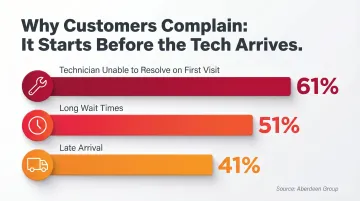
Aberdeen Group research demonstrates that 61% of customer complaints stem from the technician being unable to resolve the issue on the first visit—exceeding complaints about wait times (51%) or late arrival (41%). When contractors dispatch the wrong technician or send crews without proper tools and parts, they're creating the conditions for callbacks through organizational choices, not field execution problems.
Cost-Reduction Strategies for HVAC Installation Callbacks
Effective callback reduction requires matching the intervention to the root cause. Demanding technicians "do better" without addressing pre-installation decisions, process discipline, or structural warranty costs produces frustration without results. The strategies below target the actual decision points where callbacks originate.
Strategies That Reduce Costs by Changing Decisions
This category addresses choices made before installation is complete—interventions that eliminate entire classes of callbacks before they can occur.
Conduct proper load calculations before every installation
Manual J 8th Edition is the ANSI-recognized national standard for HVAC equipment sizing in single-family detached homes, required by national building codes and most state and local jurisdictions. Yet the majority of systems—especially emergency replacements—are installed without detailed load calculations. Contractors who rely on rule-of-thumb sizing ("match the old tonnage") or simple square-footage estimates create the oversizing problems that drive short cycling, humidity complaints, and frozen coils.
Performing Manual J calculations prevents these predictable failures. While the time investment ranges from 90 minutes to 8 hours depending on home complexity, the alternative is far more expensive: systems installed without proper sizing generate performance complaints that require multiple return visits to diagnose and address—problems that proper specification would have prevented entirely.
Assign the right technician to each job type
Callback rates vary significantly by technician skill level and job complexity. Dispatching undertrained technicians to heat pump installations, multi-zone systems, or commercial applications generates predictable callbacks. As ACHR News reports, most heat pump callbacks stem from installation and setup mistakes—incorrect sizing, poor airflow, improper refrigerant charge, and thermostat configuration errors—not equipment defects.
Matching technician capability to job complexity at the dispatch stage is a decision-point intervention that prevents callbacks before they occur. This requires honest assessment of which technicians are qualified for complex installs versus maintenance and simpler replacement jobs, and scheduling discipline to ensure the right crew is assigned to each job type.
Ensure trucks are stocked with job-specific parts before departure
Running out of parts ranks among the top reasons for callbacks. Generic truck stock doesn't prevent this—job-specific preparation does. Before each installation, verify that the assigned truck carries the exact parts, fittings, electrical components, and materials required for that specific job. This is a scheduling and dispatch decision that eliminates return trips caused by missing parts—a controllable failure mode that generates callbacks at zero revenue.
Commission every system before leaving the job
"Installed" and "commissioned" are not the same thing. Installation means the equipment is physically in place; commissioning means the system has been verified to operate correctly under real-world conditions. ACCA Standard 5 QI (Quality Installation Specification) defines the minimum requirements: verifying refrigerant charge, measuring airflow, testing thermostat and control function, and confirming system performance meets design specifications.
Skipping these steps doesn't save time—it guarantees callbacks. Genz-Ryan, a 50-technician HVAC business in Minnesota, previously employed a full-time technician ("Randy") dedicated exclusively to running callbacks. After implementing measureQuick-based commissioning protocols, the company reported that "callbacks dropped dramatically." The investment: approximately one hour to dial a system in, or 30 minutes for diagnostics—far less than the cost of repeated return visits.
How Installation Management Reduces Callbacks
Process discipline, documentation, and feedback loops catch errors before they become customer complaints.
Use job-type checklists as a completion gate
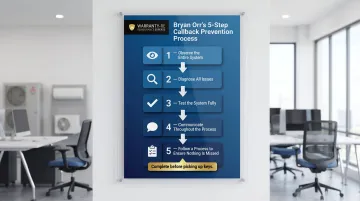
Checklists function as quality gates, not reminders. Each item completed before the technician leaves reduces the probability of returning. Bryan Orr recommends creating "a checklist you go over at the end of every call you review before you pick up your keys and put them in the ignition." His five-step prevention process:
- Observe the entire system
- Diagnose all issues
- Test the system fully
- Communicate through the entire process
- Follow a process to ensure nothing is missed
Checklists should be tailored to job type—new installation versus repair versus maintenance—and require sign-off before the work order is marked complete. This prevents technicians from leaving with critical steps unfinished: disconnects left open, refrigerant charge unverified, thermostat operation untested.
Require thorough digital documentation on every job
Mandatory before/after photos, recorded system readings, and detailed work order notes create an accountable record that prevents disputes and gives follow-up technicians the context they need. FieldEdge recommends requiring photos, signatures, and job notes before marking work orders complete—creating a digital completion gate that reduces missed steps.
This documentation serves multiple purposes: it proves work was performed correctly, provides diagnostic baseline for future service, and eliminates "he said/she said" callbacks where customers claim work wasn't done or was done incorrectly. When any technician can access the complete installation record, they can resolve issues without another return trip.
Communicate with the customer at start, during, and end of every call
Given that communication failures account for 38% of customer complaints—far exceeding technical failures—structured communication protocols directly reduce callbacks. The practice:
- Listen to all customer concerns at arrival and document them
- Explain findings before beginning work
- Review results before leaving, including what was resolved and what remains
- Document any declined repairs in writing
- Spend extra time with difficult customers explaining system operation and expected behavior
Bryan Orr notes that for challenging customers, "spending 15 extra minutes writing a detailed follow-up email can really reduce those immediate callbacks." Many "technical" callbacks are actually customers who don't understand how to use newly installed equipment or what constitutes normal system behavior.
Track callback rates by technician and job type to close the feedback loop
Without data, callback problems remain invisible at the business level. Aberdeen Group research found that a 10% improvement in first-time fix rate correlates with 14% lower service costs, 17% higher workforce productivity, and 20% improvement in customer satisfaction. Measurement drives improvement.
Track which technicians, equipment types, and job categories generate the most callbacks. This allows targeted coaching and process correction rather than blanket demands to "do better." Top-performing service organizations use technician-level data for training and inventory improvement—what SmartServiceOps calls "closed-loop learning"—rather than punitive micromanagement.
Changing the Financial Structure Around Warranty Callbacks
Some callback costs stem not from installation quality but from the financial and contractual structure around warranty obligations. Changing this structure converts callbacks from uncontrolled cost events into managed, funded claims.
Establish maintenance agreements as a structural callback reducer
Ongoing maintenance contracts shift the customer relationship from reactive (they call when something breaks) to proactive (you call when service is due). This gives contractors visibility into system condition, allowing them to catch degrading components—failing capacitors, refrigerant leaks, airflow restrictions—before they trigger emergency service calls. Maintenance agreements create scheduled touchpoints that prevent callbacks by identifying and resolving issues during planned visits rather than after system failure.
Reframe warranty structure as a cost-control decision, not just a coverage requirement
Most HVAC contractors absorb warranty costs directly: every callback, every warranty repair represents technician time, fuel, and parts paid from operating budget at zero revenue. Warranty work becomes a pure cost center with no offsetting income.
Contractors who establish their own reinsurance programs through providers like WarrantyRE change this equation entirely. Instead of paying third-party warranty companies to cover labor warranties—and letting those companies retain all underwriting profits from unused premium reserves—contractors can establish customer-funded warranty reserve pools that they own and control.
The mechanics are straightforward. On a $12,000 system replacement with a 2-year labor warranty, the warranty fee is built into the project price. Instead of that fee flowing to an external provider, it goes into the contractor's own reinsurance account. When warranty callbacks occur, claims are paid from this pool. Any unused funds stay with the contractor as profit—not with a third party.
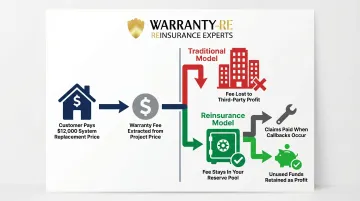
This structure converts callbacks from unpredictable out-of-pocket expenses into managed claims against a reserve pool funded by customers. WarrantyRE handles all claims administration—processing, adjudication, and resolution—while the contractor maintains ownership of the reserve funds and captures 100% of underwriting profits that would otherwise go to external warranty providers.
Invest in ongoing technician training as a systemic, not episodic, intervention
One-time training produces limited callback reduction. Lasting improvement comes from structured internal training programs tied to actual callback data—what went wrong, why it happened, and how to prevent recurrence. This closed-loop approach targets the specific failure modes your business experiences rather than generic best practices.
Slowing technician call volume slightly to allow thorough job completion reduces callbacks more effectively than additional training alone. Rushing through installations to hit call targets creates the skipped steps and incomplete commissioning that drive callbacks. Adjusting dispatch expectations to allow proper completion time—including full commissioning—eliminates more callbacks than post-failure coaching.
Conclusion
Reducing HVAC installation callbacks is about identifying where callbacks originate and intervening at the right point. Each intervention category targets a different root cause and calls for a different solution.
Pre-installation decisions deliver the highest leverage — proper load calculations, qualified technician assignments, and full commissioning before job closeout catch problems before customers do. From there:
- Process discipline — checklists, documentation, and communication protocols — creates the consistency that reduces field errors
- Smarter financial structures convert warranty risk from an uncontrolled cost into managed claims funded by customer-built reserves
The most effective callback reduction programs treat this as a continuous, data-informed business process . Contractors who combine tighter field execution with a reinsurance structure around warranty risk don't just cut callbacks — they stop absorbing the full cost when callbacks do happen, which is where the real margin protection lives.
Frequently Asked Questions
What is a callback in HVAC?
An HVAC callback is any return visit required because an installation or repair was incomplete, incorrect, or failed to resolve the customer's concern. Most industry definitions count same-issue returns within 30 days, even if the root cause differs from the original problem.
How much should an HVAC service call cost?
HVAC service calls typically range from $100–$250 depending on the problem, location, and time of service. Emergency and after-hours calls land at the higher end. Callbacks are especially costly because contractors absorb the full truck roll cost — often exceeding $136/hour when adjusted for utilization — without generating any revenue.
What is an acceptable HVAC callback rate?
The industry benchmark for acceptable callback rates is approximately 2–2.75% of all service calls, while estimated industry average rates run 10–15%. Top-performing contractors consistently outperform this benchmark through systematic process discipline, proper commissioning, and technician-level callback tracking.
How to reduce HVAC charges related to callbacks?
Callback cost reduction starts with proper Manual J load calculations, full system commissioning before leaving each job, technician skill matching to job complexity, and mandatory documentation protocols. Contractors who establish customer-funded warranty reserves through reinsurance programs can further reduce financial exposure — converting unpredictable callback costs into managed claims against reserves they own.
How do checklists reduce HVAC callbacks?
Checklists act as completion gates that prevent technicians from leaving before verifying all critical system functions: refrigerant charge, airflow, electrical connections, thermostat operation, and customer communication. This process discipline catches the small careless omissions — open disconnects, unchecked charge, unverified controls — that cause a disproportionate share of callbacks.
Can a warranty program help manage HVAC installation callback costs?
Contractor-owned reinsurance programs allow HVAC businesses to fund warranty claims from customer premiums rather than absorbing callback costs out of pocket. Providers like WarrantyRE set up this structure so unpredictable warranty expenses become managed claims against a reserve pool the contractor owns. Unused funds stay as profit instead of flowing to a third-party warranty company.