
Introduction
HVAC contractors absorb significant financial exposure through warranty-related work. According to FieldEdge's industry analysis, the estimated cost per service callback is $150 in labor and expenses per occurrence. With the acceptable callback rate sitting at approximately 2% to 2.75% of all service calls, reducing callbacks by just 5 per month can save $9,000 annually while freeing 60 service call slots for revenue-generating work.
This cost compounds the pressure on already thin margins. Industry data shows the average net profit margin for HVAC contractors sits at just 5.3%, meaning even modest unplanned warranty expenses directly erode profitability.
Warranty liability isn't just the cost of parts. It accumulates across labor, repeat dispatches, and unfulfilled customer expectations — carving into margins with every install.
For most HVAC businesses, warranty liability is a byproduct of how warranties are structured, managed, and funded — and each of those factors is controllable. This article outlines practical strategies to reduce exposure before, during, and after installation.
TL;DR
- Warranty liability accumulates across every install and surfaces unpredictably—often years after completion
- Vague warranty terms, inconsistent installs, and missing documentation drive most preventable costs
- Reducing liability starts upstream with clear warranty terms, tiered coverage options, and documented maintenance conditions
- Active management means documenting installs, verifying maintenance compliance, and reviewing every claim formally
- The strongest protection comes from owning your warranty structure through a reinsurance program backed by A-rated insurers
How Warranty Liability Builds Up for HVAC Contractors
Warranty liability isn't a single line item on your books. It accumulates incrementally across an installed base, with each job adding a new, open-ended obligation that can be triggered months or years later. Contractor labor warranties typically range from 1 to 3 years, while manufacturer parts warranties extend to 10 years with timely product registration. This means a contractor running 200 installations annually could carry forward liability on 600 to 2,000 systems at any given time.
These costs are episodic and unpredictable. Claims surface when:
- Systems fail prematurely due to equipment defects or installation issues
- Customers complain about performance that falls short of expectations
- A batch of similar installs begins to age out at the same time
Because the trigger is external and unscheduled, warranty costs stay invisible until the claim arrives—making cash flow management difficult and budgeting nearly impossible.
Most HVAC contractors don't track their total outstanding warranty exposure across their full book of installs. Without that visibility, the true liability on the balance sheet is often far larger than expected. A contractor with two or three bad install seasons hitting claims simultaneously can face five- or six-figure exposure with no reserves to cover it.
Key Drivers of Warranty Liability
Overly broad or vague warranty language is one of the most significant controllable liability drivers. When terms are unclear—covering "defects in workmanship" without defining scope, exclusions, or conditions—customers often interpret coverage more expansively than intended. Contractors absorb the cost of disputes simply because the warranty didn't clearly establish boundaries.
Inconsistent installation quality compounds the problem. When technicians vary in skill, thoroughness, or adherence to manufacturer specs, some installs will generate far more callbacks than others. According to research cited by the U.S. Department of Energy, more than 65% of residential HVAC systems have been improperly installed, resulting in equipment consuming 20-30% more energy than necessary.
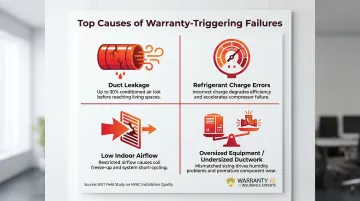
A three-year NIST study identified four primary faults that degrade efficiency and increase the probability of warranty-triggering failures:
- Duct leakage
- Refrigerant charge errors
- Low indoor airflow
- Oversized equipment with undersized ductwork
Customer behavior and post-install maintenance compliance directly affect claim frequency. Systems that are neglected, misused, or modified are more likely to fail — but without maintenance conditions tied to the warranty, contractors pay for failures they didn't cause.
Trane's warranty illustrates the standard worth matching: it requires maintenance by a licensed HVAC provider and reserves the right to request written documentation. Failure to provide that documentation can void coverage entirely.
Each of these drivers is controllable. The question is where in your process — contracting, installation, or post-sale — you're leaving the most exposure unaddressed.
Strategies to Reduce Warranty Liability
Reducing warranty liability depends on where in the business that liability originates. Decisions made at the time of sale, practices followed during and after installation, and the broader financial structure around how warranties are funded all play distinct roles.
Strategies That Reduce Liability by Changing Decisions
These upstream choices have the highest leverage on future liability because they define the terms of the obligation before it exists.
Write warranty terms with defined scope. Explicitly state what is and is not covered:
- Parts vs. labor coverage
- Specific components included (compressor, heat exchanger, refrigerant lines)
- Duration per component type
- Geographic or usage restrictions
- Exclusions (improper maintenance, unauthorized modifications, environmental damage)
This single decision reduces disputes and ambiguous claims at the source.
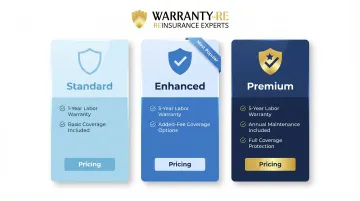
Offer tiered warranty options rather than a one-size-fits-all promise. Shorter standard coverage with an upgrade path gives customers choice, limits default exposure, and creates a revenue opportunity for extended coverage sold at a margin. For example:
- Standard: 1-year labor warranty included
- Enhanced: 3-year labor warranty for $X
- Premium: 5-year labor warranty with annual maintenance for $Y
Build warranty eligibility conditions into the agreement from the start. Require customers to:
- Register the system within 90 days (mirroring Carrier's requirement)
- Schedule annual maintenance with your company or an authorized provider
- Use only approved parts and service providers for any repairs
- Provide proof of maintenance before warranty claims are honored
These conditions mirror manufacturer requirements and give the contractor defensible grounds to decline improperly maintained claims.
Ensure every installation is completed to manufacturer specification. Poor installation compounds into warranty costs faster than most contractors expect. The NIST study found that efficiency degradations are additive when multiple faults occur simultaneously—compounding harm to system longevity. ANSI/ACCA Standard 5 QI establishes minimum requirements for properly designing, installing, testing, and commissioning HVAC installations. According to ACCA, not following this standard can increase annual energy consumption by 30% or more—a cost passed forward to the contractor through premature failures and warranty claims.
Strategies That Reduce Liability by Changing How Warranties Are Managed
These mid-stream practices determine whether claims are legitimate, preventable, or defensible while warranties are active.
Standardize documentation at the point of installation. Record for every job:
- System specifications and model numbers
- Serial numbers for all major components
- Date of installation and technician ID
- Site conditions that could affect performance (poor ductwork, inadequate ventilation, environmental factors)
- Photos of completed work and equipment placement
Without this, contractors cannot defend themselves against inflated or false claims.
Require proof of maintenance before honoring a claim. Create a simple process for verifying that the customer has met their maintenance obligation:
- Check service records for annual filter changes, coil cleanings, and inspections
- Document what happens when maintenance requirements are not met
- Apply warranty terms consistently
According to compiled industry research, preventive maintenance reduces HVAC system breakdowns by 70-75% and service requests by 31-50%. This protects the contractor from paying for failures caused by owner neglect.
Establish a formal claims review step before dispatching a technician. A brief intake process should check:
- Claim history for the system and customer
- Warranty eligibility and coverage status
- System age and installation date against the reported issue
- Whether the issue falls within defined warranty scope
This prevents unnecessary service calls that turn out to be out-of-scope or not covered.
Train technicians to identify and document warranty-voiding conditions on every service visit:
- Improper use (incorrect thermostat settings, blocked airflow)
- Unauthorized modifications (aftermarket parts, DIY repairs)
- Deferred maintenance (dirty filters, neglected coil cleaning)
This creates a paper trail that protects the business if a future claim arises from the same system.
Strategies That Reduce Liability by Changing the Context Around Warranties
For many contractors, the biggest structural risk isn't any individual claim — it's that every claim draws directly from operating cash flow.
Pass through manufacturer warranty coverage wherever possible. Distinguish clearly in customer-facing materials between what the manufacturer covers (equipment parts) and what the contractor covers (installation labor). Trane's warranty voids coverage if the product is not installed by a licensed HVAC service provider, not installed per manufacturer specifications, or not part of an AHRI-rated matched system. Understanding these conditions reduces the contractor's direct exposure on equipment-side failures.
Stop self-funding warranty obligations out of operating revenue. When contractors self-insure labor warranties informally, they carry risk without structure. Common exposures include:
- Unexpected repair costs from factors outside their control
- Cash flow disruption from unpredictable claim timing
- Legal exposure without proper insurance backing
- No actuarial data to accurately price the risk upfront
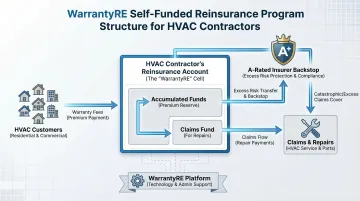
Consider transitioning to a self-funded reinsurance model. Rather than paying premiums to a third-party warranty company and losing the underwriting profit, HVAC contractors can establish their own administrator obligor reinsurance structure. Warranty fees are built into job pricing, flow into the contractor's own reinsurance account, and cover claims from that customer-funded pool — rather than from operating revenue.
This is the structure WarrantyRE helps contractors build. Backed by A-rated insurers, the program handles all claims administration while the contractor retains underwriting profits in a tax-advantaged account. The contractor stops subsidizing a third party's margin and starts capturing it instead.
Conclusion
Warranty liability isn't a fixed cost. It's shaped by decisions made at the point of sale, by the operational discipline applied during and after installation, and by the financial structure around how warranty obligations are funded.
HVAC contractors who reduce warranty liability strategically—rather than simply absorbing claims as they come—protect their margins, serve customers better, and keep more of what they earn.
The strategies covered here give you a clear starting point:
- Tighten warranty language to define scope and exclusions
- Standardize installation documentation across every job
- Add maintenance conditions that protect your coverage obligations
- Implement a claims review process before approving payouts
- Explore structured funding options that move warranty risk off your operating budget
That last point is where reinsurance programs—like those WarrantyRE structures for HVAC contractors—turn warranty liability from a recurring expense into a profit center funded by your own customer base.
Frequently Asked Questions
Frequently Asked Questions
How to reduce warranty cost?
Tighten your warranty language with clear scope and exclusions, add maintenance conditions customers must meet, and standardize installation documentation on every job. For larger cost control, explore structured funding options like self-funded reinsurance rather than absorbing all claims out of operating revenue.
What voids an AC unit warranty?
Manufacturer warranties are typically voided by improper installation, use of unauthorized parts, failure to register the system within the required timeframe (often 90 days), and lack of documented annual maintenance by a licensed provider.
What is the biggest source of warranty liability for HVAC contractors?
Imprecise warranty language and inconsistent installation quality are the two most common and controllable sources. Vague terms lead to disputes over what's covered, and variable workmanship creates claims that cluster around specific technicians or installs—patterns rarely tracked back to their source.
How do service agreements reduce warranty liability?
Maintenance agreements keep systems operating within manufacturer specs, create a documented service history that supports or defeats warranty claims, and shift some responsibility to the customer for proper upkeep. This protects contractors from paying for failures caused by owner neglect.
What is a self-funded reinsurance program for HVAC contractors?
A self-funded reinsurance program lets an HVAC contractor act as their own warranty administrator. Instead of paying premiums to a third-party company that keeps the profit, the contractor collects customer-funded warranty fees, covers routine claims, and uses A-rated reinsurance backing for large exposures.
How can HVAC contractors protect themselves from expensive warranty claims?
Protection works in three layers:
- Upstream decisions: clear warranty terms, tiered coverage options, and installation standards
- Operational practices: documentation, maintenance verification, and claims review processes
- Financial structures: reinsurance programs that cap exposure on large claims while retaining underwriting profits