

Introduction
A burst pipe on a Sunday night. A water heater that quits in January. A sewage backup with no warning and no plan.
According to HomeAdvisor's 2025 plumbing cost guide, emergency and after-hours trip fees typically run $300–$400, and that's before a plumber touches anything. The average plumbing job costs $339 — but emergencies can push that figure far higher, fast.
Most homeowners don't think about their plumbing until something fails. Maintenance club memberships exist specifically to change that equation — replacing unpredictable, expensive emergencies with a known annual cost and a licensed plumber who already knows your home.
This article covers what a plumbing maintenance club actually includes, the measurable advantages members get, and what happens to households that skip preventative care entirely — with real cost figures and specific examples.
TL;DR
- Plumbing maintenance clubs are subscriptions (monthly or annual) covering inspections, water heater service, and priority scheduling
- Members typically pay $8–$18/month, receive 10–20% discounts on repairs, and get waived emergency service fees
- Routine inspections catch small problems before they become water damage claims averaging $15,400
- A single avoided emergency surcharge ($300–$400) can offset an entire year of membership fees
- Skipping maintenance means full rates, no priority access, and no documented system history
What Is a Plumbing Maintenance Club Membership?
A plumbing maintenance club is a recurring subscription — monthly or annual — offered directly by a licensed plumbing contractor. Members pay a flat fee in exchange for scheduled services, discounted rates, and priority access when something goes wrong.
What It Typically Covers
Most programs include a combination of:
- Annual whole-home plumbing inspection
- Water heater flush and maintenance check
- Drain inspection and minor clearing
- Waived or reduced dispatch/trip fees
- Priority scheduling for service calls
- 10–20% discount on parts, labor, and diagnostic charges
Some contractors extend coverage to water quality testing or HVAC if they offer both services. Scope varies by provider, so it's worth reviewing what's included before signing up.
How to Think About It
Think of a maintenance membership as a risk management tool. Plumbing systems don't announce problems in advance — they either run quietly or fail at cost. Regular inspections by a licensed plumber catch small issues early, before they turn into emergency repairs.
Key Benefits of a Plumbing Maintenance Club Membership
Preventative Inspections That Catch Problems Early
The core of any maintenance membership is the annual whole-home inspection — a systematic walkthrough of visible pipes, drains, fixtures, shut-off valves, water heater condition, and toilet function.
What this inspection actually finds:
- Early-stage corrosion on supply lines
- Slow-draining fixtures indicating partial blockages
- Sediment buildup reducing water heater efficiency
- Pressure irregularities suggesting regulator wear
- Minor fixture leaks that carry no obvious symptoms yet
None of these feel urgent. All of them get expensive if left alone for 12–18 months.
The cost math is straightforward. According to III insurance data, water damage and freezing claims affected roughly 1 in 67 insured homes from 2019–2023, with a weighted average severity of $15,400. A standard plumbing inspection costs an average of $300. What the inspection does is find problems while they're still inexpensive to fix — before they become the kind of damage that triggers a claim.
A slow drip identified during a routine visit is a quick, low-cost fix. That same drip, undetected for six months, can work into a wall, cause mold growth, and trigger an insurance claim that costs several times more to remediate than the original repair would have.
When this matters most:
- Homes 15+ years old with original fixtures
- Properties with hard water or freeze-thaw climate cycles
- Any household that hasn't had a professional plumbing inspection in several years
Priority Scheduling, Waived Emergency Fees, and Repair Discounts
Beyond the inspection, membership fundamentally changes how you're treated when something breaks.
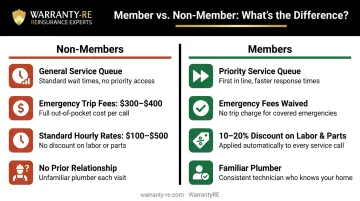
What non-members experience during a plumbing emergency:
- Added to a general service queue — often waiting days during peak demand
- Emergency/after-hours trip fees of $300–$400 on top of repair costs
- Standard hourly rates running $100–$500/hour, averaging $170/hour
- No established relationship with the plumber who shows up
What members experience:
- Moved to the front of the service queue
- Emergency dispatch fees waived or reduced
- 10–20% discount on labor and parts
- Same-day or priority next-day service in most contractor programs
The break-even math isn't complicated. At published membership rates of roughly $8–$18/month, the annual cost runs $96–$216. A single avoided emergency trip fee of $300–$400 more than covers the full year.
That math doesn't account for a less obvious advantage: consistent access to a plumber who already knows your home. When something fails at 9 p.m. on a holiday, non-members typically call whoever answers first. That often means unfamiliar contractors, rushed diagnostics, and bills that don't hold up under scrutiny.
Particularly relevant for:
- High-occupancy households with heavy fixture use
- Homes with aging water heaters or fixtures approaching end of life
- Anyone who has made multiple plumbing service calls in the past two years
Extended Equipment Lifespan and Whole-Home System Protection
Routine maintenance isn't just about finding problems. It directly extends the functional life of expensive plumbing components.
The clearest example is the water heater. Rheem's guidance puts traditional tank water heater lifespan at 8–12 years. The EPA and DOE both recommend annual flushing to remove sediment buildup that forces the unit to work harder and heat less efficiently. Without that annual flush, a unit that might reach 12 years often fails closer to 8–9.
The cost comparison:
| Service | Average Cost |
|---|---|
| Professional water heater flush | $160 |
| Water heater replacement | $1,339 (average) |
| Replacement range | $882–$1,817 |
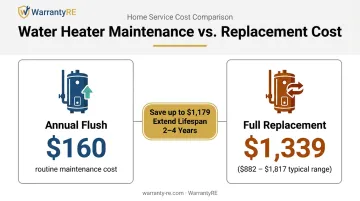
A $160 flush that extends a $1,339 appliance by two to four years pays for itself many times over. What makes membership valuable is that it makes this kind of maintenance automatic — it happens on schedule, not when a homeowner remembers to call.
Many membership programs also extend replacement discounts to members when equipment does eventually need replacing, reducing the cost of an inevitable expense.
Other components that benefit from routine attention:
- Anode rods (recommended inspection every 3–4 years per DOE)
- Pressure regulating valves
- Supply line hoses on appliances
- Drain lines prone to gradual buildup
Most relevant for: Homes with water heaters over seven years old, properties on hard water systems, and households with no documented maintenance in the past two to three years.
What Happens When Plumbing Maintenance Is Skipped
The pattern is predictable: no visible problems mean nothing gets scheduled, wear accumulates silently, and by the time something fails the repair is more complex, more expensive, and poorly timed.
Specific consequences of skipping maintenance:
- Pays full emergency rates with no priority scheduling — the highest cost at the worst time
- Sediment buildup, pressure variance, and slow leaks compound quietly until something gives
- Every repair bills at full rate, with no contractor relationship or discount history to draw on
- Each service call starts from scratch — no record of prior repairs, recent replacements, or known problem areas
The financial exposure is real. A 2024 Roto-Rooter survey found that 67.5% of homeowners had less than $5,000 set aside for repairs or maintenance, and 34% had no savings at all for unexpected repairs. For those households, an unplanned plumbing failure isn't just inconvenient — it's a financial disruption with no buffer.
How to Get the Most Value from a Plumbing Maintenance Membership
A membership only delivers value if you use it. That means:
- Schedule the annual inspection promptly — don't let it sit on the calendar for months
- Request the water heater flush — confirm it's included and book it at the same time
- Call when something seems off — members have priority access; use it before a minor issue escalates
- Review the terms before you need them — confirm whether discounts apply to labor, parts, or both, and whether emergency fee waivers have conditions
Questions to Ask Before Joining
- Does the inspection cover the whole home or just one system?
- Are emergency/dispatch fees waived entirely, or just reduced?
- What does the discount apply to — labor, parts, diagnostics, or all three?
- What is the priority scheduling commitment, and how is it defined?
- Is this a maintenance club or a home warranty? (These are structurally different products)
For plumbing contractors building their own membership programs: the financial side matters as much as the service side. Honoring repair warranties and funding member benefits requires a structure that covers warranty claim costs when they arise. Contractors looking to replace third-party warranty arrangements with programs they own and control can explore contractor-owned reinsurance structures through providers like WarrantyRE.
Conclusion
A plumbing maintenance club membership delivers outcomes you can measure: lower repair costs, faster emergency response, extended equipment life, and fewer surprise failures — with a licensed plumber who knows your home's systems before anything goes wrong.
Each inspection that catches a minor leak, each emergency surcharge avoided, and each extra year pulled from a water heater represents real money saved versus reactive, unplanned service. Over five years, those differences routinely amount to thousands of dollars that stay in your pocket instead of going toward emergency dispatch fees and premature replacements.
Membership isn't a premium add-on. It's a practical approach to managing one of the most expensive and least visible systems in any home — at a fixed, predictable cost, with a plumber who already understands your system when something does go wrong.
Frequently Asked Questions
What is typically included in a plumbing maintenance club membership?
Most memberships include an annual whole-home plumbing inspection, water heater flush, drain checks, priority scheduling, waived emergency service fees, and a 10–20% discount on parts and labor for repair work. Exact scope varies by contractor, so always confirm what's included in writing.
How much does a plumbing maintenance club membership cost?
Published contractor examples range from roughly $8–$18/month, with some offering lower annual lump-sum pricing. Cost depends on the provider and what services are bundled into the program.
Is a plumbing maintenance club membership worth it?
For older homes, households with frequent plumbing calls, or anyone who would pay for inspections and water heater maintenance separately, yes. A single avoided emergency trip fee ($300–$400) typically offsets the full annual membership cost.
How is a plumbing maintenance club different from a home warranty?
A maintenance club is offered directly by your plumbing contractor and focuses on preventative care and priority service. Home warranties are third-party products that cover repair or replacement costs, but typically come with exclusions, coverage caps, and claim delays that reduce their practical value.
Can you claim plumbing repairs on taxes?
Plumbing repairs on a primary residence are generally not tax-deductible for homeowners. Repairs on a rental property or qualifying home office may be deductible as a business expense. A tax professional can confirm what applies to your specific property type and use.
Do renters have to pay for plumbing?
Landlords are generally responsible for repairs that affect habitability; renters may be liable for damage they caused. Lease terms and state tenant laws vary, so review your agreement and local regulations to confirm your obligations.