

Seasonal tune-ups are widely recommended, but the real value of an HVAC maintenance club membership only becomes clear when you look at actual outcomes: lower monthly bills, fewer surprise breakdowns, longer equipment life, and a contractor relationship that exists before you need it most.
This article breaks down what club memberships actually deliver — for homeowners and for the HVAC contractors who offer them.
TL;DR
- A maintenance club membership includes scheduled tune-ups, priority service access, and member discounts on parts and labor.
- Members typically see lower utility bills, fewer emergency repairs, and longer equipment lifespans than homeowners without a plan.
- Most HVAC manufacturers require documented annual maintenance to keep warranty coverage valid, and a club membership creates that paper trail.
- For contractors, memberships create predictable recurring revenue, fill slow-season schedules, and improve customer retention.
- Over time, consistent maintenance delays costly replacements and reduces the risk of five-figure surprise expenses.
What Is an HVAC Maintenance Club Membership?
An HVAC maintenance club membership — sometimes called a comfort club, service agreement, or maintenance plan — is a recurring subscription with a licensed HVAC contractor. Most plans include one or two scheduled tune-ups per year, plus member-exclusive benefits like:
- Priority scheduling during peak seasons
- Reduced or waived diagnostic fees
- Discounts on parts and labor
These plans are most commonly used by homeowners and small business owners with central air conditioning, heating, or heat pump systems who want consistent upkeep rather than waiting for something to break.
What the membership actually delivers is a system that runs efficiently, lasts longer, and costs less to operate — because regular maintenance gets scheduled and done instead of skipped.
Key Benefits of Joining an HVAC Maintenance Club Membership
The benefits below connect to measurable outcomes — energy costs, repair frequency, equipment longevity, and service reliability. These aren't vague comfort promises.
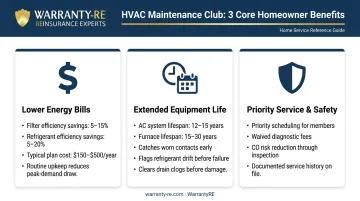
Benefit 1: Lower Energy Bills and Reduced Repair Costs
A dirty, poorly calibrated HVAC system works harder to reach the same temperature set-point — burning more electricity or fuel in the process. The inefficiency is silent and gradual, which makes it easy to overlook until the utility bill arrives.
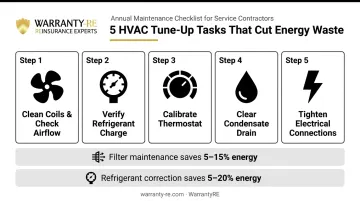
Scheduled tune-ups address this directly. During a visit, technicians typically:
- Clean coils and check airflow
- Verify refrigerant charge levels
- Calibrate thermostats
- Clear condensate drain lines
- Tighten electrical connections
Each of these tasks restores operating efficiency. According to the U.S. Department of Energy, replacing a dirty, clogged filter alone can lower AC energy consumption by 5% to 15%. ENERGY STAR data shows incorrect refrigerant levels can reduce efficiency by an additional 5% to 20%. Those losses add up fast during peak cooling season.
On the repair side, the math is straightforward. A typical AC capacitor replacement runs $120 to $475. A blower motor replacement averages $560, ranging up to $900. A refrigerant recharge costs $200 to $500 on average, according to Angi's 2026 cost data. Compare that against an annual club membership, which typically costs $150 to $500 per year — and one avoided or discounted repair often covers the entire plan cost.
When it matters most: July through August for cooling systems, December through January for heating — when the system runs near-continuously and inefficiency compounds fastest.
Benefit 2: Extended Equipment Lifespan and Manufacturer Warranty Protection
HVAC systems aren't cheap to replace. HomeAdvisor estimates full system replacement at $5,000 to $12,500, averaging around $7,500. Consistent maintenance protects that investment directly.
According to AHRI, properly maintained central AC systems last 12 to 15 years, and heat pumps average around 14 years. A well-maintained gas furnace can run 15 to 30 years, per ACHR News. Systems that skip annual maintenance fall short of those benchmarks — not from one catastrophic failure, but from small problems left undetected over time.
A maintenance club addresses this by catching issues early:
- Worn electrical contacts before they cause compressor damage
- Refrigerant drift before it strains the entire system
- Cracked heat exchangers before they become both a safety hazard and a full replacement
- Clogged drain lines before they cause water damage and mold
The warranty angle matters too. Some HVAC manufacturers require documented annual maintenance to keep warranty coverage valid. Addison's publicly available limited warranty, for example, states that coverage does not apply without proof of required annual maintenance history. Without a club membership generating dated service records, a homeowner may pay out of pocket for a repair that would otherwise have been covered — a direct out-of-pocket cost that a service record would have prevented.
When it matters most: Critical for systems over five years old, and especially for homes in climates with extreme seasonal temperature swings where equipment runs harder and wears faster.
Benefit 3: Priority Service, Safety Checks, and Documented Reliability
Club members typically receive priority scheduling over non-members, reduced or waived diagnostic fees, and discounts on parts and labor. During peak demand periods — when every HVAC contractor in the region is booked out — that priority access has real dollar value.
ENERGY STAR notes that contractors get swamped once summer and winter arrive, making pre-season scheduling the smarter move. Club members are already in the system before demand spikes.
The safety dimension is often underestimated. Bi-annual tune-ups include checks for:
- Cracked heat exchangers (a carbon monoxide risk in gas systems)
- Refrigerant leaks
- Electrical hazards
- Blocked combustion vents
CPSC data from 2021 estimated 63 unintentional non-fire CO deaths associated with heating systems in that year alone, with gas heating devices accounting for 39 of those. Combustion-safety inspections included in furnace maintenance visits directly reduce this risk.
Beyond safety, membership delivers practical, tangible value: a vetted contractor already on file, a predictable annual cost for maintenance, and a documented service history that supports home resale value and strengthens any warranty claim that does arise. That service record is especially valuable for households with elderly residents, young children, or anyone with respiratory sensitivities — and for homeowners who travel frequently and need the system to run reliably without active oversight.
What HVAC Contractors Gain From Offering Club Memberships
The benefits of a maintenance club run in both directions. For HVAC contractors, a healthy membership base creates predictable recurring revenue and solves one of the trade's chronic problems: feast-or-famine seasonality.
Maintenance visits fill technician schedules during shoulder months — spring and fall — when on-demand calls slow down. That keeps crews productive and revenue flowing between peak seasons.
On conversion and retention:
- ACHR News reports that technicians should target converting 25% to 50% of demand service calls into service agreements
- Specialized maintenance technicians can reach 70% conversion rates, per ACCA
- One profiled contractor reported an 83% annual renewal rate on maintenance agreements
Members also convert to replacement sales at higher rates than one-time service customers. A homeowner who has a trusted contractor maintaining their system for five years doesn't shop around when replacement becomes necessary — the relationship is already established.
That long-term trust also opens a second financial opportunity that most contractors overlook: warranty reinsurance.
WarrantyRE helps HVAC contractors build their own reinsurance companies rather than paying a third-party warranty provider. Contractors retain the underwriting profits, capture tax advantages, and stop sending money out the door on every agreement they sell. For a contractor who has already built a stable membership base, this is where that recurring revenue compounds.
What Happens When HVAC Maintenance Gets Skipped
Skipped maintenance doesn't look like a problem immediately. Systems continue running. Homeowners don't notice. Then peak season arrives, something fails, and the costs stack up fast.
A failed capacitor, catchable during a routine tune-up for the cost of the part, can mask a compressor struggling to start. Left unaddressed, that compressor keeps running under dangerous load.
ACHR News documented a case where a masked capacitor fault drove surface temperatures to 213.8°F and refrigerant pressure to 700 psi. What could have been a $200 fix becomes a compressor replacement or a full system write-off.
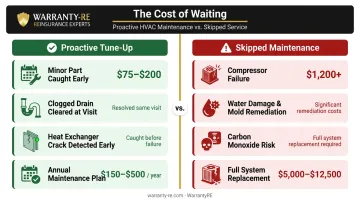
These aren't edge cases. The same cost escalation plays out across common failure types:
- A $75 part caught at tune-up → a $1,200+ compressor failure if missed
- A clogged condensate line → water damage and mold remediation costs
- A missed heat exchanger crack → carbon monoxide risk and likely full system replacement
Each of those failures also lands on the contractor's reputation — even when the root cause was deferred maintenance. That's the other side of skipped tune-ups.
For contractors, a customer base without maintenance plans creates a different set of problems: revenue unpredictability, higher emergency callback rates, and weaker customer relationships. Reactive-only service models are harder to schedule, harder to staff, and harder to scale.
How to Get the Most Value From Your HVAC Club Membership
A few consistent habits separate a membership that pays for itself from one that gets ignored.
For homeowners:
- Enroll early — ideally within the first two years of a new system's life, before small issues develop
- Schedule both tune-ups every year — don't defer the fall heating visit because summer went smoothly
- Keep service records — for warranty documentation and as negotiating leverage when selling the home
- Review what's actually included — quality plans cover comprehensive inspections (not just filter swaps), safety checks, meaningful repair discounts, and priority scheduling with defined response windows. ANSI/ACCA 4 QM (reaffirmed 2024) defines the minimum inspection tasks any contractor-quality plan should meet
For contractors:
The metrics below help you gauge whether your program is delivering real business value:
- Track renewal rates annually — an 83% renewal rate is a realistic benchmark for well-run programs
- Monitor average member ticket value versus non-member customers
- Review callback frequency on maintained equipment to validate the program's technical quality
- Ensure plan language is specific: visit frequency, inspection scope, member discounts, and response time commitments should all be written down, not implied
Frequently Asked Questions
What is the $5,000 rule for HVAC?
The $5,000 rule is a contractor rule of thumb: multiply the system's age (in years) by the repair estimate. If the result exceeds $5,000, replacement is usually the smarter call. Regular maintenance through a club membership helps homeowners stay well below that threshold by extending equipment life and catching small problems early.
How much does an HVAC maintenance club membership typically cost?
Most plans run $150 to $500 per year, with many contractors pricing around $299 annually (roughly $25/month). The break-even point is low — one avoided emergency call or discounted service visit typically covers the full annual cost.
Does an HVAC maintenance plan void my manufacturer warranty?
No — a maintenance plan does not void a manufacturer warranty. The opposite is true. Many manufacturers require documented annual maintenance to keep warranty coverage valid. A club membership generates the dated service records that satisfy that requirement, protecting coverage rather than threatening it.
What's the difference between a home warranty and an HVAC maintenance club membership?
A home warranty kicks in after a breakdown occurs, covering repair or replacement costs subject to claim approvals and deductibles. A maintenance club membership works differently — it focuses on scheduled inspections to prevent breakdowns in the first place, typically with faster contractor access and more straightforward pricing.
How often should HVAC maintenance be performed?
Most manufacturers and ENERGY STAR recommend at least one inspection per year. Twice annually — spring for the cooling system, fall for heating — is the standard for optimal performance and warranty compliance. Heat pump systems, which handle both heating and cooling, particularly benefit from the twice-yearly cadence.
Can I cancel my HVAC maintenance club membership at any time?
Cancellation policies vary by contractor. Many reputable plans allow cancellation before the next service cycle begins with no penalty. Before enrolling, ask specifically about auto-renewal terms, cancellation windows, and whether any prorated refund applies if you cancel mid-year.