
The tension is real: warranties help you close jobs and build customer trust, but without the right structure behind them, every promise you make at point of sale can become a financial liability you absorb alone.
This article covers how to limit that exposure — through written warranty terms, job documentation habits, staff communication, and a structural model that turns warranty obligations into retained profit rather than a recurring cost.
TL;DR
- Completed operations and water damage claims are the most costly post-job risks plumbing contractors face.
- Vague or verbal warranty promises create unlimited liability — and customers will always interpret them broadly.
- Pre-job photos, written scope of work, and customer sign-offs are your strongest defense when disputes arise.
- Confusing manufacturer warranty with workmanship warranty costs contractors money they should never owe — keep them clearly separate.
- Contractor-owned reinsurance converts warranty fees into profit you keep — instead of revenue you hand to a third party.
Why Warranty Claims Are a Serious Risk for Plumbing Businesses
Most plumbing contractors think of warranty risk as a minor nuisance — the occasional callback, a fitting replaced under goodwill. The actual exposure is broader than that.
The NAIC defines completed operations liability as coverage for firms like plumbers and contractors for bodily injury or property damage resulting from defective work that has been completed away from the insured premises. That means the liability trigger isn't the job — it's what happens after you've already been paid and moved on.
A pipe joint that fails six weeks later. A water heater improperly seated that causes a slow leak behind drywall. A drain line that backs up because the slope was off. All of these generate claims after the fact, and all of them land on you.
The Gap Between GL Coverage and Workmanship Liability
Many plumbing business owners believe their general liability policy covers warranty disputes. It doesn't — not entirely. According to The Hartford, products-completed operations coverage protects against damage to other property caused by your faulty work. Here's where that distinction becomes costly:
- GL covers: flooring, drywall, or contents damaged by the leak
- GL does not cover: the fitting you installed that caused it
- Workmanship warranty: your responsibility — and if you haven't defined it in writing, the customer gets to define it for you
The Hidden Cost of Vague Warranty Terms
When contractors offer open-ended verbal warranties to win jobs, disputes become difficult to resolve on any terms other than capitulation. The Insurance Information Institute reports a $15,400 weighted average severity for residential water damage and freezing claims from 2019–2023. That figure represents downstream homeowner losses — but it illustrates the scale of what a single plumbing failure can set in motion.
Many contractors absorb repair costs to protect their reputation. The problem is that this normalizes a pattern where the business pays for failures regardless of cause, scope, or original warranty intent.
The Most Common Warranty Claims Plumbing Contractors Face
Understanding where claims originate helps you build the right defenses before they arrive.
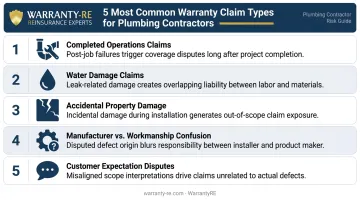
Completed operations claims — Pipe joint failures, bad water heater installs, or drain line issues that surface weeks after you've left the site — and by then, the customer's account of what was promised has shifted.
Water damage claims — A slow leak can spread through insulation, flooring, and cabinetry before anyone notices — and by the time it's found, the originating condition is nearly impossible to pin down.
Accidental property damage during service calls — Cracked tiles, scratched fixtures, damaged cabinetry — sometimes it's just the reality of working in a 1970s bathroom with zero clearance. Without pre-job documentation, the damage lands on you.
Manufacturer vs. workmanship confusion — When a water heater element fails or a faucet cartridge cracks, customers often come to you first. Without written terms directing them to the manufacturer, you absorb costs you were never obligated to cover.
Customer expectation disputes — "We guarantee our work" is precise to you and open-ended to a frustrated customer six months later. Loosely worded warranties create exactly this kind of dispute.
How to Protect Your Plumbing Business from Warranty Claims
Written Warranty Terms That Define Scope
Every job — not just major installations — should have a written warranty document attached to the contract. Verbal promises made to close a job are not enforceable on your terms. They're enforceable on the customer's interpretation.
A complete written warranty should specify:
- What's covered — labor, parts, or both, with clear language distinguishing your workmanship from manufacturer components
- The warranty period — specific dates, not vague language like "within a reasonable time"
- What voids the warranty — customer modifications, unauthorized repairs, lack of maintenance
- How claims are submitted — contact method, response time, and what documentation the customer must provide
- Manufacturer redirection — explicit language directing customers to the manufacturer for parts-related failures rather than defaulting to you
Massachusetts requires that any express warranty offered by a contractor have its full terms attached to the home improvement contract. Whether your state mandates it or not, attaching written warranty terms protects you.
Job Documentation as a Claims Defense
Documentation doesn't prevent claims. It determines how they resolve.
When a customer argues that a cracked tile was your doing, or that the water stain under the sink was caused by your installation, your only defense is a record of what conditions existed before you started work. Undocumented pre-existing conditions are routinely attributed to the most recent contractor on site.
A solid documentation system includes:
- Timestamped pre-job photos — every area you're working in or near, especially existing damage, old fittings, corroded valves, or worn fixtures
- Written scope of work — specific and detailed, not just "plumbing repair"
- Post-job customer sign-off — a completed-work checklist signed at job completion, confirming the work performed
- Noted conditions — written record of anything you observed that could affect future performance (aging supply lines, slow drains not addressed in this scope, pressure irregularities)
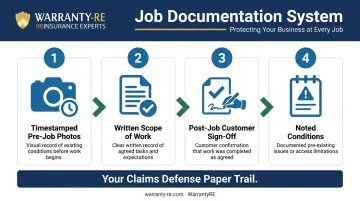
That paper trail is what separates a dispute you can defend from one you absorb.
Staff Training and Customer Communication
Inconsistent communication is one of the most common sources of warranty claims — not failures, not negligence, just different people saying different things about what the warranty covers.
Field technicians need to know exactly what the company's warranty does and does not cover. If your office staff tells a customer the warranty covers "anything that goes wrong" but your written terms say labor only, you have a conflict you'll lose.
A brief post-job walkthrough addresses this directly. At minimum, every technician should:
- Explain what work was completed and what wasn't
- Flag any conditions observed that could affect future performance
- Confirm the maintenance requirements that keep the warranty valid
- Document the conversation with the customer's signature or initials
That record ties what was promised to what was delivered — in writing, not memory.
Common Warranty Mistakes Plumbing Contractors Make
Most of these problems aren't one-off failures — they're habits. And habits are what make them expensive. Three patterns show up consistently across plumbing businesses, and each one is preventable:
Verbal warranties with no defined scope. "We stand behind our work" is not a warranty term — it's an open-ended liability that the customer defines when something goes wrong. If you wouldn't accept those terms in writing, don't offer them out loud.
No pre-existing condition documentation. Any problem discovered after you've been on site becomes yours to explain. Without photos or notes showing what the job looked like before you started, that explanation is nearly impossible to make.
Absorbing manufacturer warranty costs to keep the peace. Replacing a failed water heater element under your labor warranty is a short-term relationship fix with long-term consequences. It sets a precedent — and future claims will be framed the same way.
How Contractor-Owned Reinsurance Turns Warranty Risk Into Revenue
Most plumbing contractors absorb warranty risk out of pocket or hand premiums to a third-party provider. There's a better option: establishing a reinsurance company you legally own — one that captures the underwriting profits your customer base generates instead of passing them to someone else.
How the Structure Works
A small warranty fee is built into every job price. The customer pays it as part of the total invoice. Instead of that fee going to an outside warranty company, it flows into a reinsurance structure the contractor legally owns.
When a warranty claim comes in, it's covered from that pool of funds. Any dollars not used to cover claims stay with the contractor. That's the retained underwriting profit — money that, under a third-party arrangement, would have belonged to the warranty provider.
WarrantyRE's admin obligor structure backs the contractor's reinsurance entity with A-rated insurers. The contractor's liability is limited to their formation costs plus accumulated earnings, while the insurer provides regulatory backing and financial guarantee.
What WarrantyRE Handles
WarrantyRE takes on the administrative load so contractors don't have to:
- Full claims management from first call to final resolution
- Legal filings, tax returns, and compliance management for the reinsurance entity
- Monthly financial statements and performance reporting
- Staff training and onboarding support
- No hidden fees — compensation is aligned with program performance

The result is a warranty program funded by customers, managed by WarrantyRE, and owned by the contractor — with fees that stay in the business rather than flowing out of it.
WarrantyRE has been helping home service contractors — including plumbing businesses — establish contractor-owned reinsurance programs since 1994. To find out whether the model fits your operation, reach the WarrantyRE team directly: (804) 824-9533.
Frequently Asked Questions
What types of warranty claims are most common for plumbing contractors?
The three most common sources are completed operations claims (arising after you've left the site), water damage disputes (where delayed discovery complicates attribution), and expectation disagreements rooted in vague or verbal warranty terms. Each type is easier to defend when you have written documentation and clearly scoped warranty language in place.
What is the difference between a workmanship warranty and a manufacturer warranty?
A workmanship warranty covers the quality of your installation labor — it's your obligation. A manufacturer warranty covers defects in the parts themselves — that's the manufacturer's obligation. Plumbing contractors should direct customers to the manufacturer for parts failures rather than absorbing those costs as their own liability.
What should be included in a plumbing contractor's written warranty terms?
At minimum, your written warranty should specify what is covered (labor, parts, or both), the warranty period, and what voids coverage — such as customer misuse, unauthorized repairs, or neglected maintenance. Include manufacturer redirection language so parts failures don't automatically become your liability, and spell out how customers submit claims.
How does job documentation protect a plumbing business from warranty disputes?
Pre-job photos, written scope of work, and a post-job customer sign-off create a defensible record of what conditions existed before you arrived and exactly what work was performed. Without that record, any problem a customer discovers after your visit can be attributed to your job.
Can a plumbing contractor profit from offering warranties instead of just absorbing risk?
Through a contractor-owned reinsurance structure, warranty fees collected on each job flow into a legally owned reinsurance entity. Claims are paid from that pool, and unused funds remain with you as retained underwriting profit — money that would otherwise go to a third-party provider.
Does general liability insurance cover all plumbing warranty claims?
No. General liability covers third-party bodily injury and property damage; completed operations coverage addresses damage to other property caused by faulty work. Neither covers the specific workmanship you're warranting, which is why a written warranty program with defined scope, exclusions, and claim terms is essential.