The difference between a break-even program and a true revenue engine comes down to how agreements are priced, structured, sold, and managed at scale. Even more importantly, it hinges on who ultimately captures the underwriting profits when warranty claims run lower than premiums collected.
This guide covers the core levers that transform maintenance agreements from side programs into strategic assets: smart pricing that covers true loaded costs plus healthy margins, high-value tiered agreement packages that increase average contract value, technician-led selling tactics that convert at 25% or higher, and the advanced strategy most contractors never consider—capturing underwriting profits through reinsurance instead of sending them to third-party providers.
TLDR
- HVAC maintenance agreements now represent 55% of HVACR industry revenue, but most contractors price them below true loaded costs
- Profitable pricing requires calculating tech labor (loaded at $40–$50/hr), materials, and admin overhead — then adding a 35–50% gross margin minimum
- Tiered Good/Better/Best packages capture 40% more revenue than single-option pricing
- Technician point-of-service presentations close at 25%+ conversion rates — making delivery method as important as the offer itself
- Contractors who own their warranty risk pool through a reinsurance structure keep 100% of underwriting profits — money that currently goes straight to third-party administrators
Why Most HVAC Maintenance Agreement Programs Fall Short
Recurring service agreements now represent 55% of HVACR industry revenue, yet fewer than 35% of residential HVAC companies actively sell them. For those who do, agreements often contribute minimal profit. The typical mid-size contractor carries a few hundred agreements generating less than $200,000 in annual agreement revenue—a side program rather than a strategic asset.
The Real Cost of a Maintenance Visit
A single maintenance call consumes more resources than most contractors account for:
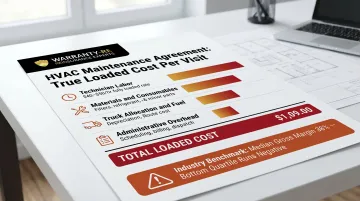
- Loaded technician labor: $40-$50/hour (base wage plus 31.3% for benefits, payroll taxes, workers' comp, health insurance, PTO, and training)
- Visit time: 45-60 minutes on-site plus 30 minutes drive time each way in suburban markets
- Materials and consumables: Filters, refrigerant top-offs, cleaning solutions
- Truck allocation and fuel: Vehicle depreciation, insurance, fuel costs
- Administrative overhead: Scheduling, billing, customer service, renewal management
Without disciplined cost accounting and pricing, direct costs consume most agreement revenue before the first invoice is even generated. Analysis of 2,200+ contractors reveals median gross margins of just 38% on maintenance agreements, with the bottom quartile running negative margins—losing money on every agreement sold.
Agreement customers do spend more — 78% purchase replacement equipment from their existing service provider compared to one-time callers, and agreement holders spend 3-5x more over their lifetime. But that loyalty comes from consistent, quality service — not the agreement itself. A poorly executed maintenance visit erodes trust regardless of contract status.
Most programs also lack systematic processes for profitability:
- No formal upselling protocols during maintenance visits
- Renewal rates tracked inconsistently or not at all
- Pricing set years ago and never adjusted for inflation
- Discounts offered to agreement holders that wipe out multiple years of revenue (a 15% discount on an $8,000 heat pump replacement equals $1,200—roughly six years of membership fees on a $199/year plan)
There's also a profit leak most contractors never recognize. When you route warranty coverage or extended service contracts through third-party administrators, you're funding their margins. Premium dollars flow out of your business to providers who capture the spread between premiums collected and claims paid — the underwriting margin.
Representative extended service contract models show that approximately 50% of premiums go to commissions and administrative costs, leaving only 36% in pure reserves for claims. When actual loss ratios run at 38%, that means 62 cents of every reserve dollar becomes profit — profit that could stay in your business instead.
What to Include in an HVAC Maintenance Agreement
Standard Service Elements
A residential HVAC maintenance visit needs a defined task list — one that justifies your pricing and gives customers something concrete to point to when renewal time comes:
- Coil cleaning (evaporator and condenser)
- Refrigerant pressure check and leak inspection
- Thermostat calibration and control testing
- Electrical connection inspection and amperage measurement
- Air filter replacement (standard size)
- Lubrication of moving parts and motor bearings
- Condensate drain clearing and pan inspection
- Safety control testing (limit switches, flame sensors, pressure switches)
- Heat exchanger visual inspection for cracks or deterioration
- Combustion analysis for gas furnaces (CO levels, draft pressure)
- Blower assembly inspection and belt tension adjustment
The ANSI/ACCA 4 QM standard establishes minimum maintenance inspection tasks organized across six categories: cabinet integrity, electrical systems, blower assembly, condensate removal, gas combustion components, and venting systems. Following this 34-point checklist ensures thorough, defendable service scope.
Tiered Agreement Structure
The Good/Better/Best model increases average contract value by giving customers a choice rather than a binary decision. According to OXmaint's HVAC revenue analysis, three-tier agreements capture 40% more revenue than single-option contracts — with mid-tier plans drawing the most sign-ups and premium tiers anchoring the overall price perception.
Basic Tier (Good):
- One annual visit
- Standard inspection checklist
- Member discount on repairs (10%)
- Standard scheduling priority
Mid-Tier (Better):
- Two seasonal visits (spring cooling prep, fall heating prep)
- Priority scheduling during peak seasons
- Enhanced member discount (15%)
- Extended parts coverage (1-year labor warranty)
- Waived overtime/after-hours fees
Premium Tier (Best):
- Two seasonal visits plus emergency service coverage
- 24/7 priority response
- Premium member discount (20%)
- Extended parts and labor coverage (2-year warranty)
- Free filter replacements between visits
- Annual system replacement credit ($200-$500)
Contract Terms That Protect Profitability
Clear exclusions and terms prevent scope creep from eroding margins:
- Agreement term: 12 months from effective date, with automatic renewal for additional 12-month periods
- Covered services: Specific tasks from your standard checklist only — not open-ended language like "all maintenance" or "tune-ups as needed"
- Exclusions: Equipment over 30 years old, commercial systems, pre-existing conditions found during the initial visit, and refrigerant charges exceeding 1 lb
- Cap discounts — write "up to $500" rather than an uncapped percentage that can quietly cost you on large equipment sales
- Cancellation: 30-60 days written notice required, no refunds for partial terms
- Priority service language: Use "available appointment within 24-48 hours" — not a vague "priority" promise you can't enforce
- Auto-renewal clause: Automatic renewal with 30-day notice period before expiration for price changes
According to ServiceTitan, one club membership equates to roughly 4 hours of guaranteed future technician work. Vague contract language turns those hours into unprofitable obligations — specific terms keep them in the black.
How to Price HVAC Maintenance Agreements for Maximum Profitability
Start with true loaded cost per agreement. Most contractors underprice because they calculate only direct labor and parts, ignoring the full cost allocation:
Sample Cost Breakdown (Two-Visit Annual Agreement):
- Technician labor: 2.5 hours total (2 hours on-site, 1 hour drive time) × $45/hr loaded rate = $112.50
- Materials and consumables: $15 per visit × 2 = $30
- Truck allocation: $20 per visit × 2 = $40
- Administrative overhead: $25 per agreement (scheduling, billing, CRM, renewal management)
- Total loaded cost: $207.50
Add your target gross margin. Industry benchmarks from 2,200+ contractors show:
- Median gross margin: 38%
- Top quartile: 53%+
- Minimum threshold: 35%
For our example:
- Cost: $207.50
- Target margin: 45%
- Minimum price: $377 (Cost ÷ (1 - margin %))
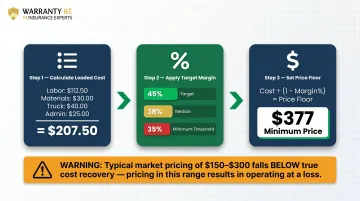
Yet typical annual HVAC service contract pricing runs $150-$300. Contractors pricing at the low end of this range are either losing money or delivering minimal service. Premium plans at $39-$69/month ($468-$828/year) reflect realistic cost recovery plus healthy margins.
One contractor ran -23% margins on a $3.8M service agreement book because agreements priced in 2019 were never repriced through inflation — destroying $876K in margin over 12 months. Pricing math only works if you revisit it.
Once your price floor is set, how you collect that revenue shapes both cash flow and customer behavior.
Billing Cadence Affects Profitability and Cash Flow
Annual upfront billing:
- ✅ Improves cash position immediately
- ✅ Reduces churn (higher psychological commitment)
- ✅ Lower administrative cost
- ❌ Higher barrier to entry for price-sensitive customers
Monthly billing:
- ✅ Converts 2x more prospects than annual upfront
- ✅ Reduces churn by 15-25% compared to annual
- ✅ Steady recurring revenue stream
- ❌ Higher administrative overhead
- ❌ More cancellation risk throughout the year
Use monthly billing with auto-charge/EFT for customer acquisition and retention. Use annual upfront billing with modest discounts (10-15%) for cash flow needs or customers who prefer single transactions.
Pricing Improves at Scale
Agreement economics transform as volume grows:
- Small base (under 200 agreements): High per-agreement overhead, limited route density, minimal purchasing leverage
- Medium base (200-500 agreements): Improved routing efficiency reduces drive time per visit by 20-30%, bulk material purchasing cuts consumable costs
- Large base (500+ agreements): Dedicated maintenance technicians at lower loaded rates than senior service techs, specialized tune-up techs achieve 70%+ conversion rates, shared admin costs drop to under $15 per agreement
One revenue model shows that 1,000 maintenance agreements should generate at least $1 million in total residential business including equipment sales, accessory sales, service calls, and agreement revenue—$702 per agreement annually. Four technicians can generate 500 agreements per year, reaching this threshold in under four years with 86% renewal rates.
Build in Annual Price Escalation
Without annual price increases, margins erode as labor and material costs climb — quietly, then all at once. Standard escalation clauses tie increases to measurable indices:
- Annual increases up to 5% tied to labor cost increases or Consumer Price Index
- Maximum total increase of 20% over five-year contract term
- 30-60 day advance notice before renewal
Signing multi-year contracts without escalation clauses leads to losses by the third year. Build the clause in from the start — renegotiating later is a harder conversation than never having to have it.
How to Sell HVAC Maintenance Agreements Effectively
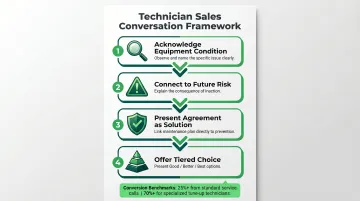
The highest-converting sales opportunity happens when a technician is already in the home. Minimum 25% conversion rate from service calls to agreements is the industry standard for technician-presented offers. Specialized maintenance technicians who focus exclusively on tune-ups can achieve 70%+ conversion rates by building the entire visit around agreement value rather than mixing repair and sales roles.
Train every technician to present agreements as part of every service call:
Conversation framework:
- Acknowledge equipment condition: "Your system is running well right now, but I noticed [specific observation—dust buildup on coils, older capacitor, etc.]"
- Connect to future risk: "Without regular maintenance, this kind of issue typically leads to [specific consequence—compressor failure, efficiency loss, breakdown during peak season]"
- Present agreement as solution: "Our maintenance plan ensures we catch these issues during scheduled visits before they become expensive emergency repairs"
- Offer tiered choice: Present all three tiers with mid-tier as recommended option
Seasonal Sales Windows Drive Agreement Enrollment
Spring is the primary selling season for HVAC maintenance agreements. Weather is mild and service call demand is low, giving technicians time for thorough presentations. Agreements sold in spring put revenue-generating visits on the calendar before peak season demand hits — giving you a committed customer base when it matters most.
Shoulder seasons (spring and fall) are the optimal windows for tune-up campaigns that drive agreement enrollment. Waiting until the slow season when customers aren't thinking about HVAC reduces conversion rates significantly.
Equipment age creates specific conversion opportunities:
- 0-4 years: Upsell add-ons (UV lights, high-efficiency filters, surge protectors)
- 4-9 years: System modifications (ductwork improvements, zoning, mini-splits)
- 9+ years: Full system replacement conversations
Lead With Customer Value, Not Price
Knowing where a customer's equipment falls on that age curve shapes how you frame the conversation. Regardless of system age, agreements sell faster when you lead with protection and peace of mind — not cost:
Effective value statements:
- "Priority service means you're never waiting three days in July when your AC fails"
- "We catch 90% of potential failures during maintenance visits before they become $800 emergency repairs"
- "Regular maintenance extends equipment life by 40%—that's 5-6 extra years on a $12,000 investment"
- "Agreement holders get our best technicians scheduled first, and you'll never pay overtime or after-hours fees"
Once a customer understands what they're actually buying — priority access, fewer emergency calls, longer equipment life — the monthly cost rarely becomes an objection.
Three Tiers Close More Deals Than One
Presenting customers with three tiers rather than a single yes/no decision improves conversion because it reframes the question from "Should I buy?" to "Which option fits my needs?" The mid-tier typically captures 50-60% of customers, the premium tier captures 20-30%, and the basic tier captures 10-20%—meaning 80%+ choose Better or Best when presented with choice architecture.
Protect Revenue: Keep Renewals Above 80%
Target minimum 80% renewal rate, with top quartile hitting 85%+. Top performers use proactive 90-day renewal workflows that keep expirations below 5%.
Renewal best practices:
- Handle renewals during the last tune-up visit (11th or 12th month of agreement)
- Send automated renewal reminders 60-90 days before expiration
- Offer loyalty pricing for multi-year commitments (3-year agreements at 10% discount)
- Personal outreach from service manager when renewal is at risk
- Emphasize investment already made: "You've invested in two years of preventive maintenance—continuing protects that investment"
Companies must replace approximately 20% of revenue annually just to maintain flat growth due to natural customer attrition. High renewal rates reduce acquisition cost and increase lifetime value — the two levers that determine whether your agreement program actually builds wealth or just covers churn.
The Hidden Profit Layer: Owning Your Maintenance Risk Through Reinsurance
Most contractors don't realize they're funding someone else's profit margin every time they route warranty coverage through a third-party administrator.
When you collect agreement premiums and pay a third-party provider to handle claims, you're absorbing the customer acquisition cost and service delivery burden. The provider captures the underwriting margin — the spread between premiums collected and claims paid.
In a typical extended service contract model, approximately 50% of premium revenue goes to commissions and sales costs, 14% to administrative expenses, and only 36% flows into pure reserves for claims. When actual claims run at 38% of reserves — a typical early-year loss ratio — 62% of reserve dollars become profit. That underwriting profit stays with the third-party provider, not with you.
The Reinsurance Model Captures Underwriting Profits
Contractors can establish their own administrator obligor reinsurance company to replace third-party providers entirely. Instead of sending premium dollars out, your reinsurance entity holds those funds, pays claims from that pool, and retains 100% of underwriting profits.
The structure works like this:
- Warranty fees build into job pricing — On every maintenance agreement or installation with warranty coverage, the warranty fee flows into your reinsurance account rather than to an outside company
- Claims are fully administered — WarrantyRE handles all claims adjudication, compliance, and regulatory management while you retain ownership
- Unused funds remain yours — Premium reserves not consumed by claims become profit in your tax-advantaged reinsurance structure
- Investment income compounds returns — Reserve funds are invested in conservative government bonds initially, with investment income belonging to your company; once reserves exceed 125% of unearned premiums, excess funds can be invested more aggressively

Tax Advantages Amplify Profitability
Contributions to your reinsurance account come with significant tax advantages under IRS Code 831(b). Money that would otherwise go to tax obligations instead stays within a structure that builds real value for your business. Insurance companies with less than $2.9 million in annual net premiums can elect to be taxed only on investment income rather than underwriting profits, allowing premium reserves to accumulate tax-deferred.
WarrantyRE Provides Full-Service Administration
Managing a reinsurance structure in-house sounds complex — WarrantyRE handles the operational side so you don't have to. The company has helped over 400 businesses establish and manage reinsurance programs since 1994. For HVAC contractors, the program includes:
- Sets up your company with all legal forms, filings, and regulatory compliance handled on your behalf
- Manages every claim from initial call through resolution — no burden on your team
- Maintains IRS Code 831(b) compliance and all required state approvals
- Delivers monthly financial statements, annual tax reports, and performance analysis
- Tracks reserve fund performance and investment income
The reinsurance structure is backed by A-rated insurers, meaning if your reinsurance company is unable to meet financial obligations, ultimate liability rests with the direct writing insurance company — limiting your personal liability to formation costs plus accumulated earnings.
Reinsurance turns maintenance agreements into a real profit center. On a $12,000 system replacement with a 2-year labor warranty built into the job price, that warranty fee stays in your structure. Multiply this across hundreds of installations annually, and the underwriting profit layer becomes material. In many cases, it exceeds the gross profit on the installation itself.
Learn more about how reinsurance captures underwriting profits your business is currently sending to third-party providers, or contact the WarrantyRE team at (804) 824-9533 for a free owner analysis.
Frequently Asked Questions
What is the profit margin for HVAC maintenance contracts?
Median gross margin on maintenance agreements is 38% across 2,200+ contractors analyzed, with top quartile exceeding 53%. Margins vary significantly based on pricing discipline and scale—bottom quartile runs below 32% or even negative when agreements are underpriced relative to true loaded costs of labor, materials, and administrative overhead.
How to price HVAC maintenance contracts?
Calculate true loaded cost per agreement first: technician labor at $40-$50/hr fully burdened, materials, vehicle allocation, and admin overhead. Add a target gross margin of 35-50% minimum to determine your pricing floor. Billing cadence (monthly converts better but adds admin cost) is a secondary input once that floor is set.
What should be included in a HVAC maintenance agreement?
Core service elements include coil cleaning, refrigerant pressure checks, electrical connection inspection, filter replacement, thermostat calibration, lubrication of moving parts, and safety control testing. Contract terms should specify visit frequency (typically two seasonal visits), covered vs. excluded services, priority response guarantees, discount caps, and auto-renewal clauses to protect profitability.
How to sell HVAC maintenance agreements?
Present agreements at the point of service when technicians are already on-site—this drives 25%+ conversion rates. Use tiered Good/Better/Best packaging to reduce friction, lead with customer value (equipment protection, priority service, cost avoidance) rather than price, and target spring and fall seasonal windows when receptivity is highest.
How do you get customers to renew HVAC maintenance agreements?
Send automated reminders 60-90 days before expiration and handle renewals during the final tune-up visit. Offer loyalty pricing for multi-year commitments. Top performers hit 85%+ renewal rates by pairing proactive outreach with consistently high-quality service visits.
What is the difference between an HVAC maintenance agreement and a home warranty?
A maintenance agreement is a proactive, contractor-managed plan covering scheduled tune-ups you deliver directly. A home warranty is a reactive product covering repair or replacement costs when equipment fails, typically run by third-party companies. Contractors can capture the underwriting profits from both by owning a reinsurance structure rather than paying external providers.