This scenario plays out thousands of times a year across the roofing industry, quietly eroding margins that were already razor-thin. Roofing companies typically operate on net profit margins of just 5-10%, making every uncompensated warranty callback a direct hit to profitability. Yet most roofers have no formal system to account for, fund, or recover these costs—treating callbacks as an unavoidable cost of doing business rather than a manageable, and potentially profitable, line item.
This article lays out a three-part solution: building a warranty reserve fund that compensates your service team, pricing labor warranties as a standalone product to create new revenue, and using warranty claims strategically to drive retention and upsells.
TLDR
- Uncompensated warranty callbacks are unbudgeted labor — they come straight out of your profit
- Fund a warranty reserve at 1-2% per job and turn callbacks into paid service calls
- Tiered labor warranties are a sellable product, not just a cost center
- Professionally handled claims build customer loyalty and generate referrals
- Roofers who own their warranty program through reinsurance capture underwriting profits instead of handing them to a third party
Why Labor Warranty Claims Are Silently Draining Your Roofing Business
Manufacturer warranties cover defective shingles, underlayment, and flashings—but they don't reimburse you for the labor to tear off and reinstall those materials. That cost falls entirely on your company.
Most roofing businesses handle warranty callbacks reactively: when a customer calls, the service team responds at normal crew rates but generates no revenue in return. According to Profitability Partners' roofing margin analysis, uncompensated warranty callbacks are "pure cost with zero revenue" — pulling your best technicians off paying jobs with nothing to show for it.
Consider the math on a typical callback:
- Two-person crew
- 4 hours on-site (diagnosis, material pickup, repair, cleanup)
- Loaded labor rate of $75/hour per technician (including wages, taxes, insurance, vehicle costs)
- Total uncompensated cost: $600
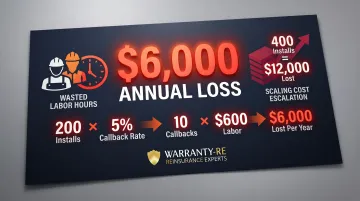
If your company completes 200 roofs annually and experiences even a 5% callback rate, that's 10 warranty jobs per year at roughly $600 each—$6,000 in direct, unrecovered labor costs annually. As install volume grows, so does the warranty backlog.
Those numbers reveal a deeper problem: most contractors treat callbacks as unavoidable rather than quantifiable. When that's the mindset, there's no reserve plan, no pricing adjustment, and no system to manage the exposure.
That gap creates real consequences beyond day-to-day cash flow. When a roofing company is sold, buyers routinely demand a "warranty holdback" from the purchase price to cover future claims on pre-sale work. Without a funded reserve, that holdback comes straight out of the seller's pocket.
The Warranty Reserve: Getting Your Service Team Paid for Every Callback
A warranty reserve is a dedicated fund (kept separate from operating accounts) built by depositing a set percentage of every installation job's revenue. When a callback occurs, the service team invoices the reserve at normal service rates, ensuring they're always compensated.
How the Reserve Works
Industry guidance recommends setting aside 1-2% of each job's sale price into the warranty reserve account. When your service department performs a warranty repair, the invoice is billed at regular service rates and paid from the reserve, turning uncompensated callbacks into funded service calls.
Example:
- $2M in annual installation revenue
- 1.5% reserve deposit per job
- $30,000 deposited per year
- Over five years: $150,000+ in funded warranty capacity
The pool absorbs normal callback volumes without touching operating cash flow. Jobs with no callbacks grow the reserve; jobs with multiple visits draw from it without creating out-of-pocket expenses.
Tax Treatment and Accounting
For financial accounting purposes (GAAP), warranty reserve deposits are treated as accrued liabilities at the time of sale. However, for federal tax purposes, the IRS generally does not allow a current-year deduction for warranty reserves.
Under IRC Section 461, warranty expenses are deductible only when "economic performance" occurs, meaning when the actual repair is performed, not when the reserve accrual is recorded.
GAAP lets you book the reserve as an expense at point of sale, but the IRS requires waiting until the actual service is performed. Contractors should work with a qualified CPA to understand this book-tax timing difference and plan cash flow accordingly.
Management and Quality Control Benefits
The reserve's financial discipline also reveals operational patterns. Tracking which jobs generate the most callbacks exposes:
- Specific crew performance issues
- Material quality problems with certain suppliers
- Job types or roof configurations that generate disproportionate callbacks
If warranty spending consistently exceeds the 1-2% threshold, the data points to installation deficiencies or training gaps that need correction. The reserve becomes a diagnostic tool, not just a financial one.
Business Exit Value
A contractor cited in Roofing Contractor Magazine accumulated over $1 million in a warranty reserve. Upon the sale of the business, this reserve was paid out as a cashier's check directly to the seller. The funded reserve eliminated the buyer's need to impose a warranty holdback against the purchase price, increasing net sale proceeds by more than $1 million.
How to Price Labor Warranties as a Profit Line Item
Instead of treating labor warranties as a buried cost, you can offer tiered warranty packages as paid add-ons—creating a new revenue stream per job.
Calculating Your Warranty Price
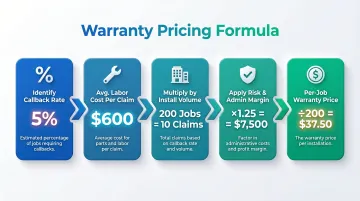
Start with your estimated callback rate and average labor cost per claim. Multiply by the warranty term, add a margin for risk and administration, then divide by the number of installs you expect to sell the warranty on.
Simplified example:
- Expected callback rate: 5%
- Average labor cost per callback: $600
- Warranty term: 5 years
- Margin for risk/admin: 25%
- Installs per year: 200
Calculation:
- Expected claims: 200 jobs × 5% = 10 callbacks
- Total expected labor cost: 10 × $600 = $6,000
- Risk/admin margin: $6,000 × 1.25 = $7,500
- Per-job warranty price: $7,500 ÷ 200 = $37.50 per job
For a 10-year warranty, double the expected claim window and adjust accordingly. The result is a per-job price grounded in your actual cost data—ready to present with confidence in any quote.
Presenting Warranty Pricing in Quotes
Don't bury the warranty as a line item. Frame it as a protection plan or peace-of-mind upgrade with clear benefit statements:
Poor approach:
- Labor Warranty (10-year): $75
Better approach:
- 10-Year Workmanship Protection Plan: $150
- Covers all labor for repairs related to installation defects
- No service call fees for covered repairs
- Priority scheduling for warranty claims
- Transferable to new homeowner if property is sold
This positions the warranty as value, not a fee, and justifies premium pricing for the overall job.
Using Warranty as a Competitive Differentiator
Homeowners are skeptical of vague "lifetime" coverage claims. A roofer who explains exactly what's covered, for how long, and how to file a claim builds trust and signals professionalism. Homeowners are skeptical of vague "lifetime" coverage claims. A roofer who explains exactly what's covered, for how long, and how to file a claim builds trust and signals professionalism.
Only 2% of U.S. roofing contractors qualify for GAF Master Elite status, which is required to offer GAF's manufacturer-backed 25-year workmanship warranty. Certification-linked warranties support premium pricing, but they also increase long-term liability exposure. That's why a funded reserve or reinsurance structure becomes essential at this level.
When a homeowner compares two quotes, that certification context matters. The contractor offering a structured, clearly priced warranty with defined terms appears more credible than one offering undefined coverage—and credibility closes more jobs at higher prices.
Turning Warranty Claims Into Customer Retention and Revenue
A warranty callback isn't just a repair visit—it's a scheduled touchpoint with a customer who already trusts you enough to have hired you once. The crew that shows up promptly, communicates clearly, and resolves the issue professionally is the same crew a homeowner calls when they need gutter replacement, a neighbor needs a new roof, or a rental property needs attention.
Operationalize the Touchpoint
Train your technicians to conduct a brief complimentary visual inspection during any warranty visit. Note areas of concern—worn flashing on a dormer, sagging gutters, moss buildup in valleys—and leave the homeowner with a written summary. This creates a natural follow-up opportunity without being pushy.
Revenue potential: Repairs and maintenance carry gross margins of 50-65%, the highest margin rate of any roofing job type. A $500 leak repair discovered during a warranty visit may have only $50 in materials, generating real profit from a job you were already dispatched to handle.
The Referral Flywheel
That revenue potential compounds through referrals. Customers who had a warranty issue resolved quickly and professionally are among the most likely to send new business your way — the claim experience proves your commitment in a way the original sales pitch never could. Research on the "service recovery paradox" shows mixed results on whether effective service recovery increases repurchase intent, but roofing contractors consistently report that responsive callback handling is "critical in slow times" for maintaining referral-driven business.
One contractor cited in Roofing Contractor Magazine stated that callbacks "often result in additional business" and described them as a "golden chance" to prove the company's worth. Every callback is a chance to convert a resolved complaint into a loyal advocate — and potentially your next referral source.

From Warranty Reserve to Reinsurance: Capturing the Full Profit Picture
A warranty reserve solves the cost problem: it funds callbacks so your service team is compensated and your cash flow isn't disrupted. But it's still a reactive model. The money sits idle until claims occur, and unspent funds may trigger tax obligations when withdrawn. More importantly, a reserve doesn't generate returns on the capital sitting in the account.
The Limitation of Reserves Alone
Even a well-funded reserve account only protects against costs—it doesn't capture the underwriting profit that third-party warranty companies earn when claims remain low. If you're a quality roofer with strong installation practices, your actual callback rate should be well below industry averages. That gap between premiums collected and claims paid is profit—but in a traditional reserve model, it's just unused cash.
Contractor-Owned Reinsurance
Instead of paying a third-party warranty administrator to manage and fund warranty claims, roofing contractors can establish their own administrator obligor reinsurance company. Warranty fees collected from customers flow into the contractor's own legal entity, not a third party's. When claims are low—as they should be for quality roofers—the contractor keeps the underwriting profit.
Here's what that looks like on a real job:
- You close a $15,000 roof replacement with a 5 or 10-year labor warranty
- A warranty fee is built into the contract price (the homeowner is already paying for it)
- That fee flows into your reinsurance account, not to an outside warranty company
- When a claim arises, it's covered from your account
- Unused funds remain yours—capturing 100% of underwriting profit
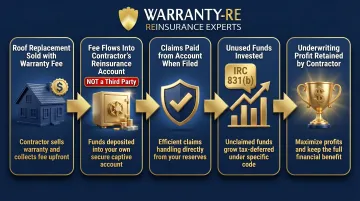
The profit advantage extends beyond claims. Under IRC Section 831(b), the reinsurance entity is taxed only on investment income—not premium revenue. Your reinsurance company initially invests those premiums conservatively in government bonds; once reserves exceed 125% of unearned premiums, more aggressive investment options become available. All investment income belongs to your reinsurance company.
Full Administrative Support
WarrantyRE, a reinsurance administrator with over 30 years of experience, has helped contractors across the country build exactly this structure. They handle all claims adjudication, compliance management, financial bookkeeping, and ongoing optimization. That lets roofing contractors stay focused on roofing while keeping the warranty profits that third-party providers would otherwise retain. This is not a warranty sold to homeowners; it's a reinsurance structure owned by the roofing contractor.
The structure is designed for roofers who are already doing quality work—because low callback rates are exactly what make it profitable.
Frequently Asked Questions
How profitable are warranties?
Labor warranties can be highly profitable when properly priced and backed by a funded reserve or reinsurance structure. The key is treating them as a revenue line, not just a liability, and pricing them to cover expected claim costs plus a margin for risk and administration.
What is the average workmanship warranty on a roof?
The NRCA states there is "no industry standard" for workmanship warranty length. An informal NRCA survey found the average contractor-offered term is one to two years, though certified contractors offering manufacturer-backed warranties can extend coverage to 10 or even 25 years.
What is the ROI on a roof replacement (for the contractor)?
ROI depends on materials cost, labor, overhead, and warranty obligations. Adding a structured, funded labor warranty program improves net ROI by reducing unbudgeted callbacks and creating a revenue-generating warranty product per install, which can add 1-2% to job pricing with minimal incremental cost.
How do I quote roof repair to account for warranty costs?
Include a warranty cost line in every quote based on a percentage of the job price—typically 1-2%. Offer tiered warranty add-ons as paid upgrades so customers choose their coverage level, rather than absorbing uncertain future costs into the base price.
How do I handle a roof leak warranty claim profitably?
Profitable claim handling starts with a pre-funded reserve or warranty program so the service team is compensated at normal rates. The visit should include a brief complimentary inspection and follow-up notes to create upsell or referral opportunities from the interaction.
Final Takeaway: Labor warranty claims are a cost you're already carrying—the question is whether you're managing them strategically or absorbing them quietly. With a funded reserve, deliberate pricing, and a structured approach to callbacks, warranties become a predictable line item instead of a recurring surprise. Roofing contractors who want full control over that process can explore contractor-owned reinsurance through WarrantyRE, which handles claims funding, compliance, and underwriting profit retention under one structure.