This scenario plays out more than it should. Whole home generator warranties are genuinely layered—they combine manufacturer coverage, installer workmanship guarantees, and optional extended plans, each with different durations, exclusions, and fine print. Knowing what you actually have before you need it is the difference between a covered repair and an unexpected bill.
This guide covers standard warranty durations by major brand, what's actually included (and what isn't), the most common ways homeowners void coverage, and how to protect your investment from day one.
TL;DR
- Most residential standby generators carry 5–7 year manufacturer warranties, but coverage narrows significantly after year 2
- Labor and travel are typically included early—then quietly drop off; parts-only coverage is common in years 3–5
- Registration, authorized installation, and documented maintenance records are all required to keep coverage active
- The generator, transfer switch, and installer workmanship may each carry separate warranties — confirm all three before signing
- Extended warranties tend to pay off most in high-outage regions with larger, liquid-cooled units
How Long Is the Warranty on a Whole Home Generator?
Most residential standby generators carry 2 to 7 year manufacturer warranties, with some dealer-exclusive programs reaching 10 years. The term length, though, tells you almost nothing about what's actually covered — or for how long.
Coverage Narrows Over Time
Here's how the tiering looks across major brands:
| Brand | Standard Term | Years 1–2 | Years 3+ |
|---|---|---|---|
| Generac | 5 yr / 2,000 hrs | Parts, labor, limited travel | Parts only (Yr 3); engine block & alternator only (Yrs 4–5) |
| Kohler | 5 yr / 2,000 hrs | Parts, labor, travel (with mileage limits) | Item-specific limitations apply |
| Briggs & Stratton PowerProtect | 7 yr comprehensive | Engine, alternator, controls, fuel system, electrical, enclosure | Marketed as comprehensive throughout |
| Champion | 10 yr / 2,000 hrs | Parts, labor, mileage | Years 3–10: parts only |
| Cummins | 5 yr / 2,000 hrs (13–20 kW) | Standard limited coverage | 2-year term for 25–125 kW models |
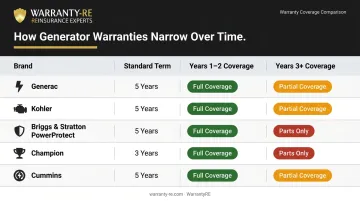
A "5-year warranty" on a Generac and a "7-year comprehensive warranty" from Briggs & Stratton are not equivalent products. Generac coverage drops to parts-only in year 3, then narrows to select major components in years 4–5. Briggs markets full system coverage across all seven years.
Before purchase, ask specifically what is covered in years 3, 4, and 5 — not just the total term length.
When the Clock Starts
Most warranties begin on the date of installation and activation, not the purchase date. Generac treats the activation process as registration simultaneously. Kohler begins coverage on the registered startup date — or the purchase date if no startup is registered. Champion starts coverage upon authorized dealer activation.
Confirm when your warranty period officially begins, and keep that documentation. A generator sitting in a warehouse for six months before install doesn't get those six months credited back to you.
What Does a Whole Home Generator Warranty Actually Cover?
Manufacturer warranties cover defects in materials and workmanship—meaning the unit failed because something was wrong with how it was built, not because of wear, misuse, or outside damage.
Four Coverage Elements to Verify
Before signing off on any warranty, confirm coverage in each of these areas:
- Parts replacement — Is the specific failed component listed as covered?
- Labor costs — Does the warranty pay the technician's time, or just the part?
- Travel/service call fees — Will the manufacturer cover the trip charge?
- Component scope — Which systems are included (engine, alternator, controls, fuel system, enclosure)?
Briggs & Stratton's comprehensive warranty covers all six: engine, alternator, control system, fuel system, electrical components, and enclosure. Generac's coverage narrows after year 2, meaning the same generator carries meaningfully less protection at year 4 than it did at year 1.
What's Not Covered
Every major manufacturer excludes a predictable set of items:
- Routine consumables — oil, filters, spark plugs, starting batteries, fuses
- External damage — flooding, lightning strikes, vandalism, physical impact
- Improper installation — if the unit wasn't installed correctly, the manufacturer won't cover resulting damage
- Prime power use — generators rated for standby applications won't be covered if run as a primary power source
- Rental use — operating a residential standby unit in a commercial or rental context
Travel Coverage Has Geographic Limits
Travel reimbursement limits are a hidden cost that catches many homeowners off guard. Generac limits travel reimbursement to 100 miles or 3 hours round trip from the nearest authorized service dealer. Kohler excludes travel beyond 200 miles round trip per repair. If you're in a rural area, you may be paying a service call fee even during the warranty period.
Transfer Switch Coverage Is Separate
The transfer switch is not automatically covered under your generator's warranty. Generac includes the transfer switch system under its warranty "when applicable." Champion specifies that transfer switches carry a separate warranty. Verify coverage for every component of your system—not just the generator unit.
Types of Generator Warranties: Manufacturer, Workmanship, and Extended
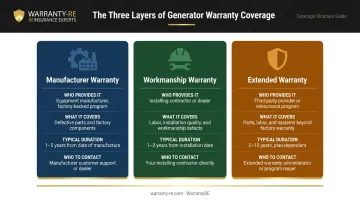
Most homeowners only think about the manufacturer warranty. In practice, three separate layers of coverage apply to a whole home generator installation.
The Three-Layer Framework
| Type | Who Provides It | What It Covers | Typical Duration | Who to Call |
|---|---|---|---|---|
| Manufacturer | Generator brand (Generac, Kohler, etc.) | Defects in the generator unit itself | 2–10 years (brand-dependent) | Authorized service dealer |
| Workmanship | Installing contractor | Quality of the installation—wiring, placement, transfer switch hookup | 1 year to lifetime (varies widely) | Your original installer |
| Extended | Manufacturer, dealer, or third party | Coverage beyond the original manufacturer term | Varies; up to 10 years | Depends on provider |
Manufacturer Warranty
All warranty service must go through an authorized service dealer. Using an unlicensed or non-authorized technician for repairs—even routine maintenance—can create coverage complications. Multiple manufacturer warranties tie claims eligibility to authorized startup procedures and approved parts.
Workmanship Warranty
This is the contractor's warranty on their own installation quality. If a wiring issue, improper placement, or transfer switch problem emerges, that falls on the installer—not the manufacturer. Workmanship warranty terms vary widely: some contractors offer one year, others offer multi-year coverage.
Contractors who back their workmanship warranties through a dedicated reinsurance structure—rather than reselling a third-party plan—maintain direct control over the claims process. That means faster resolution, less back-and-forth with outside providers, and a stronger customer experience that reflects on the contractor's own reputation.
Companies like WarrantyRE help electrical and home service contractors build these contractor-owned programs, so claims are handled through the contractor's own reinsurance account rather than routed through a third party.
Extended Warranties
Beyond workmanship, extended plans pick up where the manufacturer warranty ends. They may come from the original manufacturer, the dealer, or an independent provider. Terms, exclusions, and claims processes differ across all three—ask each provider what voids coverage and who handles claims before signing.
What Voids a Whole Home Generator Warranty?
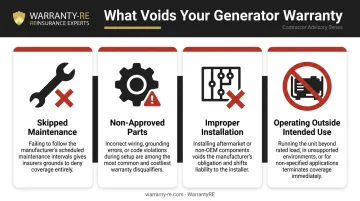
Warranty voids are rarely caused by a single catastrophic mistake. Most happen because of specific, documented behaviors — the kind manufacturers explicitly exclude in their warranty terms.
The Most Common Voiding Conditions
- Skipping scheduled maintenance — Generac and Champion require proof of service upon request; Kohler excludes failures from neglected maintenance, dirty air intakes, or failure to exercise the unit
- Using non-approved parts — Champion excludes damage from non-Champion components, and a non-approved transfer switch can void coverage entirely
- Improper installation — if the unit wasn't installed by a certified dealer, the warranty may be void from day one; authorized installation isn't just a quality issue, it's an eligibility requirement
- Operating outside intended use — using the generator as a primary power source, for rentals, or with incorrect fuel types are explicitly excluded under most manufacturer terms
The Documentation Issue
Even when homeowners follow every maintenance requirement, claims still get denied for one avoidable reason: no proof. Without service records, a manufacturer can reject a claim regardless of what was actually done.
Keep a maintenance log that includes:
- Date of service
- What was performed (oil change, filter replacement, spark plug, annual tune-up)
- Technician name and contact information
- Any parts replaced and their source
Written records from every service visit are your strongest defense when filing a claim.
How to Register and Protect Your Generator Warranty
Registration Comes First
For most brands, warranty activation is tied to the installation date — but registration and documentation still protect you if questions arise later. Kohler, for instance, starts coverage on the registered startup date; if no startup is recorded, it defaults to the purchase date. Retain your:
- Activation confirmation
- Purchase receipt
- Installation documentation
- Dealer contact information
Annual Maintenance Keeps Coverage Active
Most manufacturer warranties require proof of scheduled maintenance. Use authorized service technicians and request written service records after every visit—not just invoices, but documentation of what was inspected and performed.
Review Warranty Terms at Closing
Before signing off at installation, ask your installer to walk through:
- What triggers a warranty claim and how to file
- Whether labor and travel are included in years 3–5 or only years 1–2
- Which specific components are covered in the back half of the warranty term
- Whether the warranty transfers if you sell the home, and what that process costs
Is an Extended Generator Warranty Worth It?
Whole home generators are substantial investments. According to Consumer Reports, generator units alone range from $3,400 to nearly $7,000, with professional installation adding $2,000 to $20,000 or more. Cummins lists starting MSRP at $3,957 for a 13 kW unit and $5,438 for a 20 kW model—before installation.
When major components fail outside the warranty window, repair costs come out of pocket. An extended warranty converts that unpredictable exposure into a fixed annual cost.
When Extended Coverage Makes Sense
- High-outage regions — The EIA reported U.S. customers averaged 11 hours of interruptions in 2024, with South Carolina averaging nearly 53 hours and Hurricane Milton affecting 3.4 million Florida customers. Heavy generator use accelerates component wear
- Liquid-cooled or larger-capacity units — More complex systems carry higher repair costs when components fail
- Homeowners who rely heavily on backup power — Medical equipment, home offices, or business use increases both the urgency and frequency of service needs

When It May Be Less Valuable
- Your unit is still within a comprehensive manufacturer coverage period
- You're in a region with rare outages and use the generator infrequently
- The extended plan has significant exclusions that overlap with what already isn't covered
Once you've weighed whether extended coverage fits your situation, the source of that coverage matters just as much as the decision to buy it.
Where Extended Warranties Come From—and Why It Matters
Manufacturer-backed extended warranties tend to be the most comprehensive. Dealer-backed programs can offer advantages in claims speed and local service relationships.
The more important distinction: a contractor or dealer who operates their own warranty reinsurance program handles claims through their own account — not through a third-party insurer. That means one direct contact, faster decisions, and no claims queue to wait on. For homeowners, that structure is often invisible. For contractors offering these programs, it's the difference between controlling the customer experience and handing it off.
Frequently Asked Questions
How do I get the 10-year warranty on my Generac generator?
Generac offers extended warranty options including 5-year, 7-year, and 10-year terms, but access to these programs typically requires purchase through a qualifying dealer and proper warranty registration at activation. Ask your installer specifically whether they participate in an extended dealer warranty program before purchase—not after.
Is an extended warranty on a generator worth it?
For most homeowners in storm-prone regions or with larger liquid-cooled systems, yes—out-of-warranty repairs on major components can be substantial. The value depends on what the plan actually covers, so read the exclusions carefully before committing.
What voids the warranty on a Generac generator?
The most common conditions: using unauthorized service technicians, skipping required scheduled maintenance, making unauthorized modifications, and operating the unit outside its intended standby application. Always keep dated maintenance records—without them, a claim can be denied even if the maintenance was performed.
How long is the warranty on a generator?
Standard residential standby generator warranties range from 2 to 7 years, with some dealer-exclusive programs reaching 10 years. Labor and travel are often included in years 1–2, then drop to parts-only coverage in later years. Compare coverage structure, not just total duration.
Does a whole home generator warranty transfer to a new homeowner?
Transferability varies by manufacturer. Kohler warranties transfer if the unit was installed and maintained by authorized technicians; Champion allows transfer between owners at the original installation site. Contact the manufacturer to initiate the transfer—there may be a fee and a notification deadline.