For HVAC contractors, that gap matters. You're usually the first call when something goes wrong, which means understanding warranty mechanics isn't just useful — it directly affects your liability exposure, your callback costs, and your customer relationships. And once that manufacturer warranty eventually runs out, how you respond to that moment shapes whether a customer stays loyal or shops around.
This guide covers how boiler warranties actually work, what they cover and exclude, what voids them, and how contractors can think about coverage once the manufacturer's protection ends.
TL;DR
- Boiler warranties cover defects in materials or workmanship — not every breakdown — and terms vary significantly by brand and component
- Heat exchangers typically carry the longest coverage (10–20+ years); labor coverage is often limited to just one year
- Registration deadlines vary by brand — Bosch and Rinnai require 90 days for extended benefits; others skip registration entirely
- Common voiding conditions include uncertified installation, skipped annual service, unauthorized parts, and relocating the unit
- Once the warranty expires, repair costs range from $95 to $1,500 — a natural window for contractors to offer extended service agreements
How Boiler Warranties Work: The Basics
A boiler warranty is a written agreement from the manufacturer to repair or replace the unit if covered defects arise during the warranty period, provided the owner meets all stated conditions. The operative phrase is covered defects. Manufacturer warranties address failures rooted in how the unit was built — not how it was used, maintained, or installed.
That distinction puts contractors at the center of nearly every warranty outcome.
The Contractor's Role
The manufacturer issues the warranty, but HVAC contractors carry much of the practical responsibility for keeping it intact. Installation quality, registration timing, and annual servicing requirements all fall within the contractor's sphere — and each one can make or break a customer's claim.
Warranty Lengths Vary More Than You'd Expect
There's no universal boiler warranty. Coverage differs not just by brand, but by model, application (residential vs. commercial), and component type. Here's a snapshot from verified manufacturer documents:
| Brand | Heat Exchanger (Residential) | Parts | Labor |
|---|---|---|---|
| Weil-McLain (CG gas boiler) | 20 years | 2 years | Not covered |
| Navien NHB | 15 years (pro-rated) | 5 years | 1 year |
| Rinnai M-Series | 12 years | Varies | 1 year |
| Lochinvar residential | 15 years | 5 years | Not covered |
| Slant/Fin cast-iron | Lifetime / 25 years | 1 year | Not covered |
| Bosch Greenstar (registered) | Extended benefits | 5 years parts & labor | Included in plan |
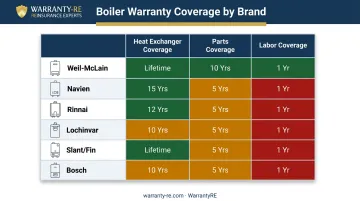
The pattern is consistent: heat exchangers receive the longest coverage, parts coverage runs shorter, and labor is either limited to one year or excluded entirely.
Registration Requirements
Many contractors assume a universal 30-day registration window. That's not accurate. Verified registration terms vary by brand:
- Bosch Greenstar: 90 days to unlock extended benefits
- Rinnai: 90 days establishes proof of purchase and extended service plan eligibility
- Weil-McLain: Registration is recommended, but not explicitly required to validate the warranty
- Slant/Fin electric boilers: Registration is not required
Know each brand's specific registration rules and help customers complete registration at the time of install. It takes minutes and can prevent a costly denial later.
Extended Warranty Options
Several manufacturers offer optional coverage upgrades worth discussing with customers:
- Weil-McLain: Protection Plan covering up to 10 years, purchased within 1 year of installation
- U.S. Boiler: Optional 5-year or 10-year parts and limited labor coverage on select models
- Rinnai: Extended Service Plan eligibility tied to 90-day registration
Extended options are a legitimate customer protection conversation — and a natural opening for contractors to position themselves as the ongoing service provider of record.
What's Typically Covered — and What's Not
Covered Components
Manufacturer warranties generally cover internal component failures arising from defects in materials or workmanship. That language matters. If a part was manufactured incorrectly and fails as a result, it's covered. If it failed because of poor water quality, improper installation, or lack of maintenance, it almost certainly isn't.
Commonly covered components include the heat exchanger, boiler sections, and — where specified — parts like gas valves, blower assemblies, and wiring harnesses. Weil-McLain's Protection Plan, for example, explicitly lists covered items including the blower assembly, gas valve, wiring harnesses, and mixing valve.
Labor coverage is where most residential boiler warranties fall short. Here's how major brands compare:
- Navien and Rinnai: Include one year of limited labor coverage
- Weil-McLain, Lochinvar, and Slant/Fin: Exclude labor, removal, reinstallation, and shipping entirely
Even when parts are covered, the customer pays for the technician's time — a detail worth spelling out before the job is done.
What's Usually Excluded
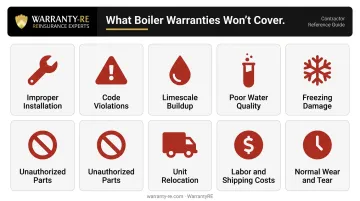
Exclusions are where most warranty surprises happen — and they tend to be buried in the fine print. Common exclusions verified across multiple manufacturer documents include:
- Damage from improper installation or sizing
- Failure to follow manufacturer instructions or local codes
- Limescale and sediment buildup, particularly in hard water areas
- Poor water quality, magnetite, or contaminated combustion air
- Freezing damage
- Unauthorized parts, modifications, or non-genuine components
- Relocation from the original installation site
- Labor, removal, reinstallation, and shipping costs
- Normal wear and tear
Contractors should review warranty documents for every brand they regularly install, and revisit them whenever a new model enters their lineup. Walking customers through the key exclusions before installation closes the gap between what they expect and what the warranty actually delivers.
What Can Void a Boiler Warranty
Warranty voidance is a practical risk for contractors, not just homeowners. If your installation or service work is what triggers the void, the customer's frustration lands on you.
The Most Common Voiding Conditions
- Navien, Rinnai, and Lochinvar all require installation and repairs by a licensed or qualified professional — unlicensed work voids coverage outright.
- Navien voids coverage for scale buildup and vent blockage; Lochinvar excludes limescale; Rinnai requires documented professional maintenance records. Skipped annual service is one of the fastest ways to lose coverage.
- Navien, Rinnai, Slant/Fin, and Weil-McLain all void coverage when non-genuine or non-approved parts are used. A cheaper third-party component that saves $40 on a service call can wipe out the customer's entire remaining warranty.
- Weil-McLain, Navien, Rinnai, Bosch, and Lochinvar tie coverage to the original installation address. This is relevant for commercial clients who reconfigure spaces — relocation alone can void the policy.
The Contractor's Liability Exposure
When a warranty claim gets denied because of installation error, unapproved parts, or a missed service requirement, the customer doesn't call the manufacturer. They call you. That means callback costs, billing disputes, and reputational fallout that the manufacturer won't share.
Knowing the warranty terms for every brand you install is how you stay ahead of that exposure — before it becomes a claim denial conversation with your customer.
Boiler Warranty vs. Extended Service Plans vs. Boiler Insurance
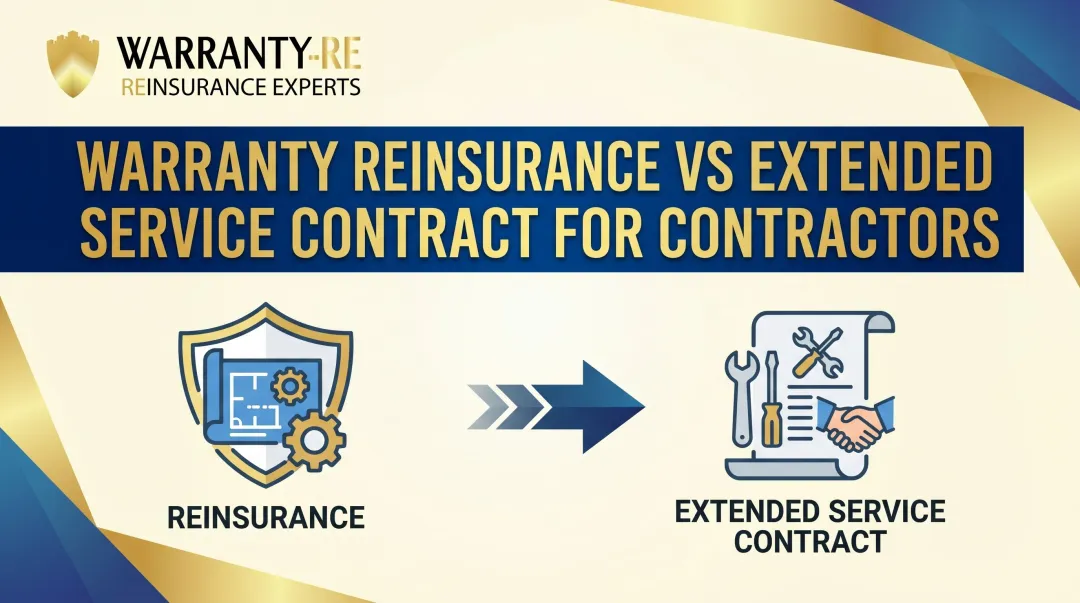
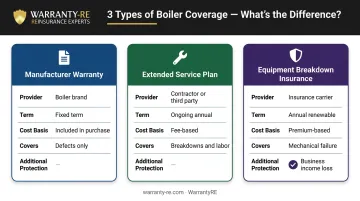
These three coverage types are often confused, and mixing them up leads to gaps — especially for commercial clients.
| Coverage Type | Provider | Duration | Cost Structure | Scope |
|---|---|---|---|---|
| Manufacturer warranty | Boiler manufacturer | Fixed term (varies by brand/component) | Included in purchase price | Defects in materials or workmanship only |
| Extended service/maintenance plan | Contractor or third party | Ongoing, typically annual | Monthly or annual fee | Breakdowns, labor, parts — beyond warranty |
| Equipment breakdown insurance | Insurance carrier | Annual, renewable | Premium-based | Mechanical/electrical breakdown + often business income loss |
When each type makes sense:
- Manufacturer warranty: Covers the early life of the unit; most valuable in years 1–5
- Extended service plan: Best offered as the warranty approaches expiration, or immediately for customers who want fuller coverage from day one
- Boiler/equipment breakdown insurance: Most relevant for commercial or industrial clients where downtime translates directly to lost revenue. IRMI defines equipment breakdown insurance as covering both repair/replacement costs and often business income losses — a meaningfully different product from a manufacturer warranty
Standard homeowners insurance typically won't cover boiler breakdowns from mechanical failure; optional equipment breakdown endorsements can fill that gap, but they're not automatic.
Understanding these coverage distinctions also has direct implications for how contractors structure their own service offerings. When you route customers through a third-party service plan administrator, that provider captures the underwriting profit (the premium reserves not paid out in claims). That's revenue your business generated but never collected.
HVAC contractors who work with a reinsurance partner like WarrantyRE can establish their own warranty programs, retaining those underwriting profits within a contractor-owned company structure while still providing customers with full coverage and claims administration.
What Happens After the Warranty Expires
Most residential boilers carry a hot-water lifespan of 20–30 years. Manufacturer warranties, even generous ones, cover a fraction of that lifespan. When coverage ends, homeowners absorb the full cost of repairs — and those costs add up fast.
Typical out-of-pocket repair costs once under warranty expires:
- Average boiler repair: ~$400
- Typical repair range: $95–$1,500
- Gas valve repair: $300–$1,100
- Circulating pump: $300–$1,000
- Heat exchanger: $1,000–$2,000
- Full boiler replacement (installed): $4,500–$10,000
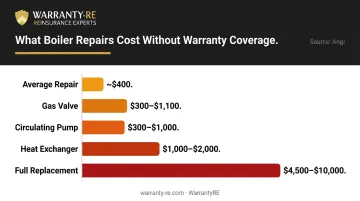
(Source: Angi boiler repair cost guide)
The Contractor Opportunity
Those repair cost figures aren't just a homeowner problem — they're a contractor opportunity. When a customer faces a $1,500 repair bill on an out-of-warranty boiler, they're already thinking about who to call. A well-timed conversation about an extended service agreement can turn a one-time installation into a recurring revenue relationship — and keep your business top of mind when they eventually need a full replacement.
Every installation is a liability on your books until the warranty period ends. Contractors who offer their own extended service agreements — rather than deferring to third-party administrators — retain the underwriting profit they've been giving away. WarrantyRE helps HVAC contractors build reinsurance-backed warranty programs where unused premium funds stay with the contractor, not an outside provider.
Frequently Asked Questions
How does a boiler warranty work?
A boiler warranty is the manufacturer's written promise to repair or replace a unit if covered defects arise during a set period, provided the homeowner meets required conditions — including proper installation, registration (where required), and annual professional service. It covers manufacturing defects, not breakdowns from misuse or poor maintenance.
What is the typical warranty on a boiler?
Warranty lengths vary significantly by brand and component. Heat exchangers often carry 12–20 years of residential coverage; parts warranties typically run 1–5 years; labor coverage is usually limited to one year or excluded entirely. Extended warranties are available from several manufacturers at an additional cost.
What invalidates a boiler warranty?
The most common voiding conditions are installation by an uncertified technician, skipping required annual professional service, using non-approved or non-genuine replacement parts, and relocating the unit from its original installation site. Registration requirements vary by brand and can affect coverage levels if not completed.
Is boiler failure covered by insurance?
Standard homeowners insurance typically does not cover boiler breakdowns from mechanical failure. Optional equipment breakdown endorsements can cover these repairs. Commercial boiler insurance may also cover lost business income during downtime — an entirely different product from a manufacturer warranty.
What is the difference between a boiler warranty and a service plan?
A warranty comes from the manufacturer, covers defects for a fixed term, and is included in the purchase price. A service plan is an ongoing agreement, typically purchased from the installer or a third party, that covers breakdowns, labor, and parts and usually picks up where the warranty leaves off.
Can a boiler warranty be extended?
Yes. Several manufacturers offer extended warranty options purchased at or shortly after installation. Weil-McLain's Protection Plan extends coverage to 10 years; U.S. Boiler offers optional 5-year and 10-year upgrades. Contractors may also offer their own extended service agreements beyond the manufacturer's standard term.