
The right warranty management software closes those gaps by keeping coverage terms, job documentation, and claim workflows tied to the same record as the work order. This guide compares the leading platforms, breaks down the key features that matter for trade contractors, and covers a question most software comparisons skip entirely: whether the warranty program behind the software is actually working for you.
TL;DR
- Warranty management software tracks coverage dates, documents installs, manages claims, and cuts disputed callbacks — but features vary widely by trade and business size
- The best platform depends on business size and trade — commercial teams need field-integrated systems; residential contractors often prioritize mobile simplicity
- Top picks covered: BuildOps, ServiceTitan, Housecall Pro, Jobber, WarrantyHub, and Workiz — each suited to a different contractor profile
- Must-have features include job record integration, mobile proof capture, a claims workflow, and reporting
- Software tracks warranty obligations — but if a third party is keeping the underwriting profits, you're still leaving money on the table
What Is Contractor Warranty Management Software?
Contractor warranty management software connects warranty terms, installation records, coverage windows, and claim documentation to individual jobs and customer accounts. That means techs can verify coverage before dispatching, resolve claims without repeat visits, and produce a clear installation record if a dispute comes up.
Most contractor operations deal with two distinct warranty types:
- Manufacturer/product warranties — tied to the equipment installed, usually requiring model, serial number, and install date documentation
- Workmanship or labor warranties — issued by the contractor on the quality of the install itself, with terms and coverage dates that vary by job type
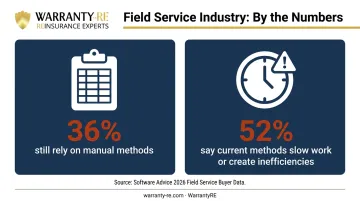
Despite that, most contractors still manage both in spreadsheets, paper files, or disconnected notes. According to Software Advice's 2026 field service buyer data, 36% of field service businesses still rely on manual methods, and 52% say their current methods slow work or create inefficiencies.
For warranty workflows, the costs are concrete: missed claim windows, unnecessary truck rolls, and billing disputes that a complete job record would have prevented.
Top Contractor Warranty Management Software Compared
Platforms below were evaluated on contractor-specific workflow fit, field and mobile usability, claims documentation capability, integration with scheduling and invoicing, and pricing transparency for trade businesses.
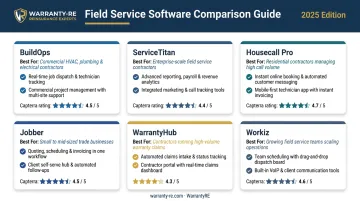
BuildOps
Built exclusively for commercial contractors — HVAC, mechanical, plumbing, electrical, and fire safety — BuildOps integrates warranty tracking directly into dispatch, work orders, mobile job execution, and job closeout. Warranty context lives where techs actually work. The platform stands out for commercial teams managing multi-site customers, layered approvals, and complex asset histories — proof capture (photos, serial/model numbers, readings) ties directly to the ticket and asset record, reducing disputed claims and unnecessary return visits.
| Feature | Details |
|---|---|
| Best For | Commercial contractors: HVAC, plumbing, electrical, fire safety |
| Key Features | Warranty-aware dispatch, mobile proof capture, asset history, billing separation for covered vs. billable work, performance reporting |
| Pricing | Quote-based; contact vendor for current rates |
| Capterra Rating | 4.4/5 (177 reviews) |
ServiceTitan
ServiceTitan is the enterprise standard for large HVAC, plumbing, and electrical contractors. Its mobile app exposes both manufacturer warranty and service warranty fields directly on equipment records, and service agreement software handles preventative maintenance and coverage tracking at scale.
The tradeoff is implementation scope and cost — ServiceTitan fits contractors who need warranty management embedded in a system that already handles scheduling, dispatch, invoicing, marketing, and reporting across high job volumes.
| Feature | Details |
|---|---|
| Best For | Enterprise HVAC, plumbing, and electrical contractors |
| Key Features | Equipment and service warranty fields, service agreement tracking, technician mobile app, integrated reporting |
| Pricing | Quote-based per-technician model (Starter, Essentials, The Works) |
| Capterra Rating | 4.3/5 (332 reviews) |
Housecall Pro
Housecall Pro is a cloud-based platform popular with residential contractors across HVAC, plumbing, electrical, and general home services. Warranty documentation lives in job history and customer profiles, which works well for smaller residential operations that don't need structured claims workflows.
| Feature | Details |
|---|---|
| Best For | Residential contractors with high call volume and straightforward warranty needs |
| Key Features | Job history, customer profiles, technician mobile access, scheduling, invoicing |
| Pricing | Basic: $59/mo (annual); Essentials: $149/mo; MAX: $299/mo |
| Capterra Rating | 4.7/5 (2,739 reviews) |
Jobber
Jobber is built for small to mid-sized contractors across trades including HVAC, roofing, plumbing, and electrical. It's known for ease of use, clean client management, and solid job history — all of which support workmanship warranty follow-through without requiring a steep learning curve.
Warranty documentation runs through job records and client notes. That's a practical starting point for growing businesses that need core operations solid before layering in more structured tracking.
| Feature | Details |
|---|---|
| Best For | Small to mid-sized contractors across multiple trades |
| Key Features | Client management, job and quote history, scheduling, invoicing, mobile notes and attachments |
| Pricing | Core: $22/mo (annual) to Grow: $109/mo (annual); Plus at $387/mo |
| Capterra Rating | 4.6/5 (1,456 reviews) |
WarrantyHub
WarrantyHub is the only purpose-built warranty management platform on this list. Designed from the ground up for claims automation, warranty registration, customer self-service portals, and analytics.
The platform supports 80+ automated notifications, real-time dashboards, and structured claims workflows — making it the strongest option for contractors or warranty administrators with high-volume, structured claims needs.
| Feature | Details |
|---|---|
| Best For | Contractors and administrators with high-volume, structured warranty claim needs |
| Key Features | Claims automation, customer portal, warranty tracking, registration management, 80+ notifications, analytics |
| Pricing | SaaS subscription; demo required for pricing |
| Capterra Rating | 5.0/5 (6 reviews) |
Workiz
Workiz serves growing multi-trade service businesses that need reliable warranty documentation tied to daily work orders. Equipment history logs include installation dates, warranty dates, and service history — and Workiz has an official JB Warranties integration for contractors using extended warranty programs.
| Feature | Details |
|---|---|
| Best For | Growing service contractors scaling dispatch and documentation consistency |
| Key Features | Equipment history with warranty dates, job and asset notes, scheduling, technician mobile tools, JB Warranties integration |
| Pricing | Tiered plans; extra members from $46/mo (annual) |
| Capterra Rating | 4.4/5 (218 reviews) |
Key Features to Look For
Software Advice's 2026 field service data shows 90% of buyers consider mobile accessibility vital, 81% prioritize contract management, and 44% specifically value service history access. For warranty workflows, those numbers translate into three must-have capabilities:
1. Integration with job records and field execution
Warranty terms, asset history, coverage dates, and proof documentation should live on the same record as the work order. If a tech has to cross-reference a spreadsheet or call the office to confirm coverage, that friction costs time and creates room for errors. Platforms like BuildOps and ServiceTitan embed this directly; others like Jobber and Housecall Pro approximate it through job history.
2. Mobile proof capture
Photos, model and serial numbers, install readings, and customer sign-off captured at the unit on the day of the job are the difference between a defensible claim and a dispute. If techs can't document coverage in the field without extra steps, that gap exposes claims — particularly for manufacturer submissions requiring photos, serial numbers, and install readings captured on-site.
3. Claims workflow and reporting
Strong claims workflow means more than tracking status. Look for platforms that let you:
- Tag labor and parts as covered versus billable on each work order
- Report on warranty volume by asset type, trade, or technician
- Pull callback rate data by equipment type to identify patterns
Contractors with that reporting visibility protect margin and carry operational intelligence most competitors lack.
Beyond Software: Should Contractors Own Their Warranty Program?
Warranty management software helps contractors track and administer their warranty obligations more accurately. That's real value. But most contractors using these platforms are still sending warranty premiums — and the underwriting profits that come with them — to a third-party provider. The software manages the process while someone else keeps the money.
The alternative is a different program structure, not just better tools.
How Contractor-Owned Reinsurance Works
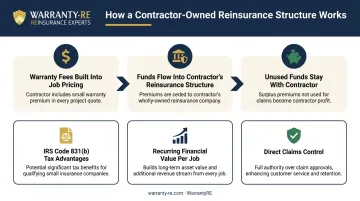
Instead of paying a third-party warranty company, contractors can establish their own reinsurance company through an administrator-obligor structure — backed by A-rated insurers — that allows them to retain underwriting profits, earn investment income on reserves, and control the claims experience from start to finish.
Warranty fees get built into job pricing and flow into the contractor's own reinsurance structure. Claims are covered from that pool. Unused funds stay with the contractor — not a third party.
Beyond profit retention, the structure creates:
- IRS Code 831(b) tax advantages that reduce the cost of holding reserves
- Recurring financial value that compounds with every job completed
- Direct claims control, with no third-party adjuster deciding outcomes for your customers
Where WarrantyRE Fits
WarrantyRE has helped HVAC, roofing, plumbing, and electrical contractors set up and manage their own reinsurance companies since 1994. The company handles the full administrative load: company formation, legal filings, tax returns, claims adjudication, compliance monitoring, monthly financials, and staff training. Contractors get the program without the overhead of running it themselves.
One common misconception: that reinsurance requires large volume to work. As WarrantyRE notes, "many larger home service businesses do own their own reinsurance company" but that smaller businesses are often simply unaware of the option rather than ineligible for it.
If profit retention is the goal, the right question isn't which software to choose — it's whether the underlying program structure is worth owning in the first place.
Conclusion
The best contractor warranty management software depends on business size, trade, and how deeply warranty workflows need to connect with daily field operations. BuildOps fits commercial contractors managing complex asset histories; ServiceTitan suits enterprise teams that need everything in one platform; Housecall Pro and Jobber serve residential and smaller contractors who need practical, mobile-friendly tools; WarrantyHub is the strongest option for dedicated claims management; Workiz works well for growing teams scaling documentation consistency.
Any of these platforms will reduce claim disputes and save time compared to spreadsheets — that's a meaningful operational improvement worth making.
The deeper question, though, is structural: are you managing a warranty program that sends profits to a third-party provider, or building one that keeps those profits in your business? If the goal is profit retention and long-term customer loyalty, the structure behind the program matters as much as the software managing it.
Contractors who want to explore what a contractor-owned warranty program could look like for their specific trade and volume can reach out to WarrantyRE at (804) 824-9533 or through warranty-re.com to learn more about the reinsurance model.
Frequently Asked Questions
What is the best warranty management software for HVAC contractors?
It depends on whether you're running commercial or residential operations. Commercial HVAC contractors typically get the most from BuildOps or ServiceTitan, which embed warranty tracking in dispatch and asset management. Residential HVAC businesses often find Housecall Pro or Jobber more practical given their simpler workflows and lower cost.
How much does contractor warranty management software cost?
Pricing varies widely by platform. Housecall Pro starts at $59/month and Jobber at $22/month (annual), while commercial platforms like BuildOps and ServiceTitan are quote-based and scale with team size and modules. Contact vendors directly for current pricing, as rates change and depend heavily on your configuration.
What features should I look for in warranty tracking software for contractors?
Focus on three things: integration with job records so warranty data lives on the same record as the work order, mobile proof capture so techs can document coverage at the unit on the day of the job, and claims workflow tools that separate covered from billable work and track submission status.
Can warranty management software help contractors increase profitability?
Yes, by reducing time spent on disputed claims, repeat truck rolls, and billing errors tied to undocumented installs. Software improves the administration of existing warranty arrangements, but capturing the underwriting profits from those programs requires a different structure — not just better tracking tools.
What is the difference between warranty tracking software and a contractor-owned warranty program?
Software organizes and tracks warranty obligations: coverage dates, claim status, and documentation. A contractor-owned reinsurance program changes who keeps the money — instead of paying underwriting profits to a third-party provider, the contractor retains them through their own reinsurance structure.
Do small contractors need dedicated warranty management software?
Not immediately. Platforms like Jobber and Housecall Pro include job history tools that handle basic warranty documentation well for smaller operations. As volume grows, dedicated workflows reduce claim errors, billing disputes, and admin time enough to justify the upgrade.