
Not all warranty administration looks the same. Some companies simply process claims for a fee, taking a share of the premiums while you handle all the operational headaches. Others—particularly reinsurance-based models—let contractors own the warranty company and keep the underwriting profits those claims generate. This fundamental difference determines whether your warranty program becomes a cost center you manage or a revenue stream you own.
This article covers the best warranty claims administration companies for contractors in the home service space—what to look for, how the models differ, and how the right partner can turn warranty programs from an expense into an asset.
TL;DR
- Warranty claims administrators manage intake, adjudication, compliance, and payouts so contractors can focus on running jobs instead of chasing claims
- Reinsurance-based models let contractors own their warranty company and capture underwriting profits instead of paying third parties
- Top companies: WarrantyRE, Centricity, Fortegra, PWSC, and Builders Protection Group
- Key selection criteria: contractor specialization, claims speed, compliance support, and financial transparency
- The strongest programs give contractors full visibility into claims performance, reserves, and profit distributions
What Is Warranty Claims Administration for Contractors?
Warranty claims administration is the process of receiving, verifying, adjudicating, and paying out warranty claims on labor and materials after installation. Unlike standard product warranties handled by manufacturers, contractor warranty programs cover workmanship—the labor, installation quality, and performance of the systems contractors install.
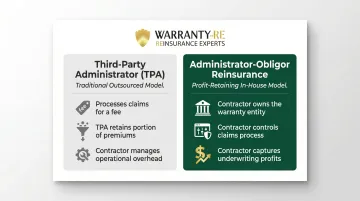
Two main models exist:
| Model | How It Works | Who Keeps the Profit |
|---|---|---|
| Third-Party Administrator (TPA) | You sell their program; they process claims | The TPA keeps a portion of revenue |
| Administrator-Obligor Reinsurance | You own the warranty entity and control claims | You capture the underwriting profits |
The global extended warranty market reached $129.65 billion in 2022 and is projected to hit $286.4 billion by 2032, driven by rising equipment costs and consumer demand for coverage. While no authoritative source isolates contractor-specific warranty data, the growth reflects increasing reliance on structured warranty programs across service industries.
Which model fits your business depends on your annual install volume and whether you want to simply offload claims processing or build a warranty program that generates its own revenue. The companies below cover both approaches.
Best Warranty Claims Administration Companies for Contractors
These companies were selected based on contractor-sector specialization, claims handling capability, program flexibility, compliance track record, and overall business value for HVAC, roofing, plumbing, and electrical contractors.
WarrantyRE
Founded in 1994 by Tim Byrd in Southeast Virginia, WarrantyRE has spent over 30 years helping contractors and auto dealers build and manage their own administrator-obligor reinsurance companies. It now serves HVAC, roofing, plumbing, electrical, and general contractors nationwide through its sister company DealerRE.
What makes WarrantyRE stand out: Rather than acting as a TPA that pockets underwriting profits, WarrantyRE helps contractors establish their own warranty company backed by A-rated insurers. Contractors capture 100% of those profits and build recurring revenue from their installs. The full-service model covers training, claims adjudication, compliance, bookkeeping, legal filings, and tax returns—keeping warranty revenue in-house without adding internal overhead.
| Services Offered | Full-service administrator-obligor reinsurance setup, claims adjudication, compliance management, staff training, financial reporting, tax filings, and renewals |
|---|---|
| Best For | HVAC, roofing, plumbing, electrical, and general contractors looking to replace third-party warranty providers and own their warranty program |
| Key Differentiator | Contractors own their reinsurance company and capture underwriting profits; backed by A-rated insurers with no hidden fees |
Centricity
Centricity is a subsidiary of Bankers Financial Corporation, formed through the consolidation of Bankers Warranty Group and Bonded Builders Warranty Group. With 48 years in business, Centricity combines consumer product protection expertise with new home construction warranty administration.
The company operates a proprietary Centricity 360 (C.360) platform for 24/7 claims filing and real-time business insights. Centricity serves 1,928 retailer and channel partners across 137 industries, managing over $3 billion in assets protected. Its "Service Your Own Customers" model lets qualified contractors perform warranty repairs on contracts they sell, keeping labor revenue and the customer relationship in-house rather than dispatching third-party technicians.
| Services Offered | Claims processing, service dispatch, 50-state compliance management, product protection programs, contractor service network |
|---|---|
| Best For | Home service contractors (HVAC, plumbing, electrical) who want to service their own warranty claims while leveraging third-party administration |
| Key Differentiator | "Service Your Own Customers" model lets contractors perform warranty repairs on contracts they sell, keeping labor revenue in-house |
Fortegra
Fortegra is a specialty insurance and warranty administration company headquartered in Jacksonville, Florida, and a wholly owned subsidiary of Tiptree Inc. (NASDAQ: TIPT). With 45+ years in the industry, Fortegra operates through 10 insurance subsidiaries and holds an AM Best Financial Strength Rating of A- (Excellent) with a stable outlook.
Fortegra offers customizable home protection plans covering HVAC, plumbing, and electrical systems. The company partners with third-party administrators and provides Producer-Owned Reinsurance Companies (PORCs), enabling distribution partners to participate in underwriting profit through risk-sharing arrangements. Few warranty administrators combine A-rated insurance backing with profit-participation structures at this scale.
| Services Offered | Embedded insurance, underwriting, claims infrastructure, compliance support, reinsurance profit-sharing (PORCs) |
|---|---|
| Best For | Medium to large contractors seeking insurance-backed warranty programs with profit-participation options |
| Key Differentiator | A- rated insurance carrier with profit-sharing reinsurance structures (PORCs) for larger partners |
Professional Warranty Service Corporation (PWSC)
Founded in 1995 and acquired by PCF Insurance Services in August 2022, PWSC is a builder-and-contractor-focused warranty administrator based in Chantilly, Virginia. The company offers three warranty tracks: insurance-backed, builder-backed, and system & appliance warranties.
PWSC's System & Appliance Warranty covers HVAC, plumbing, and electrical systems for both new and aftermarket homes, making it relevant for service contractors beyond new construction. Contractors submit claims online via the PWSC Claims Center; reviewers evaluate them against defined Construction Performance Guidelines. PWSC's arbitration provisions were upheld by California Superior Court in 2016, providing legal validation of its dispute resolution framework.
| Services Offered | Insurance-backed and builder-backed warranty programs, claims processing, arbitration and dispute resolution, system & appliance coverage |
|---|---|
| Best For | New-construction builders and contractors who need structural warranty coverage with dispute resolution frameworks |
| Key Differentiator | Court-tested arbitration provisions and builder-specific warranty structures for new construction projects |
Builders Protection Group (BPG)
Founded in 2003 as a Small Business Enterprise (SBE), Builders Protection Group is a construction risk management firm providing inspection-driven warranty services. BPG's model focuses on preventing warranty claims through proactive quality control rather than simply processing claims after failures occur.
BPG executes third-party QA/QC inspections covering HVAC, electrical, plumbing, and roofing systems. Every unit is inspected individually, with re-inspection within 24-48 hours after correctable items are completed. The final report serves as certified evidence of remediation, reducing future warranty exposure. BPG also offers customized limited warranty programs, property condition assessments, and wrap policy compliance administration.
| Services Offered | Pre-, during-, and post-construction inspections, limited warranty design, homeowner care programs, property condition assessments |
|---|---|
| Best For | Commercial, mixed-use, and residential development projects where litigation risk from construction defects is high |
| Key Differentiator | Prevention-first model using mandatory inspections to identify and remediate defects before they become warranty claims |
How We Chose the Best Warranty Claims Administration Companies for Contractors
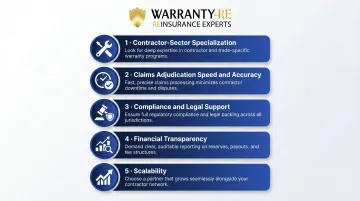
Each company on this list was evaluated against five criteria:
- Contractor-sector specialization — does the administrator actually understand HVAC, roofing, plumbing, and electrical warranty needs?
- Claims adjudication speed and accuracy — how fast and reliably are contractor claims processed?
- Compliance and legal support — does the administrator handle regulatory filings, or leave that to you?
- Financial transparency — are cost structures clear, with full reporting?
- Ability to grow with your business — can the program scale as your contractor operation expands?
A common contractor mistake is choosing a TPA based on name recognition alone without considering whether the program structure allows them to recapture underwriting profits. Contractors who treat warranty administration as a cost item rather than a profit center often miss the financial upside.
Program model matters. The best administrators either provide full financial reporting with clear cost structures (for TPA models) or help contractors build their own reinsurance entity (for ownership models). Reinsurance-based programs let contractors capture 100% of underwriting profits instead of paying third parties. TPA models suit contractors who want straightforward claims processing — the tradeoff is giving up profit participation in exchange for simplicity.
Compliance is non-negotiable. The NAIC Service Contracts Model Act (Model 685) requires administrators to register with state insurance commissioners and maintain financial security through reimbursement insurance, funded reserves, or $100 million net worth.
The best administrators handle legal filings, renewals, and staff training as part of their core service — not as hidden extras billed separately.
Conclusion
For contractors, warranty claims administration is a strategic business decision with direct impact on profitability, customer satisfaction, and growth. Choosing the wrong administrator often means handing underwriting profits to a third party — money that could stay in your business.
Evaluate your current warranty setup against the criteria covered here. The right fit depends on your goals:
- Claims processing only: Look for a reliable TPA with contractor-sector experience and transparent fee structures
- Profit capture: A reinsurance program turns warranty premiums into retained earnings rather than revenue for a third party
- Either path: Prioritize partners with documented compliance coverage and clear financial reporting
Contractors who want to explore owning their own warranty program and capturing underwriting profits can contact WarrantyRE at (804) 824-9533 or visit warrantyRE.com.
Frequently Asked Questions
What do warranty administrators do?
Warranty administrators handle the full lifecycle of a warranty claim on behalf of a contractor—including claim intake, verification, adjudication, and payout. This eliminates the need for contractors to manage disputes or compliance internally, keeping technicians focused on billable work.
Who is the best warranty provider for contractors?
The right provider depends on your goals. Contractors focused on capturing underwriting profits and building long-term program value should look at reinsurance-based models like WarrantyRE. High-volume contractors needing straightforward claims processing may prefer a TPA like Centricity or Fortegra.
Who are the top TPAs for warranty claims?
Top TPAs in the home service contractor market include Centricity, Fortegra, and PWSC. Each administers claims on your behalf, though a portion of premiums stays with the TPA as profit. Contractors looking to keep those profits should explore reinsurance-based alternatives.
What is the KPI for warranty claims?
Core metrics include claims resolution time, approval rate, cost per claim, repeat claim rate, and customer satisfaction score. A strong administrator delivers regular reporting on these so contractors can monitor program performance over time.
What is the difference between a TPA and a reinsurance warranty program for contractors?
A TPA administers claims on behalf of a contractor but retains a portion of the premiums as profit. A reinsurance program (like those set up by WarrantyRE) allows the contractor to own the warranty company itself and keep the underwriting profits, turning warranty operations into a revenue stream.
How do contractors benefit from owning their own warranty company?
Contractors capture 100% of underwriting profits, cut third-party fees, build recurring revenue from installs, and gain direct control over the claims experience. The reinsurance structure also creates meaningful tax planning advantages.