
The difference between express, implied, and statutory warranties isn't just legal vocabulary. It determines how long you're on the hook, what you owe when something goes wrong, and whether your contract language actually protects you or just looks like it does.
This guide breaks down what California requires, what each warranty type covers, how long those obligations last under the actual code sections, and how contractors can manage that exposure more deliberately.
TL;DR
- California requires written contracts for home improvement projects over $500 (Business and Professions Code §7159); warranty terms should be documented in writing per CSLB guidance
- Three warranty types apply: express (written), implied (by law), and statutory (mandated under SB 800)
- SB 800 (Civil Code §§895–945.5) sets tiered performance standards for new residential construction — coverage periods vary by defect type, not a flat "1-2-10" rule
- Implied warranties apply by law regardless of contract language, and disclaiming them is rarely enforceable
- Contractors who own their warranty program structure can retain underwriting profits instead of funding a third-party provider's margins
What Is a California Contractor Warranty?
A contractor warranty is a legally enforceable promise that work meets an agreed quality standard and will remain free from defects for a defined period. It applies to both labor and materials.
Warranties serve two functions at once. They protect clients from defective work, and they protect contractors by defining the scope and duration of post-completion liability. The problem is that many contractors assume their written contract controls both. It doesn't.
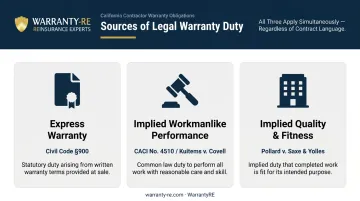
California law supplies warranty obligations from three separate sources, and all three operate at once — regardless of what the contract says:
- Civil Code §900: Requires a minimum one-year express written limited warranty for fit-and-finish items in new residential construction
- CACI No. 4510 and case law (Kuitems v. Covell, 104 Cal.App.2d 482): Establishes an implied covenant to perform work in a competent, workmanlike manner
- Pollard v. Saxe & Yolles Dev. Co., 12 Cal.3d 374: Recognizes implied warranties of quality and fitness in the sale of new residential construction
The CSLB recommends documenting any warranty for labor and materials in writing, specifying what's covered and for how long. BPC §7159 requires the underlying contract to be written and signed, but the warranty disclosure itself flows from CSLB guidance. Either way, written warranty documentation protects contractors from disputes about scope and duration after the job is done.
Types of Contractor Warranties in California
Express Warranties
Express warranties are explicitly stated in a written contract or proposal. They specify covered defects, available remedies, and the timeframe the contractor commits to honoring. Because many contractors use proposals as the functional basis for their contracts, warranty language in those proposals carries the same legal weight.
Implied Warranty of Workmanlike Performance
This warranty exists by operation of California law whether written in the contract or not. Under CACI No. 4510, any contractor has an implied covenant to perform work in a good and competent manner. It applies to residential and commercial projects alike.
The practical implication: a contractor can draft a contract with no warranty language whatsoever and still face liability for substandard workmanship.
Implied Warranty of Habitability and Quality in New Construction
Pollard v. Saxe & Yolles established that sales of new residential construction carry implied warranties of quality and fitness. This is distinct from the workmanlike performance warranty — it guarantees the completed structure will be safe, livable, and meet California building code requirements.
California courts rarely allow this warranty to be disclaimed. Any attempt requires specific, unambiguous contract language reviewed by California construction counsel.
Statutory Warranties
Statutory warranties are mandated by state law under SB 800 (Civil Code §§895–945.5). They set minimum coverage floors that no express warranty can legally undercut. These apply specifically to new residential construction and operate independently of contract terms.
Manufacturer vs. Contractor Warranties
The CSLB draws a clear distinction between contractor workmanship warranties and manufacturer product warranties. If a defect traces to product failure rather than installation error, liability shifts to the manufacturer.
Contractors should document installation practices carefully to separate workmanship claims from product claims before disputes arise. Key records include:
- Photos taken during and after installation
- Signed installation checklists
- Specification compliance records
What California Contractor Warranties Cover
Workmanship and Fit-and-Finish
Civil Code §900 requires a minimum one-year express written limited warranty for cabinets, mirrors, flooring, interior and exterior walls, countertops, paint finishes, and trim. This covers defects in how the work was performed — improperly installed roofing, cracked drywall, peeling paint, poorly sealed windows.
Major Systems — Actual Statutory Periods
This is where the common "1-2-10" shorthand breaks down. Civil Code §896 contains component-specific periods, not a blanket two-year major systems rule:
| Component | Verified Statutory Period |
|---|---|
| Certain items (untreated wood posts, dryer ducts) | 2 years |
| Plumbing and electrical systems | 4 years from close of escrow |
| Exterior paint and stains | 5 years |
| Structural elements | Up to 10-year outside limit |
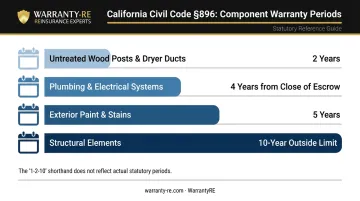
Presenting "2 years for HVAC/plumbing/electrical" as a California statutory rule is incorrect. The actual periods vary, and contractors who draft warranty language based on the simplified version may create gaps in coverage.
Structural Elements
Foundations, load-bearing components, and slabs are addressed under Civil Code §896's structural standards. Civil Code §941 sets a 10-year outside limit for Right to Repair Act claims from substantial completion. That 10-year figure is a hard outer limit on when claims can be filed — not a rolling warranty that restarts with each repair.
What's Not Covered
Standard warranty exclusions include:
- Normal wear and tear
- Natural events (earthquakes, flooding)
- Owner-caused damage or lack of maintenance
- Repairs made by anyone other than the original contractor
One important court ruling to understand: in Aas v. Superior Court, 24 Cal.4th 627, the California Supreme Court held that homeowners couldn't recover in negligence for construction defects that hadn't yet caused actual property damage. SB 800 later changed the equation for new residential construction by establishing statutory standards that don't require proof of actual damage. Contractors working in that space need to understand both frameworks, not just Aas.
California's Legal Framework: Key Laws Contractors Must Know
SB 800 and Civil Code §§895–945.5 (Right to Repair Act)
SB 800, enacted in 2002, added Title 7 to Part 2 of Division 2 of the Civil Code. It applies to original construction intended for sale as individual dwelling units and covers measurable performance standards for water intrusion, structural integrity, soil movement, plumbing, sewer, and electrical systems.
Civil Code §943 limits the causes of action available for covered claims. Except for contract, fraud, personal injury, or specific statutory violations, the Right to Repair Act is the exclusive remedy for property damage claims from construction defects in new residential construction.
Critical note: SB 800 is the construction defect Right to Repair Act. SB 244 is a separate 2023 electronics and appliance right-to-repair law. These are frequently confused.
BPC §7159 Contract Mechanics
BPC §7159 sets strict requirements for home improvement contracts over $500. Key obligations include:
- Contract must be written, legible, and signed before work begins
- Written, signed change orders required before any extra or changed work is incorporated
- Scope changes that affect warranty terms must be documented in writing
- Verbal modifications do not create enforceable contract obligations
Limitations and Repose Periods
Contractors often assume a "one-year warranty" caps all liability. It doesn't:
- CCP §337.1: 4-year period for patent (obvious) construction deficiencies
- CCP §337.15: 10-year repose period for latent deficiencies, running from substantial completion
- Civil Code §941: 10-year outside limit for Right to Repair Act claims
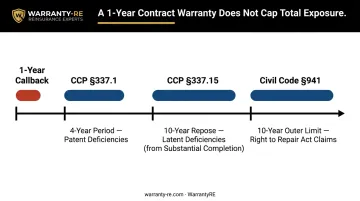
The one-year callback window in standard contract language is exactly that: a callback window. Implied warranty and statutory exposure extends well beyond it.
Notable Court Precedents
Three cases every California contractor should understand:
- Moore v. Teed, 48 Cal.App.5th 280 (2020): Supports liability for construction-related misrepresentations made during the sales process. Not a blanket "verbal promises create warranties" rule, but relevant to fraud and misrepresentation claims
- Howard Contracting v. G.A. MacDonald Construction, 71 Cal.App.4th 38 (1998): Supports delay-related damages recovery on public works projects and subcontractor pass-through claims in that context
- Aas v. Superior Court, 24 Cal.4th 627 (2000): Bars negligence recovery for construction defects without actual property damage. Apply carefully alongside SB 800, which modified the landscape for new residential construction claims
Managing Warranty Obligations Strategically
Start With Contract Language
Written contracts with clearly drafted warranty provisions are the first line of defense. Vague warranty terms expose contractors to the broader implied warranty standard, which California courts interpret in favor of the consumer under Civil Code §1654 — ambiguous contract language is construed against the party who drafted it.
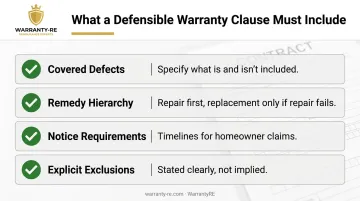
A defensible warranty clause should specify:
- Which defects are covered (and which aren't)
- The remedy hierarchy (repair first, replacement only if repair fails)
- Notice requirements and timelines for homeowner claims
- Any exclusions, stated explicitly
Disclaiming Implied Warranties
California makes it very difficult to disclaim implied warranties, particularly the warranty of habitability for new residential construction. Any disclaimer must be specific and explicit — courts treat ambiguous disclaimers as non-operative. Don't attempt to limit implied warranty coverage in contracts without reviewing the language with a California construction attorney.
Owning the Warranty Program Structure
Defensive contract language limits exposure on paper. But contractors who want to stop absorbing warranty costs altogether take a different approach: owning the warranty program structure directly instead of paying a third-party administrator.
WarrantyRE helps HVAC, roofing, plumbing, and electrical contractors establish reinsurance structures they legally own. A warranty fee is built into every job's pricing (the homeowner is already paying it), and those funds flow into the contractor's own reinsurance account rather than to an outside company. When warranty claims arise, they're covered from this pool. Unused funds stay with the contractor.
The structure turns warranty obligations into a source of retained profit rather than a recurring expense. Claims administration, compliance, legal filings, and tax returns are handled by WarrantyRE — contractors stay focused on the work rather than warranty paperwork.
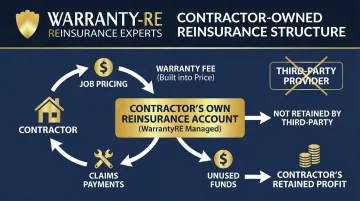
For contractors running consistent installation volume, the underwriting profits that previously went to third-party providers start accumulating inside their own business instead.
Frequently Asked Questions
What are the requirements for a contractor warranty in California?
CSLB guidance recommends that contractors document all labor and material warranties in writing within the contract, and BPC §7159 requires written, signed contracts for home improvement projects over $500. The Right to Repair Act (SB 800) mandates specific performance standards for new residential construction, and implied warranties apply by law regardless of what the contract says.
What does a California contractor warranty cover?
California warranties typically cover workmanship defects, major systems, and structural elements, with periods varying by component under Civil Code §896 (4 years for plumbing and electrical, 5 years for exterior paint, 10-year outside limit for structural claims). Normal wear and tear, owner-caused damage, and natural disasters are generally excluded.
How long is a contractor warranty in California?
It depends on the component. Civil Code §896 sets 2-, 4-, and 5-year periods for specific items, with a 10-year cap under Civil Code §941. Implied warranty exposure under CCP §337.15 can extend that total liability window well beyond what a standard one-year contract warranty implies.
What is the Right to Repair Act and how does it affect California contractors?
The Right to Repair Act (SB 800, Civil Code §§895–945.5) sets mandatory performance standards for new residential construction covering water intrusion, structural integrity, plumbing, electrical, and more — regardless of contract terms. Under Civil Code §943, it serves as the exclusive remedy for most property damage claims tied to new residential construction defects.
Can a California contractor disclaim an implied warranty?
Not easily. California courts require disclaimers to be specific and unambiguous, and unclear language is interpreted against the contractor. The implied warranty of quality and fitness for new residential construction (established in Pollard v. Saxe & Yolles) is especially resistant to waiver. Review any limitation language with California construction counsel before using it.