Introduction
Home service contractors—HVAC, roofing, plumbing, and electrical—face mounting pressure to back their work with formal labor warranties. Customers expect it, competitors offer it, and skipping one costs deals. At this point, a labor warranty is a straightforward competitive requirement that directly affects close rates and profitability.
The real challenge is how contractors handle it. Most either skip labor warranties altogether and lose deals, or pay a third-party provider to administer a program, handing over underwriting profits they could keep themselves. According to ACCA research, a mid-sized contractor doing $2M in annual revenue with a 5% callback rate can lose roughly $80,000 annually in callback costs alone.
A structured labor warranty program addresses this directly. The provider you choose, though, determines whether that program drains profit or generates it.
This guide breaks down the top labor warranty program providers for home service contractors, what to look for when evaluating them, and introduces an alternative model that lets contractors own their warranty program entirely, capturing profits instead of paying them away.
TL;DR
- Labor warranties guard against workmanship defects and are now a genuine differentiator for contractors in crowded markets
- Most providers offer third-party programs where contractors pay premiums and the provider keeps underwriting profits
- WarrantyRE's administrator-obligor reinsurance model sets contractors up to own their warranty company and keep those underwriting profits
- Key selection criteria: claims support, compliance management, training, program flexibility, and profit retention structure
- The right provider depends on your goals — a simple hands-off program or a contractor-owned structure that generates ongoing profit
What Is a Labor Warranty Program for Home Service Contractors?
A labor warranty program is a structured service contract that covers the cost of returning to a job site to correct workmanship defects—distinct from manufacturer product warranties, which cover parts and equipment only. Contractors sell or bundle these warranties to homeowners at the point of installation or service, creating documented protection for both parties.
Why Contractors Need Formal Programs
Contractors increasingly need formal warranty programs rather than informal callbacks for several critical reasons:
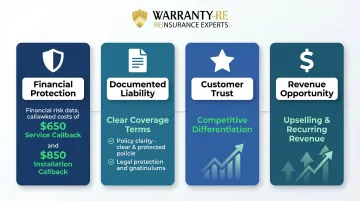
- Financial protection — ACCA data shows a single service callback costs approximately $650, while installation callbacks cost around $850, with some complex callbacks reaching $2,500
- Documented liability structure — Formal programs create clear terms, reducing dispute risk and establishing enforceable coverage limits
- Customer trust and differentiation — Third-party verification of workmanship quality serves as a measurable competitive advantage in competitive markets, according to ACCA research
- Revenue opportunity — Well-structured programs enable upselling and, depending on structure, generate recurring revenue
Two Main Program Structures
| Third-Party Administrator | Administrator-Obligor / Reinsurance | |
|---|---|---|
| Who handles claims | External provider | External administrator on contractor's behalf |
| Who owns the entity | Third-party provider | The contractor |
| Underwriting profit | Retained by provider | Retained by contractor |
| Compliance & financials | Managed by provider | Managed by administrator for contractor |
| Complexity | Lower setup burden | Higher setup; contractor builds equity |
High Stakes for HVAC, Roofing, Plumbing, and Electrical Contractors
For these trades specifically, callbacks and warranty claims carry both financial and reputational weight. California contractor law, for example, mandates tiered warranty durations: 1 year for fit and finish, 2–5 years for plumbing and electrical systems, and 4 years for installed items. That tiered structure makes program design and claims management critical selection factors—not just best practices.
Best Labor Warranty Program Providers for Home Service Contractors
These providers were evaluated on program flexibility, claims administration quality, contractor support, compliance track record, and profit-sharing or ownership potential.
WarrantyRE
WarrantyRE (operating alongside sister company DealerRE) is a Southeast Virginia-based reinsurance firm founded in 1994 by Tim Byrd. With over 30 years of experience, the company has helped 400+ business owners—originally auto dealers, now home service contractors—build their own warranty programs rather than outsourcing them to third parties. It serves HVAC, roofing, plumbing, electrical, and general contractors nationwide.
What Sets WarrantyRE Apart:
WarrantyRE's administrator-obligor reinsurance model works differently from traditional providers. Instead of enrolling in a third-party program, contractors work with WarrantyRE to establish and operate their own warranty company, backed by A-rated insurers.
This allows contractors to:
- Capture 100% of underwriting profits their customer premiums generate
- Invest those premiums for additional ROI
- Control the claims experience
- Build long-term recurring revenue
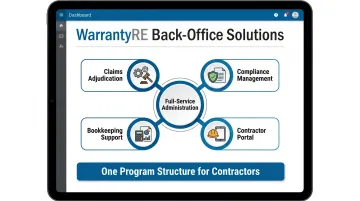
WarrantyRE handles the full operational load: legal filings, tax returns, compliance, staff training, claims adjudication, and bookkeeping. Contractors get a complete back-office infrastructure without building it themselves.
| Program Model | Administrator-Obligor Reinsurance — contractor owns their own warranty company |
|---|---|
| Key Services | Full-service administration: claims adjudication, compliance, training, bookkeeping, legal filings |
| Best For | Established home service contractors seeking to capture underwriting profit and build long-term recurring revenue |
2-10 Home Buyers Warranty
Founded in 1980, 2-10 HBW is an Aurora, Colorado-based warranty administrator with over 1 million homes covered across all products. The company is a Frontdoor brand (sister brands include American Home Shield and HSA Home Warranty).
2-10 HBW is the industry-leading administrator of builder warranties, designed primarily for home builders rather than HVAC, plumbing, or electrical service contractors. Program tiers include workmanship warranty (Year 1), distribution systems warranty (Years 1-2), and structural warranty (Years 1-10, insurance-backed).
What Differentiates 2-10 HBW:
The company offers insurance-backed programs where the builder is the insured and the homeowner is the beneficiary. 2-10 HBW manages claims filtering, inspection arrangements, dispute resolution, and repair sourcing — shifting warranty liability off the builder's balance sheet.
| Program Model | Third-party administrator with insurance-backed programs |
|---|---|
| Key Services | Enrollment, claims administration, inspection coordination, compliance support |
| Best For | Residential home builders and remodelers seeking structured warranty management on new construction |
Residential Warranty Company (RWC)
Founded in 1981, RWC is a Harrisburg, Pennsylvania-based warranty provider with over 4 million homes warranted since inception. The company is backed by Western Pacific Mutual Insurance Company, a Risk Retention Group with nearly $130 million in surplus equity and an A.M. Best rating of A- (Excellent).
RWC provides insured home warranties for builders, remodelers, and manufacturers across the US. Programs include 10-Year New Home Warranty (traditional 1-2-10 structure), Customized State Warranty, and Day One Warranty. Coverage areas include roofing, plumbing, electrical, HVAC, carpentry, and structural components.
What Differentiates RWC:
The company measures claims against warranty book standards and offers an online Warranty Express platform for builder enrollment. RWC's programs target residential builders managing new home construction — they are not structured for standalone labor warranties or trade service contractors.
| Program Model | Third-party administrator with insurance-backed 1-2-10 warranty programs |
|---|---|
| Key Services | Claims administration, online enrollment platform, warranty book standards |
| Best For | Residential home builders and remodelers managing new construction warranty obligations |
PWSC (Professional Warranty Service Corporation)
Founded in 1995 and headquartered in Chantilly, Virginia, PCF Insurance Services (a top-20 US insurance brokerage) acquired PWSC in 2022. The company operates as a Managing General Agent (MGA) specializing in warranty and risk programs for new home construction.
PWSC's insurance-backed warranty is backed by Zurich (A-rated insurer) and includes a "duty to defend," naming the builder on the policy. Coverage follows the 1-2-10 structure: workmanship and materials (Year 1), major systems (Years 1-2), and structural (Years 1-10). No start-up or annual renewal fees. No homeowner deductibles for claims.
What Differentiates PWSC:
PWSC offers digital platforms including FirstLink (service intake) and PWSC Portal (builder enrollment and account management). The company provides flat-rate arbitration ($80 homeowner filing fee) and measures claims against established building standards and tolerances.
| Program Model | Insurance-backed warranty (MGA model) backed by Zurich |
|---|---|
| Key Services | Digital platforms, claims administration, flat-rate arbitration, compliance support |
| Best For | Residential home builders seeking insurance-backed warranty programs with digital claim management |
Centricity (formerly Warrantech)
Centricity was formed in 2017 through the combination of Bankers Warranty Group and Bonded Builders Warranty Group. Headquartered in St. Petersburg, Florida, the company is a privately held subsidiary of Bankers Financial Corporation (founded 1976).
In 2021, Centricity spun off its home warranty business into a separate company called Maverick Builders. Today, Centricity focuses exclusively on consumer product protection — flooring, cabinets, countertops, jewelry, and electronics — serving retail channel partners, manufacturers, and buying groups.
Centricity does not currently serve HVAC, plumbing, electrical, or roofing contractors with labor warranty programs.
| Program Model | Not applicable (does not serve home service contractors) |
|---|---|
| Key Services | Consumer product protection for retailers and manufacturers |
| Best For | Not applicable for trade contractors |
How We Chose the Best Labor Warranty Program Providers
Providers were assessed on program flexibility (can it be tailored to specific trades?), claims administration quality (speed, transparency, contractor control), compliance management (legal filings, state-level requirements, renewal handling), and staff training and onboarding support.
The Critical Factor Most Contractors Overlook
The most overlooked question when evaluating providers: who keeps the underwriting profit?
In a third-party model, contractors pay premiums and the administrator keeps any unclaimed surplus. In a reinsurance or owner-operator model, that surplus stays with the contractor. Third-party warranty companies profit from premium reserves not used to pay claims — the only question is whether that profit flows to an external company or back into your business.
Program Structure Determines Long-Term Value
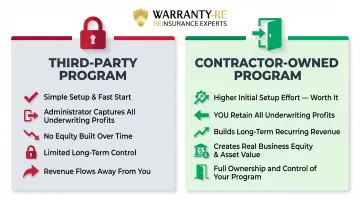
The right provider is the one whose program structure matches your growth goals, risk tolerance, and customer base. Two fundamentally different structures exist:
- Third-party programs — simple to start, fast to set up, but the administrator captures underwriting profits instead of you
- Contractor-owned programs — require more setup upfront, but generate long-term recurring revenue and keep underwriting profits inside your business
According to approximately 25 states that have adopted the NAIC Service Contracts Model Act, service contract providers must maintain specific financial security mechanisms—registration, bonding, or insurer-backing—so compliance management belongs on every contractor's evaluation checklist.
Conclusion
Every home service contractor who offers labor warranties faces a choice: pay a third party to administer that program (and hand over underwriting profit), or build a program that works as a revenue generator for the business itself.
Evaluate providers not just on monthly cost or ease of enrollment, but on long-term financial structure, claims control, and scalabilityas your install volume scales. The structure you lock in now determines whether warranty obligations become a cost center or a profit center.
If those criteria point toward keeping underwriting profits in-house, WarrantyRE has spent over 30 years helping HVAC, roofing, plumbing, and electrical contractors do exactly that. Call the WarrantyRE team at (804) 824-9533 to find out what an administrator-obligor model could mean for your revenue and your customers.
Frequently Asked Questions
Who are the best labor warranty providers?
The top providers vary by program model. Third-party administrators like 2-10 HBW, RWC, and PWSC suit contractors seeking simplicity and fast setup, while WarrantyRE suits contractors seeking to own their program and capture underwriting profits.
Are labor warranties worth it?
Yes. For contractors, offering a labor warranty increases close rates, builds customer trust, and reduces dispute exposure. In certain program structures, contractors also retain underwriting profits from unclaimed premiums, generating revenue the warranty itself produces.
What is the difference between a labor warranty and a manufacturer warranty?
A manufacturer warranty covers product defects in parts and equipment. A labor warranty covers the contractor's workmanship—the cost of returning to correct installation or service errors not related to product failure.
Can contractors actually make money from offering labor warranties?
In a standard third-party program, contractors typically do not profit from the warranty itself. However, in an administrator-obligor reinsurance model, contractors own the warranty entity and retain underwriting profits from unclaimed premiums—turning warranties into a revenue stream.
What should a contractor look for in a labor warranty program provider?
Prioritize claims administration support, compliance management, staff training, and trade-specific flexibility. Also consider whether the program lets you retain underwriting profit or surrenders it to a third party, and evaluate setup speed and transparent pricing.
How does a labor warranty program help with customer retention?
A formal labor warranty gives homeowners documented assurance of workmanship quality, reduces post-install anxiety, and creates a touchpoint for future service—all of which increase repeat business and referrals for the contractor.