
This guide walks you through setting up a structured labor warranty program—one that protects your business, delivers a better customer experience, and can actually generate profit instead of draining it.
TL;DR
- A labor warranty covers labor costs (and sometimes parts) for repairs within a defined window after installation — typically 1–2 years
- Key decisions: what work is covered, coverage duration, funding model, and explicit exclusions
- Funding options: self-funded (you absorb costs), third-party provider, or reinsurance-backed (you own the program)
- Essential components: written policy, clear claims process, pricing strategy that builds warranty costs into install prices
- A well-structured labor warranty gives customers a reason to choose you over competitors — and can generate recurring revenue rather than draining margin
What Is a Contractor Labor Warranty Program?
A labor warranty program is a formal commitment by a contractor to return to a job and cover the cost of labor for qualifying repairs or failures within a specified period after installation. This is separate from—and complementary to—any manufacturer's parts warranty.
What Labor Warranties Cover:
- Technician time and travel for callback visits
- Diagnostic work to identify installation-related failures
- Repair labor for workmanship defects
- Re-installation work when initial installation fails
What They Typically Don't Cover:
- Manufacturer-warranted parts (covered separately by equipment makers)
- Equipment failure unrelated to installation quality
- Customer-caused damage or modifications
- Normal wear and tear
- Work performed by other contractors after the original install
Understanding what's in and out of scope sets the foundation for choosing the right program structure.
Three Main Program Structures
| Structure | How It Works | Trade-Off |
|---|---|---|
| Contractor-funded | You absorb all callbacks from operating cash | Simple to run, but claims costs are unpredictable |
| Third-party provider | Pay a per-install fee; provider reimburses your labor | Transfers risk, but also transfers profit to the warranty company |
| Reinsurance-backed | You establish your own warranty company funded by customer fees | You control claims and keep underwriting profits when claims run below premiums collected |
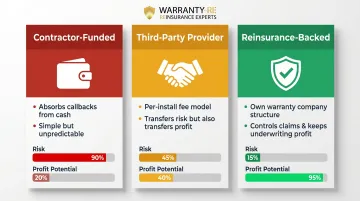
The reinsurance-backed model is the most complex to set up, but it's the only structure where the contractor captures the financial upside. WarrantyRE helps contractors build and manage these programs with backing from A-rated insurers.
Why Offer a Labor Warranty Program?
Competitive Advantage at Point of Sale
Warranty coverage influences buying decisions. Research shows that presenting multiple proposal options including warranty packages increased close rates by 10% in a 2025 study of over 1,000 HVACR contractors. Contractors offering no warranty — or only vague verbal guarantees — lose deals to competitors with structured programs.
Tangible Business Benefits:
- Reduced objections during sales conversations
- Higher average ticket when warranty is priced as an upgrade option
- Stronger customer retention and repeat business
- Fewer negative reviews tied to unresolved callback disputes
From Cost Center to Profit Center
The shift happens when you stop absorbing callbacks informally and start pricing, documenting, and funding warranty service as a deliberate business model. A properly structured program generates premium income that — over time — can exceed claims costs.
When collected premiums exceed claims paid, the difference is yours to keep. Third-party providers already capture this spread on programs they administer for you. A reinsurance structure puts that profit back in your pocket — which is exactly what the rest of this guide walks through.
What to Consider Before Setting Up Your Program
Understand Your Claims Exposure
The biggest mistake contractors make is offering warranties without understanding their claims exposure. Before building your program, assess three metrics:
- Historical callback rate – What percentage of installs generate warranty calls?
- Average cost per callback – Labor hours, travel, and lost opportunity costs
- High-risk service lines – Which trades or services generate the most warranty calls?
Callbacks are expensive. A typical HVAC callback adds 2 hours of unbillable time to a $450 job, moving labor cost from 22% to 33% and costing at least $300 in lost opportunity revenue.
Answer Three Structural Questions
1. How long will coverage last?
Common terms: 1 year (standard), 2 years (competitive), 5-10 years (extended/premium). Longer terms increase exposure but also allow higher warranty fees.
2. Who bears financial risk if claims exceed premiums?
- Self-funded: All claim costs come out of your pocket — straightforward but exposed
- Third-party provider: The provider carries the risk and keeps the underwriting profit
- Reinsurance-backed: You carry the risk and capture the profit, with an A-rated insurer as a financial backstop
3. How will the warranty be communicated and documented?
Verbal promises create disputes. A signed written policy at installation documents exactly what's covered, what isn't, and for how long — eliminating ambiguity on both sides.
Navigate State Compliance Requirements
Labor warranties and extended service agreements fall under insurance or service contract law in many states — and the requirements vary significantly.
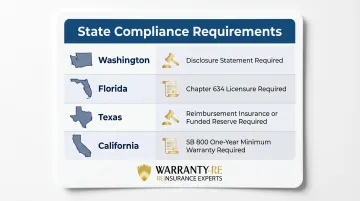
| State | Key Requirement |
|---|---|
| Washington | Contractors must provide disclosure statements covering registration, bond, retainage, and lien rights before work begins |
| Florida | Home Warranty and Service Warranty Associations regulated under Chapter 634, requiring licensure and financial assurances |
| Texas | Service Contract Providers must carry reimbursement insurance, a funded reserve (40% of gross + $250,000 deposit), or $100M net worth |
| California | SB 800 mandates at least a one-year express limited warranty for fit and finish on residential construction |
Consult with an attorney familiar with your state's requirements before launching your program. The NCOIL presentation on service contracts provides a useful regulatory landscape overview.
How to Set Up a Labor Warranty Program – Step by Step
Step 1 – Define What Your Warranty Will Cover
Start by making specific scope decisions before anything is written or priced. Ambiguity at this stage is the root cause of most warranty disputes.
Services and installations included:
- Which work qualifies? (HVAC installs only, or all service calls?)
- What equipment types are covered?
- Are there minimum job size thresholds?
Failure types that qualify:
- Installation defects: Yes
- Equipment failure: Only if installation-related
- Improper use by customer: No
Response commitments:
- Geographic service area limits
- Response time commitments
- After-hours or emergency callback terms
Explicit Exclusions to Document:
- Pre-existing conditions discovered during work
- Customer-modified equipment or DIY repairs
- Failure to maintain system per manufacturer guidelines
- Storm damage, flooding, or acts of God
- Work performed by other contractors after your install
- Consumable items (filters, batteries, etc.)
Step 2 – Choose How Your Program Will Be Funded
Self-Funded Programs
You absorb all callback labor costs directly from operating cash.
Pros: Simple, no third-party fees
Cons: Unpredictable cash flow exposure, no profit capture from well-performing work
Third-Party Provider Programs
You pay a per-install fee to an extended warranty company (like Trinity Warranty or JB Warranties) that reimburses your labor when claims arise.
Pros: Transfers risk, predictable per-job cost
Cons: Transfers premium income and underwriting profit to the warranty company
Trinity Warranty offers labor reimbursement tiers at $75, $100, or $125 per hour with terms from 1 to 10 years. JB Warranties provides Parts Only, Labor Only, and Parts & Labor Plus options for HVAC, plumbing, and other trades.
Reinsurance-Backed Programs
You establish your own warranty company that collects premiums from customers and pays claims. The program is backed by an A-rated insurer, and you capture 100% of underwriting profits when claims run lower than premiums collected.
Pros: You own the program, control claims, keep profits, tax-advantaged structure
Cons: Requires setup, compliance management, and administrative support
Who Benefits from Each Model:
- Low-volume contractors (<$1M annual installs): Third-party providers offer simplicity
- High-volume contractors ($1M+ annual installs): Reinsurance models generate more revenue by keeping profits in-house
Companies like WarrantyRE help contractors structure and manage reinsurance-backed warranty companies, replacing third-party providers while maintaining compliance.
Step 3 – Write the Warranty Policy Document
Your written labor warranty policy must include:
Required Elements:
- Contractor contact information and business details
- Installation date and job description
- Warranty term: start date, end date, and coverage period
- Covered services and equipment listed specifically
- Explicit exclusions (reference your Step 1 list)
- Service fee (if any) for callback visits
- Claims filing process: how customers request service
- Voiding conditions: what actions cancel coverage
Legal Protection:
A clear signed document protects you as much as the customer. Vague verbal warranties invite scope disputes, bad-faith claims, and costly resolutions.
Have your policy reviewed by an attorney before rolling it out. Some states require specific service contract language — your attorney can confirm what applies in your market.
Step 4 – Price the Warranty Into Your Services
Never offer labor warranties as a free add-on that erodes your margin. Calculate the cost of coverage and build it into your install price or offer it as an explicit upsell.
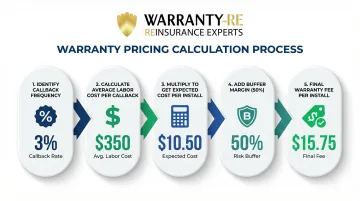
Warranty Cost Calculation:
- Average callback frequency (e.g., 3% of installs)
- Average labor cost per callback (e.g., $350)
- Expected cost per install = 0.03 × $350 = $10.50
- Add buffer for high-claim periods (e.g., 50% margin)
- Warranty fee per install = $10.50 × 1.5 = $15.75
Two Pricing Approaches:
Bundled Pricing:
Warranty included in the install price, presented as a value-add. Customer sees "Includes 2-year labor warranty" as a benefit, not a line item.
Tiered Pricing:
- Basic install with 1-year warranty: $8,500
- Premium install with 5-year warranty: $9,200
Tiered pricing increases average ticket size by making the warranty feel like a customer choice rather than a mandatory fee. It also shifts premium equipment mix higher when warranty options are presented alongside efficiency and payment plan options.
Step 5 – Set Up Your Claims and Callback Process
A documented callback workflow keeps your team consistent and protects you from paying claims that don't qualify. Define it before your first warranty call comes in.
Customer-Facing Process:
- How do customers request warranty service? (Phone, online form, customer portal)
- What information must they provide? (Install date, symptoms, equipment details)
- What is your response time commitment? (Same day, 24 hours, 48 hours)
Internal Adjudication Process:
Create a written checklist to determine if a claim is covered:
- Was the failure related to the original installation?
- Is the equipment in the same condition as when you left the job?
- Is the claim within the warranty period?
- Do any exclusions apply? (Customer modification, lack of maintenance, storm damage)
- Has another contractor worked on the system since your install?
Why This Matters:
A written adjudication checklist prevents technicians from making inconsistent decisions in the field. It protects you from paying non-covered claims and protects customers from being charged for legitimately covered work.
Step 6 – Train Your Team and Track Performance
Your warranty program is only as strong as the people executing it. Train both office staff and field technicians before the program goes live.
Office Staff Training:
- How to explain the warranty at point of sale
- How to register warranties and log customer information
- How to handle inbound warranty claims and route them properly
Field Technician Training:
- How to identify covered vs. non-covered failures using the adjudication checklist
- How to complete callback paperwork and document findings
- How to communicate warranty decisions to customers professionally
Key Metrics to Track:
| Metric | What It Tells You |
|---|---|
| Claims rate per install category | Which services generate the most callbacks |
| Average cost per claim | Whether your pricing buffer is adequate |
| Total warranty revenue vs. total claims paid | Whether the program is profitable |
| Customer satisfaction scores on warranty calls | Whether warranty service builds loyalty |
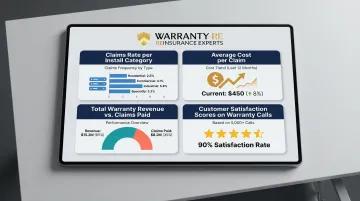
Review these numbers quarterly. A rising claims rate in a specific install category is often a training issue — not a warranty pricing problem.
Conclusion
Setting up a labor warranty program isn't just about protecting customers—it's about building a system that is funded, documented, and manageable enough to survive the unpredictable volume of callbacks that comes with scale.
The most important shift is treating warranty service as a deliberate part of the business model: priced into jobs, documented in writing, and funded before claims arrive. Contractors who build that infrastructure typically find the program covers its own costs — and returns more than it spends.
For contractors ready to stop paying third-party providers and own their program outright, WarrantyRE helps set up the reinsurance structure, handle claims administration, and manage ongoing compliance — so the program runs as a real business unit, not an afterthought.
Frequently Asked Questions
How does a labor warranty work?
A labor warranty is a contractor's commitment to return and perform repairs at no additional labor cost to the customer within a set period after installation. It covers workmanship defects but not manufacturer parts failures or customer-caused damage.
What is usually not covered under a labor warranty?
Common exclusions include damage caused by the customer or third parties, equipment failures unrelated to installation quality, improperly maintained systems, pre-existing conditions, and work performed by another contractor after the original install.
How do I create a warranty policy for my contracting business?
A warranty policy should be a written document specifying covered services, term length, exclusions, claims process, and any service fees. It should be signed by the customer at installation for legal clarity and reviewed by an attorney before use.
What is the difference between a labor warranty and a parts warranty?
A parts warranty (provided by the manufacturer) covers replacement components, while a labor warranty covers the technician's time and travel to diagnose and perform repairs. Most manufacturers do not include labor in their standard warranty coverage.
How much does it cost a contractor to offer a labor warranty program?
Cost varies by funding model: third-party providers charge a per-install fee based on trade and term length, self-funded programs carry your historical callback costs, and reinsurance-backed programs are customer-funded. Regardless of structure, all costs should be priced into the install — not absorbed as overhead.
Can contractors actually profit from offering labor warranties?
Yes. Contractors who own reinsurance-backed warranty companies capture the underwriting profits that third-party providers otherwise keep. When claims run below premiums collected, the difference flows back to the contractor's program — not to an outside provider.