Introduction
HVAC technicians, plumbers, electricians, and roofers are experts at their trade—but the back-office side of running a business often tells a different story. Missed invoices, poor job costing, and murky cash flow steadily eat into what should be profitable operations. 82% of small businesses fail due to cash flow problems, and that risk multiplies when contractors rely on spreadsheets or generic tools that can't track income and costs by job.
Choosing the right accounting software is one of the highest-leverage decisions a home service contractor can make. The right platform gives you real-time job costing, faster invoicing, and a clear picture of which jobs are actually profitable. This guide breaks down the top options built for contractors—covering features, pricing, and what to look for before you buy.
TL;DR
- Home service contractors need accounting software that handles invoicing, job costing, expense tracking, and payroll
- QuickBooks Online is the most versatile and widely supported option; FreshBooks and Zoho Books suit smaller operations on tighter budgets
- Knowify and Jobber are purpose-built for trade contractors, covering dispatch, service agreements, and mobile time tracking
- Prioritize ease of use in the field, invoicing speed, bank reconciliation, and integration with scheduling or CRM tools
- Accounting software tracks your money; capturing revenue from service warranties and recurring agreements is what grows profit
Why Home Service Contractors Need Purpose-Built Accounting Software
Home service contractor accounting differs fundamentally from general business bookkeeping. Contractors must track income and costs by individual job, manage technician labor hours across multiple sites, and navigate irregular cash flow tied to seasonal demand—think HVAC peaks in summer and winter, or roofing surges after storm seasons.
Generic tools break down fast. 71% of small business owners still use pen and paper or spreadsheets to manage some financial processes—and when contractors add crews, service agreements, and multiple job sites, those manual systems create blind spots that kill profitability.
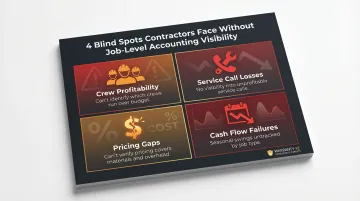
Without job-level visibility, the gaps compound quickly:
- Can't identify which crews generate profit vs. which consistently run over budget
- No visibility into which service calls lose money after labor and drive time
- No way to verify whether pricing actually covers materials, overhead, and callbacks
- Cash flow projections fail when seasonal swings aren't tracked by job type
The five platforms below were selected for home service contractors—from solo operators to small growing teams—based on features that match how trade businesses actually run in the field.
Best Accounting Software for Home Service Contractors
These five platforms were selected based on:
- Ease of use for non-accountants
- Features relevant to trade and field service businesses
- Transparent, predictable pricing
- Mobile accessibility for field use
QuickBooks Online
QuickBooks Online is the most widely adopted small business accounting platform in the U.S., used across HVAC, plumbing, electrical, and roofing businesses of all sizes. Its massive ecosystem of bookkeepers and accountants familiar with the platform means you can find local support easily.
Where it earns its reputation: bank feeds and reconciliation are seamless, invoicing includes payment links, and payroll is available as an add-on. It also connects with field service tools like Knowify and Jobber for job costing and dispatching. Native job costing for trades isn't built in, but those integrations fill the gap well.
| Pricing | Starts at $38/month; tiers range from Simple Start to Advanced ($275/month) | | Key Features | Invoicing, expense tracking, bank reconciliation, payroll (add-on), job costing with third-party add-ons | | Best For | Growing home service businesses that want wide accountant support and flexible integrations |
FreshBooks
FreshBooks is a cloud-based accounting platform built for freelancers and small service businesses. It's particularly well-suited for solo contractors or small crews (1–5 employees) who need to send professional invoices quickly and track time against jobs without a steep learning curve.
The invoice creation interface is among the fastest available, and time tracking rolls directly into billing — a genuine time-saver for contractors billing hourly. Client retainer management and a clean mobile app round it out, all at a lower monthly cost than QuickBooks. That said, the base Lite plan caps you at 5 billable clients and one user, and budgeting or forecasting tools are thin — so it's not built for growth beyond a small crew.
| Pricing | Starts at $23/month; Lite, Plus, Premium, and Select tiers | | Key Features | Professional invoicing, built-in time tracking, expense management, online payment collection, basic reporting | | Best For | Solo contractors or micro-crews who need fast invoicing and simple bookkeeping without complexity |
Zoho Books
Zoho Books is one of the few accounting platforms offering a genuinely free tier, making it an attractive starting point for contractors just formalizing their finances. It's part of the broader Zoho suite (which includes CRM, project management, and inventory tools), allowing for affordable scaling as the business grows.
Standout features include a built-in payables calendar for cash flow visibility, automated bank reconciliation, a client portal for invoicing transparency, and 1099 filing support for contractors managing subcontractors. Payroll and time tracking require paid add-ons, but the free plan covers core bookkeeping, invoicing, estimates, and expense tracking — a solid foundation before spending anything.
| Pricing | Free plan available; paid plans start at $20/month | | Key Features | Bookkeeping, invoicing, bank reconciliation, estimates, expense tracking, client portal | | Best For | Budget-conscious contractors wanting a scalable platform with a free starting tier |
Knowify
Knowify is a cloud-based platform built specifically for trade contractors in HVAC, plumbing, electrical, and solar—combining project management, job costing, invoicing, and time tracking in a single purpose-built tool.
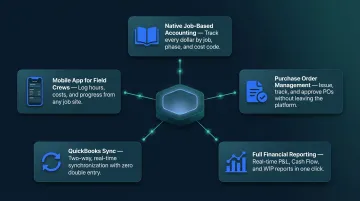
Key capabilities include:
- Native job-based accounting without workarounds
- Purchase order management
- Full financial reporting (P&L, cash flow, WIP)
- QuickBooks sync for contractors working with an accountant
- Mobile app for field crews
It may have limited scalability for very large multi-crew operations, but for small to mid-sized trade contractors, it's a strong all-in-one option.
| Pricing | Core plan starts at $99/month; Advanced plan at $249/month | | Key Features | Job costing, invoicing, time tracking, purchase orders, financial reporting, QuickBooks integration | | Best For | Trade contractors (HVAC, plumbing, electrical) who want an all-in-one purpose-built platform |
Jobber
Jobber is one of the most widely used field service management platforms for home service businesses, with built-in accounting features including invoicing, payment collection, and client management. It's widely used by HVAC, landscaping, cleaning, plumbing, and electrical contractors across North America.
Jobber's real strength is operations: scheduling, dispatch, and client communication — automated follow-ups, online booking, and a branded client hub — with billing integrated into that same workflow. It syncs with QuickBooks Online for full accounting depth. Think of it as the operations layer, not a standalone accounting system — it works best when paired with a dedicated accounting tool.
| Pricing | Plans start at $49/month (monthly); annual billing discounts available | | Key Features | Quoting, scheduling, dispatching, invoicing, payment collection, automated client follow-ups, QuickBooks sync | | Best For | Home service contractors who need strong field operations alongside billing and client management |
What to Look For: Must-Have Features for Home Service Accounting Software
Many home service contractors choose software based on name recognition—often defaulting to QuickBooks without evaluating whether its features actually map to field service workflows. The right tool depends on business size, crew count, and whether the owner or an accountant manages the books. Here's what actually matters when evaluating your options.
Job Costing and Service-Based Billing
Unlike product-based businesses, home service contractors need to track profitability at the individual job level—labor hours, materials, and overhead per visit. Software without native job costing forces manual workarounds that create errors and blind spots. Work-in-progress (WIP) schedules are a window into job profitability, project cash flow, and backlog, making accurate job costing non-negotiable.
Invoicing Speed and Mobile Access
In field service, the ability to generate and send an invoice from a mobile device immediately after job completion directly affects cash collection. Sending invoices within 10 days post-job is the sweet spot for faster payment—waiting more than 20 days can add up to 30 days to the payment cycle. At 28+ days, payments average 86 days. Look for platforms with mobile apps and quick invoice-creation workflows.
Payroll and Subcontractor Management
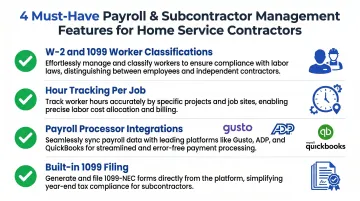
Home service contractors often mix W-2 employees with 1099 subcontractors, creating complexity at tax time. The right software should handle:
- Both W-2 and 1099 worker classifications in a single system
- Hour tracking per job for accurate labor costing
- Payroll processor integrations (Gusto, ADP, QuickBooks Payroll)
- Built-in 1099 filing to reduce compliance risk at year-end
Bank Reconciliation and Cash Flow Visibility
Seasonal businesses (especially HVAC) need real-time visibility into cash position to manage slow periods. 82% of contractors now wait more than 30 days to get paid, and the average collection time is 83 days. Automatic bank feeds and a payables calendar are essential for staying solvent through lean months.
Integrations with Field Service Tools
Accounting software rarely works in isolation—contractors need it to sync with scheduling, dispatch, and CRM tools like Jobber, ServiceTitan, or Housecall Pro. Verify integration compatibility before committing to a platform, or you'll end up re-entering data across systems.
How We Chose the Best Accounting Software for Home Service Contractors
We selected these platforms by evaluating them against the specific financial challenges of home service contractors — not general construction or commercial builders. Selection criteria drew from current pricing structures, mobile usability, and third-party review data from G2, Capterra, and Forbes Advisor.
Key differentiators that elevated some tools over others:
- Purpose-built field service functionality
- Transparent pricing (no hidden fees)
- Short learning curves appropriate for owner-operators
- Ability to integrate with commonly used scheduling and CRM tools in the trades industry
Enterprise-level ERP systems — Sage Intacct, Acumatica, NetSuite — were intentionally excluded. These platforms are built for large commercial contractors and carry complexity and cost that exceed what most home service businesses need.
Third-party validation: Ratings below reflect verified user reviews at time of writing.
| Tool | Capterra | G2 |
|---|---|---|
| QuickBooks Online | 4.3/5 (8,408 reviews) | 4.4/5 |
| FreshBooks | 4.5/5 | 4.5/5 |
| Zoho Books | 4.4/5 | 4.4/5 |
| Knowify | 4.5/5 | 4.5/5 |
| Jobber | 4.6/5 (1,420 reviews) | 4.6/5 |
Conclusion
The best accounting software for a home service contractor is the one that matches how your business actually operates. A solo electrician has different needs than a 10-technician HVAC company, and the right choice is determined by business size, team structure, and the need for field integration, not just brand familiarity.
Take advantage of free trials before committing, involve your bookkeeper or accountant in the evaluation, and prioritize tools that reduce time spent on admin so you can focus on generating revenue in the field.
Good accounting software tracks the money you're already making. But many contractors leave a separate profit stream untouched: the underwriting profits paid to third-party warranty providers on every service agreement they sell.
HVAC, plumbing, roofing, and electrical contractors who replace third-party warranty providers with their own reinsurance company turn those service agreements into a recurring profit center. WarrantyRE helps contractors capture 100% of warranty underwriting profits through a tax-advantaged reinsurance structure, handling all claims administration, compliance, and tax filings while your crews stay focused on billable work.
Learn more about recapturing warranty profits or call (804) 824-9533.
Frequently Asked Questions
What is the best software for contractors?
The best software depends on business size and trade type. QuickBooks Online is the most versatile for most contractors, while purpose-built tools like Knowify or Jobber offer stronger field service functionality for trade contractors specifically.
What is the best bookkeeping for independent contractors?
Solo or independent contractors typically do best with lightweight, affordable platforms like FreshBooks or Zoho Books. These tools cover invoicing, expense tracking, and basic reporting without the complexity of enterprise software.
What are the top 3 accounting softwares?
QuickBooks Online, FreshBooks, and Zoho Books are the most widely used general accounting platforms for small businesses and contractors. Trade-specific tools like Knowify are also worth considering for home service businesses that need built-in job costing.
Do HVAC or plumbing contractors need specialized accounting software?
General accounting tools can work, but contractors in HVAC, plumbing, and electrical benefit from platforms with job costing, service billing, and mobile time tracking built in. These features reduce manual workarounds and give clearer visibility into job-level profitability.
Can I use Jobber as my only accounting software?
Jobber is primarily a field service management platform—it handles invoicing and payments effectively, but for full accounting (tax preparation, payroll, financial statements), most contractors pair Jobber with QuickBooks Online through its native sync.