

Introduction
Plumbing business owners face a frustrating reality: You're out in the field every day, managing crews, handling emergency calls, and closing jobs—only to watch a massive chunk of your hard-earned profit vanish when tax season arrives. The IRS estimates the gross tax gap at $540 billion annually, and self-employed contractors account for a disproportionate share — largely through missed deductions and poorly structured businesses.
Most plumbing contractors overpay taxes not because they earned too much, but because they've never moved beyond basic write-offs.
This post covers three layers of tax planning: foundational entity structure decisions that reduce self-employment tax, trade-specific deductions most owners miss, and a lesser-known strategy — owning your own reinsurance company — that changes how warranty revenue is taxed and kept inside your business.
These strategies range from straightforward to sophisticated, so professional guidance matters.
Disclaimer: This content is for informational purposes only and does not constitute tax, legal, or financial advice. Consult a qualified CPA, tax advisor, or attorney for guidance specific to your business situation.
TLDR
- S-Corp election cuts self-employment tax by treating distributions separately from salary—most beneficial above $50,000–$80,000 net profit
- Most plumbing contractors leave thousands on the table each year by overlooking vehicle, equipment, home office, and training deductions
- Reinsurance lets you own the warranty company instead of paying third parties—capturing underwriting profits in a tax-advantaged structure
- Entity structure, equipment purchases, and warranty programs must be set up proactively—tax season is too late to act
Foundational Tax Strategies Every Plumbing Business Owner Should Know
Entity Structure and Self-Employment Tax
Your business entity determines how income is taxed. The structure that made sense when you started may cost you thousands now.
Four main entity types:
| Entity | Self-Employment Tax Treatment | Key Characteristic |
|---|---|---|
| Sole Proprietor | 15.3% on all net earnings | Simplest structure; all profit subject to SE tax |
| Single-Member LLC | Same as sole proprietor | No separate federal tax treatment |
| Partnership / Multi-Member LLC | Partners pay SE tax on their share | Each partner liable for SE tax |
| S-Corporation | SE tax only on salary; distributions exempt | Requires reasonable salary; remaining profit avoids SE tax |
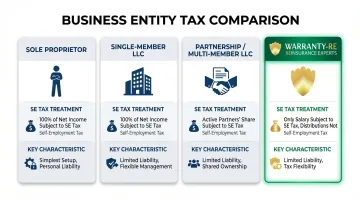
Self-employment tax breaks down as:
- 12.4% Social Security (capped at the annual wage base)
- 2.9% Medicare (no cap)
- 0.9% additional Medicare tax above $200,000 (single) or $250,000 (married filing jointly)
- Applies to 92.35% of net earnings — totaling 15.3% on most income
The S-Corp Election Sweet Spot
S-Corp election specifically reduces self-employment tax by splitting income into two categories: reasonable salary (subject to SE tax) and distributions (not subject to SE tax).
When does S-Corp make sense?
Most CPAs recommend considering S-Corp election at $50,000-$80,000 in net profit, with significant savings above $100,000. However, annual compliance costs run $3,000-$8,000+ for payroll processing, quarterly filings, and additional tax preparation—so net profit must justify these expenses.
Example: A plumber earning $120,000 net profit takes a $60,000 reasonable salary and $60,000 in distributions. The $60,000 in distributions avoids the 15.3% SE tax, saving approximately $9,180 annually.
Key S-Corp requirements:
- Must be a domestic corporation
- Maximum 100 shareholders (individuals, certain trusts, or estates only)
- Only one class of stock
- File Form 2553 by March 15 for calendar-year filers
S-Corp status also pairs well with the Section 199A qualified business income (QBI) deduction. Pass-through entities can deduct up to 20% of qualified business income — and with the deduction now made permanent, you can factor it into long-term planning rather than treating it as a year-to-year uncertainty.
Quarterly Estimated Taxes
Once you're self-employed, W-2 withholding disappears. You must pay quarterly estimated taxes covering both income tax and SE tax.
Payment schedule (calendar year):
| Quarter | Income Earned | Due Date |
|---|---|---|
| Q1 | Jan 1 - Mar 31 | April 15 |
| Q2 | Apr 1 - May 31 | June 15 |
| Q3 | Jun 1 - Aug 31 | September 15 |
| Q4 | Sep 1 - Dec 31 | January 15 (following year) |
Safe harbor rule: Avoid penalties by paying the lesser of:
- 90% of current year tax, OR
- 100% of prior year tax (prior year must cover 12 months)
Even if you're owed a refund at filing, underpayment penalties apply if you paid too little in any quarter.
The "Tax Savings Account" Habit
Quarterly due dates hit hard if you haven't been setting money aside. The simplest fix: treat taxes like any other operating expense and reserve 25-35% of every customer payment into a dedicated account before it touches your operating funds.
This prevents cash-flow shocks when quarterly payments arrive, and keeps payroll and vendor obligations protected throughout the year.
Year-Round Planning
Building a savings habit is only one piece. The plumbing businesses that consistently pay the least in taxes treat planning as a year-round discipline, not a December scramble. That means:
- Timing major equipment purchases to maximize Section 179 deductions
- Reviewing quarterly estimates after each payment to catch gaps early
- Planning year-end bonuses with payroll tax implications in mind
- Revisiting your entity structure annually as revenue grows
Tax Deductions Plumbing Contractors Frequently Miss
Vehicle Deductions
Work trucks are one of the largest deductible expenses—yet many contractors miss them entirely or choose the wrong calculation method.
Two methods:
Standard mileage rate:
- 72.5 cents per mile for 2026 (up from 70 cents in 2025)
- Simple tracking: multiply business miles by the rate
- Cannot be used if you've claimed MACRS, Section 179, or bonus depreciation previously on the vehicle
Actual expense method:
- Deduct gas, oil, repairs, tires, insurance, registration, and depreciation attributable to business use
- Often yields higher deductions for plumbers carrying heavy equipment with high maintenance costs
- Parking fees and tolls are separately deductible under either method
For plumbing contractors driving frequently and carrying jetters, cameras, and tools with significant repair costs, the actual expense method typically delivers larger deductions.
Method election rules to know:
- Owned vehicles: standard mileage must be elected in the first year the vehicle is placed in service; you can switch to actual expenses in later years
- Leased vehicles: standard mileage must be used for the entire lease period — no switching
Section 179 and Bonus Depreciation
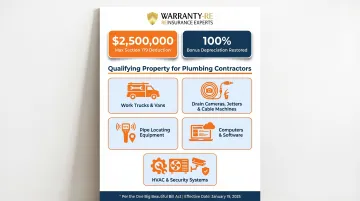
Section 179 lets plumbers deduct the full purchase price of qualifying equipment in the year of purchase rather than depreciating over time.
2025 limits:
- $2,500,000 maximum deduction
- Phase-out begins at $4,000,000 in total qualifying purchases
Qualifying property includes:
- Work trucks and vans used for business
- Drain cameras, jetters, cable machines
- Pipe locating equipment
- Computers and software
- HVAC systems, fire alarms, security systems (for nonresidential property improvements)
Bonus depreciation restored: The One Big Beautiful Bill Act restored 100% bonus depreciation for property acquired after January 19, 2025 (previously phasing down to 40% under TCJA). This means plumbing contractors purchasing equipment after mid-January 2025 can expense the full cost immediately.
Commonly Overlooked Deductions
- Home office: Field-based plumbers managing scheduling, invoicing, and admin from home can deduct rent/mortgage, utilities, and insurance proportional to the square footage used exclusively for business.
- Uniforms and safety gear: Work boots, branded shirts, protective eyewear, and gloves are fully deductible — as long as they can't double as everyday clothing.
- Continuing education and licenses: License renewals, backflow certification, code update training, and trade association memberships are 100% deductible.
- Business meals: Meals with clients, subcontractors, or suppliers are deductible at 50% of the unreimbursed cost. Required records include:
- Amount, date, and location
- Business purpose of the meal
- Names and roles of all attendees
- Itemized receipts for any expense $75 or more
What Is Reinsurance and How It Fits Into Tax Planning
Reinsurance in Plain Language
Rather than paying third-party warranty companies and losing those premiums forever, a plumbing contractor can establish their own administrator-obligor reinsurance company that receives warranty premiums and holds them in a structure the contractor owns and controls.
Here's how it works: When you complete a water heater replacement, repipe, or fixture install, you include a warranty fee in the job estimate. Instead of that fee going to an external warranty provider, it flows into your reinsurance entity—a separate company you own 100%.
The Core Tax Principle
The IRS treats premiums paid into a properly structured reinsurance entity differently than ordinary business income. This structure potentially allows for:
- Tax deferral on warranty revenue
- Investment of reserves with returns accumulating inside the reinsurance structure rather than being immediately taxed
- Return of underwriting profit when claims are lower than premiums collected
The IRS recognizes small captive/reinsurance structures under Section 831(b) of the Internal Revenue Code. Qualifying companies with annual premiums at or below $2.85 million (for tax year 2025) may elect to be taxed only on investment income, excluding underwriting income entirely.
Proper legal setup and ongoing compliance are required. This is not a loophole—it's a legitimate business structure used by automotive dealers, home builders, and healthcare groups alike.
Reinsurance and Your Warranty Obligations
Instead of outsourcing warranty risk to a third party at full premium cost, your plumbing business's own reinsurance entity assumes that risk. You:
- Keep unclaimed premium reserves
- Build equity over time
- Control the claims experience
- Maintain ownership of underwriting profits
That ownership distinction matters when it comes to how contractors misread what reinsurance actually is.
Common Misconception Addressed
Reinsurance is not a tax shelter. It is an IRS-recognized business structure used by industries from automotive to home services. Tax benefits arise from the fundamental economics of owning an insurance entity rather than paying premiums to someone else's company.
How Owning a Reinsurance Company Reduces Your Tax Burden
The Financial Shift
When you sell a service agreement or warranty to a plumbing customer, that premium flows into your reinsurance entity instead of a third party. This changes both cash flow and the tax treatment of that income stream.
Before reinsurance:
Warranty fee → Third-party provider → Gone forever
With reinsurance:
Warranty fee → Your reinsurance company → Retained as reserves, invested, and returned as profit if claims are low

The Investment Component
Reinsurance reserves can be invested, generating additional ROI. Those investment returns accumulate within the reinsurance structure rather than being immediately taxed as ordinary income on your personal return.
Investment strategy typically follows two phases:
- Early reserves: Held in conservative instruments like government bonds, prioritizing capital preservation
- Excess funds: Once reserves exceed 125% of unearned premiums, the surplus can be deployed more aggressively based on your risk tolerance
All investment income belongs directly to the reinsurance company you own.
Tax Planning for Your Personal Financial Picture
A properly structured reinsurance company reduces the amount of income exposed to high marginal tax rates and self-employment tax in your operating business. Warranty revenue routed through the reinsurance entity is taxed under the company's structure rather than flowing directly onto your personal return — which means less exposure to self-employment tax and top marginal rates on that income stream.
For many plumbing contractors, this shift is one of the most impactful components of their personal tax plan. It doesn't eliminate taxes — it defers and restructures how and when income is recognized.
WarrantyRE: A Resource for Plumbing Contractors
Getting the tax structure right requires proper setup from the start. WarrantyRE (operating alongside DealerRE) has over 30 years of experience helping home service contractors — including plumbing businesses — establish and manage their own administrator-obligor reinsurance companies.
Services include:
- Reinsurance company setup and legal formation
- Full claims administration (zero paperwork on your end)
- Compliance management and regulatory filings
- Tax return preparation and coordination
- Monthly financial reporting and performance analysis
- Bookkeeping and reserve management
Who Should Consider Reinsurance?
This strategy works best for plumbing businesses that:
- Already offer service agreements or labor warranties consistently
- Plan to build warranty products into their service offering
- Generate sufficient warranty volume to justify setup and compliance costs
- Want to capture underwriting profits rather than paying third parties
Important: Setup requires proper legal formation, compliance with applicable insurance regulations, and coordination with a qualified tax professional.
Building a Long-Term Tax-Efficient Plumbing Business
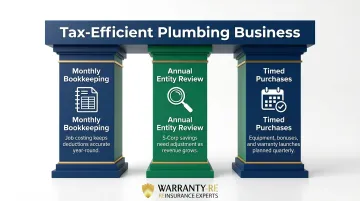
Three Pillars of a Tax-Efficient System
The most tax-efficient plumbing businesses treat taxes as a system built into the business—not a year-end scramble.
Pillar 1: Monthly bookkeeping tied to job costing keeps deduction tracking accurate and supports better decisions year-round — not just at tax time.
Pillar 2: Your entity structure needs annual review as revenue grows. The S-Corp that saves you $10,000 at $100,000 in profit may need adjustment at $500,000.
Pillar 3: Equipment purchases, payroll bonuses, and warranty program launches all affect taxable income. Time these moves quarterly, not in December.
Professional Support
Professionals who know the trades handle bookkeeping, payroll, and tax filing more effectively than generalists — fewer errors, fewer missed deductions.
Key professionals for plumbing contractors:
| Professional | Role | Relevant Credentials |
|---|---|---|
| CPA (Certified Public Accountant) | Tax planning, entity structure, compliance | CPA, MST, M.Acc. |
| Tax Attorney | Legal structure, IRS defense, complex planning | J.D., LL.M. (Taxation) |
| Enrolled Agent (EA) | IRS representation, tax preparation | EA (IRS Special Enrollment Exam) |
| Reinsurance Specialist | Captive formation, claims admin, actuarial analysis | Industry-specific experience |
For reinsurance specifically, work with advisers experienced in insurance tax law—the regulatory landscape has intensified following IRS final regulations issued January 2025 (T.D. 10029).
Warranty Products as Tax Strategy
Adding a labor warranty or service agreement product line to your plumbing business is more than a revenue strategy. When paired with a reinsurance structure, it becomes a tax strategy, converting single-transaction revenue into recurring, strategically structured income.
Instead of absorbing callback costs or paying third-party providers, a reinsurance structure lets you capture those premiums yourself. Specific advantages include:
- Deductible reserve contributions funded by customer warranty payments
- Underwriting profits retained in your own captive company rather than paid to a third party
- Reduced taxable income through properly structured claims reserves
- Investment income on reserves held between premium collection and claims payment
Frequently Asked Questions
What is the best business structure for a plumbing business?
The most common options are LLC (taxed as sole proprietor or partnership) and S-Corp. The right choice depends on your annual net profit—S-Corp typically makes sense above $50,000-$80,000 net profit due to self-employment tax savings. Consult a CPA to evaluate the tax impact of each structure based on your specific numbers.
How do I make my plumbing business more profitable?
Focus on tax reduction (keeping more of what you earn), adding high-margin service agreements, and using reinsurance structures to turn warranty premiums into business equity rather than third-party expenses. Capturing underwriting profits and reducing tax liability directly increases net profitability without acquiring more customers.
What business expenses are 100% tax-deductible?
Fully deductible plumbing business expenses include tools and equipment, work-required uniforms, business insurance premiums, professional licenses and continuing education, and technology/software. Documentation (receipts, invoices, mileage logs) is required for all deductions to be valid under IRS audit.
Can you write off plumbing work on taxes?
A plumbing business owner can deduct the costs of running the business: labor, parts, equipment, vehicles, and overhead. A homeowner may be able to deduct plumbing expenses related to a home office or rental property. Each situation depends on the specific tax context and IRS rules for business vs. personal deductions.
Can plumbing business owners use reinsurance for tax planning?
Yes. Plumbing contractors can establish their own administrator-obligor reinsurance company to receive warranty premiums, build reserves, and invest those funds in a tax-advantaged structure. Proper legal setup and ongoing compliance are required, so involve a qualified tax advisor from the start.