
Introduction
Most HVAC business owners already know about Section 179 deductions, S-corp elections, and retirement contributions. These are valuable, legitimate strategies—but they represent only part of the tax planning equation. A lesser-known strategy can unlock significant additional savings: owning your own warranty reinsurance company.
The core problem is straightforward: HVAC owners pay premiums to third-party warranty providers every year, and none of that money comes back. According to NFIB's 2024 Tax Survey, nearly half of small businesses operate as S-corporations, yet many still miss opportunities to optimize tax outcomes.
Reinsurance changes this equation by converting a recurring cost into a tax-advantaged profit center.
What follows breaks down how HVAC owners can use reinsurance to capture underwriting profits, reduce taxable income, and build a financial structure that works alongside the strategies already in place.
TLDR
- Owning your reinsurance company captures premium deductibility, reserve accumulation, and underwriting profit that third-party providers would otherwise keep
- HVAC owners who establish a reinsurance company shift taxable income into a separate entity where it grows in a more tax-advantaged structure
- Reinsurance works alongside other strategies — S-corps, Section 179, retirement contributions — rather than replacing them
- The reinsurance company is backed by an A-rated insurer and structured under IRS Code 831(b), making this a compliant, professionally administered structure
- Getting started means setting up a separate legal entity — a reinsurance specialist handles compliance, filings, and claims administration for you
Why Standard HVAC Tax Strategies Leave Money on the Table
Common strategies like Section 179 deductions, S-corp elections, retirement plans, and the QBI deduction are legitimate and valuable. Forbes reports that 93% of small businesses overpay taxes, often due to missed planning opportunities. HVAC contractors face a specific gap that these strategies don't address.
The Third-Party Warranty Problem
That gap centers on how most HVAC contractors handle warranty costs. Once you pay a third-party provider and take the deduction, that capital is gone — with no compounding benefit to your business. Your premiums flow directly to the warranty company, where they fund:
- Claims reserves held and invested by the provider
- Administrative overhead and operational costs
- Underwriting profit margins paid to their shareholders
If third-party warranty providers weren't profitable, they'd stop offering coverage. That profit comes from your premiums. With a reinsurance structure, those underwriting profits stay inside your own company instead.
How Reinsurance Works as a Tax Strategy for HVAC Contractors
An administrator obligor reinsurance company is an entity you own that replaces the role of the third-party warranty provider. This is a legitimate, IRS-recognized business structure backed by A-rated insurers — not a tax shelter. The structure operates under Internal Revenue Code Section 831(b), which governs taxation of property and casualty insurance companies.
How the Premium Flow Works
When a customer pays for a service agreement or warranty, that money no longer disappears to a third-party provider. Instead:
- Your HVAC business charges customers for service agreements or warranties
- You collect those premiums and build them into your job pricing
- Premiums route into your owner-controlled reinsurance company instead of paying a third party
- The premium payments remain a deductible business cost
From there, the money stays inside your corporate structure — and starts working for you in three distinct ways.
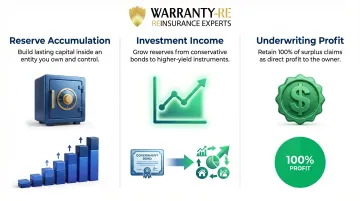
Three Financial Layers Inside Your Reinsurance Company
| Layer | What Happens | Benefit to You |
|---|---|---|
| Reserve accumulation | Claim funds sit in a trust account under your structure, not with an external provider | Capital builds inside your entity over time |
| Investment income | Reserves invest in conservative instruments — initially government bonds — then more aggressively once cash exceeds 125% of unearned premiums | All investment returns belong to your reinsurance company, creating a second layer of return |
| Underwriting profit | When claims paid are less than premiums collected — typical for well-run programs — the difference stays as profit in your company | You capture 100% of underwriting profits instead of sending them to a third party |
The Key Tax Benefits of Owning Your Own HVAC Reinsurance Company
Owning your own reinsurance company doesn't just shift where money goes — it changes what that money does. Each of the five benefits below builds on this premise.
Premium Deductibility with Retained Upside
Your HVAC business still deducts the premium expense. But instead of that money leaving permanently, it accumulates in an entity you control. The funds stay within your structure, building reserves and generating investment returns — rather than padding a third-party carrier's bottom line.
Tax Benefit 2: Deferred Tax on Reserve Accumulation
Funds held in reserve within the reinsurance entity are not immediately treated as personal income. Under IRC § 831(b), qualifying small nonlife insurance companies with less than $2,900,000 in annual net premiums can elect to be taxed only on investment income—not on underwriting income. Reserves sit in a corporate structure, allowing deferral of when and how that income is recognized and taxed.
Tax Benefit 3: Investment Income Inside a Favorable Structure
Reserve funds invested in permitted instruments generate returns taxed at the corporate level — not as personal income. Premiums are taxed on a premiums-earned basis under IRC § 832(b)(4), with adjustments for unearned premium reserves. That distinction matters: the same dollar earned inside an 831(b) entity carries a lighter tax burden than if it flowed directly to you.
Tax Benefit 4: Underwriting Profit Treated as Business Income, Not Self-Employment Income
When your reinsurance company generates underwriting profit, that profit flows through the corporate entity — not directly through your HVAC business. That distinction can eliminate the self-employment tax that would otherwise apply. The current self-employment tax rate is 15.3% (12.4% Social Security + 2.9% Medicare) — a meaningful reduction on profits that are now sitting inside a properly structured reinsurance company.
Tax Benefit 5: Reduced Dependency on Third-Party Costs That Inflate Taxable Revenue
By replacing a recurring third-party cost with a self-funded program, you need less gross revenue to generate the same net profit. This lowers the income threshold at which higher tax brackets become relevant. For 2025, the 32% tax bracket begins at $197,300 for single filers and $394,600 for married filing jointly.
How to Stack Reinsurance with Other HVAC Tax Strategies
S-Corp Structure + Reinsurance
The HVAC operating company (taxed as S-corp) reduces self-employment taxes through the salary/distribution split, while the reinsurance company captures and holds reserves. These are two distinct entities with different income treatment — and that separation is exactly what makes the combination effective.
Section 179 in the Same Tax Year
Equipment purchases reduce taxable income through Section 179 deductions, while reinsurance premiums shift additional income into the reserve structure. Because they operate in different entities and address different income streams, these strategies compound rather than offset each other.
Retirement Contributions on Top
Retirement contributions — SEP IRA, Solo 401(k) — layer on top of both strategies without displacing either. The 2025 IRA contribution limit is $7,000, or $8,000 if age 50 or older.
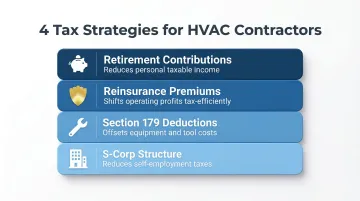
Together, these three tools cover your business income, equipment investments, and personal retirement savings — each working in a different part of your financial picture:
- S-corp structure reduces self-employment taxes on business distributions
- Section 179 offsets taxable income from equipment purchases
- Reinsurance premiums shift operating profits into a controlled reserve
- Retirement contributions reduce personal taxable income at the owner level
How HVAC Contractors Set Up a Reinsurance Company
Basic setup steps:
- Work with a reinsurance specialist to form a new legal entity (the administrator obligor reinsurance company)
- Establish the program structure with A-rated insurer backing
- Train staff on warranty sales and administration
- Begin routing premiums into your reinsurance account
WarrantyRE handles legal forms, filings, tax returns (Form 1120PC), and renewals on behalf of clients. The process moves faster than most owners expect. After a preliminary business analysis to confirm fit, the typical sequence covers entity formation, product analysis, staff training, and program launch.
Compliance requirements:
The reinsurance company must be supported by an A-rated insurer, must administer claims properly, and must maintain proper financial records. Under the NAIC Service Contracts Model Act, service contract providers must satisfy financial security options such as reimbursement insurance, funded reserves, or minimum net worth requirements.
WarrantyRE provides administration covering claims adjudication, compliance management, and financial bookkeeping. Compliance carries real consequences — programs that fail IRS scrutiny often do so because of poor administration, not bad intent. Working with a specialist who has 30+ years in reinsurance makes that risk manageable.
Who this strategy is best suited for:
This structure works best for HVAC contractors who are:
- Already profitable and looking to retain more of what they earn
- Currently selling service agreements or warranties (even through third-party providers)
- Ready to recapture the underwriting profits leaving their business each year
High volume isn't a prerequisite. Smaller operations can qualify and benefit just as much as larger contractors.
Frequently Asked Questions
How can HVAC business owners avoid the 32% tax bracket?
The 32% bracket is triggered when taxable income exceeds specific thresholds ($197,300 single/$394,600 MFJ for 2025). Strategies like S-corp distributions, maximizing retirement contributions, Section 179 deductions, and routing premiums into a reinsurance reserve structure can reduce taxable income enough to stay below that threshold—the right combination depends on your revenue and business structure.
How does the $6,000 tax deduction work for HVAC business owners?
This typically refers to IRA contribution limits. For 2024 and 2025, the combined Traditional and Roth IRA annual limit is $7,000, or $8,000 if age 50 or older. HVAC owners can deduct traditional IRA contributions within income eligibility limits, reducing taxable income while building retirement savings.
What is the $2,500 expense rule for HVAC business owners?
The IRS de minimis safe harbor rule allows businesses to immediately deduct tangible property purchases under $2,500 per item without capitalizing and depreciating them. This is especially useful for HVAC owners who regularly purchase tools, parts, and small equipment—enabling immediate write-offs rather than multi-year depreciation schedules.
What is the IRS $75 rule and how does it affect HVAC business owners?
The IRS generally requires written documentation for meals and travel expense deductions over $75. HVAC owners should maintain receipts and written records for expenses above this threshold to withstand an audit. Lodging always requires a receipt regardless of amount.
What is the 'LLC loophole' for HVAC business owners?
The so-called "LLC loophole" typically refers to electing S-corp taxation through an LLC structure, allowing HVAC owners to split income between a W-2 salary and distributions—reducing self-employment taxes on the distribution portion. This is a legitimate tax election, not a loophole, and works best when properly documented with a reasonable salary.
Ready to explore how reinsurance can work for your HVAC business? WarrantyRE has been helping home service contractors establish and manage reinsurance companies since 1994. Call (804) 824-9533 or visit warranty-re.com to schedule an owner analysis and determine if this strategy fits your business.