
The gap isn't the program. It's the marketing.
This article gives contractors and dealers a practical roadmap for communicating their warranty program in ways that build trust, improve close rates, and turn one-time customers into repeat clients — without requiring a big budget or a dedicated marketing team.
TLDR:
- Most warranty programs fail to hit their revenue potential because the team can't explain the offer clearly
- A contractor-owned program is a stronger promise than a third-party plan — but only if customers understand why
- Point-of-sale conversations and simple visual tools consistently outperform complex presentations
- Staff training is the single biggest lever for improving attachment rates
- Track warranty attachment by job type, then adjust training and messaging based on what the data shows
Why Most Warranty Programs Are Under-Marketed
Setting up a reinsurance-backed warranty program takes real effort — legal formation, compliance, product analysis, pricing. Most of that energy goes into the operational side. Customer-facing communication is an afterthought, if it's addressed at all.
The cost of this gap shows up in attachment rates. In the automotive F&I space, JM&A Group's 2025 benchmark data puts service-contract penetration at 46% across more than 6,000 dealerships. For home service contractors, HVACR Business reports a 25% minimum conversion rate from service calls to service agreements as a baseline target. Most contractor-owned warranty programs don't come close to either benchmark without intentional marketing and a trained sales process.
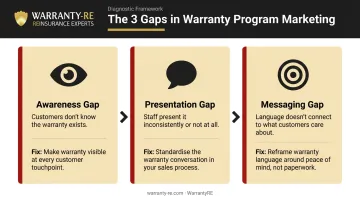
The problem isn't usually the program. It's three interconnected gaps:
- Awareness gap — customers don't know the warranty exists or what it covers
- Presentation gap — sales or service staff present it inconsistently or not at all
- Messaging gap — when staff do present it, the language doesn't connect to what the customer cares about
Marketing a warranty reinsurance program has nothing to do with explaining reinsurance mechanics to homeowners or car buyers. It means communicating the benefits of your contractor-owned warranty in language that moves customers toward yes — and closing that gap starts with the sections below.
Know What Makes Your Program Different Before You Market It
Before any marketing materials get written, contractors need to be clear on what they're actually selling. This sounds obvious. It rarely is.
The Core Differentiator
A contractor-owned, reinsurance-backed warranty means your business stands behind the coverage — not a faceless third-party administrator the customer has never heard of. That's a fundamentally different promise. When something goes wrong, the customer calls you, not a 1-800 number.
The customer-facing benefits that should anchor your messaging:
- Claims handled by people they already trust — the same business that did the installation
- No third-party friction — no adjuster approval chains, no network dispatching, no waiting
- Financial backing from A-rated insurers — the program is backed by established carriers, not just goodwill
- A relationship that continues after the job — the warranty is a reason to stay in contact
Translating the Business Model Into Customer Language
Contractors sometimes get attached to the internal language of their program: terms like "reinsurance," "administrator obligor," or "underwriting profit." None of that belongs in customer conversations. What customers want to know is: if something breaks, what happens and how fast?
The more relevant translation: when you own the warranty, you're financially motivated to handle claims fairly and efficiently. That's a credibility signal customers can grasp.
Common positioning mistakes to avoid:
- Using technical terms like "reinsurance" in customer-facing materials
- Leading with the price of the warranty instead of the risk it eliminates
- Presenting the warranty as a separate product rather than an extension of the relationship
Getting this positioning right before writing a single word of marketing copy is what separates programs that generate referrals from programs that generate confusion. WarrantyRE's business analysis process helps contractors nail that distinction first.
How to Explain Your Warranty Program to Customers
Most contractors and their sales teams don't need a deep explanation of how reinsurance works. Their teams need to answer one question for every prospect: what makes our warranty worth more than a third-party plan?
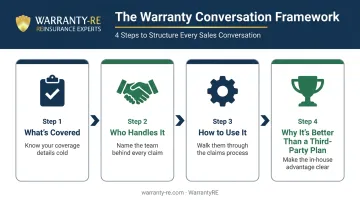
A Simple Four-Part Framework
Structure every warranty conversation around these four points:
- What's covered — be specific; vague language creates doubt
- Who handles it — emphasize direct, company-handled claims
- How to use it — make the process sound easy, because it should be
- Why it's better than a third-party plan — this is where the differentiator lands
Language That Works
Avoid insurance industry boilerplate. Use plain-language phrases that put the contractor's accountability front and center:
- "We back this warranty ourselves — if something goes wrong, you call us."
- "Claims are handled directly by our team, not routed through a third party."
- "This is our guarantee, not a middleman's promise."
Third-party warranties often feel slow, impersonal, and hard to use — your customers have experienced this firsthand. Naming that frustration and positioning your program as the direct alternative is more persuasive than any feature list.
Using Scenarios Instead of Terms and Conditions
That language is a starting point. Scenarios close the deal. Coach your team to use two or three short "what if" examples that match your most common service calls:
- "Imagine a customer's HVAC fails in July. With our program, they call the same number they always use — and we handle it directly, usually within 24 hours."
- "If a roof develops a workmanship issue two years out, we go back. No claim forms, no waiting on a third party for authorization."
Handling Price Objections
Customers resist warranty add-ons partly because the industry has trained them to see them as upsells. Reframe around risk instead:
- Ask: "If this system needed a major repair in year three, what would that cost you out of pocket?"
- Then: "This program covers that scenario for [price] — is that a trade-off worth making?"
Written Communication
On proposals, invoices, and follow-up emails, warranty language should be:
- Two to three sentences covering what's included and how claims work — no jargon, no exclusion lists up front
- The same tone and framing the customer heard in person
- Written to reinforce accountability, not disclaim it
Marketing Channels and Tactics That Drive Warranty Attachment
At the Point of Sale
The point of sale — or the moment of installation completion — is the highest-leverage moment in the warranty marketing process. The customer is engaged, the relationship is warm, and the risk of going unprotected is immediately real.
The mistake most teams make is treating the warranty as a separate add-on pitched at the end of the transaction. Instead, embed it naturally:
- During a quote, include the warranty option as a line item with a brief benefit statement
- At job completion, have the technician or project manager walk the customer through what they're now covered for
- Make the conversation feel like a handoff, not a sales pitch
A laminated one-pager showing what coverage looks like with and without the program, side by side, helps customers process the decision quickly. A clear comparison makes the choice obvious. One well-designed page, consistently used, does real work.
Digital and Content Marketing
Your website communicates your warranty program before customers ever pick up the phone. Key placements:
- Services page — a brief description of what your warranty covers and how claims work
- "Why choose us" section — a direct statement that you own and stand behind your warranty
- FAQ page — answers to "what if something goes wrong?" questions
Cox Automotive's 2024 Car Buyer Journey Study found that 30% of buyers preferred selecting protection products online but only 14% actually did — meaning the demand exists, but most businesses don't give customers the digital infrastructure to act on it. The same pattern applies in home services.
Email follow-up is underused. A post-installation email that briefly revisits the warranty offer, timed to the customer's first week of ownership, catches people who weren't ready to decide at the point of sale. Tie it to a seasonal concern or a relevant scenario and it reads as helpful, not promotional.
Word of Mouth and Referral Marketing
Digital channels build awareness, but the referral loop closes offline. A smooth, company-handled claims experience is one of the most powerful referral triggers a contractor can create.
Historical data from a Cox Automotive service study found 86% of service-contract-covered customers were very satisfied and always returned for service — compared to much lower rates among those without coverage.
The lesson: collect testimonials specifically about the claims experience, not just the installation. A customer saying "they came back and fixed it, no hassle, no runaround" is worth more than five five-star reviews about the original job. Prompt that story intentionally — ask satisfied customers directly after a claim is resolved, when the experience is still fresh.

Train Your Team to Present the Program with Confidence
A warranty program is only as effective as the person presenting it. A team that doesn't understand the program — or doesn't believe in it — will skip the conversation under time pressure, handle objections weakly, or present the option so tentatively that customers don't take it seriously.
Consistent training isn't optional. It determines whether the program reaches its revenue potential.
What Staff Training Should Cover
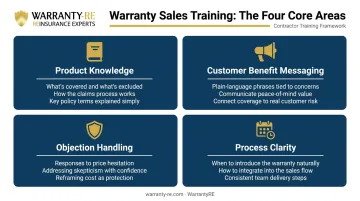
Effective warranty sales training addresses four areas:
- Product knowledge — what's covered, what's excluded, exactly how claims work
- Customer benefit messaging — the plain-language phrases that connect the program to customer concerns
- Objection handling — specific responses to "I'll think about it," "I don't need it," and "it's too expensive"
- Process clarity — when in the conversation to introduce the warranty, and how to make it feel natural rather than tacked on
Once the content is solid, execution is what moves the needle. Role-play and scenario practice help teams internalize the material, but attachment rate data over time is the real indicator — if rates aren't moving, the training needs adjustment.
WarrantyRE's onboarding program covers both program structure and customer-facing presentation for contractor and dealer teams. That combination shortens the learning curve and gives new reps a consistent foundation from day one.
Measure What's Working and Adjust
Warranty program marketing requires ongoing measurement — not just a strong launch. Track these metrics consistently:
| Metric | What It Tells You |
|---|---|
| Warranty attachment rate | % of customers who purchase coverage per job type |
| Revenue per job with warranty | Financial impact of attachment on total job value |
| Claims satisfaction | Whether the program delivers on what was promised |
| Post-training attachment change | Whether training investments are moving the number |
For context, dealer-side benchmarks put service-contract penetration at 46% per JM&A's 2025 F&I data. Home service contractors working with a structured program and trained teams should target at least 25% as a baseline, using HVAC service-agreement conversion benchmarks as a comparable reference point.
Low attachment in a specific job type usually points to one of three things: a pricing mismatch, a messaging problem, or a training gap. High attachment following a team training session is data worth acting on — and worth sharing with the team so they understand what's working.
Making those calls confidently depends on having reliable data. WarrantyRE includes performance reports and analysis as part of its full-service administration, so contractors can see exactly where attachment is strong, where it's slipping, and what to do about it.
Frequently Asked Questions
How do you explain an extended warranty to customers?
Focus on three things: what's covered, who handles claims, and what it protects them from financially. Skip the insurance language. Anchor the conversation to a realistic repair scenario — what would that cost out of pocket, and how does this program compare?
What makes a contractor-owned warranty more appealing than a third-party plan?
Claims are handled directly by the business the customer already knows — no third-party administrator, no unknown call center, no friction. The contractor also has a financial and reputational stake in resolving issues well, which shapes how every claim gets handled.
How do I get my team to consistently offer the warranty program?
Build it into the standard workflow as a defined part of every quote or job completion conversation, not an optional last step. Scripted talking points and regular reinforcement outperform one-time onboarding. Track attachment by individual team member so you can coach based on real data.
What marketing materials work best for a warranty program?
A simple one-page comparison sheet at the point of sale, a clear website section explaining what's covered, and a post-service follow-up email. All three should use plain language focused on customer benefit — not program mechanics or legal terminology.
How does a reinsurance-backed warranty help build long-term customer loyalty?
When claims are handled directly and well, customers remember it. That experience drives repeat business and referrals more reliably than ad spend, and the ongoing coverage relationship gives you a legitimate reason to stay in contact over time.
Does marketing a warranty program require a large budget?
No. The highest-impact tactics — point-of-sale conversations, staff training, website messaging, and email follow-up — cost very little. The investment is primarily time and process consistency, not advertising.