
SB 112 isn't a minor regulatory tweak. It amends Title 10 of the Official Code of Georgia Annotated with four specific consumer protections that affect how manufacturer warranties work from the moment a system is installed to the day a home changes hands. Contractors who understand what the law actually requires — and what it deliberately leaves unaddressed — are in a better position to protect their customers and grow their business.
This article breaks down the statute's four core protections, clarifies the gap SB 112 doesn't fill, and explains how Georgia contractors can use this moment strategically.
TL;DR: Georgia HVAC Warranty Updates at a Glance
- SB 112 took effect January 1, 2026, applying to any HVAC warranty issued, sold, or offered for sale on or after that date
- Manufacturer warranties automatically transfer to new homeowners when a Georgia home is sold — no paperwork, no fees
- Warranty coverage begins on the date of installation — not shipment or sale — when a licensed contractor completes the work
- Product registration cannot be required for full warranty coverage — customers are protected regardless of whether they register
- Contractor workmanship warranties fall outside SB 112 — that coverage remains a separate contractor responsibility
What Is Georgia SB 112 and Why HVAC Contractors Need to Know It
SB 112 amends Chapter 1 of Title 10 of the Official Code of Georgia Annotated by adding Article 37 — OCGA §§ 10-1-960 through 10-1-962. The bill was authored by Senators Dixon of the 45th, Goodman of the 8th, Anderson of the 24th, and others, and was signed into law by the Governor in 2025.
That legislation directly affects manufacturer, distributor, and retailer warranties. Its protections cover warranties tied to "an HVAC system or any component of such system" — meaning both whole-system coverage and individual component warranties fall under the law.
Coverage timeline under SB 112:
- Applies to warranties manufactured, issued, sold, or offered for sale on or after January 1, 2026
- Modifications or extensions of existing warranties issued after that date also fall under the law
- Pre-existing warranties issued before January 1, 2026 are not retroactively affected
- "HVAC" is defined in the statute as heating, ventilation, and air-conditioning
Georgia contractors who sell or distribute HVAC equipment are subject to these requirements starting with warranties issued in 2026. Understanding the scope now leaves time to align documentation, disclosures, and program structures before the effective date.
The Four Key Protections SB 112 Establishes
Automatic Transfer of Manufacturer Warranties
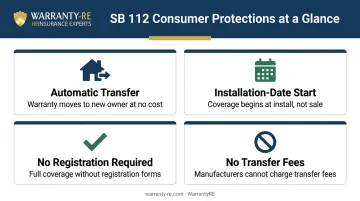
When a Georgia residential property with an HVAC system is sold, the manufacturer's warranty automatically transfers to the new owner. The statute specifies that the new owner receives coverage "as if they were the original purchaser" — no paperwork, no notification, and no action required from either the buyer or seller.
Two important limits apply:
- The manufacturer cannot charge a fee for the transfer
- The transfer does not extend the remaining warranty term — the new owner inherits whatever coverage time was left
Warranty Term Starts at Installation — Not at Sale or Shipment
Under SB 112, the full warranty term begins on the date of installation, provided the system was installed by a contractor licensed under Chapter 14 of Title 43 (Georgia's conditioned air contracting license).
A unit that sits in a warehouse for six weeks before installation still receives its full warranty period starting from the installation date. That makes accurate installation documentation more important than ever — it's the record that establishes when coverage begins.
Key implication for contractors: The installation date, not the sale or shipment date, is what determines warranty start. Date-stamped installation records protect both the contractor and the customer if a claim dispute arises later.
No Registration Required for Full Coverage
Manufacturers, distributors, and retailers can no longer condition warranty coverage on product registration. A homeowner who never returns a registration card or submits an online form is entitled to full warranty rights.
The statute goes further: if any registration card or form is provided, it must clearly and conspicuously state two things:
- The card or form is for registration purposes only
- Failure to return it does not diminish any warranty rights or reduce the warranty term
No Transfer Fees Permitted
SB 112 explicitly prohibits manufacturers from charging fees to transfer a warranty. Any fee structure that previously existed to "activate" a warranty transfer is no longer enforceable for warranties issued on or after January 1, 2026.
What SB 112 Does NOT Cover: The Contractor Workmanship Gap
SB 112 governs manufacturer, distributor, and retailer warranties. Contractor-issued labor and workmanship warranties are outside its scope entirely.
That creates a real gap. A homeowner whose equipment carries a strong manufacturer warranty may have no protection against:
- Installation defects
- Improperly sized systems
- Labor callbacks that fall outside the manufacturer's coverage
This isn't a minor distinction. The manufacturer warranty covers the equipment. When something goes wrong because of how the system was installed, that's a contractor workmanship issue — and SB 112 doesn't address it.
What Georgia law does say about contractor warranties:
Under OCGA § 43-41-7 and Board Rule 553-7, licensed residential contractors are required to offer a written warranty on covered residential construction work where the value exceeds $2,500. That written warranty must identify covered work, exclusions, warranty term, commencement date, and claim procedures.
No specific "$5,000 HVAC contractor warranty rule" exists in Georgia statute. The verified threshold is $2,500 for residential contractor written warranties, with separate incidental-work limits addressed under OCGA § 43-41-17. Contractors should confirm any applicable labor-warranty threshold against current OCGA provisions or with Georgia counsel before citing a specific dollar figure.
Third-party home warranty plans — sold by home warranty companies as service contracts — are separate from SB 112 entirely. They are regulated under Title 33, not manufacturer warranties.
How SB 112 Changes the Customer Conversation
SB 112 gives Georgia HVAC contractors something concrete to discuss at the point of sale — and a documentation obligation to take seriously.
Using the Law as a Customer Confidence Builder
Three consumer-facing protections in SB 112 make new system installations easier to sell — and easier to stand behind:
- Installation-date coverage — customers aren't penalized for delays between purchase and install
- No registration requirement — coverage isn't contingent on a form they might forget to submit
- Automatic resale transfer — their warranty follows the home, adding genuine resale value
Contractors who lead with these points give customers a reason to choose them over a competitor who never brought it up.
The Documentation Imperative
Warranty terms under SB 112 hinge on installation date and licensed-contractor status. Document each installation with:
- Date of installation
- Licensed contractor credentials (Chapter 14, Title 43)
- System details and model/serial numbers
- Customer name and property address
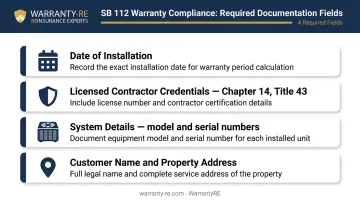
This protects the customer in any future warranty dispute and protects the contractor if a manufacturer questions whether SB 112 applies.
The Resale Value Angle
That same documentation also supports the automatic transfer provision — and that's where contractors have a real edge with homeowners who may sell in the next few years. Telling a customer their new HVAC warranty transfers automatically to the next buyer, at no cost, is a value-add most competitors aren't mentioning.
Turning SB 112 Into a Strategic Business Opportunity
SB 112 covers the manufacturer side of the warranty equation. The labor and workmanship side remains entirely up to the contractor — and that's where the business opportunity sits.
Georgia customers now expect seamless, no-friction warranty coverage. A contractor who meets that expectation at the manufacturer level (by explaining SB 112 clearly) but leaves a gap at the labor level is leaving customer confidence on the table.
The Problem With Third-Party Warranty Providers
Many HVAC contractors currently offer labor warranties through third-party providers. The problem is straightforward: the third-party keeps the underwriting profit. If they weren't making money on your warranty premiums, they wouldn't offer the program.
The Contractor-Owned Alternative
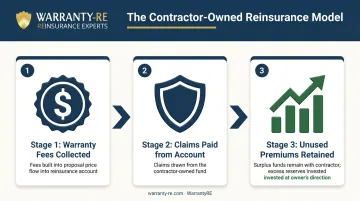
You can instead establish your own reinsurance company — a separately incorporated entity that you own — which reinsures the labor warranties your business issues. In this structure:
- Warranty fees are built into your proposal price and flow into your reinsurance account
- Claims are paid from that account
- Unused premium funds remain yours
Funds are held in a U.S. custodial trust account and invested in instruments acceptable to insurance regulatory authorities. Investment income belongs to your reinsurance company. When reserves exceed 125% of unearned premiums, excess funds can be invested at the owner's direction.
WarrantyRE has helped contractors across the country set up exactly this kind of program. Full administration is handled for you, including:
- Claims adjudication and compliance filings
- Financial reporting and tax returns
- Legal forms and regulatory renewals
The structure is backed by A-rated insurers. If the reinsurance company can't meet its obligations, the direct-writing insurance company carries ultimate liability.
For Georgia contractors navigating SB 112, a contractor-owned labor warranty program closes the coverage gap customers notice — and keeps the profit that would otherwise go to a third party.
Frequently Asked Questions
What is Georgia's threshold for contractor-issued HVAC warranties?
Georgia law under OCGA § 43-41-7 requires licensed residential contractors to provide a written warranty on covered work exceeding $2,500. No separate HVAC-specific dollar threshold has been established — contractors should confirm applicable requirements against current OCGA provisions or with Georgia counsel.
Does SB 112 apply to warranties already in place before January 1, 2026?
No. SB 112 applies only to warranties manufactured, issued, sold, or offered for sale on or after January 1, 2026. Pre-existing warranties are not retroactively affected by the statute.
Does SB 112 cover contractor workmanship warranties?
No. SB 112 specifically governs manufacturer, distributor, and retailer warranties. Contractor-issued labor and workmanship warranties are a separate category governed by different statutes and contract terms.
Does the installation-date warranty start affect how contractors should document their work?
Yes. Clear documentation of the installation date, Chapter 14 licensing credentials, and system details protects both parties in any future warranty dispute under the new start-date rule.
What happens if a manufacturer refuses to honor a warranty transferred to a new Georgia homeowner?
SB 112 makes automatic transfer a legal obligation — the manufacturer remains bound under the original terms. Homeowners who face a refusal should document the denial and file a complaint with the Georgia Attorney General's Consumer Protection Division or consult private legal counsel.
Can Georgia HVAC contractors offer their own extended warranty coverage on top of the manufacturer warranty?
Yes. Contractor-issued extended warranties and service contracts are separate from manufacturer warranties and fall outside SB 112's scope. Contractors can structure and price these offerings independently based on their own business model.