
Warranty liability isn't just about bad work. It builds gradually through unclear contract terms, poor workmanship documentation, and misunderstood legal obligations that create exposure far beyond the standard one-year correction period contractors assume protects them.
This guide focuses on practical strategies contractors at every stage can use to reduce warranty liability through better decisions before a job starts, tighter management while work is happening, and smarter financial structures that protect margins long-term.
TLDR
- Warranty liability stems from contract language, operational quality gaps, and misunderstood legal obligations—not just defective work
- Your warranty exposure extends 4-15 years beyond project completion depending on state law, not just the one-year correction period
- Liability reduction works at three levels: contract decisions, operational controls, and financial structures that fund warranty risk
- Treating warranty obligations as a managed financial risk protects margins while building customer trust
Understanding Where Warranty Liability Comes From
Warranty liability doesn't originate when a customer files a claim. It originates at contract signing, when vague or uncapped warranty language creates open-ended obligations that courts will later interpret broadly.
The Contract Creates the Exposure
Every construction contract carries an implied warranty of good workmanship under common law, regardless of whether you write warranty terms into the agreement. Louisiana courts held in Davidge v. H&H Construction Co. that "implicit in every building contract is the requirement that the work shall be performed in a good, workmanlike manner, free from defects in material and workmanship."
Contract omission doesn't eliminate warranty exposure. You must manage it through explicit terms.
The critical mistake contractors make is confusing two distinct warranty provisions:
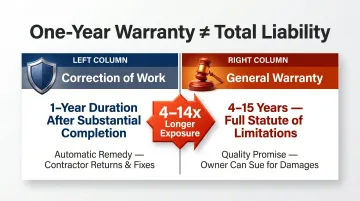
| Provision Type | Duration | Legal Nature |
|---|---|---|
| Correction of Work | 1 year after substantial completion | Automatic remedy—contractor must return and fix |
| General Warranty | Full statute of limitations (4-15 years) | Quality promise—owner can sue for damages |
AIA A201-2017 separates these into Section 12.2 (correction of work) and Section 3.5 (general warranty). The one-year correction period is an additional remedy, not a replacement for the general warranty. If you treat the "one-year warranty" as your total liability window, you're misunderstanding your legal exposure by a factor of 4-14x.
Your Liability Extends Far Beyond One Year
State statutes of limitations for construction contract claims range from 4 to 15 years depending on jurisdiction:
- Utah: 6 years from completion date
- Iowa: 10 years (residential); 8 years (other)
- Illinois: Up to 14 years maximum
- South Carolina: 8 years with exceptions for fraud or gross negligence
That exposure window means warranty claims can surface years after project completion. By then, crews have moved on, documentation has gaps, and warranty reserves may already be depleted on other jobs.
That financial pressure compounds over time — which is where hidden cost accumulation becomes the real threat.
Hidden Cost Accumulation
Warranty costs accumulate in ways that rarely appear on a single line item. A single callback shows up on your books, but the true financial drain compounds across:
- Recurring issues across multiple jobs
- Legal obligations from manufacturer warranties passed to contractors
- Uninsured rework costs that accumulate until they create a margin crisis
A 2018 report by FMI and PlanGrid found that rework caused by poor project data and miscommunication cost $31.3 billion in the U.S. that year. Miscommunication accounts for 26% of all rework, while bad or inaccurate data contributes an additional 14-22%.
Strategies That Reduce Warranty Liability by Changing Upfront Decisions
The most powerful point of influence over warranty liability is before a project begins. Decisions about contract language, warranty scope, material responsibility, and subcontractor agreements determine how much exposure you carry for months or years after the job is done.
Nail Down Your Warranty Language Before You Sign
Define specific warranty duration (e.g., one year for workmanship) and spell out exactly what is and isn't covered. Avoid language like "all work performed" that creates broad, court-enforceable obligations. Express warranty language in the same contract typically cannot be overridden by a generic disclaimer clause.
Your warranty clause should include:
- Clear commencement dates: substantial completion triggers both the correction period and warranty clock
- Specific exclusions — normal wear and tear, owner abuse, alterations by others, improper maintenance
- A written notice requirement so the owner must notify you in writing before your obligations activate
- Defined scope limited to workmanship, not product defects or manufacturer issues
Separate Workmanship Warranties from Material and Manufacturer Warranties in Writing
Contractors who don't explicitly disclaim responsibility for product defects risk absorbing claims that should fall on the manufacturer or distributor. Your contract should clearly state that your warranty covers installation quality only, and that manufacturer warranties pass through directly to the homeowner.
This separation protects you from:
- HVAC equipment failures due to manufacturing defects
- Roofing material degradation
- Plumbing fixture component failures
- Electrical panel defects
A clear contract provision might read: "Contractor's warranty covers installation workmanship. All equipment and material defects are subject to manufacturer's warranty only. Contractor will assist owner in submitting manufacturer warranty claims but assumes no financial responsibility for product failures."
Negotiate Limitation of Liability and Shortened Limitation Periods Where Permissible
In most commercial contracts, parties can negotiate shorter statutes of limitations, capped liability amounts, and exclusions for consequential damages. Negotiate these terms explicitly and word them clearly — vague limitation clauses rarely hold up in court.
Key considerations:
- Commercial contracts: Courts generally uphold limitation clauses between sophisticated parties who can negotiate risk
- Residential contracts: Stricter scrutiny applies due to consumer protection laws; some clauses may be deemed unconscionable
- Gross negligence: Most jurisdictions won't enforce waivers for gross negligence, willful misconduct, or statutory violations
Limitation of liability clauses typically cap exposure to:
- The contract value
- The contractor's fee only
- A specific fixed sum negotiated upfront
Vet Subcontractors as a Warranty Risk Decision
Subcontractors who do defective work create warranty liability that flows back to the GC or prime contractor. Vetting subcontractors on quality track records, insurance coverage, and warranty pass-through agreements directly reduces your claim exposure after the job closes.
Subcontractor risk management checklist:
- Review past project quality and callback history
- Verify adequate insurance coverage
- Include flow-down warranty provisions in subcontracts
- Require written warranty documentation
- Establish clear remediation obligations
One caution worth flagging: attorney Y. Lisa Colon of Saul LLP warns that flow-down clauses can have "unintended negative consequences" if not carefully drafted. Have counsel review any flow-down language to confirm it transfers — rather than inadvertently waives — warranty obligations to the subcontractor.
Build Warranty Risk Into Job Pricing
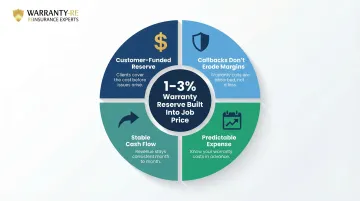
Many contractors price jobs without accounting for the statistical cost of warranty callbacks. Industry guidance suggests setting aside 1% to 3% of contract value for warranty costs. Pricing jobs to include a warranty risk reserve changes warranty obligations from a surprise cost to a managed business expense.
When you embed warranty costs into job pricing:
- Customers fund your warranty reserve directly through the job price
- Callback costs stop eroding margins after the fact
- Claims become a predictable expense rather than a surprise
- Cash flow holds steady even when multiple claims hit at once
Strategies That Reduce Warranty Liability Through Better On-the-Job Management
Decisions made at the contract stage define what you're liable for—but what happens on the job determines how often those liabilities get triggered. Operational discipline during and at the close of a job is the frontline defense against warranty claims.
Use Inspection Checklists at Key Project Phases
Phase-based inspection checklists force verification of workmanship against defined standards before moving to the next stage. This prevents recurring issues from becoming warranty claims later.
Inspection checkpoints:
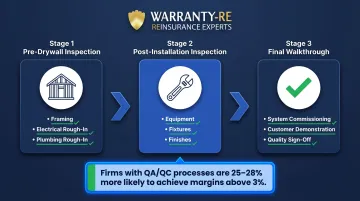
- Pre-drywall inspection (framing, electrical rough-in, plumbing rough-in)
- Post-installation inspection (equipment, fixtures, finishes)
- Final walkthrough (system commissioning, customer demonstration)
Firms with consistent QA/QC processes are 25-28% more likely to achieve profit margins above 3%. Documented inspections also give you defensible records if a warranty claim is disputed — proof that the work met standard at each phase, not just at final sign-off.