Introduction
A contractor maintenance agreement isn't just a service document — it's a financial commitment that can either protect your margins or quietly drain them. Get the terms right and you have predictable revenue, loyal customers, and a business that holds up through slow seasons. Get them wrong and you're locked into unlimited callbacks, unpredictable parts costs, and liability you didn't plan for.
This article is written for HVAC, roofing, plumbing, and electrical contractors who are either drafting their first maintenance agreement or renegotiating existing ones. According to a 2023 study by ACHR News and Clear Seas Research, 72% of HVAC contractors already offer maintenance agreements — yet many issue them without fully understanding the terms that create long-term risk. The sections below break down what to negotiate, what to include, and where contractors most often leave money on the table.
TL;DR
- A contractor maintenance agreement defines scope, pricing, response time, liability, and renewal terms for recurring service work.
- Vague agreements create unlimited service obligations and erode margins — precise language protects both parties.
- Pricing must cover true per-visit costs; multi-year deals without escalation clauses bleed margin by year two.
- Every agreement needs defined exclusions, a liability cap, and clear termination and renewal mechanics.
- High-volume maintenance contractors should confirm their financial structure captures the underwriting profit rather than handing it to a third party.
What Is a Contractor Maintenance Agreement?
A contractor maintenance agreement is a recurring service contract where a contractor commits to performing specific tasks on a customer's system or property over a defined period in exchange for a set fee. Unlike a one-time service call or a project contract, it's an ongoing commitment — and it's not a warranty.
How It Differs from a Warranty
That last point matters more than most contractors realize:
- Warranty: A promise to fix defects in workmanship or materials after a job is completed — reactive, time-limited, tied to a specific installation.
- Maintenance agreement: A proactive, ongoing service commitment — scheduled visits, defined tasks, paid in advance or on a recurring basis.
The two are frequently confused, and that confusion creates real problems when customers assume their maintenance agreement covers repair work that isn't in scope.
Why Maintenance Agreements Matter for Your Business
Maintenance agreements deliver on three fronts that matter directly to your bottom line:
- Create predictable recurring revenue that compounds year over year
- Smooth out seasonal cash flow swings common in HVAC, plumbing, and roofing
- Keep competitors from poaching your customers between service cycles
DiFilippo Service Co., profiled by ACHR News, reported an 83% annual renewal rate across roughly 1,600 maintenance agreements. That kind of retention doesn't happen by accident — it comes from agreements structured to deliver consistent value on both sides.
The risk of getting it wrong is real. Contractors who use vague scope language, skip exclusions, or ignore renewal mechanics end up absorbing costs they never priced for. Instead of building a compounding customer base, they're re-selling the same customers every year from scratch.
Key Steps to Negotiating a Contractor Maintenance Agreement
Negotiating a maintenance agreement is about more than settling on a price. The real work is aligning scope, risk allocation, payment structure, and renewal mechanics before anyone signs anything.
Step 1: Define the Exact Scope of Services
Vague scope language is the single biggest source of disputes and margin loss in maintenance agreements. The agreement should specify:
- Which systems, equipment, or areas are covered
- Exactly what tasks are performed at each visit (filter replacement, coil cleaning, pressure checks, etc.)
- How often each task occurs and what triggers a visit
- What the contractor will inspect versus what they will repair
ACCA's ANSI/ACCA 4 QM - 2019 (R2024) standard establishes minimum tasks for residential HVAC maintenance inspections — a useful reference when building scope language that holds up to scrutiny.
Generic phrases like "full tune-up" or "comprehensive inspection" create the impression of broad coverage. That ambiguity always resolves in the customer's favor during a dispute.
Step 2: Establish Pricing That Reflects True Costs
Contractors often price maintenance agreements to win the deal rather than to cover the cost of delivering the service. Every underpriced agreement locks in a loss that repeats each visit, each year — compounding quietly until the program bleeds margin.
Before setting an annual fee, calculate the true cost of each service visit:
- Labor: Technician time, including drive time and documentation
- Parts and consumables: Filters, refrigerant top-offs, minor materials
- Travel and vehicle costs: Per-mile allocation or route overhead
- Overhead allocation: Dispatch, scheduling, admin, insurance
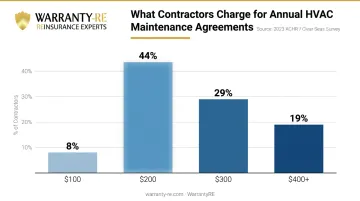
The 2023 ACHR/Clear Seas survey found contractor-reported annual HVAC maintenance pricing spread widely — 8% charged $100, 44% charged $200, 29% charged $300, and 19% charged $400 or more. That range reflects very different service scopes and cost structures, not just market positioning.
On multi-year agreements, a fixed price without an escalation clause transfers all inflation risk to you. Tie price adjustments to the BLS Employment Cost Index for labor and the BLS Producer Price Index for materials — both are published monthly and widely accepted in contract language.
Step 3: Negotiate Response Time and Service Windows
A promise of "24-hour response" or "same-day service" sounds like a competitive differentiator. But during peak demand — the hottest week in August, the first hard freeze — that commitment becomes an operational constraint you either honor at a loss or break at the cost of customer trust.
Response time terms should reflect what you can actually deliver. Practical guidelines:
- Specify business hours vs. emergency hours separately
- Define "response" clearly — does it mean a callback, a scheduled appointment, or a technician on-site?
- Negotiate different response windows for routine service vs. emergency calls
- Avoid blanket priority guarantees if your scheduling capacity is already stressed in peak season
The same 2023 survey found 77% of homeowners want priority service included in their agreement. The demand is real — the question is whether your staffing model supports the commitment year-round.
Step 4: Limit Liability and Define Exclusions Clearly
A well-negotiated agreement tells customers exactly what is not covered. Exclusions prevent scope creep and protect you from claims on conditions that existed before you arrived.
Standard exclusions to include:
- Pre-existing conditions or deferred maintenance not disclosed at agreement start
- Customer-caused damage or improper operation
- Code upgrades required by local authority
- Third-party or manufacturer equipment failures
- Systems outside the contracted scope
Beyond exclusions, include a liability cap — typically tied to the annual fee paid or the value of a specific service visit. Construction Executive notes that limitation-of-liability provisions are a standard risk management tool in service contracts.
That said, the ACC cautions that poorly drafted or inconspicuous liability clauses can be unenforceable in some jurisdictions. Have an attorney review your cap language before relying on it.
Step 5: Build In Renewal, Escalation, and Termination Terms
Without defined renewal mechanics, you're re-selling every customer at the end of each term — and losing a meaningful percentage each time. Retention starts with the contract structure, not the renewal call.
Every agreement should include:
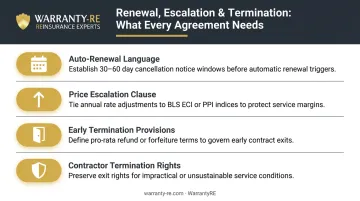
- Auto-renewal language with a defined notice period for cancellation (30–60 days is typical)
- Price escalation clause tied to an objective index (BLS ECI or PPI)
- Early termination provisions — what happens if the customer cancels mid-term? Are prepaid fees refunded pro-rata or forfeited?
- Contractor termination rights — you should be able to exit agreements where equipment condition or customer behavior makes service delivery impractical
Note that auto-renewal rules vary by state. Florida, Wisconsin, and several other states impose specific disclosure and notice requirements for auto-renewing service contracts. If you operate across state lines or with commercial clients, review applicable law before finalizing your renewal language.
Essential Terms Every Contractor Maintenance Agreement Should Cover
Beyond negotiation strategy, the written agreement itself must contain specific clauses. Missing even one creates ambiguity that will cost you eventually.
| Term | What to Specify |
|---|---|
| Payment structure | Annual upfront, monthly, or per-visit — plus a proration or refund policy if terminated early |
| Service documentation | Written records required after each visit: what was inspected, found, and done |
| Parts responsibility | Included in flat fee, billed at cost, billed with markup, or excluded entirely |
| Emergency provisions | What qualifies as an emergency, covered hours, and whether emergency calls are included or billed separately |
| Governing law | Which state's law applies and how disputes are resolved (mediation, arbitration, small claims) |
Parts and Materials
Parts and materials is the most common source of post-agreement disputes. If a compressor fails during a maintenance visit on a 15-year-old system, is the replacement covered under the flat fee? Without explicit language, the customer will assume it is — and they won't be wrong to.
Emergency Coverage
Flat-rate emergency coverage is one of the most reliable ways to lose money on a maintenance agreement. Define "emergency" precisely, set hour limitations, and price accordingly — or exclude it entirely and offer emergency calls as a discounted add-on.
Get these two terms right, and the rest of the agreement will be far easier to enforce.
Common Negotiation Mistakes That Cost Contractors
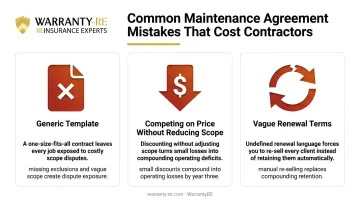
Using a generic template without customizing it. Downloaded templates are rarely written with the contractor's interests in mind. They often lack exclusions, have no liability cap, and use scope language vague enough to cover almost anything. Arcadis' 2025 North America Construction Disputes Report identified errors and omissions in contract documents as the top cause of construction disputes in 2024 — poor drafting is expensive.
Competing on price without reducing scope. Lowering the annual fee to win a deal while keeping the same service obligations is a loss that compounds over the full agreement term. Equipment ages, visit frequency creeps up, and parts costs rise. A small discount in year one can become a significant operating loss by year three.
Leaving renewal terms vague or absent. Without automatic renewal language, you must re-sell every customer annually. Chasing renewals manually is not a retention strategy. Contractors with strong renewal mechanics grow their agreement base year over year rather than constantly replacing lost customers.
When a Standard Maintenance Agreement Is Not Enough
Contractors who have scaled their maintenance programs — managing hundreds of active agreements — often discover a structural ceiling in the standard service contract model. You're delivering the service, covering the claims, and bearing all the operational risk. But if you're also using a third-party warranty or service contract administrator to back those agreements, that provider is capturing the underwriting profit: the difference between what customers pay and what claims actually cost.
That margin doesn't disappear. It goes to the third party.
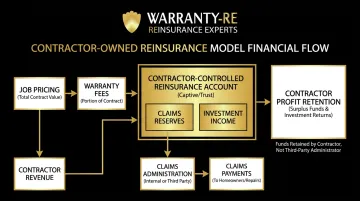
Some contractors use their maintenance agreement volume as the foundation for a contractor-owned reinsurance structure — a model where the contractor establishes their own company to hold reserve funds and retain the profit margin that would otherwise leave the business. Warranty fees are built into job and agreement pricing, flow into the contractor's own reinsurance account, and unused funds stay with the contractor rather than enriching an outside provider.
WarrantyRE has helped home service contractors across HVAC, roofing, plumbing, and electrical trades make this transition, replacing third-party arrangements with contractor-owned structures that retain underwriting profits. The program includes full claims administration, compliance management, and financial oversight — so contractors aren't adding operational burden, just changing where the profit goes.
This isn't a replacement for a well-negotiated agreement. The scope, pricing, and exclusion terms still need to be right. But the financial architecture around the agreement determines how much revenue the contractor actually keeps — specifically:
- Who holds the reserve funds
- Who captures the underwriting profit
- What happens to unused funds at the end of the term
Frequently Asked Questions
What is an MSA vs. a contract?
A Master Service Agreement (MSA) is a framework document that sets overarching terms for an ongoing relationship — liability, payment, and dispute resolution. A specific maintenance contract defines the scope and pricing for individual service engagements. In practice, the MSA governs the relationship while each service contract covers the specific work.
What should be included in a contractor maintenance agreement?
At minimum: scope of services, service frequency, pricing and payment terms, parts responsibility, response time commitments, exclusions, liability limits, renewal terms, and termination rights. Leave out any one of these and you'll likely face disputes over who owes what when something goes wrong.
How do contractors price maintenance agreements?
Contractors price agreements by calculating the true cost of each service visit (labor, parts, travel, overhead), multiplying by expected annual visits, then adding margin. Multi-year agreements should include an escalation clause tied to the BLS Employment Cost Index or Producer Price Index to protect against rising costs. Knowing this helps you spot agreements that underestimate costs and may be renegotiated or dropped mid-term.
What is the difference between a maintenance agreement and a warranty?
A warranty is a promise to fix defects in workmanship or materials after a job is completed. A maintenance agreement is a proactive, recurring service commitment. Treating one as a substitute for the other leaves you either under-protected or paying for duplicate coverage.
Can a contractor renegotiate a maintenance agreement mid-term?
Only if both parties agree or if the agreement includes a change-in-scope clause. Build amendment provisions and annual review rights into the original agreement rather than trying to modify terms after the fact.
How long should a contractor maintenance agreement last?
Most residential agreements run one to three years; commercial agreements often extend to five. Longer terms improve retention, but without strong escalation clauses and clear exit provisions, you risk being locked into unprofitable pricing as labor and material costs climb.